Cleansing Oil vs Micellar Water vs Face Wash: How to Build a Double-Cleansing Routine
Cleansing oil, micellar water and face wash are all used to remove impurities from the skin, but they are not designed to do exactly the same job.
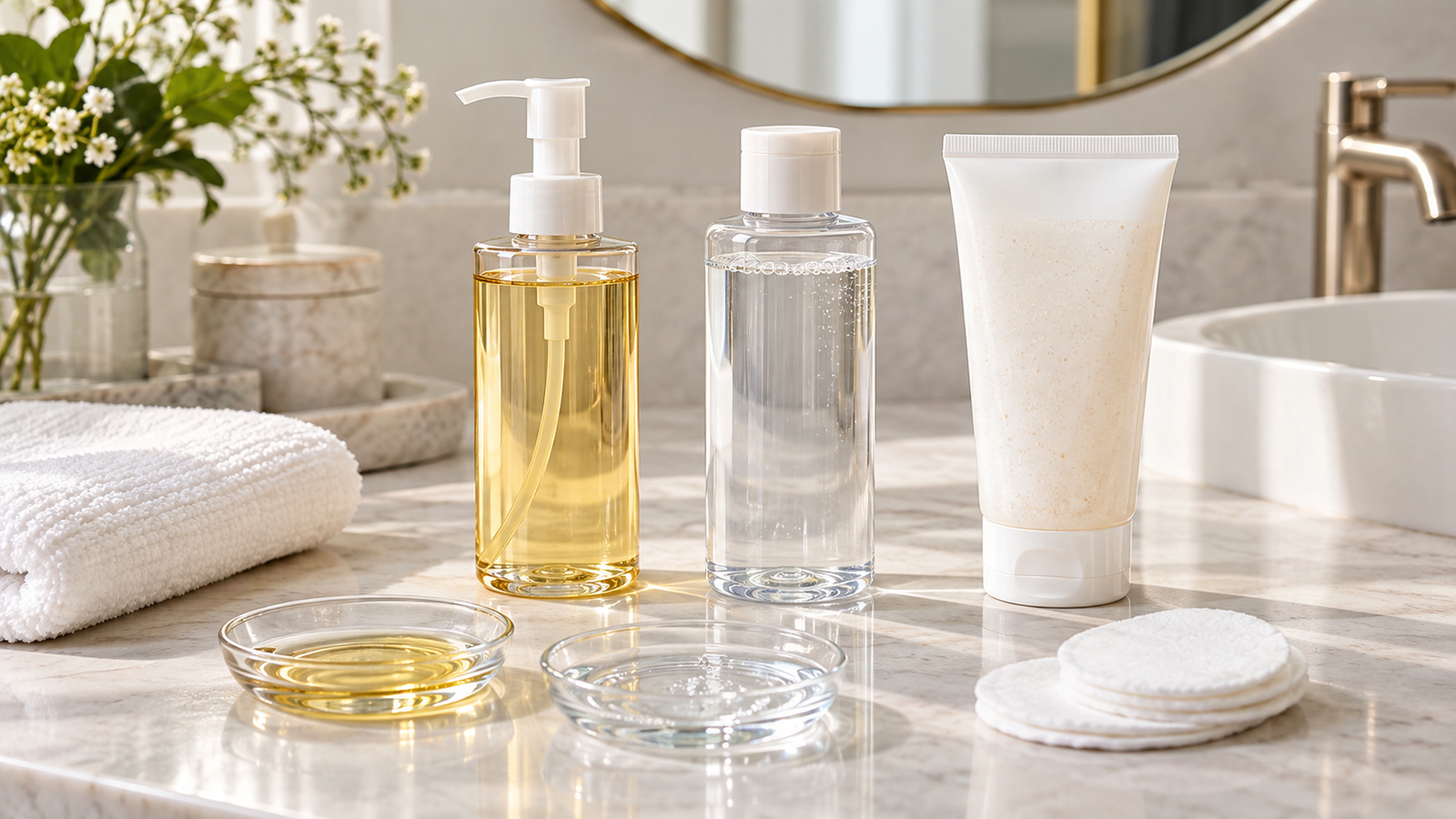
A cleansing oil is particularly useful for dissolving oil-based residue such as sunscreen, makeup and sebum. Micellar water offers a lightweight way to lift makeup and surface dirt with a cotton pad. Face wash is generally designed to cleanse the skin with water and remove sweat, excess oil and everyday residue.
For some routines, one cleanser is enough. For others, combining two cleansing steps can make sense. The right choice depends on what you wear on your skin, how your skin responds to cleansing and how simple you want your routine to be.
What does a cleanser actually need to remove?
During the day, the skin can accumulate a combination of:
- Natural skin oil.
- Sweat.
- Sunscreen.
- Makeup.
- Dust and environmental residue.
- Skincare products applied earlier in the day.
These materials do not all behave the same way. Some rinse away easily with water, while others contain oils, waxes, pigments or film-forming ingredients that may be harder to remove with a basic water-based cleanser.
That difference explains why several cleansing formats exist.
The goal is not to make the skin feel completely stripped or “squeaky clean.” A useful cleanser should remove unwanted residue while leaving the skin comfortable enough for the rest of your routine.
What is cleansing oil?
Cleansing oil is an oil-based facial cleanser formulated to dissolve oil-soluble substances on the skin.
Most modern cleansing oils contain both oils and emulsifying ingredients. When water is added, the formula can turn milky and rinse away rather than leaving a heavy layer of oil behind.
This makes cleansing oil different from simply applying a plain facial oil.
What is cleansing oil particularly useful for?
Cleansing oils can be useful when you regularly wear:
- Water-resistant sunscreen.
- Foundation or other face makeup.
- Long-wear cosmetic products.
- Several layers of skincare and sunscreen.
Oil-based cleansers can help loosen these materials before a water-based cleansing step.
That does not mean everyone needs a cleansing oil every night. If you wear very little product and your usual cleanser removes it comfortably, adding another step may offer little practical benefit.
How to use a cleansing oil
Follow the directions for the exact product you are using, but a typical cleansing-oil routine involves:
- Dispensing the cleanser into dry hands.
- Massaging it gently over dry facial skin.
- Adding a small amount of water so the cleanser emulsifies.
- Rinsing thoroughly with water.
- Following with a water-based cleanser if your routine calls for double cleansing.
Avoid aggressively rubbing the skin for long periods. The cleansing process should help remove products, not become a form of physical exfoliation.
What is micellar water?
Micellar water is a water-based cleansing liquid containing surfactant structures commonly described as micelles.
It is typically applied with a cotton pad and used to lift makeup, sunscreen and surface residue from the skin.
Its main appeal is convenience. Unlike a traditional face wash, it does not require you to create a lather at a sink before wiping away residue.
When can micellar water be useful?
Micellar water can work well for:
- Removing light makeup.
- Cleaning around areas where precision is useful.
- Quick cleansing when access to a sink is inconvenient.
- Removing some sunscreen before a second cleanser.
- People who simply prefer a lightweight liquid cleanser.
However, heavily layered or water-resistant makeup may require several passes or another cleansing method.
Repeatedly rubbing the skin with cotton pads can also become irritating, especially around the eyes. Use gentle pressure rather than scrubbing.
Do you need to rinse micellar water?
This depends on the product and your skin.
Some micellar waters are marketed as no-rinse cleansers. Even so, some people prefer rinsing or following them with a face wash, particularly if residue remains on the skin or the product causes discomfort.
The manufacturer’s directions should be your starting point.
If your skin feels sticky, tight, itchy or irritated after use, continuing simply because the product says “no rinse” is not necessary.
What is face wash?
Face wash is a broad term for water-based cleansers designed to be applied with water and then rinsed away.
They are available in many formats, including:
- Gel cleansers.
- Cream cleansers.
- Foaming cleansers.
- Low-foam cleansers.
- Medicated or active-ingredient cleansers.
A face wash is often the main cleansing product in a basic skincare routine.
Gel cleanser vs cream cleanser vs foaming cleanser
The format can influence how a cleanser feels, although the complete formulation matters more than the label alone.
Gel cleansers
Gel cleansers tend to have a lightweight texture and are commonly marketed toward normal, combination or oily skin.
Some foam noticeably while others remain relatively low-foaming.
Cream cleansers
Cream cleansers generally feel richer and may appeal to people whose skin becomes uncomfortable after more aggressive cleansing.
A creamy texture does not automatically mean a product is suitable for every dry or sensitive skin type, so check the complete formula.
Foaming cleansers
Foaming products can give a strong sensation of cleansing, but more foam does not necessarily mean better cleansing.
If your face consistently feels tight immediately after washing, the cleanser or the way you are using it may be too harsh for your skin.
Cleansing oil vs micellar water vs face wash
| Factor | Cleansing oil | Micellar water | Face wash |
|---|---|---|---|
| Main format | Oil-based emulsifying cleanser | Lightweight water-based cleansing liquid | Water-rinse cleanser |
| Typical use | Dissolving sunscreen, makeup and oil-based residue | Lifting light makeup and surface residue | Routine cleansing of sweat, oil and everyday buildup |
| Usually requires water | Yes, during emulsification and rinsing | Depends on product and preference | Yes |
| Application method | Hands | Usually cotton pad | Hands |
| Can be first step of double cleansing | Yes | Yes | Usually used as the second step |
| Best reason to choose it | You regularly need to remove persistent oil-soluble products | You want convenient, targeted cleansing | You want a straightforward everyday cleanser |
None of the three is inherently superior. They solve somewhat different cleansing problems.
What is double cleansing?
Double cleansing means using two cleansing stages in succession.
A common version involves:
Step 1: An oil-based cleanser or micellar water to remove makeup and sunscreen.
Step 2: A water-based face wash to cleanse the skin and remove remaining residue.
This approach can be useful for people who wear substantial makeup or persistent sunscreen.
But double cleansing is not automatically necessary for everyone.
If one gentle cleanser removes your daily products effectively and your skin feels comfortable afterward, using two products simply because double cleansing is popular can add expense and complexity without solving a real problem.
Who may benefit from double cleansing?
You may find it useful if you regularly use:
- Water-resistant sunscreen.
- Foundation.
- Long-wear makeup.
- Heavy cosmetic layers.
- Oil-rich skincare products.
It can also be useful when your regular face wash does not fully remove the products you wear.
The key is to evaluate the result rather than assume that more cleansing must be better.
Can you over-cleanse your skin?
Yes.
Using several cleansers, cleansing too frequently, using very hot water or rubbing aggressively can leave the skin feeling dry, tight or irritated.
Common signs that your routine may be too aggressive include:
- Persistent tightness after washing.
- Dry or flaky patches.
- Increased stinging when applying normal skincare.
- Redness or discomfort.
- A feeling that you constantly need to apply more moisturiser after cleansing.
If this happens, simplify the routine and look at both the cleanser and your cleansing technique.
Which cleanser is better for oily skin?
Oily skin still benefits from gentle cleansing.
A lightweight gel or foaming cleanser may feel comfortable for some people, but the goal should not be to remove every trace of oil from the skin.
If you wear water-resistant sunscreen or makeup, an oil cleanser can still be useful even if your skin is oily. The fact that the product contains oil does not automatically mean it will leave the skin greasy, particularly if it is formulated to emulsify and rinse cleanly.
Choose according to how the finished product behaves on your skin rather than avoiding an entire cleanser category based on its name.
Which cleanser is better for dry skin?
People with dry skin often prefer cleansers that leave less of a stripped sensation.
A mild cream cleanser may be enough for everyday use. If you wear persistent makeup or sunscreen, a well-formulated cleansing oil followed by a very gentle second cleanser may also work.
However, two cleansing steps can be excessive if the second cleanser is strong.
If your skin becomes progressively tighter through the week, reconsider whether you need both steps every night.
What about sensitive skin?
With sensitive skin, simplicity can be useful.
Look for a cleanser that removes what you need without causing repeated burning, redness or tightness. Strong fragrance, excessive rubbing and using several cleansing products unnecessarily can complicate the routine.
When introducing a new product, avoid changing several other skincare products at the same time. That makes it easier to identify the cause if irritation develops.
Persistent or significant skin reactions deserve assessment by a qualified healthcare professional.
How to choose between cleansing oil and micellar water
These two products often compete for the same role: the first cleansing step.
Choose cleansing oil when:
You regularly wear heavier makeup or persistent sunscreen and want a cleanser that can be massaged across the entire face.
It may also be more practical if you dislike using multiple cotton pads.
Choose micellar water when:
You want a lightweight, convenient product for light makeup, targeted cleansing or occasional use.
It can also be convenient for correcting makeup or cleansing specific areas.
You do not necessarily need both
Using micellar water followed by cleansing oil and then a face wash creates three cleansing stages.
For most everyday routines, that is unnecessary unless there is a specific reason for each product.
How to choose a face wash
A practical face wash should clean effectively without making your skin consistently uncomfortable.
Consider the following factors.
Your skin’s response after washing
Your face should feel clean, but it should not need to feel extremely tight.
If you immediately notice discomfort after cleansing, examine the cleanser, water temperature, frequency of washing and amount of product used.
Your daily sunscreen and makeup
If your face wash cannot comfortably remove your daily products, consider adding an appropriate first cleanser rather than using a harsher face wash.
Product format
Gel, cream and foam formats can feel different, but judge the finished product rather than the format name alone.
Active ingredients
Some cleansers contain ingredients such as salicylic acid.
These products may serve a different purpose from a basic cleanser and should be evaluated as part of your complete skincare routine rather than automatically used twice daily.
Morning cleansing vs evening cleansing
Your cleansing needs may differ between morning and evening.
Morning
The skin generally does not have sunscreen and makeup from the previous day if it was properly cleansed before bed.
Some people prefer a gentle face wash in the morning, while others with dry or easily irritated skin may find that a water rinse or very mild cleansing routine is sufficient.
Evening
Evening cleansing usually needs to remove sunscreen, makeup, sweat and accumulated daily residue.
This is where cleansing oil, micellar water or double cleansing may become more useful.
There is no requirement for your morning and evening cleanser routines to be identical.
Common cleansing mistakes
Assuming more foam means cleaner skin
Foam is a sensory characteristic of a cleanser, not a direct measure of cleansing quality.
Using very hot water
Very hot water can make cleansing more uncomfortable, particularly for dry or sensitive skin. Lukewarm water is generally more practical.
Scrubbing with cotton pads
Micellar water should lift residue with gentle wiping. Repeated friction can irritate delicate skin.
Using too much cleansing oil
More product is not necessarily more effective. Use enough to spread comfortably across the face according to the manufacturer’s directions.
Skipping emulsification
Many cleansing oils are designed to interact with water before rinsing. Adding water and allowing the oil to emulsify can help the formula rinse more cleanly.
Double cleansing when you do not need it
A routine should solve your actual cleansing needs. Extra steps are not automatically an upgrade.
A simple way to decide what you need
Ask yourself three questions.
1. What am I trying to remove?
If it is mostly everyday oil and sweat, a suitable face wash may be enough.
If you regularly wear water-resistant sunscreen or makeup, a cleansing oil or micellar water may be useful first.
2. Does my current cleanser remove it comfortably?
If yes, there may be no need to complicate the routine.
If not, adding a dedicated first cleanser may make more sense than simply choosing a stronger face wash.
3. How does my skin feel afterward?
Clean skin should not routinely feel painful, excessively tight or irritated.
Use your skin’s response as feedback when adjusting cleansing frequency and product combinations.
Frequently asked questions
Can I use cleansing oil without face wash afterward?
Some cleansing oils are formulated to emulsify and rinse cleanly enough to be used alone.
Whether you need a second cleanser depends on the product, what you are removing and how your skin feels after rinsing.
Is micellar water enough to remove sunscreen?
It may remove some sunscreens effectively, but performance depends on the sunscreen formulation, how much was applied and the micellar product itself.
If significant residue remains, follow with a suitable water-based cleanser.
Can oily skin use cleansing oil?
Yes. A properly emulsifying cleansing oil can be used by people with oily skin. The more useful question is whether the specific product rinses comfortably and fits your routine.
Does double cleansing prevent clogged pores?
Double cleansing can improve removal of sunscreen, makeup and residue, but it should not be presented as a guaranteed way to prevent clogged pores or acne.
Persistent acne or congestion can have multiple causes and may need targeted treatment.
Should I use micellar water and cleansing oil together?
Usually there is no need to use both as separate first-cleansing steps. Choose the format that best removes the products you wear and that suits your routine.
Can I use face wash twice during double cleansing?
Using the same water-based face wash twice is not the usual meaning of double cleansing and may increase unnecessary cleansing. The typical approach combines two different cleansing formats.
Building a practical cleansing routine
A good cleansing routine does not need to be complicated.
For a minimal routine, a gentle face wash may be all you need. If you regularly wear makeup or persistent sunscreen, consider a cleansing oil or micellar water as the first step and follow it with an appropriate face wash.
Judge the routine by three outcomes: whether it removes what you wear, whether it rinses comfortably and whether your skin remains comfortable afterward.
Once you understand the role of each cleanser type, you can compare actual products more meaningfully rather than choosing based on trends alone.
Physical Glow’s Top 5 Double-Cleansing and Makeup-Removal Products in India comparison looks at different first-step cleansing options and formats. Use that comparison alongside this guide, then verify the current ingredient list, size and directions for the exact product you plan to purchase.