Mineral vs Tinted Sunscreen: How to Compare Coverage, Finish and Texture
Mineral sunscreen and tinted sunscreen are often discussed as though they are two separate sunscreen categories, but the terms actually describe different things.
“Mineral” refers primarily to the type of ultraviolet filters used in the formula. “Tinted” refers to the colour or pigment added to the finished product. A sunscreen can therefore be mineral and tinted at the same time.
This distinction matters because choosing between sunscreens is not simply about deciding between “mineral” and “tinted.” You also need to look at SPF, broad-spectrum protection, texture, finish, shade compatibility, comfort and how well the product fits your daily routine.
What is a mineral sunscreen?
Mineral sunscreens use mineral ultraviolet filters, most commonly zinc oxide and titanium dioxide.
They are sometimes called physical sunscreens, although “mineral sunscreen” is generally the clearer description for consumers.
These filters help protect the skin from ultraviolet radiation. The exact level and range of protection depend on the finished sunscreen formulation and its tested SPF and broad-spectrum performance.
Mineral sunscreens are available in several forms, including:
- Creams.
- Lotions.
- Fluid sunscreens.
- Tinted formulas.
- Moisturising sunscreens.
- Matte sunscreens.
The fact that two products both use mineral filters does not mean they will feel or look the same on the skin.
What is a tinted sunscreen?
A tinted sunscreen contains pigments that give the formula visible colour.
These pigments are usually added to reduce the appearance of a white cast, provide some cosmetic coverage or make the sunscreen blend more naturally with certain skin tones.
Tinted sunscreen can contain:
- Mineral UV filters.
- Organic UV filters.
- A combination of different filter types.
So “tinted” does not tell you whether the sunscreen is mineral or non-mineral.
You need to read the product label or ingredient list to understand the filter system.
Mineral sunscreen vs tinted sunscreen: the key difference
The simplest way to think about it is:
Mineral describes the sunscreen filters.
Tinted describes the colour of the formula.
That means you could encounter all of the following:
- Untinted mineral sunscreen.
- Tinted mineral sunscreen.
- Tinted sunscreen using non-mineral filters.
- Hybrid sunscreen with added tint.
This is why comparing “mineral vs tinted” as though they are mutually exclusive categories can be misleading.
Why do some mineral sunscreens leave a white cast?
Zinc oxide and titanium dioxide are naturally white powders.
Depending on particle size, concentration, dispersion and the overall formulation, they can leave a visible light or greyish appearance on the skin.
This effect is commonly called a white cast.
The amount of visible cast varies considerably between products.
A mineral sunscreen may blend relatively well on one skin tone but appear very noticeable on another.
Several factors influence the final appearance:
- Concentration of mineral filters.
- Particle characteristics.
- Formula thickness.
- Added pigments.
- Skin tone.
- Amount of sunscreen applied.
- Whether makeup is layered on top.
Do not assume that every mineral sunscreen will leave the same degree of white cast.
How does tint help?
Tinted sunscreens contain colour pigments that can visually offset the white appearance of mineral filters.
Depending on the shade, the formula may blend more naturally into the skin than an untinted white sunscreen.
Some tinted sunscreens are designed to provide barely noticeable colour, while others behave more like a light cosmetic base.
The important limitation is shade compatibility.
A tint that reduces white cast for one person may look orange, grey, pink or too deep on another.
Are all tinted sunscreens available in multiple shades?
No.
Some products are available in only one universal tint.
Others offer several shades.
A single-shade product may work for some skin tones but not others, even if the sunscreen itself performs well.
When evaluating a tinted sunscreen, check:
- The available shade range.
- Whether the tint oxidises after application.
- Whether it transfers easily.
- Whether it changes the appearance of facial hair.
- Whether the shade works when the recommended amount is applied.
Testing only a very small amount can be misleading because sunscreen normally needs to be applied generously enough to achieve its labelled protection.
Mineral vs tinted sunscreen at a glance
| Factor | Untinted mineral sunscreen | Tinted sunscreen |
|---|---|---|
| What the term describes | UV filter type | Colour or pigment in the formula |
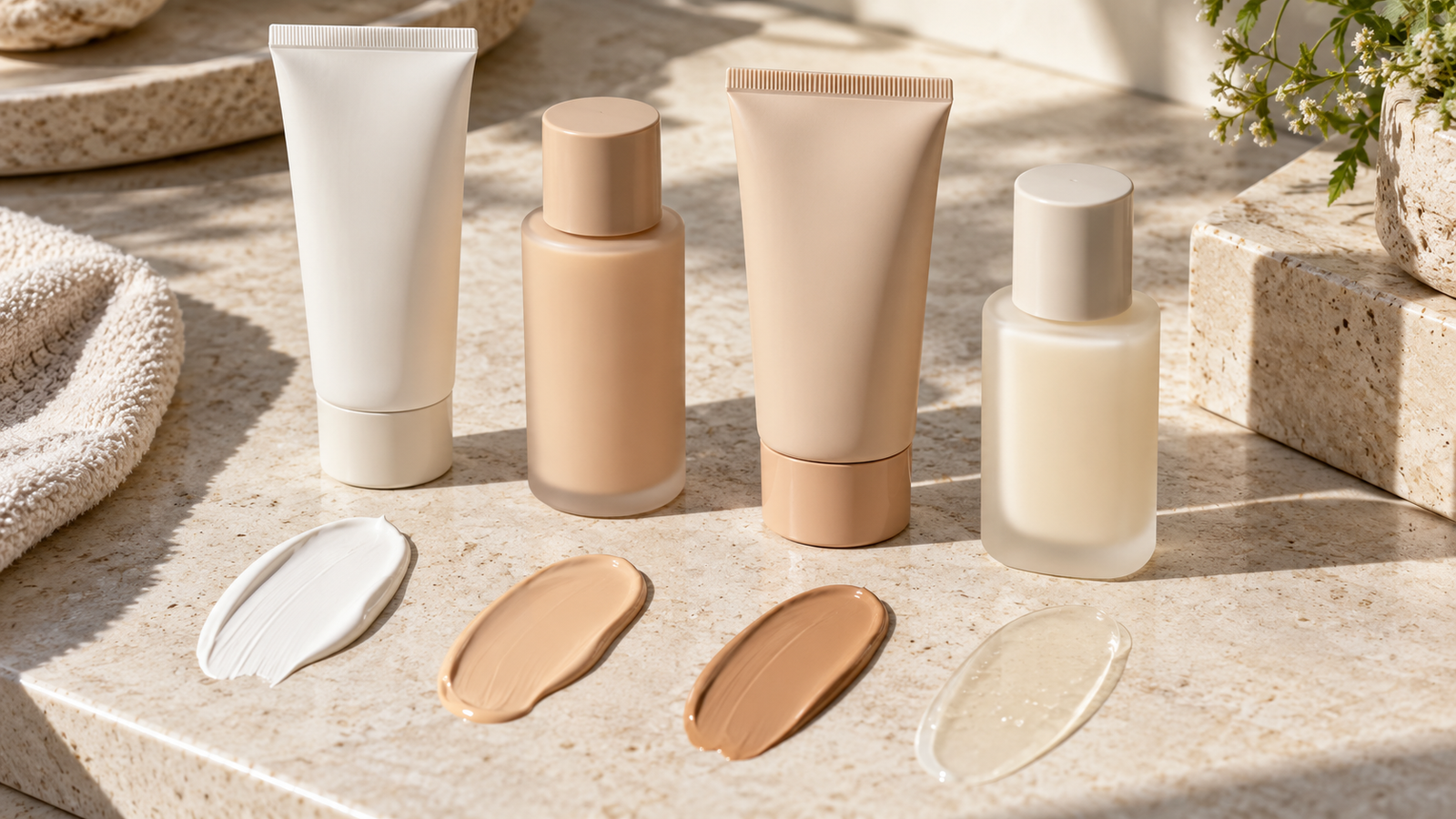
| Typical appearance | White or translucent depending on formula | Beige, tan or other skin-toned finish |
| White cast risk | Can be noticeable | Often reduced, depending on shade |
| Shade matching required | Usually no | Often yes |
| Cosmetic coverage | Usually minimal | May provide light visible coverage |
| Filter system | Mineral | Can be mineral, non-mineral or hybrid |
| Best comparison point | Filters, texture, finish and cast | Shade, finish, filters and coverage |
What does sunscreen texture mean?
Texture describes how the sunscreen feels during and after application.
Common sunscreen textures include:
- Thick cream.
- Lightweight lotion.
- Fluid.
- Gel-cream.
- Silicone-rich matte formula.
- Moisturising cream.
Texture matters because sunscreen is a product you may need to apply every day and reapply when appropriate.
A sunscreen with excellent theoretical features is not very useful if you dislike the way it feels so much that you avoid applying enough.
Thick cream formulas
Cream sunscreens may feel richer and more moisturising.
They can work well for people who prefer a nourishing texture or whose skin feels dry.
However, some thicker mineral formulas may take longer to spread and can make white cast more noticeable if they do not blend well with your skin tone.
Use gentle, even spreading rather than aggressive rubbing.
Lightweight fluid sunscreens
Fluid sunscreens generally spread quickly and can feel less heavy on the skin.
They may appeal to people who dislike rich creams, especially in hot or humid weather.
Shake fluid sunscreen when the manufacturer instructs you to do so because some formulas are designed to be mixed before application.
Matte sunscreen formulas
Matte sunscreens are designed to reduce shine.
They may contain silicones, powders or other ingredients that create a smoother, less glossy surface.
A matte finish can be useful under makeup or for someone who dislikes a shiny appearance, but very matte formulas may feel dry on some skin types.
Hydrating sunscreen formulas
Hydrating sunscreens usually contain moisturising ingredients and may leave a more luminous finish.
They can be convenient for people who prefer to combine moisturiser and sunscreen into fewer morning steps.
However, a hydrating sunscreen is not automatically suitable for every dry skin type, and a moisturiser underneath may still be useful depending on your routine.
What does sunscreen finish mean?
Finish describes how the product looks once it settles on the skin.
Common finishes include:
- Matte.
- Natural.
- Satin.
- Dewy.
- Luminous.
Finish is mainly a preference and compatibility issue rather than a measure of protection.
A matte sunscreen is not automatically more effective than a dewy one.
The important protection information comes from the tested sunscreen claims, not the visual finish.
Which sunscreen is better for oily skin?
People with oily skin often prefer lighter or more matte formulas because they may feel more comfortable during the day.
Look for:
- Lightweight textures.
- Fast-spreading formulas.
- A finish you can tolerate for several hours.
- Compatibility with your moisturiser and makeup.
Do not assume that mineral sunscreen is automatically better for oily skin.
Some mineral products are rich and creamy, while others are very lightweight.
The finished formulation matters more than the filter category alone.
Which sunscreen is better for dry skin?
Dry skin may benefit from a sunscreen with a comfortable cream or lotion texture.
Look for formulas containing moisturising ingredients and avoid products that consistently leave the skin feeling tight.
If your sunscreen alone does not provide enough comfort, use an appropriate moisturiser underneath.
Give the moisturiser time to settle before applying sunscreen so that excessive layering does not cause pilling.
What about sensitive skin?
Sensitive skin does not have one universally suitable sunscreen type.
Some people prefer mineral formulas because they find them comfortable. Others tolerate non-mineral filters perfectly well.
The better approach is to judge the specific product.
If your skin is reactive, consider:
- A shorter ingredient list if that suits your history.
- Fragrance-free options if fragrance causes problems for you.
- Patch testing when practical.
- Introducing one new product at a time.
Persistent burning, swelling or rash deserves medical assessment rather than repeated experimentation.
What is white cast and how should you test it?
White cast is the visible pale or greyish layer that some sunscreens leave after application.
To evaluate it properly, apply a realistic amount rather than testing only a tiny dot.
Then allow the product several minutes to settle.
Check the appearance in:
- Natural daylight.
- Indoor lighting.
- Around the hairline.
- Near facial hair.
- Around the eyebrows.
A sunscreen that appears invisible in dim indoor lighting may look different in daylight.
Can tinted sunscreen replace foundation?
Sometimes, but it depends on what you expect from it.
Tinted sunscreen may provide enough colour correction or light coverage for someone who prefers a minimal makeup routine.
However, most tinted sunscreens are not designed to provide the same coverage or shade precision as foundation.
If you want additional coverage, you can usually apply makeup over sunscreen once the sunscreen has settled.
Avoid deliberately using less sunscreen simply because you plan to apply foundation afterward.
Makeup does not reliably compensate for inadequate sunscreen application.
Does tinted sunscreen offer additional visible-light protection?
Some tinted sunscreens contain iron oxide pigments.
These pigments are of particular interest because they can help reduce exposure to visible light, which may matter for certain pigmentation concerns.
However, you should not assume that every tinted sunscreen provides the same visible-light protection.
The amount and type of pigment, formulation and supporting evidence differ between products.
If visible-light protection is important for a specific pigmentation condition, a dermatologist can help you choose an appropriate sunscreen strategy.
How much sunscreen should you apply?
The practical goal is to apply enough sunscreen to exposed skin to obtain the protection represented by the labelled SPF.
For the face and neck, people often underestimate the amount they use.
Rather than relying on an exact household measurement that may not suit every product or face size, focus on applying a generous, even layer that covers all exposed areas.
Do not forget commonly missed areas such as:
- Ears.
- Hairline.
- Sides of the face.
- Neck.
- Upper chest when exposed.
Follow the manufacturer’s directions for application and reapplication.
Why a beautiful finish still has to work at the proper amount
Many sunscreens look excellent when only a tiny quantity is applied.
That is not a useful test.
When choosing a sunscreen, evaluate:
Can I apply enough of this product comfortably?
If a tinted sunscreen looks natural only when you use far less than the recommended amount, the shade or formula may not be a good match for you.
The same applies to a mineral sunscreen that becomes excessively white or heavy when applied generously.
How to prevent sunscreen pilling
Pilling happens when products form small rolls or flakes on the skin during application.
It can occur because of:
- Too many skincare layers.
- Incompatible textures.
- Not allowing previous layers to settle.
- Excessive rubbing.
- Applying too much product at once.
- Particular film-forming ingredients.
To reduce pilling:
- Keep the morning routine relatively simple.
- Allow moisturiser to settle before sunscreen.
- Apply sunscreen evenly rather than repeatedly rubbing the same area.
- Allow sunscreen to set before applying makeup.
- Reconsider unnecessary skincare layers if pilling continues.
Pilling does not automatically mean the sunscreen itself is defective.
Mineral sunscreen under makeup
Mineral sunscreen can work well under makeup if the formula spreads evenly and settles without leaving excessive texture.
Potential problems include:
- Visible white cast.
- Dry patches becoming more noticeable.
- Foundation separating.
- Pilling when layered.
Allow sunscreen to settle before adding makeup.
Rather than aggressively blending foundation over it, use a gentle application technique that does not disturb the sunscreen layer unnecessarily.
Tinted sunscreen under makeup
Tinted sunscreen can sometimes reduce the amount of foundation needed because it already provides some colour.
However, shade interaction matters.
A tinted sunscreen that is noticeably warmer or cooler than your complexion can affect how foundation looks on top.
If you regularly wear makeup, test the sunscreen both alone and underneath your usual base products.
Common sunscreen buying mistakes
Choosing only by SPF number
SPF is important, but it is not the only practical consideration.
You also need broad-spectrum protection, adequate application and a formula that you will use consistently.
Assuming all mineral sunscreens are gentle
Mineral filters do not guarantee that the complete formula will suit sensitive skin.
Other ingredients can still cause irritation.
Assuming tinted means mineral
Tint describes colour, not the ultraviolet filter system.
Check the actual sunscreen filters.
Testing only a tiny amount
A sunscreen can behave very differently when applied at a realistic quantity.
Ignoring the tint once the product dries
Some tinted products change slightly after settling.
Evaluate the final colour rather than only the first few seconds after application.
Choosing a shade that looks good but applying too little
Protection should not be sacrificed to make the tint appear more flattering.
If the proper amount looks obviously mismatched, consider another shade or product.
How to choose between mineral and tinted sunscreen
Start with protection requirements.
Choose a broad-spectrum sunscreen with an appropriate SPF for your daily exposure and follow its directions.
Then consider appearance and comfort.
An untinted mineral sunscreen may make sense if:
- You prefer mineral filters.
- You do not want colour in your sunscreen.
- The product blends acceptably with your skin tone.
- You already use foundation or another base product.
A tinted sunscreen may make sense if:
- White cast is a major concern.
- You like some cosmetic colour correction.
- You want light coverage.
- You can find a tint that works at the proper application amount.
A tinted mineral sunscreen may make sense if:
You want mineral filters and would also like pigments to help offset visible white cast.
This combination is common and demonstrates why “mineral” and “tinted” should not be treated as opposing categories.
Frequently asked questions
Is tinted sunscreen better than mineral sunscreen?
They are not directly comparable categories.
Tint refers to pigments, while mineral refers to the UV filter system. A tinted sunscreen may itself be mineral.
Evaluate the tested protection, formula, shade and comfort of the specific product.
Does mineral sunscreen always leave a white cast?
No.
The amount of visible cast varies considerably between formulations and skin tones.
Tinted mineral products may reduce the visible white appearance.
Is tinted sunscreen makeup?
It can provide cosmetic colour, but its primary role is still sun protection when sold as sunscreen.
Some formulas provide barely noticeable tint, while others provide light coverage.
Can men use tinted sunscreen?
Yes.
Tinted sunscreen is not limited by gender. The relevant question is whether the shade and finish work with your skin tone, facial hair and preferences.
Can I mix sunscreen with moisturiser or foundation to improve the colour?
It is generally better to apply sunscreen as formulated rather than mixing it with another product before application.
Mixing can interfere with the uniform sunscreen film and makes it harder to know whether you are applying an adequate amount.
Apply sunscreen first and layer compatible makeup afterward.
Is zinc oxide sunscreen the same as mineral sunscreen?
Zinc oxide is a mineral UV filter. A sunscreen using zinc oxide, titanium dioxide or both may be described as mineral sunscreen.
Check the exact product label for its active filters.
Is a higher SPF always better?
A higher SPF can provide greater UVB protection when the product is applied correctly, but the difference does not compensate for inadequate application or failure to reapply when needed.
Broad-spectrum protection and consistent use remain important.
Building a sunscreen routine you can maintain
The best everyday sunscreen choice is one that combines adequate tested protection with a texture and appearance you can use consistently.
Start by checking SPF and broad-spectrum protection. Then compare the formula’s texture, finish and filter system.
If white cast is a problem, explore tinted options and evaluate the shade at the amount you actually need to apply.
If your skin becomes dry or oily throughout the day, test different textures instead of assuming the entire mineral or tinted category is unsuitable.
Physical Glow’s Top 5 Tinted, Mineral and Hydrating Sunscreens in India comparison examines several different sunscreen formats and finishes. Use that comparison alongside this guide, then verify the current SPF, ingredient list, shade and application instructions for the exact sunscreen variant you intend to purchase.