Spin Bike Flywheel Weight Explained: What Kilograms Do Not Tell You
When shopping for an indoor exercise bike, one specification appears repeatedly: flywheel weight.
You might see a spin bike advertised with an 8 kg flywheel, another with a 12 kg flywheel and a more expensive model highlighting an even heavier flywheel.
This creates an obvious question: Does a heavier flywheel automatically provide a better workout?
No. Flywheel weight influences how an indoor cycle feels, but it does not independently determine resistance, workout intensity, smoothness or overall quality.
The design of the flywheel, its rotational inertia, the resistance mechanism, drivetrain and bike geometry all contribute to the riding experience.
A well-designed exercise bike with a relatively light flywheel may feel smoother and more controllable than a poorly designed model with a heavier one.
Understanding these differences can help you make a more informed purchase without relying on a single marketing specification.
This guide explains what a flywheel does, how its weight affects cycling, the differences between resistance systems and what you should check before choosing a stationary bike for home workouts.
1. What Is a Flywheel on an Exercise Bike?
A flywheel is a rotating component that stores kinetic energy while spinning.
On many indoor cycling bikes, it is connected to the pedals through a belt or chain.
As you pedal, energy is transferred through the drivetrain, causing the flywheel to rotate.
Once moving, the flywheel resists changes in its rotational speed because of its rotational inertia.
This can help create the continuous pedaling sensation associated with indoor cycling.
Why is a flywheel necessary?
A flywheel can contribute to several characteristics of an exercise bike:
- Maintaining rotational momentum between pedal strokes.
- Influencing how quickly the pedals accelerate or decelerate.
- Helping produce a continuous pedaling sensation.
- Working with the drivetrain and resistance mechanism.
- Affecting the bike’s response to changes in pedaling speed.
However, flywheel behavior depends on more than mass.
The shape, diameter, mass distribution and gearing of the complete system also matter.
2. Does a Heavier Flywheel Make a Spin Bike Better?
Not automatically.
A heavier flywheel can have greater rotational inertia when other design factors remain similar.
Higher rotational inertia means more torque is required to change the flywheel’s rotational speed at the same rate.
In practical terms, this can contribute to a riding sensation that resists abrupt changes in speed.
However, flywheel weight alone does not tell you how much rotational inertia the system has.
Two flywheels weighing exactly 10 kg can behave differently because their mass is distributed differently.
Why flywheel design matters
Consider two hypothetical flywheels.
Flywheel A concentrates more mass near its outer edge.
Flywheel B concentrates more mass closer to its center.
Even if both have the same total mass, Flywheel A can have a greater moment of inertia.
This happens because rotational inertia depends on how far the mass is distributed from the axis of rotation.
The engineering principle is commonly expressed as:
Torque = Moment of inertia × Angular acceleration
The moment of inertia is influenced by both mass and its distribution around the rotational axis.
This means manufacturers can achieve different riding characteristics through flywheel design rather than simply increasing weight.
What does this mean for buyers?
Do not assume a 12 kg flywheel is automatically superior to an 8 kg flywheel.
Instead, consider how the complete bike performs.
A well-engineered bike with a lower flywheel mass may offer a comfortable and consistent pedaling experience.
Likewise, a heavy flywheel does not compensate for poor frame stability, uncomfortable geometry or a problematic resistance system.
3. What Is the Difference Between an 8 kg and 12 kg Flywheel?
An 8 kg flywheel and a 12 kg flywheel differ in physical mass.
If their geometry, rotational speed and drivetrain are otherwise identical, the heavier flywheel would generally have greater rotational inertia.
But real indoor cycling bikes rarely have identical engineering.
They may differ in:
- Flywheel diameter.
- Distribution of flywheel mass.
- Belt or chain gearing.
- Magnetic or friction resistance.
- Pedal-to-flywheel rotation ratio.
- Bearing quality.
- Frame construction.
Example comparison
| Feature | Hypothetical 8 kg bike | Hypothetical 12 kg bike |
|---|---|---|
| Flywheel mass | 8 kg | 12 kg |
| Rotational inertia | Depends on geometry | Depends on geometry |
| Resistance range | Depends on resistance system | Depends on resistance system |
| Pedaling smoothness | Depends on complete design | Depends on complete design |
| Noise | Depends on drivetrain and resistance | Depends on drivetrain and resistance |
| Workout difficulty | Adjustable through workload | Adjustable through workload |
| Suitability for beginners | Depends on fit and controls | Depends on fit and controls |
The important distinction is that the 12 kg specification does not automatically guarantee greater resistance or better workout results.
Is a heavier flywheel easier to pedal?
Not necessarily.
A higher-inertia system may resist sudden acceleration, especially when starting or rapidly changing cadence.
Once moving, its stored rotational energy can influence how consistently the pedals continue through each rotation.
However, the actual effort required also depends on the resistance mechanism and riding conditions.
Avoid interpreting flywheel weight as a direct measurement of exercise difficulty.
4. Flywheel Weight vs Resistance: What Is the Difference?
One of the most common misunderstandings about stationary bikes is treating flywheel mass and resistance as the same measurement.
They represent different concepts.
Flywheel weight describes the mass of a rotating component.
Resistance describes the opposing torque or load against which the rider pedals.
The resistance mechanism is what allows you to adjust how demanding the workout feels.
For example, an indoor cycling bike may use a magnetic system to create resistance against the flywheel.
The rider changes the resistance level through a knob, lever or electronic control.
This alters pedaling difficulty without changing the physical weight of the flywheel.
A simple example
Imagine you are cycling at a comfortable pace.
You increase the resistance while attempting to maintain the same cadence.
The pedals become harder to turn, so your required effort increases.
The flywheel has not become heavier.
The resistance mechanism has changed the opposing load.
Can a lighter flywheel provide strong resistance?
Yes.
A relatively lightweight flywheel combined with an appropriately designed resistance system can create a demanding cycling workload.
This is why flywheel mass should not be used as a substitute for understanding the bike’s resistance capabilities.
5. Magnetic Resistance vs Friction Resistance
Indoor exercise bikes commonly use magnetic or friction-based resistance systems.
Each has different characteristics.
Magnetic resistance
Magnetic resistance systems use magnetic forces to oppose flywheel rotation.
Depending on the design, changing the resistance setting adjusts the strength of the magnetic interaction.
Many magnetic systems operate without a friction pad continuously rubbing against the flywheel.
Potential advantages include:
- Less direct-contact wear at the resistance mechanism.
- Often quieter resistance adjustment.
- Convenient resistance changes.
- Less routine pad-related maintenance.
However, magnetic resistance does not guarantee that the entire bike will be silent.
Noise can still originate from bearings, pedals, the drivetrain or loose components.
Friction resistance
Friction-resistance bikes use a pad or another contact mechanism that presses against a rotating component.
Increasing the contact force increases resistance.
Potential considerations include:
- Direct mechanical adjustment.
- Wear of the friction material over time.
- Possible rubbing noise.
- Periodic pad inspection or replacement.
The exact design determines how the system performs.
Which resistance type is better?
| Feature | Magnetic resistance | Friction resistance |
|---|---|---|
| Resistance method | Magnetic interaction | Physical contact |
| Contact-related wear | Usually lower at the resistance mechanism | Friction material can wear |
| Noise | Often quiet | May produce rubbing noise |
| Maintenance | Depends on overall design | May require pad maintenance |
| Adjustment | Manual or electronic | Often manual |
| Workout suitability | Broad range of uses | Broad range of uses |
Neither system should be judged solely by marketing descriptions.
A reliable friction-based bike may suit some users, while others may prioritize the lower contact wear commonly associated with magnetic designs.
6. Belt Drive vs Chain Drive: Does It Affect Smoothness?
The drivetrain transfers movement from the pedals to the flywheel.
Two common approaches are belt drives and chain drives.
Belt-drive exercise bikes
Belt-drive systems use a belt to transmit motion.
Depending on their construction, they may offer relatively quiet operation and limited routine maintenance.
However, belts can wear, become misaligned or require manufacturer-specified adjustment.
Chain-drive exercise bikes
Chain-drive systems transmit movement through a chain and sprockets.
They may resemble certain traditional bicycle drivetrains.
Chains can require cleaning, lubrication and tension checks according to the manufacturer’s instructions.
Is belt drive always better?
No.
The quality of the drivetrain, bearings, alignment and assembly can have a substantial effect on operation.
A properly maintained chain-driven bike can perform well.
A poorly assembled belt-driven bike may still produce vibration or noise.
When comparing two models, consider the full drivetrain rather than assuming belt drive automatically means superior quality.
7. Why Flywheel Rotation Speed Also Matters
The flywheel does not necessarily rotate at the same speed as the pedals.
Depending on the drivetrain, one complete pedal revolution can produce multiple flywheel revolutions.
This relationship is affected by the gear or pulley ratio.
As a result, two bikes may have different flywheel speeds even when their riders maintain the same pedaling cadence.
Why is this important?
Rotational energy depends on both moment of inertia and rotational speed.
A flywheel’s kinetic energy increases with the square of its angular velocity.
Therefore, the behavior of the overall system depends on:
- Flywheel moment of inertia.
- Flywheel rotational speed.
- Pedal-to-flywheel gearing.
- Mechanical losses.
- Resistance setting.
This is another reason why flywheel weight alone provides an incomplete picture.
A bike’s overall engineering determines how these components interact.
8. Does a Heavy Flywheel Burn More Calories?
Not automatically.
Calories expended during cycling depend on factors such as exercise duration, workload, intensity, body characteristics and individual efficiency.
A heavy flywheel does not independently establish how many calories a workout will burn.
For example, someone cycling at a demanding workload on an appropriately designed magnetic-resistance bike may expend more energy than someone pedaling gently on a bike with a heavier flywheel.
What matters more for exercise intensity?
Useful considerations include:
Duration: How long you exercise.
Cadence: How quickly you pedal, usually measured in revolutions per minute.
Resistance: The load opposing pedaling.
Power output: The rate at which mechanical work is performed, when reliably measured.
Perceived exertion: How difficult the activity feels.
Individual fitness: The same workload may feel very different to different riders.
The American Heart Association recommends that adults generally aim for at least 150 minutes of moderate-intensity aerobic activity or 75 minutes of vigorous activity weekly, along with muscle-strengthening activity on at least two days.
Indoor cycling can contribute to aerobic activity goals when performed at an appropriate intensity.
The weight of the flywheel does not change these recommendations.
9. What Is RPM on a Spin Bike?
RPM stands for revolutions per minute.
In indoor cycling, cadence usually refers to the number of pedal revolutions completed in one minute.
For example:
- 60 RPM means 60 pedal revolutions per minute.
- 80 RPM means 80 pedal revolutions per minute.
- 100 RPM means 100 pedal revolutions per minute.
Higher cadence does not necessarily mean higher workout intensity.
A rider can pedal quickly with very little resistance.
Another rider may pedal more slowly against a greater load.
Both experiences may require different amounts of effort.
Should beginners aim for a specific RPM?
There is no universally ideal cadence for every beginner.
A manageable cadence that permits smooth pedaling and controlled movement is a sensible starting point.
Avoid chasing high numbers before developing confidence with the bike’s controls.
Gradually adjust cadence and resistance according to your fitness and comfort.
10. How Accurate Are Exercise Bike Calorie and Power Displays?
Some indoor bikes display information such as:
- Time
- Distance
- Speed
- RPM
- Heart rate
- Calories
- Resistance level
- Power in watts
These measurements can be useful, but their accuracy varies.
Calorie estimates
A calorie estimate may use simplified assumptions about workload or the rider.
It should not automatically be treated as an exact measure of energy expenditure.
Speed and distance
Indoor exercise bikes do not travel along a real road.
Displayed speed and distance may therefore be derived from the bike’s programmed assumptions.
These readings can be useful for comparing your own sessions on the same machine, but they may not be directly comparable between different models.
Power output
Some bikes measure power using dedicated sensing technology.
Others estimate power from cadence and resistance settings.
Estimated and directly measured power are not necessarily equivalent in accuracy.
If precise power-based training is important to you, look for documented measurement methods and relevant accuracy specifications.
11. Spin Bike vs Upright Bike vs Recumbent Bike
Not all stationary exercise bikes are designed for the same riding position.
Understanding these categories may be more useful than comparing flywheel weights.
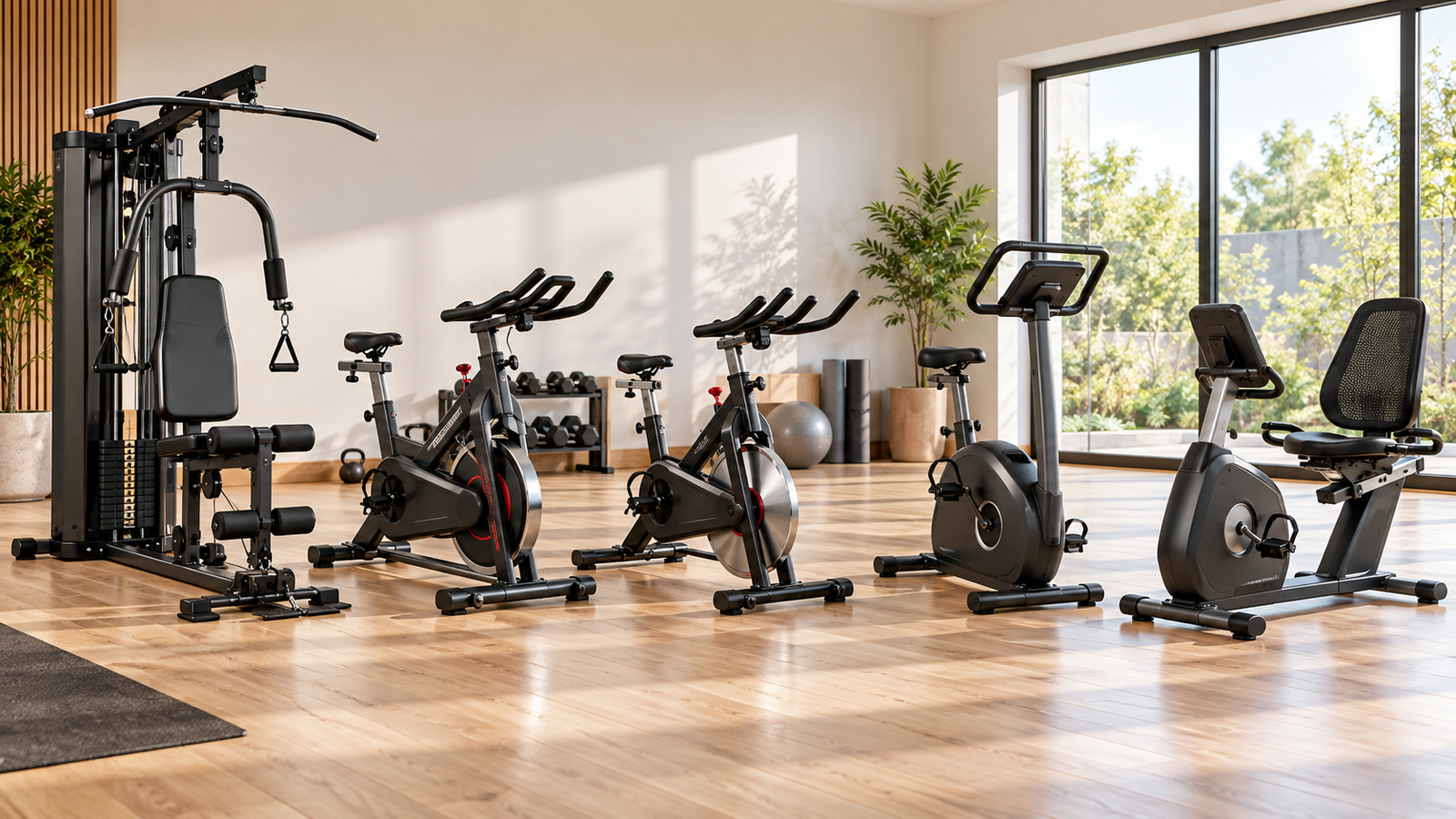
Spin-style indoor cycling bike
Spin-style bikes are generally designed around a cycling position resembling road-bike riding.
They commonly feature:
- A relatively narrow saddle.
- Adjustable seat and handlebars.
- A flywheel-based drivetrain.
- Resistance controls.
- Pedals designed for active cycling.
They may suit people who enjoy structured cycling sessions.
Upright exercise bike
An upright stationary bike often provides a more conventional exercise-bike seating position.
Some models use a wider saddle and more upright handlebars.
They can be convenient for steady indoor cycling.
Recumbent exercise bike
A recumbent bike provides a reclined seated position with a supportive backrest.
The pedals are located in front of the rider rather than directly below the saddle.
Some users may find the supported seating position more comfortable.
However, suitability for people with particular medical conditions or mobility limitations should be assessed individually.
Comparison table
| Feature | Spin-style bike | Upright bike | Recumbent bike |
|---|---|---|---|
| Riding position | Often forward-leaning | Usually more upright | Reclined and supported |
| Backrest | Usually absent | Usually absent | Typically present |
| Workout emphasis | Structured indoor cycling | General stationary cycling | Supported seated cycling |
| Fit adjustments | Vary by model | Vary by model | Vary by model |
| Flywheel specifications | Often advertised | Varies | Varies |
| Space requirements | Model-dependent | Model-dependent | Often longer overall |
Choose a riding position that you can maintain comfortably and safely.
Do not assume that a heavier flywheel makes one category universally better than another.
12. How to Set Up a Spin Bike Correctly
Even a high-quality exercise bike can feel uncomfortable if the saddle and handlebars are poorly adjusted.
Before beginning regular workouts, adjust the bike according to its manual.
Step 1: Adjust saddle height
A common starting point is to position the saddle approximately level with your hip bone while standing beside the bike.
When seated with the pedal near the bottom of its rotation, your knee should retain some bend.
Indoor cycling instructions from Spinning suggest approximately 25–35 degrees of knee bend as a general starting range.
This is guidance, not a universal measurement suitable for every person.
Step 2: Adjust the saddle position
Some bikes allow the saddle to move forward and backward.
This affects your position relative to the pedals and handlebars.
Use the manufacturer’s bike-fitting procedure.
Step 3: Adjust handlebar height
Handlebars should allow a comfortable riding position without excessive strain through the wrists, shoulders, neck or lower back.
Beginners may prefer relatively higher handlebars.
Step 4: Secure all adjustment mechanisms
Before riding, verify the saddle, seat post, handlebars and pedals are properly secured.
Step 5: Begin with low intensity
Start pedaling gently to assess the setup.
If you experience persistent discomfort or pain, stop and reassess the position.
A qualified cycling instructor or healthcare professional may help with individual fitting concerns.
13. Why the Emergency Stop Mechanism Matters
Some indoor cycling bikes have a fixed-gear-style drivetrain in which the pedals continue moving while the flywheel rotates.
This means abruptly removing your feet or trying to stop the pedals forcefully can be dangerous.
Other bikes use freewheel mechanisms that allow the pedals to stop independently.
You must understand which system your bike uses.
Before your first workout
Identify:
- How resistance is adjusted.
- Whether the drivetrain is fixed or freewheeling.
- How the emergency brake operates.
- Whether the pedals have straps or clip-in mechanisms.
- How to stop pedaling safely.
- Any manufacturer warnings about standing cycling or high cadence.
On certain spin bikes, pressing the resistance knob activates the emergency brake.
This is not universal, so follow the instructions for your specific model.
Never attempt to stop a rapidly moving fixed-drive flywheel by abruptly placing your feet or hands against moving components.
14. What Specifications Matter More Than Flywheel Weight?
Flywheel mass is one specification among many.
When comparing indoor cycles, consider these features.
Resistance mechanism
Does the bike use magnetic resistance, friction resistance or another system?
Is the adjustment easy to control?
Frame stability
Does the equipment feel stable within its intended operating range?
Check the permitted user weight and manufacturer instructions.
Bike fit
Can the saddle and handlebars accommodate your body dimensions comfortably?
Check adjustment ranges rather than relying on vague claims such as universal fit.
Drivetrain
Is the bike belt-driven, chain-driven or built with another transmission design?
What maintenance does it require?
Emergency braking
Does the bike provide an appropriate stopping mechanism for its drivetrain?
Are the controls clearly explained?
Noise
Will the bike be suitable for your home environment?
Do not assume magnetic resistance guarantees silent operation.
Pedals
Check foot straps, clip compatibility and grip security.
Space requirements
Measure the available floor area and allow clearance for mounting, dismounting and movement.
Service support
Check warranty coverage, replacement-part availability and local servicing options.
These factors can have a greater influence on long-term satisfaction than a difference of a few kilograms in flywheel mass.
15. How to Evaluate an Exercise Bike Listing Online
Online product listings frequently emphasize maximum resistance, heavy flywheels or smooth-riding claims.
Before purchasing, verify the specific model and its documented features.
Practical buying checklist
| Specification | What to verify |
|---|---|
| Flywheel weight | Actual stated mass and whether independently documented |
| Resistance type | Magnetic, friction or another design |
| Resistance adjustment | Manual, stepped or electronically controlled |
| Drive system | Belt, chain or other |
| Maximum user weight | Manufacturer-rated limit |
| Saddle adjustment | Height and fore-aft range |
| Handlebar adjustment | Available positions |
| Emergency stop | Method and operating instructions |
| Display functions | Measured vs estimated metrics |
| Floor footprint | Exact length, width and clearance |
| Warranty | Coverage and exclusions |
| Replacement parts | Availability and servicing |
Avoid comparing kilograms in isolation
For example, an advertisement highlighting a 12 kg flywheel tells you very little about the bike’s seating comfort, frame stability or long-term durability.
If important specifications are missing, consult the manufacturer’s manual or support team.
Do not assume an unlisted feature exists.
16. Common Spin Bike Buying Mistakes
Mistake 1: Assuming the heaviest flywheel is always the best
Higher mass does not guarantee superior performance.
Look at the complete mechanical design.
Mistake 2: Confusing flywheel weight with resistance
Flywheel mass and opposing pedaling load are different characteristics.
Mistake 3: Ignoring the resistance mechanism
A bike’s resistance controls strongly influence how you adjust exercise intensity.
Mistake 4: Buying a bike without checking fit
Poor saddle or handlebar positioning can make regular cycling uncomfortable.
Mistake 5: Overlooking noise
Home use may require attention to drivetrain noise, floor vibrations and placement.
Mistake 6: Ignoring the emergency stop procedure
This is particularly important on bikes with a drivetrain that keeps the pedals moving.
Mistake 7: Trusting calorie estimates as exact measurements
Display values may be estimated and should be interpreted accordingly.
Mistake 8: Ignoring servicing requirements
A well-maintained, appropriately designed exercise bike can be more valuable than one purchased solely for an impressive specification.
17. Can a Spin Bike Replace Strength Training?
Indoor cycling primarily provides aerobic exercise, although pedaling also engages several lower-body muscle groups.
However, it should not automatically be considered a complete replacement for resistance training.
General physical activity recommendations encourage adults to combine aerobic activity with muscle-strengthening exercise.
A balanced routine might include:
- Indoor cycling for aerobic fitness.
- Bodyweight exercises for general strength.
- Resistance bands or dumbbells for progressive resistance.
- Mobility activities suited to individual needs.
A cable-based home gym and a stationary bike therefore serve different exercise purposes.
One primarily provides adjustable resistance for strength exercises, while the other is designed for cycling-based activity.
They can complement each other rather than functioning as direct substitutes.
18. Beginner Indoor Cycling Routine
If you are new to stationary cycling, start with a comfortable, manageable session.
This example is intended for generally healthy adults who can exercise safely.
| Stage | Duration | Effort |
|---|---|---|
| Easy warm-up | 5 minutes | Comfortable pedaling |
| Steady cycling | 5 minutes | Light to moderate |
| Slightly increased effort | 3 minutes | Controlled, somewhat harder |
| Comfortable cycling | 4 minutes | Light to moderate |
| Cool-down | 3 minutes | Easy pedaling |
| Total | 20 minutes |
Use the talk test to judge moderate intensity: you should generally be able to talk but not sing comfortably during the activity.
If you are not ready for a 20-minute session, begin with a shorter duration.
Increase workload gradually rather than immediately chasing high resistance or cadence readings.
Stop if you develop chest pain, faintness, unusual breathlessness or other concerning symptoms.
People with significant cardiovascular, musculoskeletal or other medical conditions should seek appropriate professional guidance before beginning or substantially increasing exercise.
19. How to Maintain an Indoor Cycling Bike
Regular maintenance helps keep the bike functioning properly.
Before each ride
Inspect the bike for visible damage.
Check saddle and handlebar security.
Ensure the pedals and foot restraints are in good condition.
Verify that resistance adjustment and stopping controls operate correctly.
After each ride
Wipe sweat from appropriate surfaces.
Keep liquid away from electronics and components that should remain dry.
Follow the manufacturer’s cleaning recommendations.
Periodic maintenance
Depending on the drivetrain and design, the manufacturer may recommend checking:
- Belt or chain condition.
- Pedal attachment.
- Crank fasteners.
- Resistance mechanism.
- Frame hardware.
- Bearings.
- Electrical connections, where applicable.
Never attempt to repair a damaged resistance or braking system while continuing to use the equipment.
If the bike produces unusual grinding noises, develops unexpected pedal movement or fails to stop normally, discontinue use until the issue is corrected.
20. Frequently Asked Questions
Is a 12 kg flywheel better than an 8 kg flywheel?
Not necessarily. The complete flywheel design, rotational inertia, gearing, resistance mechanism and bike construction influence the riding experience. Weight alone does not establish which bike is better.
Is a heavier flywheel harder to pedal?
A higher-inertia flywheel may resist rapid changes in speed, but sustained pedaling effort depends on the resistance system and workload. A heavier flywheel does not automatically mean greater exercise intensity.
Does a heavy flywheel burn more calories?
No. Energy expenditure depends primarily on factors such as workload, duration, intensity and individual characteristics.
Is magnetic resistance better than friction resistance?
Magnetic systems commonly offer lower contact-related wear and quieter resistance operation. However, overall quality depends on the bike’s design, and both mechanisms can support effective workouts.
Is an 8 kg flywheel enough for home cycling?
It may be suitable, but flywheel weight alone cannot establish whether a bike meets your needs. Consider resistance range, fit, stability and intended usage.
What is the ideal flywheel weight for beginners?
There is no universally ideal flywheel mass for beginners. Adjustable workload, comfortable fit, stable construction and clear stopping controls are more useful selection criteria.
Does a bigger flywheel mean smoother cycling?
Not always. Flywheel radius and mass distribution influence rotational inertia, while drivetrain quality, gearing and resistance also affect pedaling feel.
Do exercise bikes need electricity?
Some manually adjustable stationary bikes can operate without external electricity. Others need power for electronic resistance, connected features or displays. Check the model’s specifications.
Is a spin bike better than an upright bike?
Neither is universally better. A spin-style bike and an upright exercise bike may provide different riding positions and adjustment options. Choose based on comfort, goals and fit.
What is the difference between RPM and resistance?
RPM measures pedaling cadence, while resistance is the load opposing pedaling. A high cadence does not automatically mean a high workload.
Is belt drive quieter than chain drive?
Belt drives are often relatively quiet, but actual noise depends on the complete machine, assembly and maintenance.
Should I choose a spin bike based on its maximum user weight?
The manufacturer-rated weight capacity is an important safety specification, but it should be considered alongside frame stability, fit and intended usage.
21. Final Takeaway
Flywheel weight is worth understanding, but it should never be the only factor used to choose an indoor exercise bike.
An 8 kg flywheel is not automatically inferior to a 12 kg flywheel, and a heavier flywheel does not guarantee more resistance, higher calorie expenditure or better cycling performance.
Rotational inertia, flywheel geometry, drivetrain design, resistance mechanism and overall bike quality all contribute to the riding experience.
Before buying, prioritize appropriate resistance adjustment, comfortable bike fit, stable construction, safe stopping controls and dependable after-sales support.
For most home users, a reliable exercise bike that feels comfortable and encourages consistent activity is more useful than one selected primarily because of an impressive flywheel-weight claim.
References and Further Reading
- Research on Exercise Bike Flywheel Inertia and Technical Parameters — International Journal of Applied Mechanics and Engineering
- Spinning — Getting Started: Bike Setup and Safety
- Keiser — M3i Indoor Bike Setup
- UPMC Sports Medicine — Proper Indoor Cycling Form
- CDC — Physical Activity Guidelines for Adults
- American Heart Association — Physical Activity Recommendations
Editorial note: This article provides general fitness education and explains exercise equipment principles. It does not represent hands-on testing of specific indoor cycling bikes. Equipment design, specifications and performance vary by model. Manufacturer safety instructions and individual health considerations should always take priority.