Adjustable Dumbbell and Convertible Weight Safety Checks
Adjustable dumbbells have become a practical option for people building a home gym. Instead of purchasing multiple pairs of fixed-weight dumbbells, you can use one adjustable system with removable weight plates or a built-in weight-selection mechanism.
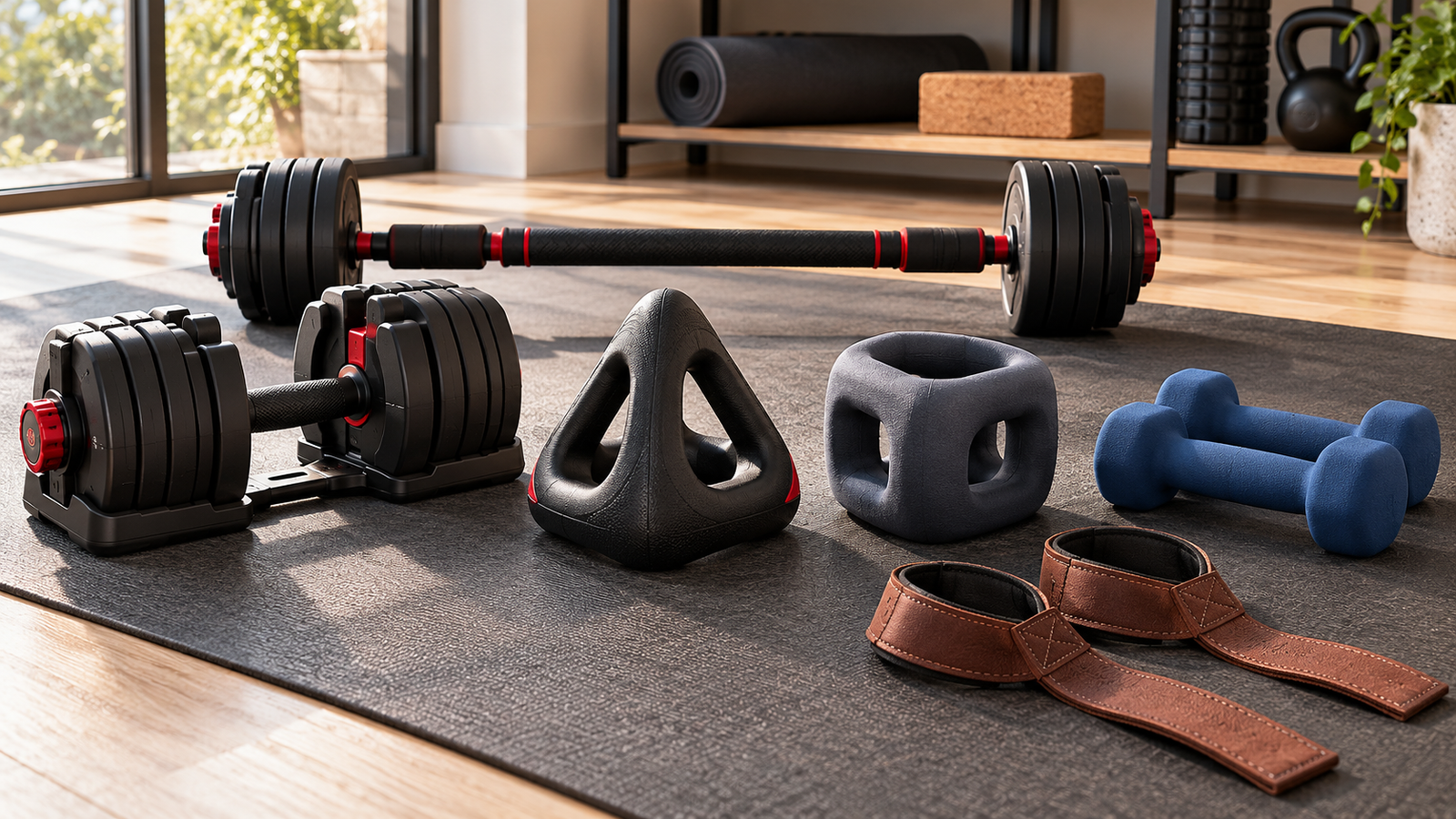
Some modern fitness products go a step further by combining dumbbell, kettlebell and barbell configurations within one equipment kit.
These designs can save space and offer training flexibility. However, their additional connectors, locking mechanisms, collars and removable plates also introduce important safety considerations.
Before every workout, adjustable weights should be checked for secure assembly, damage, correct weight selection and compatibility with the intended exercise.
A loose collar, damaged locking pin or incorrectly assembled connecting rod can create a risk of falling weights and injury.
This guide explains how to inspect adjustable dumbbells, safely convert multifunctional weights and choose an appropriate setup for home strength training.
1. Understanding Different Types of Adjustable Weights
Not every adjustable dumbbell uses the same mechanism.
Understanding the equipment’s design is the first step toward safe operation.
Traditional plate-loaded adjustable dumbbells
These dumbbells have a metal or composite handle onto which removable weight plates are added.
The plates are held in position using collars, threaded spin-lock fasteners or another manufacturer-approved securing system.
Their main components include:
- Dumbbell handle
- Weight plates
- Locking collars or threaded fasteners
- Grip section
- Plate-loading sleeves
Before exercising, verify that every plate is correctly positioned and secured.
Dial-adjustable dumbbells
Dial-adjustable systems allow users to select different weights using a rotating selector or similar mechanism.
Unselected plates usually remain inside a storage cradle.
The exact mechanism varies by manufacturer.
Some systems require the handle to be fully seated in the cradle before the selected weight can be changed.
Never force a dial, selector or locking mechanism that is not operating normally.
Convertible dumbbell and barbell sets
Convertible systems may include additional connecting rods that allow two dumbbell handles to form a longer barbell-style arrangement.
Some also offer kettlebell configurations.
These products introduce additional connection points that must be inspected.
Not every convertible system is suitable for every exercise, particularly movements involving rapid acceleration, impacts or lifting overhead.
Use only the configurations and exercises specifically permitted by the manufacturer.
2. Why Adjustable Dumbbell Safety Checks Matter
Unlike most fixed-weight dumbbells, adjustable weights have components that can be removed, repositioned or mechanically selected.
That flexibility creates potential failure points.
Examples include:
- Loose collars
- Damaged screw threads
- Incorrectly engaged selector pins
- Improperly positioned plates
- Worn connecting rods
- Cracked plastic housings
- Damaged adjustment mechanisms
- Use beyond the manufacturer’s load rating
A small mechanical problem can become dangerous during movement.
For example, a loose weight plate may shift unexpectedly while performing a shoulder press.
Similarly, a poorly secured connector in a convertible barbell system could allow unwanted movement during exercise.
These risks are why the equipment’s instructions and inspection procedures are essential.
3. The Essential Pre-Workout Dumbbell Safety Checklist
Before beginning your workout, inspect the equipment while it is resting on a stable surface.
| Component | What to check | Warning sign |
|---|---|---|
| Weight plates | Correct seating and visible condition | Cracks, chips or unusual movement |
| Collars | Fully secured according to instructions | Loose or damaged fasteners |
| Selector dial | Correct weight selection and engagement | Sticking or incomplete movement |
| Locking pin | Fully inserted where required | Bent, missing or loose pin |
| Dumbbell handle | Structural condition and grip | Cracks, deformation or instability |
| Connecting rod | Secure manufacturer-approved attachment | Looseness or damaged threads |
| Storage cradle | Stable and correctly positioned | Cracks or uneven support |
| Grip surface | Clean and secure | Slipperiness or damaged covering |
If anything appears damaged or improperly secured, do not use the equipment until the problem has been resolved according to the manufacturer’s instructions.
Check 1: Inspect the weight plates
Look for cracks, deformation or damaged attachment points.
Pay particular attention to plastic-coated or composite plates.
Minor cosmetic marks are not necessarily structural damage, but cracks around loading holes or connectors should not be ignored.
Never use a plate with suspected structural damage.
Check 2: Inspect collars and fasteners
For plate-loaded dumbbells, verify that the collars are fully secured.
If your system uses threaded fasteners, inspect the threads for unusual wear or damage.
Do not substitute improvised nuts, clips or incompatible collars.
Check 3: Inspect the handle
Check whether the handle appears straight and structurally sound.
A loose grip sleeve, visible crack or deformed component may indicate a problem.
Pay particular attention to handles that also connect to other equipment configurations.
Check 4: Verify the adjustment mechanism
For selector-based dumbbells, confirm that the selected weight is properly engaged.
Some manufacturer manuals specify an audible click or other indicator.
Follow the instructions for your exact model rather than assuming every mechanism works in the same way.
Check 5: Inspect the training space
Ensure that the floor is stable, dry and free of obstacles.
Remove unnecessary objects and keep children and pets away from the active lifting area.
4. How to Adjust Plate-Loaded Dumbbells Safely
Traditional adjustable dumbbells require manual weight changes.
A safe approach starts with a stable work surface and the manufacturer’s assembly instructions.
Step 1: Put the dumbbell down completely
Place the dumbbell on a stable surface before changing the weight.
Do not attempt to remove plates while holding the dumbbell in the air.
Step 2: Release the collar
Remove or loosen the approved fastening mechanism according to the manufacturer’s instructions.
Keep your fingers clear of areas where plates might slide.
Step 3: Select the required plates
Choose the intended weight while respecting the equipment’s capacity.
Check whether the manufacturer requires symmetrical loading on each end.
Step 4: Position the plates correctly
Ensure that each plate is properly seated against the appropriate stop or neighboring plate.
Do not mix incompatible plate systems or components.
Step 5: Secure the collar
Reattach the collar or spin-lock fastener fully.
Do not use excessive force beyond the manufacturer’s recommendations, but never leave the collar partially engaged.
Step 6: Check stability
Before beginning a normal set, inspect the complete assembly and perform only the manufacturer-approved security check.
If any plate shifts unexpectedly, stop and correct the problem.
Never attempt to tighten a slipping weight plate during an exercise. Put the equipment down safely first.
5. How to Check Dial-Adjustable Dumbbells
Dial-based systems are convenient because they reduce the time needed to change weights.
However, the adjustment mechanism is a critical safety component.
Some systems use an internal locking arrangement that secures the selected weight plates to the handle.
Before lifting
- Position the storage cradle on a stable, level surface.
- Seat the dumbbell completely in the cradle, as required.
- Select the intended weight according to the instructions.
- Verify the selection and locking indicators.
- Lift the handle using the method specified in the manual.
- Confirm that only the intended weight plates have been selected.
Do not assume that every dial-adjustable dumbbell makes the same clicking sound or uses the same release sequence.
Never force a stuck selector
If a dial will not rotate normally, the mechanism may be misaligned or obstructed.
Forcing it can damage internal components.
Stop using the dumbbell and consult the troubleshooting guidance for that model.
Do not dismantle a locking mechanism or attempt an improvised repair unless the manufacturer explicitly authorizes the procedure.
Do not drop adjustable dumbbells
Many adjustable dumbbell mechanisms can be damaged by impacts.
A dumbbell may appear usable after being dropped while concealing damaged internal components.
Follow the manufacturer’s inspection or replacement instructions after an accidental drop.
6. Convertible Dumbbell to Barbell: Essential Safety Checks
Some adjustable weight kits allow two dumbbell handles to be connected using a central extension rod.
This creates a longer barbell-style configuration.
However, a convertible barbell is not necessarily equivalent to a standard gym barbell.
Inspect every connection point
Before lifting, check:
- The compatibility of both handles.
- The condition of the connecting rod.
- The manufacturer’s specified attachment procedure.
- Correct engagement of locking mechanisms.
- The maximum permitted load for the assembled configuration.
- Any restrictions on exercise type or orientation.
Respect the lowest applicable load limit
The permitted load may differ between configurations.
For example, the manufacturer might specify different capacities for an individual dumbbell and the connected barbell assembly.
The maximum safe load should never exceed the lowest applicable manufacturer-rated capacity of the relevant components or configuration.
Do not assume that joining two dumbbells doubles the permitted load.
Avoid improvised extensions
Never join handles using unrelated metal rods, plumbing fittings or other improvised components.
Even if the parts appear to fit, they may not provide an adequately rated or secure connection.
Check exercise suitability
Some convertible systems are intended for general controlled resistance exercises.
They may not be suitable for heavy overhead lifting, dropping weights, explosive movements or exercises requiring specialized barbells.
Always check the product’s permitted uses.
7. Are Convertible Dumbbells Suitable for Every Exercise?
No.
An exercise that is safe with one type of equipment may be inappropriate with another.
Consider these differences.
| Exercise | What to consider |
|---|---|
| Biceps curl | Secure plate attachment and manageable load |
| Bent-over row | Handle security, controlled movement and posture |
| Goblet squat | Grip security and approved holding position |
| Shoulder press | Equipment’s overhead-use approval and control |
| Floor press | Handle stability and safe positioning |
| Barbell squat | Manufacturer approval and suitable supporting equipment |
| Explosive lift | Whether the system explicitly permits dynamic loading |
These examples do not constitute approval for a particular product.
A multifunctional weight should only be used in an exercise configuration permitted by its manufacturer.
Why overhead exercises need additional caution
Overhead lifting places equipment above the head and upper body.
An unsecured plate or mechanical failure in this position can cause serious injury.
Beginners should first develop suitable movement technique with appropriate weights and seek qualified instruction when needed.
Do not perform overhead movements with equipment that has an uncertain connection, damaged locking mechanism or unverified rating.
8. Dumbbells vs Y-Bell vs Multifunctional Weights
Some compact fitness products combine several training functions in a single shape.
A Y-Bell-style weight, for example, may be designed to support different grip positions.
Other multifunctional weights are marketed for kettlebell-style exercises or as push-up supports.
However, versatility claims need to be verified against the actual product.
Fixed dumbbells
Fixed dumbbells usually have fewer adjustable parts.
Their relatively straightforward construction can make them convenient for repeated exercises.
Nevertheless, they still require inspection for damaged handles and loose components.
Adjustable dumbbells
Adjustable dumbbells provide multiple weight options within one system.
Their key considerations include secure weight selection, load limits and correct assembly.
Multifunctional Y-Bell weights
These designs may provide alternative grip positions and exercise possibilities.
However, grip openings, weight distribution and stability vary.
Do not assume that a multifunctional weight can safely function as a kettlebell, medicine ball or push-up bar unless the manufacturer specifies those uses.
Which is safer?
No equipment category is automatically safer in every situation.
Safety depends on equipment condition, design, instructions, exercise selection and the user’s technique.
9. Why Balanced Weight Distribution Matters
A plate-loaded dumbbell should be assembled according to the manufacturer’s loading instructions.
Many conventional adjustable dumbbells are intended to have evenly distributed weight plates on both ends.
Unequal loading can change the balance of the handle and may affect control during exercise.
Example
Imagine a dumbbell assembled with heavier plates on one side and lighter plates on the other.
The center of mass may shift toward the heavier end.
This creates an uneven loading condition that can influence how the dumbbell behaves when lifted.
Even if a person can physically lift the dumbbell, this does not establish that the assembly is suitable.
Use the intended plate arrangement rather than improvising unusual weight distributions.
If the manufacturer permits asymmetric configurations, follow its specific instructions.
10. How to Choose an Appropriate Starting Weight
Selecting a manageable weight is an important part of safe resistance training.
A beginner should not choose weights simply because they are advertised as heavy-duty or suitable for advanced training.
Instead, choose resistance that allows controlled movement.
Start with technique
Before increasing resistance, learn the movement with little or no weight.
Pay attention to your ability to maintain stable positioning throughout the intended range of motion.
Select a manageable load
Choose a weight that allows you to complete your planned repetitions without uncontrolled swinging, excessive momentum or loss of technique.
If form begins to deteriorate, reduce the load or end the set.
Progress gradually
As an exercise becomes manageable, resistance can be adjusted.
However, progression does not always require increasing weight.
Depending on your goal, you may also change repetitions, sets or training frequency.
The American College of Sports Medicine’s updated resistance training guidance emphasizes individualized, consistent training rather than complicated routines.
For general strength and health, regular resistance exercise covering major muscle groups is more important than selecting the most elaborate equipment.
11. Do You Need a Warm-Up Before Using Adjustable Weights?
A warm-up can help prepare you for resistance training.
It also provides an opportunity to assess whether your body feels ready for the planned movements.
A practical warm-up
Begin with a few minutes of comfortable movement.
Examples include:
- Easy walking.
- Gentle marching.
- Controlled arm movements.
- Unweighted squats.
- Light versions of the exercises you plan to perform.
Then perform an easy practice set with lighter resistance before moving to your working weight, when appropriate.
The precise warm-up depends on the planned workout and individual fitness level.
Avoid beginning a demanding set with a weight you have never handled before.
12. Common Adjustable Dumbbell Mistakes
Mistake 1: Leaving collars partially tightened
Even a small amount of unexpected plate movement can affect control.
Verify collar security before lifting.
Mistake 2: Changing weight while holding the dumbbell
Weight changes should be performed according to the equipment’s instructions, generally with the dumbbell fully supported.
Never attempt to change a selector while the weight is suspended if the model prohibits it.
Mistake 3: Mixing incompatible components
Similar-looking plates, rods and collars are not necessarily compatible.
Use manufacturer-approved components.
Mistake 4: Exceeding the permitted load
Do not assume that stronger-looking handles can safely hold more than their stated capacity.
Follow the rated limits.
Mistake 5: Ignoring unusual movement
Loose plates, unexpected clicking or shifting components should be investigated before continuing.
Mistake 6: Dropping adjustable weights
Some internal adjustment mechanisms are vulnerable to impact.
Put weights down in a controlled manner.
Mistake 7: Using damaged equipment
Cracked plates, bent connectors, worn collars and malfunctioning locking components are reasons to stop using the product.
Mistake 8: Increasing weight before mastering technique
Heavier loads are not inherently better.
Exercise quality and individual suitability should guide progression.
Mistake 9: Using an unstable training surface
Loose rugs, clutter and slippery flooring can increase accident risk.
Mistake 10: Skipping the manufacturer’s instructions
Different adjustable-weight mechanisms operate differently.
A procedure suitable for one product may be unsafe for another.
13. How to Maintain Adjustable Dumbbells
Regular maintenance can help identify deterioration before it creates a safety problem.
After every workout
Check for any damage or unusual behavior noticed during training.
Wipe down handles when needed, using cleaning methods compatible with the equipment.
Return weights to their designated storage location.
Periodically inspect mechanical components
Examine collars, connecting rods, handles and locking mechanisms.
For dial-based products, perform the manufacturer’s specified inspection or functional checks.
Do not lubricate internal mechanisms unless the manual instructs you to do so.
Some systems may require particular maintenance procedures or no user maintenance at all.
Store equipment correctly
Keep dumbbells in a stable location where they cannot roll or fall.
Use the dedicated cradle when supplied.
Protect the equipment from conditions that the manufacturer identifies as unsuitable, such as excessive moisture.
Avoid storing heavy adjustable weights on unstable shelves.
What if a part breaks?
Stop using the equipment.
Contact the manufacturer or an authorized service provider to determine whether the component can be replaced.
Do not continue exercising with a damaged locking mechanism because the weight still appears to function.
14. Setting Up a Safer Home Strength-Training Space
You do not need a large gym to train effectively, but the available space should support the equipment and intended exercises.
Choose a stable floor
The surface should provide appropriate support and traction.
Avoid exercising on slippery tiles or loose rugs.
Maintain adequate clearance
Ensure that weights cannot strike furniture, walls, lights or other objects during movement.
Account for the full range of motion, including when arms move overhead.
Keep equipment organized
Store unused plates and collars away from walking paths.
Loose plates on the floor can become trip hazards.
Consider lifting support
Some exercises require appropriate racks, benches or spotters.
Do not improvise a bench or rack from household furniture.
A convertible weight kit does not automatically replace specialized supporting equipment.
Keep children and pets away
An active lifting area should not be accessible to children or pets during exercise.
Store weights securely afterward.
15. Should Beginners Choose Adjustable or Fixed Dumbbells?
Both types can be useful for beginners.
The choice depends on budget, storage space, desired resistance range and comfort with equipment adjustments.
| Factor | Fixed dumbbells | Adjustable dumbbells |
|---|---|---|
| Weight changes | Switch to another dumbbell | Adjust the same unit |
| Storage | Several pairs require more space | Often more compact |
| Moving components | Typically fewer | Varies by design |
| Initial setup | Usually straightforward | Requires understanding the mechanism |
| Weight selection | Limited to available pairs | Multiple settings or plate combinations |
| Maintenance | Inspect condition and grip | Additional checks for locks and connectors |
| Cost | Depends on number of pairs | Depends on mechanism and capacity |
A beginner who prefers simple equipment may find fixed dumbbells convenient.
Someone with limited space may prefer an adjustable system.
Neither choice removes the need for correct lifting technique.
16. Five Questions to Ask Before Buying Convertible Weights
Before purchasing a multifunctional dumbbell system, review these five areas.
1. What is the rated maximum load?
Check the permitted load for every configuration you intend to use.
2. How are the plates secured?
Identify whether the system uses threaded collars, selectors, pins or another locking mechanism.
3. Are replacement components available?
Find out whether the manufacturer provides compatible replacement collars, handles or connecting parts.
4. Which exercises are approved?
A product described as convertible does not automatically permit all barbell or kettlebell movements.
5. Is the equipment suitable for your space?
Consider storage, handling, floor clearance and whether you need supporting equipment.
Avoid selecting weights based solely on the largest advertised maximum load.
17. Frequently Asked Questions
Are adjustable dumbbells safe for home workouts?
Adjustable dumbbells can be suitable for home resistance training when they are used according to their design, maintained properly and inspected regularly. Safety also depends on appropriate exercise selection and technique.
How do I know if an adjustable dumbbell is locked?
Follow the manufacturer’s instructions for your exact model. Some systems use selector indicators, audible clicks, locking pins or other mechanisms.
Do not rely on a generic locking method from another brand.
Can I turn any adjustable dumbbell into a barbell?
No. Only use a barbell conversion if the manufacturer explicitly designed and approved the components for that configuration.
Can I use adjustable dumbbells for shoulder presses?
Only if the equipment is approved for that exercise and is in proper working condition. Overhead lifting requires particular care because a falling component can cause serious injury.
Should adjustable dumbbells have equal weight on both sides?
Many plate-loaded systems require symmetrical loading. Follow the manufacturer’s specified plate arrangement rather than assuming asymmetric loading is acceptable.
Can I drop adjustable dumbbells after a heavy set?
Do not intentionally drop them unless the manufacturer explicitly permits that use. Many adjustable mechanisms can be damaged by impacts.
How often should I inspect adjustable dumbbells?
Perform a basic security and condition check before each use, along with any periodic maintenance specified by the manufacturer.
What should I do if the selector dial gets stuck?
Stop using the dumbbell and consult the manufacturer’s troubleshooting instructions. Do not force the mechanism.
Is a convertible dumbbell-barbell kit suitable for heavy lifting?
It depends on the product’s rated capacity, approved exercises and structural design. Do not treat a compact convertible system as equivalent to a dedicated heavy-duty barbell without explicit manufacturer approval.
Do beginners need heavy adjustable dumbbells?
No. Beginners can make progress using manageable resistance, consistent training and appropriate technique.
Are multifunctional Y-Bell weights better than dumbbells?
They serve different training preferences. The best choice depends on the exercises you want to perform, the available weight options and the product’s approved uses.
Can I replace a broken collar with one from another brand?
Only if the replacement is explicitly compatible and approved for that model. An apparently similar fit does not guarantee secure operation.
18. Final Takeaway
Adjustable dumbbells and convertible weights are useful tools for building a compact home gym.
However, their flexibility makes equipment inspection particularly important.
Before every workout, verify the locking mechanism, collars, plates, handle condition and correct assembly.
For convertible systems, inspect every connecting component and respect the permitted load for the specific configuration.
Avoid improvised accessories, forced adjustments, damaged parts and exercises outside the manufacturer’s approved uses.
Remember that safe resistance training also depends on choosing manageable loads, maintaining controlled technique and progressing at a suitable pace.
A simple, correctly assembled weight system used consistently is more valuable than a complicated setup that compromises safety.
References and Further Reading
- American College of Sports Medicine — Updated Resistance Training Guidelines (2026)
- American College of Sports Medicine — Resistance Training Position Stand
- National Academy of Sports Medicine — Strength Training Routines for Beginners
- SteelPac — Adjustable Dumbbell User Manual
Editorial note: This article provides general fitness education and equipment-safety information. It is not a substitute for manufacturer instructions, hands-on coaching or individualized medical advice. The featured image is illustrative and does not represent testing or certification of specific fitness products. Stop exercising if equipment behaves unexpectedly or if you experience pain, dizziness or other concerning symptoms.