PM2.5 vs CO2 vs AQI: What Indoor Air Quality Monitors Actually Measure
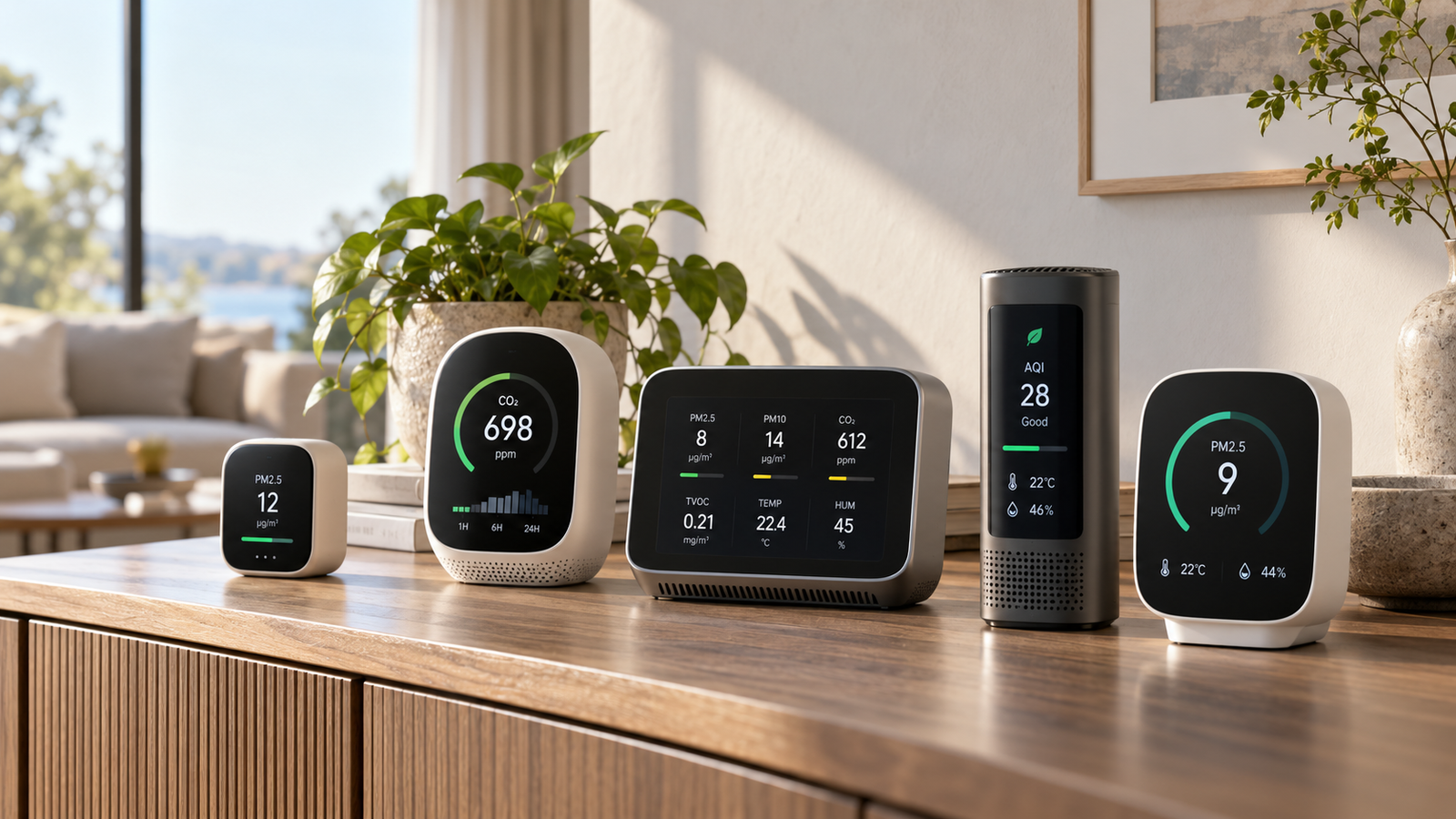
Indoor air quality monitors often display several numbers at the same time: PM2.5, CO2, temperature, humidity and sometimes an AQI score. The problem is that these measurements do not describe the same thing.
PM2.5 tells you about very small airborne particles. CO2 is mainly useful indoors as an indicator of ventilation and how much exhaled air is accumulating in occupied spaces. AQI is different again: it is an index created from pollutant measurements rather than a pollutant that a sensor directly detects.
Understanding these differences makes an air quality monitor much more useful. Instead of reacting to whichever number looks highest, you can identify what the device is actually measuring and what type of action may help.
This guide explains PM2.5, CO2 and AQI, how consumer indoor-air monitors measure them, what the readings can and cannot tell you and which sensors matter most when choosing a monitor for your home.
PM2.5 vs CO2 vs AQI at a Glance
| Metric | What It Represents | Typical Indoor Sources | What a Monitor Does |
|---|---|---|---|
| PM2.5 | Fine airborne particles up to about 2.5 micrometres in diameter | Cooking, smoke, candles, outdoor pollution entering indoors | Usually estimated with an optical particle sensor |
| CO2 | Carbon dioxide concentration in air | Primarily exhaled breath in occupied rooms | Often measured with an NDIR sensor |
| AQI | An index summarising air-pollution levels | Depends on the pollutant used to calculate it | Usually calculated from sensor data rather than directly measured |
What Is PM2.5?
PM2.5 stands for particulate matter with an aerodynamic diameter of approximately 2.5 micrometres or smaller.
These particles are much smaller than ordinary visible dust and can remain suspended in the air.
Common indoor or nearby sources can include:
- Cooking smoke and frying
- Tobacco smoke
- Incense
- Candles
- Wood or biomass burning
- Outdoor traffic pollution entering the home
- Construction dust containing a fine-particle fraction
How Do Indoor Monitors Measure PM2.5?
Most consumer air-quality monitors use an optical particle sensor.
Air passes through a sensing chamber, where a light source illuminates particles in the air.
The sensor detects how the light scatters and uses an algorithm to estimate particle concentration.
This is not the same as physically weighing every particle.
The reading is an estimate based on optical behaviour.
Why PM2.5 Sensors Can Differ
Two monitors placed beside each other may not show exactly the same PM2.5 value.
Differences can result from:
- Sensor design
- Calibration
- Airflow through the device
- Humidity
- Particle composition
- Sensor age
- Internal averaging algorithms
For home use, trends are often more useful than expecting laboratory-level agreement between devices.
What Does a PM2.5 Reading Tell You?
It tells you the estimated concentration of fine particles in the surrounding air.
That can be useful for identifying events such as:
- A spike while cooking
- Smoke entering through a window
- Pollution increasing outdoors
- An air purifier gradually reducing particle levels
PM2.5 does not tell you exactly what each particle is made of.
What Is CO2?
CO2, or carbon dioxide, is a gas naturally present in the air.
People continuously exhale carbon dioxide as part of normal breathing.
In an occupied indoor space, CO2 concentration often rises when ventilation is insufficient for the number of people present.
This makes CO2 especially useful as a practical ventilation indicator.
Why CO2 Rises Indoors
Imagine several people sitting in a closed bedroom or meeting room.
Each person exhales CO2.
If fresh outdoor air is entering slowly, the exhaled carbon dioxide gradually accumulates.
Opening a window, increasing mechanical ventilation or reducing occupancy can lower the concentration.
Does High CO2 Mean the Air Is Polluted?
Not in exactly the same sense as high PM2.5.
CO2 indoors often indicates that ventilation is limited relative to occupancy.
A room can have:
- High CO2 but low PM2.5
- Low CO2 but high PM2.5
- Both high
- Both low
They represent different air-quality problems.
How Do Air Quality Monitors Measure CO2?
Many better consumer CO2 monitors use a technology called NDIR, or non-dispersive infrared sensing.
Carbon dioxide absorbs specific wavelengths of infrared light.
An NDIR sensor passes infrared light through an air sample and estimates CO2 concentration based on how much light is absorbed.
Why NDIR Matters
Some inexpensive devices advertise a calculated or estimated CO2 value rather than using a dedicated CO2 sensor.
These estimates may be derived from other gases and should not automatically be treated as true carbon-dioxide measurements.
If CO2 tracking is important to you, look for a monitor that clearly specifies an NDIR CO2 sensor or another recognised direct CO2 measurement technology.
What Does ppm Mean?
CO2 is usually displayed in ppm, or parts per million.
This represents the approximate number of carbon-dioxide molecules for every million molecules of air.
The useful way to interpret indoor CO2 is generally as a ventilation trend rather than obsessing over one isolated reading.
Why Your Bedroom CO2 May Rise Overnight
A closed bedroom can show steadily increasing CO2 while one or more people sleep.
This happens because:
- People continuously exhale CO2.
- Doors and windows may be closed.
- Mechanical ventilation may be limited.
Opening the room to fresh air typically causes the level to fall.
Can an Air Purifier Reduce CO2?
Most standard particle air purifiers do not remove meaningful amounts of CO2.
A HEPA filter captures particles, not carbon dioxide gas.
If a room has elevated CO2 because of poor ventilation, the typical solution is more fresh-air exchange rather than simply increasing purifier speed.
Can an Air Purifier Reduce PM2.5?
A properly sized purifier equipped with an effective particle filter can reduce airborne particle concentrations when used appropriately.
This is one reason PM2.5 monitors are useful alongside air purifiers: you can observe whether particle levels fall after the purifier is switched on.
What Is AQI?
AQI stands for Air Quality Index.
Unlike PM2.5 or CO2, AQI is not a single pollutant.
It is a numerical index used to translate pollutant concentrations into an easier-to-understand scale.
Government air-quality systems may calculate AQI using pollutants such as:
- PM2.5
- PM10
- Ozone
- Nitrogen dioxide
- Sulfur dioxide
- Carbon monoxide
The exact method depends on the country or air-quality standard being used.
Does an Indoor Monitor Directly Measure AQI?
Usually no.
A sensor directly measures or estimates a pollutant such as PM2.5.
The device or app then converts that reading into an AQI value using a particular formula.
This distinction matters because two apps can potentially display different AQI numbers from similar particle measurements if they use different index standards.
Indoor AQI vs Outdoor AQI
Outdoor AQI from an official monitoring station represents ambient air conditions measured at that location.
An indoor monitor represents the air around the device inside your home.
The two may differ considerably.
For example:
- Outdoor PM2.5 may be high while an indoor purifier keeps indoor particles lower.
- Indoor cooking may temporarily make indoor PM2.5 higher than outside.
- A closed room may have low particles but elevated CO2.
Why AQI Alone Can Be Misleading Indoors
A single AQI number simplifies air quality, which is useful for communication but can hide important detail.
For indoor monitoring, knowing the underlying measurement is often more useful.
For example, a display showing:
- PM2.5
- CO2
- Temperature
- Humidity
gives you more information about what is happening than one general “air quality” score.
PM2.5 vs AQI: What Is the Difference?
PM2.5 is a measured or estimated particle concentration.
AQI is an index derived from pollutant concentrations.
A monitor might detect a PM2.5 concentration and then use that number to generate an AQI category.
Therefore:
PM2.5 = pollutant measurement.
AQI = interpretation scale.
CO2 vs AQI: What Is the Difference?
Indoor CO2 is primarily useful for evaluating ventilation relative to occupancy.
AQI is mainly an air-pollution index.
CO2 is generally not the main pollutant used in conventional outdoor AQI calculations.
This means an indoor room can show a “good” particle-based AQI while still having elevated CO2 from poor ventilation.
PM2.5 vs CO2: Which Is More Important?
They answer different questions.
PM2.5 answers:
“How much fine particulate pollution is in the air?”
CO2 answers:
“How well is this occupied space being ventilated relative to the people inside?”
A good indoor-air monitor can measure both.
Example: Cooking in the Kitchen
Suppose you start frying food.
The monitor may show:
- A rapid increase in PM2.5
- Little immediate change in CO2
This suggests particle pollution from cooking.
Useful responses may include operating an exhaust hood, improving kitchen ventilation and reducing smoke production.
Example: Closed Bedroom Overnight
In a closed bedroom, you may see:
- CO2 steadily increasing
- PM2.5 remaining relatively low
This suggests the primary issue is ventilation rather than particle pollution.
Example: Outdoor Pollution Entering Indoors
If outdoor pollution rises and windows are open, you may see indoor PM2.5 rise too.
Closing windows during a severe outdoor pollution episode and using appropriate filtration may reduce indoor particle exposure.
However, keeping a room closed for long periods can also allow CO2 to rise when occupied.
This is why indoor air management sometimes requires balancing particle control with adequate ventilation.
What Is PM10?
PM10 refers to airborne particles approximately 10 micrometres or smaller.
It includes PM2.5 as well as somewhat larger particles.
Sources can include:
- Road dust
- Construction activity
- Soil
- Some household dust
Some indoor monitors display both PM2.5 and PM10.
PM1 vs PM2.5 vs PM10
| Metric | Approximate Particle Size Category |
|---|---|
| PM1 | Particles around 1 micrometre or smaller |
| PM2.5 | Particles around 2.5 micrometres or smaller |
| PM10 | Particles around 10 micrometres or smaller |
These categories overlap rather than representing completely separate sets of particles.
What Is TVOC?
TVOC stands for total volatile organic compounds.
It is another metric shown on some indoor-air monitors.
VOCs can come from sources such as:
- Paints
- Cleaning products
- Fragrances
- New furniture
- Solvents
- Cooking
Consumer TVOC sensors generally provide a broad estimate rather than identifying every individual chemical.
Can a TVOC Sensor Tell You Which Chemical Is Present?
Usually not.
A consumer VOC sensor may detect that the overall gas environment has changed without identifying exactly which compound caused the change.
Laboratory testing is required for reliable identification and quantification of specific compounds.
What About Formaldehyde Sensors?
Some monitors advertise formaldehyde, often shown as HCHO.
Consumer gas sensors can vary significantly in quality and may respond to other compounds.
If formaldehyde exposure is a serious concern, a consumer display should not automatically be treated as equivalent to professional environmental testing.
Why Temperature Matters
Temperature is not itself a pollution measurement, but it affects comfort and can interact with ventilation and humidity.
An air-quality monitor that includes temperature can help you understand why a room feels uncomfortable even when particle levels are low.
Why Humidity Matters
Indoor humidity affects comfort, condensation and the indoor environment.
Very high humidity can encourage:
- Condensation
- Dampness
- Mould growth in suitable conditions
Very dry air can feel uncomfortable for some people.
A monitor with humidity sensing provides useful context alongside PM2.5 and CO2.
Can Humidity Affect PM Sensors?
Yes.
Optical particle sensors can sometimes respond differently when humidity is high because airborne water droplets or moisture around particles can affect light scattering.
This is another reason consumer PM readings should be interpreted as useful estimates rather than perfect laboratory measurements.
What Does an Air Quality Monitor Not Measure?
A device should not be assumed to detect every indoor hazard.
Unless specifically equipped and validated for them, it may not measure:
- Carbon monoxide
- Radon
- Natural gas leaks
- Individual VOCs
- Mould spores specifically
- Allergens specifically
- Bacteria or viruses directly
A general air-quality monitor should not replace dedicated safety alarms such as certified carbon-monoxide detectors.
Can an Air Quality Monitor Detect Mould?
Not directly.
A humidity sensor may identify conditions that could favour dampness, but it cannot tell you whether mould is present behind a wall or identify mould spores specifically.
Visible dampness, odour and professional inspection are separate considerations.
Can an Air Quality Monitor Detect Smoke?
A PM sensor may show a sharp increase when smoke particles enter the air.
However, an air-quality monitor is not a replacement for a certified smoke alarm.
Smoke alarms are specifically designed as safety devices for fire detection.
Can an Air Quality Monitor Detect Carbon Monoxide?
Only if it contains a dedicated CO sensor.
Do not confuse:
- CO — carbon monoxide
- CO2 — carbon dioxide
They are completely different gases.
A CO2 monitor cannot serve as a carbon-monoxide alarm.
Where Should You Place an Indoor Air Quality Monitor?
Placement can significantly affect readings.
A reasonable location is usually:
- In the occupied part of the room
- Away from direct outdoor drafts
- Away from an air purifier outlet
- Away from a stove unless specifically monitoring cooking emissions
- Away from direct sunlight
- At a representative breathing-zone height where practical
Why Not Put the Monitor Directly Beside an Air Purifier?
Air exiting a purifier may have much lower particle levels than the rest of the room.
Placing the sensor immediately beside the outlet can therefore make the room appear cleaner than it actually is.
A more central location usually provides a better indication of general room conditions.
Why CO2 Monitors Should Not Sit Directly Beside Your Face
Your exhaled breath contains a much higher CO2 concentration than the surrounding room air.
If the monitor sits immediately beside your mouth, short-term readings may be artificially elevated.
Place it where it represents the room rather than your breath directly.
Do Air Quality Monitors Need Calibration?
Some sensors do.
CO2 monitors in particular may use automatic baseline calibration or offer manual calibration.
Calibration requirements vary by model.
Follow the manufacturer’s instructions rather than resetting or recalibrating the device unnecessarily.
What Is Automatic CO2 Calibration?
Some NDIR monitors assume the device will periodically encounter air close to a normal outdoor baseline and use that point for calibration.
This can work well in regularly ventilated spaces.
It may be less appropriate in environments that remain occupied and closed continuously.
Wi-Fi vs Non-Wi-Fi Air Quality Monitors
Wi-Fi monitor
A connected monitor may provide:
- Remote readings
- Historical graphs
- Alerts
- Smart-home integration
Standalone monitor
A non-connected monitor can still be useful if you mainly want a live display.
It may also appeal to users who prefer:
- No cloud account
- No app dependency
- Simple local readings
Why Historical Data Is Useful
A live reading tells you what is happening now.
Historical charts can reveal recurring patterns.
For example, you may discover that:
- CO2 rises every night in the bedroom.
- PM2.5 spikes during dinner preparation.
- Outdoor pollution enters at a particular time of day.
- Humidity rises after showers.
These patterns can be more actionable than repeatedly checking one current number.
Should You Buy a Monitor With an App?
An app is useful if you want:
- Long-term graphs
- Remote monitoring
- Notifications
- Data export
If you simply want to know whether a room needs ventilation or whether particle pollution has increased, a clear on-device screen may be sufficient.
Are Cheap Air Quality Monitors Accurate?
Price alone does not determine accuracy.
However, a device displaying many measurements should contain appropriate sensors for those measurements.
Be cautious when a very inexpensive monitor claims to measure:
- PM2.5
- CO2
- Formaldehyde
- TVOC
- Carbon monoxide
- Several other gases
without explaining the sensor technologies involved.
What to Look for in a CO2 Monitor
If accurate CO2 tracking is a priority, check whether the product clearly specifies:
- NDIR sensing
- Measurement range
- Accuracy specification
- Calibration method
A vague “CO2 equivalent” reading is not the same as a dedicated CO2 measurement.
What to Look for in a PM2.5 Monitor
Useful specifications include:
- Optical or laser particle sensor
- PM2.5 measurement range
- Update interval
- Historical logging
- Clear units
If PM10 is also displayed, check whether it is independently estimated by the sensor or derived from the same optical data.
Should You Buy a Monitor With Both PM2.5 and CO2?
For general indoor use, having both can be particularly useful because they identify different problems.
PM2.5 can reveal particle events.
CO2 can reveal insufficient ventilation in occupied spaces.
Together, they provide a more complete picture than either measurement alone.
A Simple Way to Interpret Indoor Air Data
Instead of focusing on one overall score, ask three questions:
1. Are particles elevated?
Check PM2.5.
2. Is ventilation adequate for occupancy?
Check CO2 trends.
3. Is the room comfortable and at risk of excess moisture?
Check temperature and humidity.
This makes it easier to choose the right response.
What to Do When PM2.5 Suddenly Rises
First identify the likely source.
Possible actions include:
- Use kitchen exhaust during cooking.
- Stop indoor smoking or burning activities.
- Close windows if outdoor pollution is severe.
- Use an appropriately sized particle air purifier.
The correct response depends on where the particles are coming from.
What to Do When CO2 Rises
Improving ventilation is generally the relevant response.
This may involve:
- Opening windows when outdoor conditions are suitable
- Opening doors between rooms
- Using mechanical ventilation
- Reducing occupancy
An ordinary HEPA purifier should not be expected to solve elevated CO2.
Common Air Quality Monitor Mistakes
Thinking AQI is a separate sensor
AQI is usually calculated from pollutant measurements.
Confusing CO and CO2
Carbon monoxide and carbon dioxide require different sensors.
Expecting an air purifier to lower CO2
Most particle purifiers do not provide fresh-air ventilation.
Placing the monitor next to a purifier
This may give an unrealistically clean particle reading.
Reacting to every tiny fluctuation
Consumer sensors naturally vary. Look for meaningful trends and sustained changes.
Assuming more displayed metrics means a better monitor
A few well-measured parameters are often more useful than many poorly explained estimates.
How to Choose an Indoor Air Quality Monitor
Start by deciding what you actually want to understand.
If outdoor pollution is your main concern
Prioritise a good PM2.5 sensor.
If bedrooms or offices feel stuffy
Look for a genuine CO2 sensor, preferably with clearly stated sensor technology.
If you want general home monitoring
A combination of PM2.5, CO2, temperature and humidity provides a useful starting set of measurements.
If you want remote tracking
Consider Wi-Fi connectivity, app quality and historical data storage.
For specific current options, see our Top 5 Air Quality Monitors in India.
Frequently Asked Questions
Is PM2.5 the same as AQI?
No. PM2.5 is a fine-particle concentration, while AQI is an index calculated from pollutant data.
Does AQI measure CO2?
Conventional outdoor AQI systems generally focus on air pollutants such as particulate matter and gases other than indoor ventilation CO2. An indoor device may display CO2 separately.
What is more important indoors, PM2.5 or CO2?
Both can matter because they represent different issues. PM2.5 indicates fine-particle pollution, while CO2 is useful for understanding ventilation in occupied spaces.
Can a HEPA air purifier reduce CO2?
No, not meaningfully. HEPA filtration captures particles. Reducing accumulated indoor CO2 usually requires fresh-air ventilation.
Why does PM2.5 rise when I cook?
Cooking, particularly frying or high-temperature cooking, can release fine airborne particles. Effective kitchen exhaust can help remove them.
Why does my bedroom CO2 rise at night?
People exhale CO2 while sleeping. In a closed room with limited fresh-air exchange, the concentration can gradually increase.
Do I need an air quality monitor if I already have an air purifier?
A monitor can help you see whether particle levels are actually changing and can reveal issues such as elevated CO2 that a standard purifier cannot address.
Final Takeaway
PM2.5, CO2 and AQI should not be treated as interchangeable air-quality numbers.
PM2.5 tells you about fine airborne particles. CO2 is particularly useful for understanding ventilation in occupied indoor spaces. AQI is an interpretation scale calculated from pollutant measurements rather than something a sensor directly detects.
For a useful home setup, a monitor that clearly measures PM2.5 and genuine CO2, along with temperature and humidity, can provide more actionable information than a device displaying one unexplained “air quality” score.
If you are comparing specific devices, see our Top 5 Air Quality Monitors in India guide for the current options shortlisted by Physical Glow.
The goal is not to chase perfect numbers every minute. It is to understand patterns: when particles rise, when ventilation is inadequate and which changes actually improve the air in the room.
Physical Glow publishes educational beauty, fitness and wellness content. Consumer indoor-air monitors are useful for general environmental awareness but should not replace certified safety alarms, professional environmental testing or medical advice.