Do Shower Filters Work? What They Can and Cannot Remove
Shower filters are marketed as an easy way to improve shower water, but their real capabilities depend heavily on the filter media inside and the contaminants present in your local water supply.
A shower filter may reduce certain substances such as free chlorine, sediment or some dissolved impurities depending on the design. It cannot automatically turn hard water into soft water, remove every dissolved mineral or replace a proper whole-house water-treatment system.
This guide explains what shower filters can realistically do, what common filter materials are designed to target, why hard water is often misunderstood and how to decide whether a shower filter makes sense for your home.
What Is a Shower Filter?
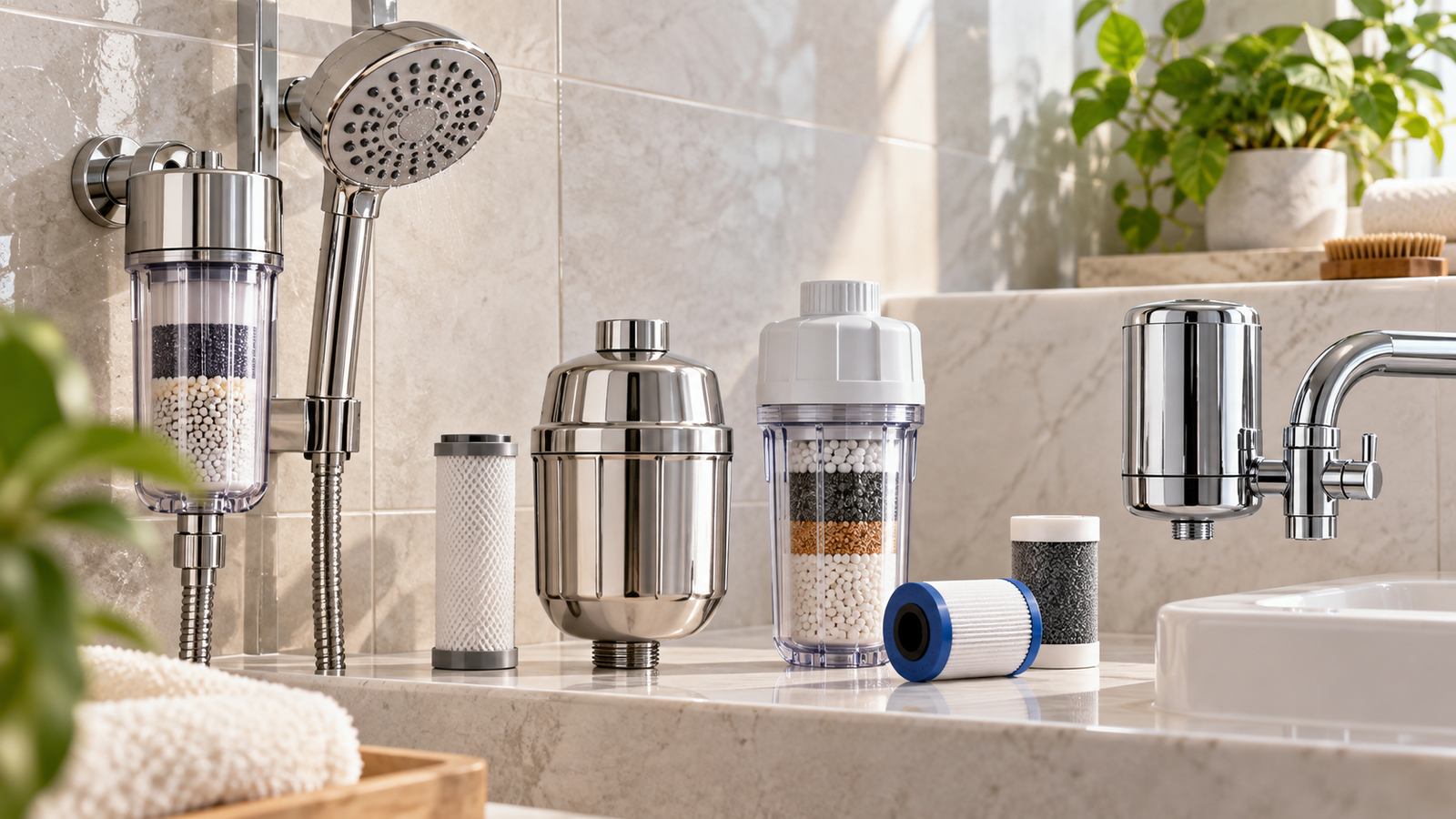
A shower filter is a compact water-treatment device fitted between the shower pipe and shower head, or integrated directly into the shower head itself.
Water passes through filter media before reaching the user.
Depending on the model, the cartridge may contain:
- Activated carbon
- KDF media
- Calcium sulfite
- Sediment filtration layers
- Ceramic media
- Mineral balls or composite filter media
Different materials target different substances, so the words “shower filter” alone do not tell you what a product can remove.
What Can a Shower Filter Remove?
The answer depends on the filter technology.
| Water Issue | Can a Shower Filter Help? | Important Limitation |
|---|---|---|
| Free chlorine | Often yes, with appropriate media | Performance varies with flow rate and cartridge condition |
| Sediment | Often yes | Depends on pore size and filter design |
| Some metals | Potentially, depending on media | Not every filter removes the same metals |
| Hard-water minerals | Usually very limited | Most shower filters do not truly soften water |
| Dissolved salts | Generally no | Requires more advanced treatment |
| Microorganisms | Not reliably with standard filters | Do not treat a basic shower filter as water disinfection |
Do Shower Filters Remove Chlorine?
Chlorine reduction is one of the more realistic reasons to use a shower filter.
Municipal water systems commonly use disinfectants to control microorganisms in supplied water.
Some filter media are designed to react with or adsorb free chlorine before the water reaches the shower head.
However, actual performance depends on:
- Filter material
- Water temperature
- Water flow rate
- Contact time
- Cartridge age
- Chlorine concentration
Why Hot Shower Water Makes Filtration More Difficult
Shower water moves through the filter quickly and is usually warm or hot.
This gives the filter only a short contact time to interact with contaminants.
Some filter media also perform differently at higher temperatures.
This is why a filter that works well in a slow-flow drinking-water system may not automatically perform equally well in a shower.
Activated Carbon in Shower Filters
Activated carbon is widely used in water filtration because its highly porous structure can adsorb certain chemicals.
It is commonly associated with reduction of:
- Chlorine
- Some organic compounds
- Unpleasant odours
However, carbon performance can be limited by the high flow rate and hot water found in showers.
A filter that combines carbon with other media may be designed to address these conditions more effectively.
What Is KDF Filter Media?
KDF refers to a copper-zinc filtration medium commonly used in certain water-treatment cartridges.
It works through an oxidation-reduction process and may be used to help reduce substances such as:
- Free chlorine
- Certain heavy metals
- Some undesirable water contaminants
KDF media is often combined with other filtration materials rather than used alone.
What Does Calcium Sulfite Do?
Calcium sulfite is another material commonly used in shower filters for chlorine reduction.
It can be useful in hot-water applications because it can react quickly with chlorine.
This is one reason some shower filters combine calcium sulfite with carbon or other media.
Do Shower Filters Remove Hard Water?
Most standard shower filters do not truly remove water hardness.
Hard water mainly results from dissolved minerals such as calcium and magnesium.
Removing these minerals usually requires a true water-softening process, such as ion exchange.
A conventional shower filter may reduce chlorine or sediment while leaving most hardness minerals largely unchanged.
Shower Filter vs Water Softener
| Feature | Shower Filter | Water Softener |
|---|---|---|
| Main purpose | Target selected contaminants | Reduce calcium and magnesium hardness |
| Installed at shower | Usually yes | Usually whole-home or supply-line system |
| Reduces chlorine | Can, depending on media | Not necessarily its primary function |
| Softens hard water | Usually no | Yes, when properly sized and maintained |
| Complexity | Low | Higher |
How Can You Tell If You Have Hard Water?
Possible signs include:
- White mineral scale around taps
- Deposits on shower glass
- Soap that does not lather easily
- Scale inside kettles or heaters
- Mineral residue after water dries
The best way to know the actual hardness level is to test the water rather than relying only on how hair or skin feels.
Can Shower Filters Prevent Limescale?
Most basic shower filters will not eliminate limescale because they do not remove enough calcium and magnesium from the water.
If mineral scale is your main problem, a shower filter may not solve it.
A water softener or another treatment specifically designed for hardness is more appropriate.
Do Shower Filters Help Hair?
A shower filter may change how the water interacts with hair if it reduces substances such as chlorine or sediment.
Some users report that filtered shower water feels less harsh.
However, hair dryness, frizz and breakage can also be affected by:
- Hair type
- Shampoo choice
- Heat styling
- Chemical treatments
- Humidity
- Hardness minerals
A shower filter should not be treated as a guaranteed solution for hair loss, hair growth or damaged hair.
Can a Shower Filter Stop Hair Fall?
No shower filter should be expected to treat hair loss.
Hair shedding can have many causes, including genetics, nutritional factors, hormones, stress, illness and scalp conditions.
Changing shower water may improve comfort in some situations, but persistent or significant hair loss deserves appropriate medical evaluation.
Do Shower Filters Help Dry Skin?
Reducing chlorine or certain irritants may make shower water feel more comfortable for some people.
But dry skin can also result from:
- Very hot showers
- Long shower duration
- Harsh cleansers
- Dry climate
- Low indoor humidity
- Skin conditions
A shower filter is therefore only one possible part of the picture.
Can Shower Filters Treat Eczema?
No.
A shower filter is not a medical treatment for eczema or other inflammatory skin conditions.
If water quality appears to aggravate symptoms, discuss the issue with a qualified dermatologist rather than relying on a filtration product alone.
Do Shower Filters Remove Iron?
Some filter media may reduce certain forms or amounts of iron, but performance varies considerably.
If your water contains substantial iron, you may notice:
- Orange or brown staining
- Metallic taste in tap water
- Discolouration around plumbing fixtures
A dedicated iron-removal system may be required when the concentration is high.
Do Shower Filters Remove Heavy Metals?
Certain media, including some KDF-based systems, may reduce specific metals under appropriate conditions.
However, you should not assume that a generic “15-stage” or “20-stage” filter removes every heavy metal.
Look for:
- Clear performance claims
- Independent testing where available
- Specific contaminants named by the manufacturer
- Test conditions relevant to shower flow
Do Shower Filters Remove Fluoride?
Most conventional shower filters are not designed to significantly remove dissolved fluoride.
Fluoride removal generally requires specialised filtration media or other water-treatment processes.
Do Shower Filters Remove TDS?
Usually not to a meaningful extent.
TDS, or total dissolved solids, includes dissolved minerals and salts.
A standard shower filter is not equivalent to reverse osmosis and does not normally remove most dissolved solids.
Why TDS Can Stay the Same After Installing a Shower Filter
This does not necessarily mean the filter is doing nothing.
A shower filter may reduce chlorine while leaving calcium, magnesium and many dissolved salts in the water.
A basic TDS meter measures conductivity related to dissolved ions; it does not directly tell you how much chlorine has been removed.
Do Shower Filters Remove Bacteria?
A standard shower filter should not be assumed to disinfect contaminated water.
If there is a concern about unsafe microbial contamination, proper water treatment and testing are necessary.
Do not rely on a typical consumer shower cartridge to make microbiologically unsafe water safe.
What Do “15-Stage” and “20-Stage” Shower Filters Mean?
Multi-stage labels usually refer to the number of different media layers or components inside the cartridge.
A larger number does not automatically mean better filtration.
For example, a filter advertised as 20-stage may divide several similar media into many thin layers.
The more useful questions are:
- Which contaminants are targeted?
- How much media is actually present?
- What is the tested flow rate?
- How long does the cartridge last?
- Is performance independently verified?
More Filter Stages vs Better Filter Media
Quality is more important than the stage count printed on the package.
A well-designed filter with fewer appropriate media layers can be more useful than a product with a long list of poorly explained stages.
Avoid choosing solely by numbers such as:
- 15-stage
- 20-stage
- 25-stage
unless the manufacturer clearly explains what those stages actually do.
How Long Does a Shower Filter Last?
Cartridge life varies by product and water conditions.
It may be expressed as:
- Number of months
- Litres filtered
- Estimated number of showers
Actual life can be shorter when the incoming water contains more sediment or contaminants.
Signs a Shower Filter May Need Replacement
Possible signs include:
- Reduced water flow
- Return of noticeable chlorine odour
- Visible sediment buildup
- Manufacturer replacement interval reached
- Changes in filter colour where the cartridge allows inspection
Do not wait indefinitely just because water still passes through the cartridge.
Can an Old Shower Filter Make Water Worse?
A clogged or exhausted cartridge can reduce flow and stop performing effectively.
Filters should therefore be replaced according to the manufacturer’s schedule and actual water conditions.
Good maintenance matters as much as initial filter selection.
Does a Shower Filter Reduce Water Pressure?
It can.
Any filter placed in the water path creates some resistance.
A clean, properly sized filter may have little noticeable effect, while a clogged cartridge can reduce pressure more significantly.
If your home already has very low shower pressure, check the filter’s rated flow before buying.
Shower Filter vs Filtered Shower Head
There are two common designs.
Inline shower filter
An inline filter is installed between the water pipe and your existing shower head.
Advantages include:
- You can keep your existing shower head.
- Cartridges may be larger.
- Replacement can be straightforward.
Filtered shower head
This combines filtration and the shower head into one product.
It may be more compact but limits your choice of shower-head design.
Can You Use a Shower Filter With a Hand Shower?
Often yes, depending on plumbing layout.
An inline filter can usually be installed before the hose or shower-head connection if the threads are compatible.
Check:
- Thread size
- Available installation space
- Water pressure
- Whether adapters are required
Are Shower Filters Easy to Install?
Many are designed for basic tool-free or simple threaded installation.
A typical process may involve:
- Turn off the shower.
- Unscrew the existing shower head.
- Clean the exposed threads.
- Apply thread-sealing tape if instructed.
- Attach the filter housing.
- Attach the shower head to the filter.
- Run water and check for leaks.
Follow the exact product instructions because fittings vary.
Do You Need a Plumber?
Usually not for a standard threaded shower filter.
A plumber may be useful if:
- The fittings are corroded
- Threads are damaged
- The plumbing uses unusual connectors
- There are persistent leaks
Why Is My Shower Filter Leaking?
Common causes include:
- Loose connections
- Missing washers
- Incorrect thread-sealing tape
- Cross-threaded fittings
- Cracked plastic housing
Do not overtighten plastic parts because this can damage them.
Should You Flush a New Shower Filter?
Many manufacturers recommend running water through a new cartridge before normal use.
This may remove fine particles left from manufacturing or filter media.
Follow the specified flushing time rather than assuming every cartridge is ready immediately.
How Do You Know What Is in Your Water?
Before buying a shower filter, identify the actual problem if possible.
Useful sources include:
- Municipal water-quality reports
- Laboratory water testing
- Local water-supply information
- Home hardness testing
This prevents spending money on a filter that does not target your main issue.
Shower Filter for Borewell Water
Borewell or groundwater can have very different chemistry from municipal water.
Possible issues include:
- High hardness
- Iron
- Sediment
- Dissolved salts
- Other local contaminants
A small shower filter may help with sediment or selected contaminants, but it is unlikely to solve severe hardness or high TDS.
Water testing is particularly useful before choosing treatment for borewell water.
Shower Filter for Municipal Water
For treated municipal water, chlorine reduction may be a more relevant goal.
If the water is already microbiologically treated and hardness is moderate, an appropriate chlorine-focused shower filter may provide the type of change you are looking for.
Again, actual water chemistry matters more than generic marketing claims.
Can You Test Whether a Shower Filter Is Working?
Yes, but use a test appropriate to the contaminant.
For example:
- Chlorine test strips can assess chlorine changes.
- Hardness test kits can measure hardness.
- Laboratory tests can evaluate specific metals or contaminants.
A TDS meter alone cannot confirm whether a chlorine filter is working.
Common Shower Filter Mistakes
Expecting it to soften hard water
Most shower filters do not remove enough calcium and magnesium to function as true water softeners.
Choosing based on stage count
More stages do not automatically mean better filtration.
Ignoring cartridge replacement
An exhausted filter cannot continue performing indefinitely.
Assuming lower TDS equals better shower water
TDS is only one measure and does not directly reflect chlorine reduction.
Believing hair-growth claims
A shower filter is not a treatment for hair loss.
Buying without knowing the water problem
The right filtration system depends on what is actually present in your water.
How to Choose a Shower Filter
Start with your main concern.
If chlorine is the main problem
Look for a filter using media specifically designed for chlorine reduction, with credible performance information.
If sediment is visible
Look for a filter containing an appropriate sediment stage.
If hard water is the main problem
A shower filter may not be enough. Consider whether a proper water-softening system is required.
If iron or metals are the concern
Look for independently supported claims for those specific contaminants rather than generic “purification” language.
What Specifications Should You Compare?
When comparing shower filters, look at:
- Filter media
- Target contaminants
- Cartridge lifespan
- Replacement cartridge availability
- Rated flow rate
- Thread compatibility
- Housing material
- Independent testing where available
For specific options, see our Top 5 Shower Filters in India.
Frequently Asked Questions
Do shower filters actually work?
They can work for specific contaminants when the filter media is appropriate. They should not be expected to remove every dissolved substance from water.
Do shower filters soften hard water?
Most do not. True softening generally requires removal or exchange of calcium and magnesium ions.
Can a shower filter reduce chlorine?
Yes, certain shower-filter media are specifically designed to reduce free chlorine, although actual performance varies by design and water conditions.
Will a shower filter reduce TDS?
Usually not significantly. Most dissolved minerals and salts remain in the water.
Can shower filters stop hair fall?
No. They are not hair-loss treatments. Hair shedding has many potential causes that a shower filter cannot address.
How often should I replace a shower-filter cartridge?
Follow the manufacturer’s stated lifespan and replace it sooner if flow drops significantly or water conditions exhaust the cartridge more quickly.
Is a 20-stage shower filter better than a 15-stage filter?
Not necessarily. Filter media, amount of media, testing and contact time matter more than the number of stages printed on the package.
Final Takeaway
Shower filters can be useful, but only when their technology matches the actual water problem.
They are most realistic for reducing substances such as chlorine and sediment, depending on the filter media. They generally do not function as true hard-water softeners and should not be expected to dramatically reduce TDS or eliminate every contaminant.
If hard water is your main concern, identify the hardness level first. If chlorine is the problem, compare filters specifically designed and tested for chlorine reduction.
If you are comparing specific products, see our Top 5 Shower Filters in India guide for the current options shortlisted by Physical Glow.
The most useful shower filter is not the one with the largest number of advertised stages. It is the one whose filter media, flow rate, cartridge life and contaminant claims match the water coming into your home.
Physical Glow publishes educational beauty, fitness and wellness content. This article is for general informational purposes. A consumer shower filter should not be relied upon to make microbiologically unsafe or otherwise contaminated water safe for use.