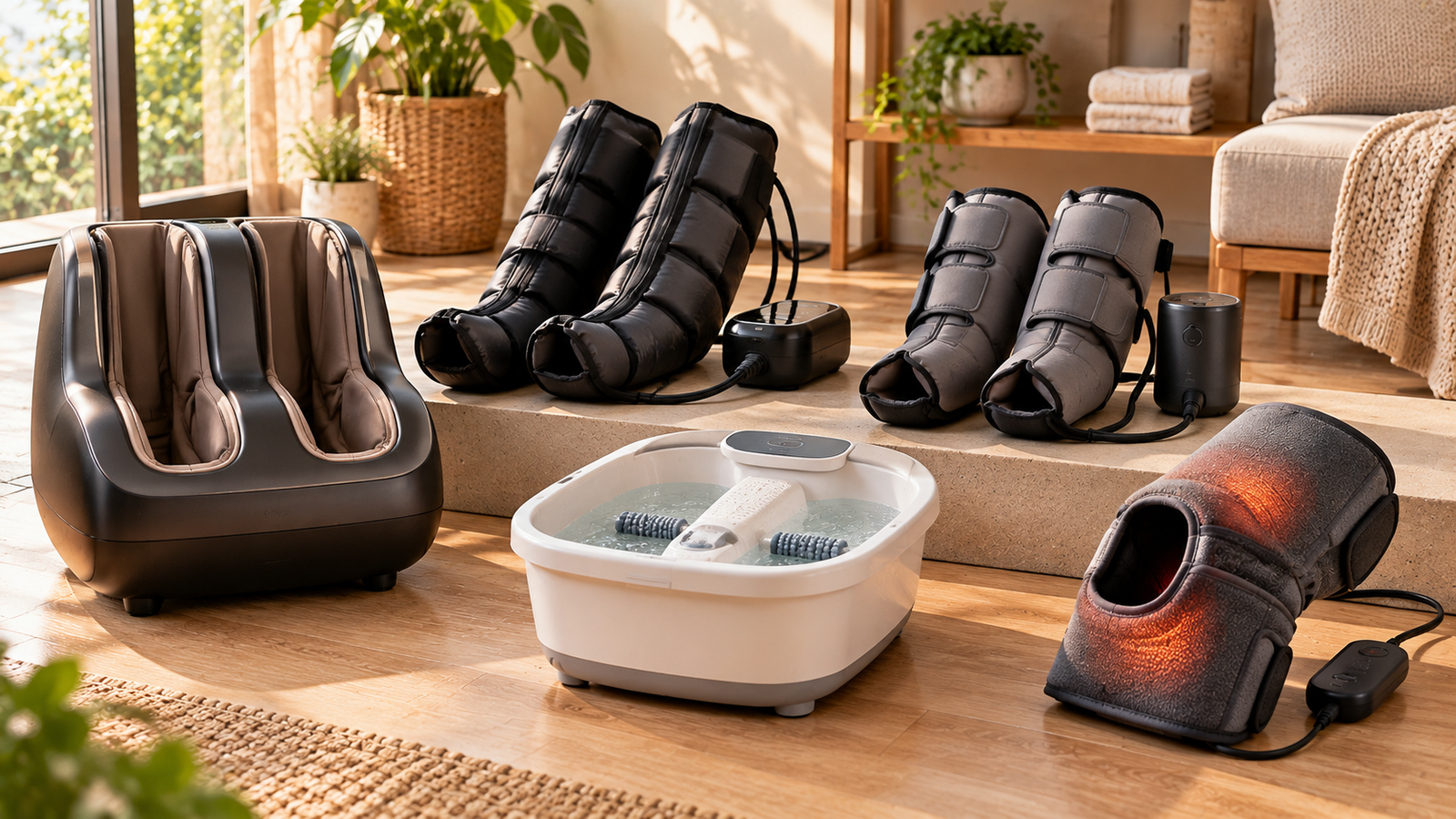
Leg Compression Sleeves at Home: Fit, Comfort and Safety Questions
Leg compression sleeves and inflatable recovery boots are becoming increasingly visible in home wellness and fitness routines. These devices typically wrap around the calves or legs and inflate and deflate using a small air pump.
Some are marketed for post-workout recovery, relaxation and temporary muscle comfort. Others are medical devices prescribed to support circulation, manage certain swelling conditions or reduce the risk of blood clots in selected patients.
Although these products may look similar, their intended purposes and safety requirements can be very different.
This raises several important questions.
How tight should inflatable leg sleeves feel? Is higher compression pressure better? Can you use them every day? And are they suitable for someone with varicose veins, diabetes, leg swelling or a history of blood clots?
Leg compression devices are not appropriate for everyone, and their safe use depends on correct sizing, appropriate settings, medical history and the manufacturer’s instructions.
A device that feels relaxing to one person may be unsuitable for someone with certain vascular, cardiac or neurological conditions.
This guide explains how inflatable compression sleeves work, how to assess their fit, what comfort signals to monitor and when medical advice is necessary before home use.
1. What Are Inflatable Leg Compression Sleeves?
Inflatable leg compression sleeves are wearable devices containing air chambers that expand and deflate under controlled pressure.
Most systems consist of three main components:
- Inflatable sleeve or boot.
- Air pump or control unit.
- Tubing or an integrated air-delivery mechanism.
When activated, the pump sends air into the chambers.
The chambers apply pressure to selected parts of the leg and then release that pressure.
This repeating process is called intermittent pneumatic compression, or IPC.
Some products are also described as sequential compression devices.
What does intermittent mean?
Intermittent compression means the pressure is applied periodically rather than remaining constant.
For example, a device may inflate for part of a cycle and then deflate.
The exact duration, pressure and sequence vary by manufacturer and model.
What does sequential compression mean?
Some devices inflate several chambers in a particular order.
This may produce a wave-like sensation along the leg.
However, not every air-compression device uses the same pattern.
A simple calf massager and a full-length sequential compression system may have significantly different designs.
2. How Do Leg Compression Devices Work?
Inflatable sleeves apply external pressure to the tissues beneath them.
In a properly selected medical IPC system, periodic compression can support venous blood movement through the legs.
The pressure is released between cycles.
Cleveland Clinic explains that medical IPC devices are used in certain clinical situations to help reduce blood pooling in the legs.
Medical applications
Clinicians may prescribe appropriate IPC devices for selected patients who need help reducing the risk of venous blood clots.
They may also be used in certain specialist treatments for conditions involving swelling.
Recreational recovery applications
Consumer recovery boots are marketed to athletes and fitness enthusiasts.
They may produce a massage-like squeezing sensation and help some users feel more comfortable after exercise.
However, a recreational compression boot should not automatically be considered equivalent to a clinically prescribed IPC system.
Medical treatment requires an appropriate device, clinical assessment and an individualized plan.
3. Medical Compression vs Wellness Recovery Boots
This distinction is essential.
| Feature | Medical IPC device | Consumer recovery boots |
|---|---|---|
| Primary purpose | Specific clinical indication | Exercise recovery or comfort |
| Selection | Based on medical assessment | Usually purchased by consumers |
| Pressure settings | Prescribed or protocol-based | Manufacturer-programmed or user-selectable |
| Session duration | Based on medical indication | Based on product instructions |
| Fit | Often assessed clinically | Based on manufacturer sizing |
| Monitoring | May require clinical supervision | User follows safety guidance |
| Treatment claims | Supported for specified indications | Depend on product authorization and evidence |
| Suitable for everyone? | No | No |
Some consumer products may also have medical-device clearance for particular intended uses.
However, that does not make them appropriate for every medical condition.
A product’s regulatory status must be interpreted alongside its specific cleared or approved intended use.
Why this matters
A hospital may prescribe IPC for a patient who has undergone surgery.
That does not mean a healthy person should purchase an inexpensive leg massager and use it for the same purpose.
Similarly, someone with a suspected blood clot should not attempt to manage the condition using a home compression device.
4. Are Leg Compression Sleeves Effective for Workout Recovery?
Scientific research has examined intermittent pneumatic compression as a post-exercise recovery method.
A 2024 systematic review and meta-analysis in Biology of Sport included 17 studies involving 319 participants.
The analysis reported small or inconsistent benefits across several recovery outcomes.
Some improvements were observed in perceived soreness, but the evidence for improvements in muscle function and other recovery markers was less consistent.
A later systematic review published in 2025 also found that the evidence was not strong enough to support definitive recommendations for improved recovery after intense exercise.
What might users experience?
Some people report:
- Temporary relaxation.
- A massage-like sensation.
- Reduced perception of muscle discomfort.
- A feeling of lighter or more comfortable legs.
These experiences can be meaningful to the user.
However, subjective comfort should not be confused with guaranteed physiological recovery.
What has not been established universally?
Compression boots have not been proven to:
- Eliminate all post-workout soreness.
- Prevent every exercise injury.
- Replace adequate sleep.
- Reverse muscle damage immediately.
- Guarantee faster athletic performance recovery.
- Treat blood clots through recreational self-use.
A compression device may be an optional recovery accessory, not a necessary part of every fitness routine.
5. Why Sleeve Fit Matters
A compression device works by applying pressure to a particular body region.
The sleeve must therefore fit the intended area correctly.
If it is too small, pressure may be uncomfortable or concentrated.
If it is too large, the air chambers may not contact the intended regions properly.
A poorly fitting sleeve can also fold, bunch or shift during inflation.
Fit influences:
- Comfort.
- Pressure distribution.
- Chamber alignment.
- Stability during use.
- Ability to inflate as intended.
- Risk of skin irritation.
- Ease of removal.
Incorrect fit can make even a well-designed device unsuitable.
Does a tight sleeve work better?
No.
Tighter is not automatically better.
An improperly tight sleeve may cause discomfort or excessive pressure.
The goal is the manufacturer-specified fit, not the maximum possible tightness.
6. How to Measure Your Legs for Compression Boots
Different manufacturers use different sizing methods.
Some require leg length, while others also consider thigh or calf circumference.
For example, Therabody’s JetBoots sizing guidance uses leg-length and inseam measurements.
Hyperice’s Normatec leg-attachment guidance also uses inseam and height to determine the appropriate size.
Clinical IPC sleeves may require circumference measurements.
Measurements you may need
Inseam
Generally measured from near the crotch to the ankle, according to the manufacturer’s instructions.
Leg length
Some manufacturers measure from the groin area toward the floor.
Thigh circumference
Measured around the thigh at the specified location.
Calf circumference
Measured around the calf according to the relevant sizing chart.
Why height alone is not enough
Two people of the same height may have different leg lengths and circumferences.
A boot that fits one person comfortably may be too short, too long or too narrow for another.
Practical fitting process
- Find the official sizing chart for the exact device.
- Identify which measurements are required.
- Measure each leg accurately.
- Compare your measurements with the chart.
- Follow the manufacturer’s advice if you fall between sizes.
- Check fit before activating compression.
- Stop if the garment causes pain, unusual pressure or sensory changes.
Do not assume that the sizing chart for one brand applies to another.
7. How Tight Should Leg Compression Sleeves Feel?
A correctly fitted device should follow its manufacturer’s instructions and allow comfortable positioning before inflation.
Medical guidance from some NHS services describes a snug fit and provides model-specific fitting checks.
For example, certain clinical IPC sleeves are fitted so that two fingers can fit beneath the sleeve near the knee.
However, that rule applies to specific clinical sleeve systems.
It should not automatically be used for every recreational compression boot.
What should a comfortable fit feel like?
Before inflation:
- The sleeve should sit in the intended position.
- The fastening mechanism should close correctly.
- The material should not pinch the skin.
- The garment should not require excessive force to secure.
- Your toes should not become numb or discolored.
During operation, you may feel pressure that rises and falls.
But the sensation should not be sharply painful.
Warning signs of poor fit
Stop using the device if you notice:
- Persistent pinching.
- Significant pain.
- Numbness.
- Tingling.
- Changes in skin color.
- Unusual coldness.
- Excessive pressure around one area.
- New swelling.
- Skin irritation or blistering.
Do not try to compensate for a poor fit by increasing the pressure setting.
8. Calf Sleeves vs Full-Leg Compression Boots
Compression equipment is available in different lengths.
Calf compression sleeves
These generally cover part of the lower leg.
They may be marketed for localized comfort or selected clinical applications.
Full-leg compression boots
These can extend from the feet or ankles toward the upper thighs.
Many recreational systems use several chambers that inflate sequentially.
Foot and calf massagers
Some machines combine mechanical massage, air compression or other functions.
They are not necessarily equivalent to dedicated medical IPC devices.
Comparison
| Device format | Typical coverage | Main buying consideration |
|---|---|---|
| Calf sleeve | Lower leg | Calf fit and intended use |
| Full-leg boot | Foot to upper leg | Length, circumference and chamber placement |
| Foot-and-calf massager | Foot and lower leg | Fixed housing and fit |
| Medical IPC sleeve | Depends on clinical system | Prescribed size and clinical protocol |
| Compression stocking | Continuous garment pressure | Different mechanism and fitting requirements |
A longer sleeve does not automatically provide better results.
Coverage should match the intended use and the manufacturer’s design.
9. Understanding Compression Pressure Settings
Some leg compression devices let users adjust pressure.
The settings may be presented as:
- Low, medium and high.
- Numbered intensity levels.
- Pressure measured in mmHg.
- Preset recovery modes.
What is mmHg?
Millimeters of mercury, abbreviated as mmHg, is a unit of pressure.
It is also used in blood pressure measurement.
However, compression pressure and blood pressure are different measurements.
A compression boot displaying 80 mmHg is not displaying your arterial blood pressure.
Is higher compression better?
Not automatically.
Higher pressure can increase the force applied to the leg.
This may create additional discomfort and may be inappropriate for certain users.
The research evidence does not establish one pressure that is ideal for every recreational user.
What pressure should you select?
Follow the manufacturer’s instructions and any medical advice relevant to your circumstances.
Do not select a pressure merely because it was used in a research study or advertised by another brand.
A pressure appropriate for one device and purpose may not be appropriate for another.
10. How Long Should a Compression Session Last?
Session duration varies according to the product and intended use.
Consumer recovery devices often provide timer-controlled sessions.
Some research on post-exercise recovery has used sessions of approximately 20–30 minutes.
However, research protocols should not be treated as universal home-use instructions.
Clinical IPC may be prescribed for much longer periods under medical supervision.
These situations are fundamentally different.
Why session duration matters
A longer session is not automatically more beneficial.
Excessively prolonged or inappropriate use can increase discomfort, limit movement and contribute to skin problems.
Practical questions before starting
- What duration does the manufacturer recommend?
- Is the device intended for recreational use or prescribed treatment?
- Does the product have an automatic timer?
- Can you stop the session immediately?
- Have you been advised to limit use because of a health condition?
If the manual does not clearly explain safe session duration, contact the manufacturer.
Avoid improvising extended sessions.
11. Can You Use Compression Boots Every Day?
Daily use may be permitted for certain products and users.
However, that does not mean daily sessions are necessary or suitable for everyone.
Frequency should reflect:
- The device’s intended use.
- Manufacturer instructions.
- Individual comfort.
- Relevant medical conditions.
- Session pressure and duration.
- Any professional recommendations.
Recreational use
Healthy users may choose compression sessions as part of a relaxation routine when the device instructions permit them.
But there is insufficient evidence to claim that everyone benefits from daily compression.
Medical use
A clinician may prescribe IPC on a particular schedule.
For some hospitalized patients, medical devices are used for extended periods to reduce blood-clot risk.
This schedule should never be copied for recreational home use.
Important principle
More pressure and longer use are not automatically better.
Use only the amount and frequency appropriate to your circumstances.
12. Who Should Avoid Compression Devices or Seek Medical Advice First?
This is the most important safety consideration.
Intermittent pneumatic compression is not suitable for certain medical conditions.
NHS clinical guidance and manufacturer safety information identify several contraindications and precautions.
Conditions requiring particular caution
| Health condition | Main concern | Recommended action |
|---|---|---|
| Known or suspected DVT | Possible blood clot | Do not self-treat; obtain urgent medical assessment |
| Suspected pulmonary embolism | Potentially life-threatening clot | Emergency medical attention |
| Severe peripheral arterial disease | Impaired arterial circulation | Avoid use unless specifically cleared by a clinician |
| Decompensated heart failure | Potential fluid and cardiovascular complications | Do not use without specialist direction |
| Acute leg infection or cellulitis | Active inflammation or infection | Avoid affected area and obtain medical advice |
| Open wound or skin ulcer | Tissue damage or irritation | Seek professional guidance |
| Recent fracture | Possible mechanical injury | Avoid use without medical clearance |
| Severe peripheral neuropathy | Reduced ability to sense excessive pressure | Seek professional assessment |
| Recent surgery | Individual postoperative risks | Follow the treating surgeon’s instructions |
| Pregnancy | Individual circulatory and medical considerations | Consult the maternity care team |
| Bleeding disorder or blood-thinning medication | Potential bruising or bleeding concerns | Review suitability with a clinician |
| Unexplained leg swelling | Cause may require diagnosis | Obtain medical assessment before compression |
This table is not exhaustive.
Product-specific contraindications can differ.
Why medical history matters
A device may apply substantial pressure even when marketed as a relaxation accessory.
People with altered sensation may be unable to recognize excessive pressure.
People with certain cardiac or vascular conditions may face risks from changes in fluid movement.
A clinician can determine whether compression is appropriate.
13. Can You Use Leg Compression Boots if You Have Varicose Veins?
Varicose veins are enlarged, twisted veins that commonly occur in the legs.
Some medical compression treatments may be used for selected venous conditions.
However, that does not mean every consumer compression boot is appropriate for someone with varicose veins.
The type, severity and associated symptoms matter.
What should you consider?
Seek medical advice if you have:
- Painful varicose veins.
- Significant leg swelling.
- Skin discoloration.
- Previous blood clots.
- Open sores.
- A diagnosed venous circulation disorder.
Therabody lists varicose veins among conditions requiring precaution for its pneumatic compression products.
Do not assume that a recreational air-compression device is a substitute for prescribed compression stockings or specialist venous treatment.
14. Are Compression Sleeves Safe for People With Diabetes?
Diabetes does not automatically mean that every compression device is unsuitable.
However, it can be associated with complications that affect safe use.
These may include:
- Peripheral neuropathy.
- Reduced sensation in the feet.
- Peripheral arterial disease.
- Skin problems.
- Foot ulcers.
Why sensation matters
If you cannot reliably feel pressure or discomfort, a compression device could apply excessive force without producing a normal warning sensation.
Why circulation matters
Certain people with diabetes also have arterial circulation problems.
Compression suitability should be evaluated individually.
Practical recommendation
If you have diabetes, particularly with numbness, foot wounds, circulation problems or neuropathy, obtain medical advice before using inflatable compression sleeves.
Do not rely on a product’s general wellness labeling as evidence of suitability.
15. Can Compression Devices Be Used During Pregnancy?
Pregnancy can change circulation and increase the risk of certain blood-clotting complications.
In clinical settings, medical IPC may sometimes be prescribed during pregnancy or after delivery for particular indications.
However, medically prescribed compression during pregnancy is not equivalent to self-directed use of recreational recovery boots.
The appropriate approach depends on individual medical circumstances.
Before using a home device
Ask your obstetrician or maternity care team whether the specific product is suitable.
Provide information about:
- Device model.
- Intended use.
- Pressure settings.
- Session duration.
- Existing swelling.
- Relevant medical conditions.
Special caution
New or significant leg swelling during pregnancy should not automatically be treated as routine fluid retention.
One-sided painful swelling may indicate a condition requiring urgent evaluation.
Other pregnancy symptoms, such as severe headache, visual changes or sudden swelling, also deserve prompt medical assessment.
16. What if One Leg Is Swollen More Than the Other?
Unexplained swelling in one leg is a warning sign that should not be ignored.
Deep vein thrombosis is one possible cause.
Other causes exist, but a home compression device cannot determine which explanation is correct.
Possible DVT symptoms
The NHS identifies symptoms that can include:
- Pain in one leg, often in the calf or thigh.
- Swelling in one leg.
- Changes in skin color.
- Enlarged or tender superficial veins.
Symptoms may look different on different skin tones.
What should you do?
Seek urgent medical assessment if you suspect DVT.
Do not use a compression massager to try to reduce unexplained painful swelling.
Do not delay medical care while experimenting with pressure settings.
Emergency warning signs
If leg symptoms are accompanied by sudden breathlessness, chest pain, fainting or coughing blood, seek emergency help immediately.
In India, the national emergency response number is 112.
A pulmonary embolism can be life-threatening.
17. Can Compression Sleeves Cause Pain or Numbness?
Yes.
Cleveland Clinic identifies discomfort, skin irritation, pressure injuries and, rarely, nerve injury among potential complications of intermittent pneumatic compression.
Mild squeezing vs warning symptoms
A normal compression cycle can feel like a firm rhythmic squeeze.
However, it should not produce significant pain.
Stop using the device if you experience:
- Sharp pain.
- Persistent numbness.
- Tingling.
- Burning.
- Excessive pressure.
- Cold feet.
- Skin color changes.
- New swelling.
- Blistering.
- Unusual discomfort that continues after removal.
What should you do afterward?
Remove the device using the approved release method.
Inspect the affected area.
Do not immediately restart at a lower setting if the symptoms are significant, unexplained or persistent.
Seek medical advice when appropriate.
18. Can You Sleep While Wearing Compression Boots?
Do not assume recreational compression boots are suitable for sleeping.
Some products are designed for supervised or awake sessions with a defined timer.
Sleeping while wearing them may reduce your ability to notice pain, excessive pressure or equipment problems.
Certain manufacturers specifically advise against wearing particular compression garments overnight.
Medical exception
Some hospitalized patients are prescribed IPC for prolonged periods, including while resting or sleeping.
That is part of a clinical treatment protocol.
It does not establish that consumer recovery boots should be worn overnight.
Best practice
Follow the exact device’s instructions.
Unless your healthcare provider and manufacturer specifically direct otherwise, avoid sleeping during an active recreational compression session.
19. Can You Walk Around While Wearing Compression Sleeves?
Usually, inflatable compression boots are intended for use while seated or lying down.
Walking while wearing them may cause:
- Tripping.
- Falls.
- Damage to air hoses.
- Displacement of sleeves.
- Equipment malfunction.
Cleveland Clinic advises removing medical IPC devices before walking.
Hyperice and other manufacturers also warn against walking while wearing certain compression attachments.
Safer positioning
Choose a stable chair, sofa or bed.
Position yourself according to the manufacturer’s instructions.
Keep tubing away from walkways.
Make sure the controls remain accessible.
Remove the device before getting up.
20. What Is the Difference Between Compression Boots and Compression Stockings?
Although both apply pressure, they operate differently.
Compression stockings
These are garments designed to apply relatively continuous pressure.
Some medical stockings provide graduated compression.
Their use depends on the type, fit and medical indication.
Pneumatic compression boots
These use air chambers to apply intermittent pressure.
The pressure rises and falls during repeated cycles.
Comparison
| Feature | Compression stockings | Pneumatic compression boots |
|---|---|---|
| Pressure type | Generally continuous | Intermittent |
| Power source | None | Usually a pump |
| Portability | Often worn during daily activity | Usually used while resting |
| Fit | Garment measurement | Sleeve measurement |
| Clinical indications | Condition-specific | Condition-specific |
| Recreational use | Some products marketed for sports | Some products marketed for recovery |
| Interchangeable? | No | No |
Do not replace a prescribed compression garment with a recreational air-compression device without consulting your clinician.
21. Compression Boots vs Foot Spa vs Foot Massager
Home wellness products are frequently grouped together under recovery and relaxation.
However, their mechanisms differ.
Inflatable compression boots
Use air pressure around the legs.
The primary sensation is intermittent squeezing.
Electric foot spa
Usually combines a water basin with optional heat, vibration or mechanical movement.
It is mainly marketed for foot soaking and comfort.
Shiatsu-style foot massager
Uses mechanical rollers, kneading mechanisms or other massage features.
Some also include air compression.
Heating wrap
Applies warmth to a selected area.
It does not provide the same mechanism as pneumatic compression.
Practical comparison
| Device | Main mechanism | Main safety concern |
|---|---|---|
| Compression sleeve | Inflating air chambers | Vascular conditions, fit and pressure |
| Foot spa | Water and optional heat | Water temperature and electrical safety |
| Foot massager | Mechanical massage | Excessive pressure and sensitive tissues |
| Heating wrap | Thermal energy | Burns and impaired heat sensation |
| Compression recovery boot | Sequential air pressure | Contraindications, settings and duration |
These products should not be treated as equivalent medical treatments.
Choose according to their intended use, not simply because they appear in the same recovery category.
22. How to Check Compression Boots Before Every Use
A brief inspection can help prevent avoidable equipment problems.
Check the sleeve
Look for:
- Tears.
- Punctures.
- Damaged stitching.
- Broken zippers.
- Loose fasteners.
- Exposed or damaged air chambers.
Check the tubing
Inspect the hoses for:
- Cracks.
- Kinks.
- Loose connectors.
- Punctures.
- Unusual wear.
Check the pump
Confirm that:
- The controls work.
- The power supply is undamaged.
- The device shows no error messages.
- The pump operates normally.
- The emergency release or stopping method is understood.
Check your legs
Before applying the sleeves, look for:
- New unexplained swelling.
- Open wounds.
- Skin irritation.
- Unusual redness.
- Painful areas.
- Changes in sensation.
If you discover a health warning sign, do not proceed with a recreational session until the concern has been appropriately evaluated.
23. A Safer First-Use Checklist
For a generally healthy adult using a recreational product, the following checklist can help organize safe operation.
It does not replace medical screening or the manufacturer’s instructions.
Before the session
- Read the device’s full safety information.
- Review contraindications.
- Confirm that the device is suitable for your intended use.
- Select the correct sleeve size.
- Inspect the sleeves and pump.
- Check your skin and legs for concerning changes.
- Position yourself comfortably.
- Make sure the controls and stop function are accessible.
During the session
- Use only the manufacturer’s recommended settings.
- Do not exceed the specified duration.
- Remain awake and aware of your symptoms.
- Avoid walking while wearing the sleeves.
- Stop immediately if significant discomfort develops.
- Do not allow children or pets to interfere with tubing or equipment.
After the session
- Stop and deflate the sleeves according to the instructions.
- Remove the garments carefully.
- Check your skin for irritation or unusual marks.
- Allow the equipment to cool or dry as directed.
- Clean and store the sleeves correctly.
Do not interpret the absence of immediate discomfort as proof that a compression device is medically safe for every health condition.
24. How to Clean and Store Inflatable Compression Sleeves
Compression equipment contains fabric, air chambers, connectors and electrical components.
These parts may require different cleaning methods.
Cleaning the sleeves
Follow the manufacturer’s instructions.
Many systems permit wiping external surfaces with an approved cloth or cleaning solution.
Do not automatically machine-wash inflatable garments.
Water entering internal air chambers or electrical connections can damage the device.
Cleaning the pump
Turn off and disconnect the unit as directed before cleaning.
Avoid allowing liquid to enter the pump housing.
Do not immerse the controller.
Drying
Allow cleaned components to dry according to the manufacturer’s directions.
Do not use unapproved heaters, hair dryers or direct high heat to accelerate drying.
Storage
Keep the sleeves in an appropriate storage position.
Avoid:
- Sharp objects.
- Heavy items placed on folded tubing.
- Excessive heat.
- Unnecessary compression of air chambers.
- Moisture exposure.
- Rough handling of electrical connectors.
What if a sleeve develops an air leak?
Stop using it.
Do not attempt to repair an inflatable chamber with household tape or glue unless the manufacturer provides an approved repair method.
Contact authorized support.
25. What Specifications Matter Before Buying?
A compression device should not be selected solely by its maximum pressure or number of chambers.
Consider the following.
| Specification | What to verify |
|---|---|
| Intended use | Wellness recovery or specified medical indication |
| Size range | Suitable leg length and circumference |
| Coverage | Calf, foot, full leg or another area |
| Pressure control | Clear, adjustable settings |
| Inflation pattern | Simultaneous or sequential |
| Timer | Automatic session control |
| Stop function | Accessible and understandable |
| Pump design | Wired, rechargeable or integrated |
| Battery | Runtime and charging safety |
| Sleeve material | Comfort and allergy considerations |
| Cleaning | Manufacturer-approved procedure |
| Warranty | Pump and sleeve coverage |
| Replacement parts | Hoses, connectors and sleeves |
| Instructions | Clear safety and contraindication information |
A useful buying rule
A device with fewer pressure settings but reliable fit, safety controls and clear documentation may be more practical than one with numerous features and limited safety information.
26. Common Compression Device Mistakes
Mistake 1: Assuming everyone can use compression boots
Certain medical conditions make compression unsuitable or require professional assessment.
Mistake 2: Using the highest pressure immediately
More pressure is not automatically more effective.
Mistake 3: Ignoring sleeve sizing
Incorrect sizing can affect comfort and pressure distribution.
Mistake 4: Using compression for unexplained leg swelling
One-sided swelling may require urgent medical assessment.
Mistake 5: Using a device over wounds or infected skin
Follow contraindications and seek medical guidance.
Mistake 6: Wearing the sleeves while walking
This can increase fall risk and damage equipment.
Mistake 7: Falling asleep during a recreational session
You may fail to notice discomfort or equipment problems.
Mistake 8: Copying hospital treatment schedules
Clinical IPC protocols are not interchangeable with consumer recovery routines.
Mistake 9: Ignoring numbness
Numbness or tingling is a warning sign, not evidence of effective compression.
Mistake 10: Using damaged hoses or sleeves
Air leaks and mechanical problems can affect device performance.
Mistake 11: Assuming recovery claims are guaranteed
Scientific evidence for athletic recovery benefits remains limited and variable.
Mistake 12: Replacing prescribed treatment with wellness equipment
Do not substitute recreational compression boots for medical care without professional approval.
27. Frequently Asked Questions
Are leg compression sleeves safe for home use?
They can be appropriate for certain people when used according to the product’s instructions. However, they are unsuitable or require medical assessment in several health conditions, including suspected blood clots, serious vascular disease and certain cardiac conditions.
How tight should compression boots be?
They should fit according to the manufacturer’s sizing and application instructions. They should not cause significant pain, numbness or skin color changes.
Is higher compression pressure better?
No. Higher pressure is not automatically more beneficial and may increase discomfort or risk.
Can I use leg compression boots every day?
Some manufacturers permit regular use, but frequency should depend on the specific product, intended use and individual medical circumstances.
How long should I wear compression boots?
Follow the manufacturer’s instructions or your clinician’s prescribed schedule. Research session lengths should not be treated as universal recommendations.
Can compression boots prevent blood clots?
Specific medical IPC systems can reduce the risk of blood clots in selected clinical situations. This does not mean recreational compression boots should be used independently to prevent or treat DVT.
Can I use compression sleeves if I have varicose veins?
Consult a healthcare professional, especially if you have swelling, pain, skin changes or a history of clots. A consumer device may not be appropriate.
Are compression boots safe for diabetes?
They may be unsuitable for people with diabetic neuropathy, poor circulation or foot wounds. Obtain medical advice before use if these complications are present.
Can I use compression boots during pregnancy?
Do not begin recreational compression therapy during pregnancy without discussing the specific device with your maternity care team.
Can compression sleeves reduce swollen legs?
Some medically prescribed compression systems are used for selected swelling conditions. However, unexplained swelling requires evaluation before treatment.
Is it normal for compression boots to hurt?
No. A squeezing sensation may be expected, but significant pain is not. Stop using the device if it hurts.
Can compression boots cause nerve damage?
Nerve injury is an uncommon but recognized potential complication of pneumatic compression, particularly when pressure or fit is inappropriate.
Can I sleep while wearing compression boots?
Do not assume recreational compression boots are intended for overnight use. Follow the manufacturer’s instructions. Hospital-prescribed IPC schedules are different.
Can I walk while wearing compression sleeves?
Most inflatable systems are intended for stationary use. Walking while wearing them can cause tripping or equipment damage.
Are compression boots better than a foot massager?
They use different mechanisms. Neither is universally better, and neither should be considered a substitute for appropriate medical care.
Do compression boots help after exercise?
Some research suggests modest improvements in perceived soreness, but benefits are inconsistent and stronger performance-recovery claims are not well established.
Are compression stockings the same as compression boots?
No. Stockings generally apply continuous pressure, whereas pneumatic devices apply intermittent pressure through inflatable chambers.
What if one leg becomes painful or swollen after use?
Stop using the device and obtain prompt medical assessment, particularly if the swelling is new or one-sided. Seek emergency care for associated chest pain or breathlessness.
Can I use one pair of compression boots with another brand’s pump?
Only if the manufacturer explicitly confirms compatibility. Different systems may use different connectors, pressure-control mechanisms and safety features.
Should I buy the device with the highest number of air chambers?
Not necessarily. Chamber count alone does not establish safety, comfort or effectiveness. Fit, intended use and manufacturer documentation are more important.
28. Final Takeaway
Inflatable leg compression sleeves can provide a distinctive massage-like sensation and may be useful for selected recovery or medically prescribed applications.
However, their benefits and safety depend on the context.
Correct sizing, suitable pressure, appropriate session duration and medical screening matter more than choosing the strongest or most expensive compression system.
For recreational users, compression boots are optional wellness accessories rather than essential recovery equipment.
For medical use, compression should be based on appropriate clinical assessment and a device suited to the prescribed treatment.
Do not use consumer compression equipment to self-treat unexplained swelling, suspected blood clots or serious circulation problems.
Stop using a device immediately if you develop significant pain, numbness, skin color changes or other concerning symptoms.
A good compression device should have a clear intended purpose, reliable fit, understandable controls and transparent safety instructions.
The best purchase is not necessarily the device promising the strongest compression. It is the one that is appropriate for your health, correctly sized and safe for your intended use.
References and Further Reading
- Cleveland Clinic — Intermittent Pneumatic Compression Devices
- NHS — Deep Vein Thrombosis
- NHS — Intermittent Pneumatic Compression Patient Information
- East Kent NHS — Preventing a Blood Clot in Hospital
- Hyperice — Normatec Safety and Contraindications
- Therabody — Product Safety and Precautions
- Maia et al. (2024) — Effects of Lower-Limb Intermittent Pneumatic Compression on Sports Recovery: A Systematic Review and Meta-Analysis
- Therabody — JetBoots Prime Size Guide
- Hyperice — Normatec Leg Attachment Size Guide
Medical disclaimer: This article provides general health, wellness and equipment-safety education. It is not a substitute for medical assessment, diagnosis or prescribed treatment. Pneumatic compression has important contraindications, and a recreational recovery device should not be used to prevent or treat blood clots without appropriate medical direction. Always follow the instructions for the exact device and consult a qualified healthcare professional if you have relevant medical conditions or unexplained leg symptoms. Physical Glow may earn a commission from qualifying affiliate purchases at no additional cost to readers.