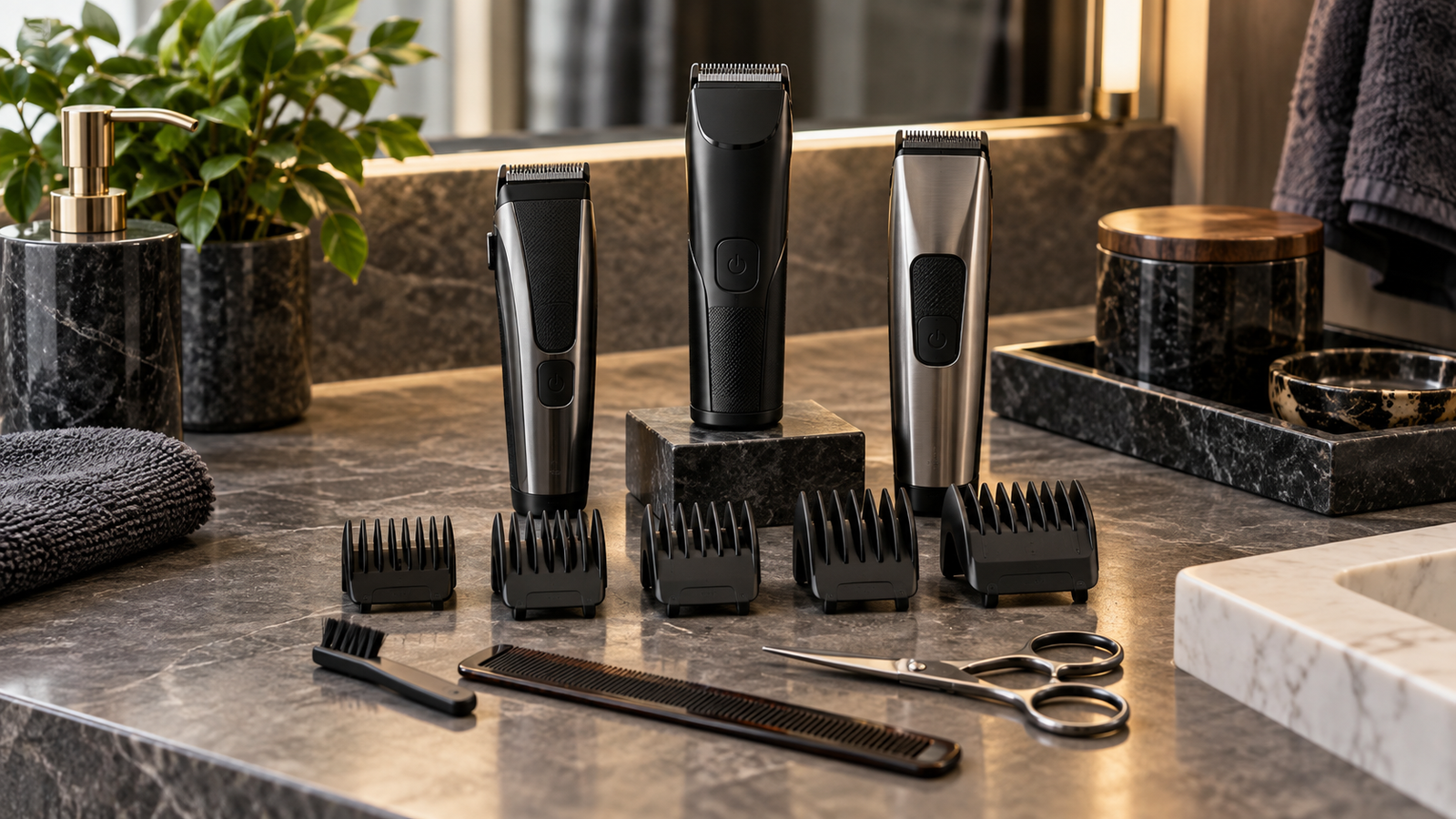
How to Choose a Beard Trimmer for Your Beard Length and Style
A beard trimmer should do more than simply shorten facial hair.
The right trimmer should make it easy to maintain the beard length and shape you actually want, whether that is:
- light stubble
- short boxed beard
- medium beard
- longer beard
- defined neckline
- moustache detailing
- clean beard edges
Different trimmers vary in cutting range, blade width, comb design, motor strength, battery life and attachments.
A trimmer that works well for maintaining 1–3 mm stubble may not be the best choice for someone keeping a 15–20 mm beard.
The most useful way to choose is to start with your usual beard length and grooming style, then look for the features that support it.
What Does a Beard Trimmer Do?
A beard trimmer uses powered blades and adjustable combs or guards to cut facial hair to a controlled length.
Depending on the design, it may be used for:
- trimming overall beard length
- maintaining stubble
- shaping the cheek line
- defining the neckline
- trimming a moustache
- blending different beard lengths
- cleaning sideburns
- detailing beard edges
Some models also include attachments for:
- nose and ear hair
- body grooming
- precision detailing
- hair clipping
More attachments are not automatically better.
The important question is whether you will actually use them.
Start With Your Beard Length
Before comparing brands or accessories, decide what beard length you normally maintain.
This determines the trimming range you need.
Very Short Stubble
If you maintain:
- approximately 0.5–2 mm
prioritise:
- fine length adjustments
- short minimum cutting length
- precision control
- good blade visibility
Small differences matter more at very short lengths.
A trimmer that only adjusts in large steps may make stubble maintenance difficult.
Short Beard
For approximately:
- 2–5 mm
look for:
- reliable short comb
- several close length settings
- even trimming
- comfortable blade system
This is one of the most common beard ranges and is supported by many general beard trimmers.
Medium Beard
For roughly:
- 5–10 mm
prioritise:
- stable comb attachments
- enough cutting power
- consistent performance through thicker hair
- multiple medium-length settings
A weak or flexible comb may produce uneven results on denser beards.
Longer Beard
For longer facial hair, such as:
- 10 mm and above
look carefully at:
- maximum supported length
- long comb stability
- motor performance
- comb tooth design
Many compact beard trimmers are primarily designed for shorter facial hair.
Do not assume every model can maintain a long beard effectively.
Length Range vs Number of Settings
Manufacturers often advertise a large number of length settings.
For example, a trimmer might offer:
- 10 settings
- 20 settings
- 40 settings
The number alone is not very meaningful.
Check:
- minimum length
- maximum length
- size of each adjustment step
A trimmer with 20 useful settings within your preferred range can be better than one with 40 settings you will never use.
Adjustment Precision
If you regularly maintain short stubble or create a fade between beard lengths, smaller adjustment increments are useful.
For example:
- 0.5 mm increments provide finer control than 2 mm increments
Fine adjustments are particularly useful around:
- sideburns
- cheeks
- moustache
- jawline
For longer beards, tiny increments may matter less.
Adjustable Dial vs Separate Combs
Trimmers generally control length in two main ways.
Adjustable Dial
A rotating wheel or slider changes the length setting.
Advantages:
- quick adjustment
- fewer loose attachments
- convenient for frequent length changes
Disadvantages:
- adjustment range may be limited
- mechanism quality matters
Separate Combs
Different guards provide different cutting lengths.
Advantages:
- simple
- often stable
- easy to understand
Disadvantages:
- more pieces to store
- easier to lose attachments
- changing length takes longer
Neither system is automatically better.
Choose the one that fits your grooming routine.
One Adjustable Comb vs Multiple Guards
A single adjustable comb is convenient if you mostly maintain one beard.
Multiple guards can be more useful if you:
- use very different lengths
- trim both beard and hair
- share the trimmer appropriately within a household
If you dislike managing accessories, a good dial-adjustable model may be more practical.
Blade Quality Matters
The blade is the most important cutting component.
Common blade materials include:
- stainless steel
- coated steel
- titanium-coated blades in some models
What matters most is:
- smooth cutting
- even performance
- durability
- easy maintenance
- reduced pulling
A premium blade material does not automatically mean better trimming if the trimmer is poorly designed.
Self-Sharpening Blades
Some trimmers advertise self-sharpening blades.
These systems are designed so the blades maintain their cutting edges through use.
This can reduce maintenance.
However, they still require:
- cleaning
- correct storage
- occasional lubrication if specified
Follow the manufacturer’s maintenance instructions.
Skin-Friendly Blade Design
If you have sensitive skin, look for:
- rounded blade tips
- smooth comb edges
- minimal pulling
- appropriate short-length guards
A trimmer should cut hair without repeatedly scraping the skin.
Do not press harder to compensate for poor cutting.
Motor Performance
Motor strength matters more if you have:
- dense beard growth
- coarse hair
- longer facial hair
A weak trimmer may:
- slow down
- pull hair
- require repeated passes
You generally do not need maximum power for short, fine stubble.
But consistent cutting performance is valuable for thicker beards.
Beard Density Matters
Two people with the same beard length may need different trimmers.
Fine or Sparse Beard
A standard trimmer is usually sufficient.
Thick or Coarse Beard
Prioritise:
- stronger motor
- rigid comb
- sharp blades
- consistent cutting through dense sections
Do not assume that a large beard automatically requires a professional hair clipper, but weaker compact trimmers may struggle.
Corded vs Cordless Beard Trimmers
Most modern beard trimmers are cordless.
Cordless Trimmer
Advantages:
- easier movement
- travel-friendly
- no cable near the face
- convenient bathroom use
Disadvantages:
- depends on battery
- requires charging
For most users, cordless is more practical.
Corded Trimmer
Advantages:
- continuous power
- no battery concern
Disadvantages:
- less convenient
- cable limits movement
Some models support both corded and cordless operation.
Check the manufacturer’s instructions because not every rechargeable trimmer can be used while plugged in.
Battery Life
Battery life matters if you:
- trim frequently
- travel often
- use the device for beard and body grooming
- dislike frequent charging
For normal beard maintenance, extremely long battery life is not essential.
One beard trim usually does not take very long.
More important features include:
- reliable battery
- clear charge indicator
- reasonable charging time
Charging Time
Two trimmers may offer similar runtime but very different charging times.
Check:
- full charging time
- usable runtime
- quick-charge support
A quick-charge feature can be useful if you forget to charge the trimmer before grooming.
Quick Charge
Some trimmers offer enough power for one trim after a few minutes of charging.
This can be useful for:
- travel
- last-minute grooming
- busy mornings
It is convenient, but not essential if you keep the trimmer charged regularly.
USB Charging
USB charging can make travel easier.
Possible connections include:
- USB-A
- USB-C
- proprietary cable
USB-C can be convenient if you already use the same type of charger for other devices.
However, charging connector should not be the main reason to choose a trimmer.
Cutting quality matters more.
Battery Indicator
A useful indicator may show:
- charging
- low battery
- full battery
More advanced trimmers may display exact battery percentage.
This is convenient but not necessary.
A basic low-battery light is sufficient for many users.
Wet vs Dry Beard Trimmers
Some trimmers are designed for dry use only.
Others are water-resistant or waterproof.
Dry-Use Trimmer
Best if you normally trim:
- before showering
- over a dry beard
- at a grooming station
Washable Trimmer
A washable trimmer can make cleaning easier.
You may be able to rinse:
- blade head
- attachments
- sometimes the entire device
Only rinse the parts specified by the manufacturer.
Waterproof Does Not Always Mean Shower-Safe
Terms such as:
- washable
- water-resistant
- waterproof
can mean different things.
Do not assume a washable trimmer can be used in the shower.
Check the manufacturer’s exact instructions.
Should You Trim a Beard Wet or Dry?
For most beard-length trimming, dry hair is easier to judge because wet hair can appear longer and lie differently.
A common approach is:
- wash the beard
- dry it thoroughly
- comb it into its natural direction
- trim
Some waterproof trimmers are suitable for wet grooming, but the final length may be harder to judge accurately.
Beard Trimmer for Stubble
For stubble, prioritise:
- low minimum length
- 0.5 mm or similarly fine adjustments
- narrow length increments
- smooth contact with skin
- good visibility
A large long-beard comb is unnecessary.
Beard Trimmer for a Short Boxed Beard
A short boxed beard typically needs:
- even bulk trimming
- defined cheek line
- clean neckline
- moustache control
A useful trimmer should have:
- multiple short-to-medium settings
- precision blade or removable comb
- good edge visibility
Beard Trimmer for a Medium Beard
Medium beards benefit from:
- strong combs
- broader length range
- good motor performance
- consistent trimming through denser areas
You may also want a precision attachment for:
- moustache
- cheek edges
- neckline
Beard Trimmer for a Long Beard
Longer beards require more careful grooming.
Look for:
- sufficient maximum guard length
- rigid long combs
- powerful motor
- consistent trimming
For very long beards, scissors may also be useful for maintaining shape.
A beard trimmer is not always the only tool required.
Precision Trimmer Attachment
A narrow precision attachment can help with:
- moustache edges
- cheek line
- neckline
- sideburns
- areas around the lips
This is useful if beard shape matters as much as overall length.
However, not everyone needs a separate precision head.
The main trimmer blade can often handle basic edging.
Detailer vs Full-Size Blade
Full-Size Blade
Best for:
- reducing overall beard length
- large areas
- fast trimming
Narrow Detailer
Best for:
- sharp lines
- moustache
- corners
- small areas
If you frequently maintain detailed beard styles, having both is useful.
Beard Trimmer vs Hair Clipper
These tools can overlap but are designed differently.
Beard Trimmer
Usually:
- smaller
- more precise
- designed for shorter lengths
- easier around facial contours
Hair Clipper
Usually:
- larger blade
- stronger motor
- designed for scalp hair
- supports longer guards
A hair clipper can trim a beard, but it may be less precise around facial details.
Beard Trimmer vs Electric Shaver
These are not the same.
Beard Trimmer
Leaves controlled hair length.
Electric Shaver
Designed to cut hair much closer to the skin.
If your goal is a clean-shaven appearance, a dedicated shaver may work better.
If you want visible stubble or beard length, use a trimmer.
Beard Trimmer vs Razor
A manual razor removes hair very close to the skin.
A trimmer is better for:
- stubble
- maintaining beard length
- reducing irritation from very close shaving in some users
You can use both:
- trimmer for beard
- razor for clean neckline or cheek edges
depending on your preferred style and skin tolerance.
How to Trim Your Beard Evenly
A simple method is:
- Wash and dry the beard.
- Comb hair in its natural direction.
- Start with a longer guard than you think you need.
- Trim gradually.
- Move against or across hair growth as appropriate for the device.
- Check both sides frequently.
- Reduce length only if needed.
- Finish with edge detailing.
Starting too short is one of the easiest grooming mistakes to avoid.
Start Longer Than Your Target
If you are unsure of the correct guard:
- begin with a longer setting
You can always shorten the beard afterward.
You cannot immediately restore hair once it has been cut too short.
This is especially important when using a new trimmer.
Beard Growth Direction
Facial hair does not always grow in one direction.
You may find that:
- cheeks grow downward
- neck hair grows sideways
- jaw hair changes direction
For an even result, you may need to trim from several directions.
Do not repeatedly press hard against the skin.
How to Trim the Neckline
A clean neckline can make a beard look more deliberate.
Avoid trimming the line too high.
A common approach is to place the neckline roughly above the Adam’s apple and follow the natural curve toward the ears.
Exact placement depends on:
- beard style
- face shape
- personal preference
Remove small amounts gradually.
How to Trim the Cheek Line
Some people maintain the natural cheek line.
Others prefer a sharper edge.
To define it:
- remove only stray hairs initially
- keep both sides balanced
- avoid lowering the line excessively unless that suits your style
A natural cheek line often requires less maintenance.
How to Trim a Moustache
For moustache maintenance:
- Comb the hair downward.
- Use a suitable guard for overall length.
- Remove the guard for careful edge work if appropriate.
- Trim stray hairs around the lip.
Use slow, controlled movements near the mouth.
How to Blend Sideburns Into Your Beard
If your hairstyle is shorter near the ears, beard blending can create a smoother transition.
Use gradually changing lengths.
For example:
- shorter near the top of the sideburn
- slightly longer moving into the beard
Small length increments make this easier.
Can a Beard Trimmer Create a Fade?
Yes, if it provides enough short length settings.
A basic beard fade requires:
- several guard lengths
- gradual transitions
- careful blending
You do not need dozens of settings, but smaller adjustment steps help.
Comb Quality Matters
Trimmer combs should be:
- rigid enough to guide hair evenly
- smooth against the skin
- secure on the trimmer
- easy to remove
A flexible comb can bend during trimming and cause uneven cutting.
This becomes more important at longer lengths.
Blade Width
A wider blade covers more area quickly.
A narrower blade offers more control.
Wide Blade
Useful for:
- large dense beard
- fast overall trimming
Narrow Blade
Useful for:
- precision
- moustache
- detailed edges
Most beard trimmers try to balance both.
Ergonomics
You may hold the trimmer at several angles around the face.
Look for:
- comfortable grip
- manageable weight
- non-slip surface
- controls that are easy to reach
A trimmer that is technically powerful but awkward to hold can make detailing harder.
Weight of the Trimmer
A very heavy trimmer can become tiring.
A very light one may feel less substantial but can be easier for detailed work.
For normal home grooming, comfort and balance matter more than absolute weight.
Noise and Vibration
All powered trimmers produce some noise and vibration.
Excessive vibration can make precise edging uncomfortable.
A smoother motor generally feels easier around:
- lips
- moustache
- cheek lines
However, noise level alone does not determine trimming performance.
Cleaning the Trimmer
Regular cleaning helps maintain:
- cutting performance
- hygiene
- blade movement
After use:
- switch the device off
- remove the comb
- brush out loose hair
- rinse washable parts if permitted
- allow parts to dry fully
- lubricate blades if required
Always follow the manufacturer’s instructions.
Do Trimmer Blades Need Oil?
Some blades require periodic lubrication.
Others are designed for reduced-maintenance use.
If oiling is recommended:
- use appropriate clipper or trimmer oil
- apply only the amount instructed
- remove excess
Do not use random household oils unless specifically approved.
How Often Should You Clean Your Beard Trimmer?
Clean loose hair after every use.
More thorough cleaning may be needed depending on:
- how frequently you trim
- whether you use the device wet
- beard density
- manufacturer guidance
Hair buildup can reduce cutting efficiency.
Replacement Blades
Before buying, check whether replacement parts are available.
This may include:
- blades
- combs
- charging cables
A good trimmer can become poor value if one lost comb makes it difficult to use.
Travel Lock
A travel lock prevents the trimmer from switching on accidentally inside luggage.
This is useful if you travel frequently.
It is not essential for home use.
Travel Pouch
A pouch can help store:
- trimmer
- combs
- charging cable
- cleaning brush
If the product includes many accessories, organised storage becomes more important.
Multi-Grooming Kits
Some beard trimmers are sold as complete grooming kits.
Attachments may include:
- beard trimmer
- hair clipper combs
- nose trimmer
- body groomer
- precision trimmer
This can be useful if you genuinely want one device for several grooming tasks.
However, a dedicated beard trimmer may be simpler and more convenient if facial hair is your only priority.
Do You Need 10 or 15 Attachments?
Usually not.
Count the attachments you will actually use.
For many users, the essentials are:
- main trimmer
- adjustable beard comb
- precision option
- charger
- cleaning brush
Extra attachments add value only if they replace another grooming device.
Beard Trimmer for Sensitive Skin
If your skin is prone to irritation:
- use a guard where possible
- avoid excessive pressure
- keep blades clean
- do not repeatedly pass over the same spot
- choose skin-friendly rounded blade edges
If close trimming consistently causes:
- rash
- painful bumps
- persistent redness
adjust your technique or leave slightly more hair length.
Persistent skin problems may need dermatological assessment.
Razor Bumps and Ingrown Hairs
Ingrown hairs are more common when hair is cut very close to the skin.
If you are prone to bumps, maintaining short stubble rather than a completely close shave may be more comfortable.
Helpful practices can include:
- avoiding excessive pressure
- trimming with clean blades
- not repeatedly cutting the same area
- gentle skincare
Do not aggressively dig out ingrown hairs.
Can You Share a Beard Trimmer?
Personal grooming devices are best kept individual where possible.
If a device is shared, detachable parts need appropriate cleaning according to the manufacturer’s instructions.
Avoid sharing if there is:
- broken skin
- active infection
- irritation
Personal-use trimmers are generally simpler from a hygiene perspective.
Beard Trimmer Maintenance
Good maintenance includes:
- clearing hair
- drying washable components
- storing guards together
- charging appropriately
- oiling where required
- protecting blades
This can improve both hygiene and useful life.
How Often Should You Replace a Beard Trimmer?
There is no fixed timetable.
Replacement may be needed if:
- blades pull hair despite cleaning
- battery capacity becomes poor
- motor becomes inconsistent
- combs break
- charging system fails
- replacement parts are unavailable
Often, replacing a worn blade can extend the life of the device.
Common Beard Trimmer Buying Mistakes
Choosing by Number of Attachments
More accessories do not guarantee better beard trimming.
Ignoring Minimum Length
This is especially important for stubble.
Ignoring Maximum Length
Long-beard users need sufficient guard range.
Focusing Only on Battery Life
Cutting quality matters more.
Assuming Waterproof Means Shower Use
Check the exact rating and instructions.
Choosing Too Many Length Settings
Only your usable range matters.
Ignoring Replacement Parts
Comb and blade availability can affect long-term value.
Buying a Weak Trimmer for a Dense Beard
Coarse hair may need more consistent cutting power.
How to Choose a Beard Trimmer Step by Step
Step 1: Define Your Beard Length
Decide whether you maintain:
- stubble
- short beard
- medium beard
- long beard
Step 2: Check the Cutting Range
Make sure the minimum and maximum lengths cover your needs.
Step 3: Check Adjustment Steps
Smaller steps are useful for stubble and fades.
Step 4: Consider Beard Density
Thicker hair benefits from better motor performance and stable combs.
Step 5: Choose the Right Blade Width
Wider for speed; narrower for precision.
Step 6: Decide Whether You Need Waterproofing
Washability can simplify cleaning.
Step 7: Check Battery and Charging
Choose enough runtime for your routine.
Step 8: Evaluate Attachments
Only pay for attachments you will use.
Step 9: Check Replacement Parts
This improves long-term usefulness.
Beard Trimmer Features by Need
| Need | What to Prioritise |
|---|---|
| Very short stubble | Low minimum length and fine adjustments |
| Short beard | Multiple short settings |
| Medium beard | Stable comb and good motor |
| Long beard | High maximum length and rigid guards |
| Beard fade | Small adjustment increments |
| Precision edges | Narrow detailer |
| Thick beard | Strong consistent motor |
| Sensitive skin | Rounded blades and smooth guards |
| Frequent travel | Long battery life and travel lock |
| Easy cleaning | Washable blade or body |
| One-device grooming | Multi-groom attachments |
What Is a Good All-Purpose Beard Trimmer?
For most users, a versatile beard trimmer should offer:
- short minimum cutting length
- enough range for your normal beard
- adjustable length control
- washable cutting head
- reliable cordless operation
- comfortable grip
- useful precision capability
You probably do not need dozens of attachments or extremely high maximum lengths unless your grooming routine requires them.
How Much Should You Spend?
Price often increases with:
- blade quality
- battery
- build quality
- attachments
- waterproofing
- motor performance
A more expensive trimmer is not automatically better.
Prioritise the features you will actually use.
A reliable mid-range trimmer with the right cutting range may be more useful than an expensive grooming kit full of unnecessary attachments.
Frequently Asked Questions
What beard trimmer length is best for stubble?
It depends on the look you prefer, but fine settings in approximately the 0.5–3 mm range are useful for maintaining different levels of stubble.
How many length settings do I need?
You only need enough settings within your actual grooming range. Adjustment precision matters more than the total number advertised.
Is a waterproof beard trimmer better?
It can be more convenient for cleaning or wet grooming, but only if those features matter to you. Cutting performance is still more important.
Can a beard trimmer give a clean shave?
Most beard trimmers leave some hair above the skin. A razor or dedicated electric shaver is generally better for a very close shave.
Should I trim my beard wet or dry?
Dry trimming usually makes beard length easier to judge. Follow your trimmer’s instructions if it is specifically designed for wet use.
Which is better: adjustable dial or separate combs?
An adjustable dial is convenient, while separate combs can be simple and stable. Either can work well.
How often should I oil beard trimmer blades?
Only according to the manufacturer’s instructions. Some models need regular lubrication while others require very little maintenance.
Can one trimmer be used for beard and hair?
Some multi-grooming trimmers are designed for both, but check blade size, power and supported guard lengths.
Final Takeaway
The best beard trimmer is the one that matches the beard length you maintain most often.
Choose a trimmer with:
- the right minimum and maximum cutting range
- small enough adjustment steps for your style
- stable combs
- smooth, reliable blades
- enough motor performance for your beard density
- practical battery life
- easy cleaning
For stubble, prioritise fine short-length adjustments.
For a medium or longer beard, prioritise a wider cutting range, rigid combs and consistent power.
For sharp beard lines, look for a narrow precision blade or detailer.
And do not choose a trimmer simply because it includes the most attachments. A smaller set of useful features is usually better than a large grooming kit that does not match your routine.
If you are comparing specific models, continue to our Top 5 Beard Trimmers in India guide, where we compare beard trimmers for stubble, short and medium beards, precision detailing and everyday grooming.