Handgrip Trainer Form: Wrist Position, Reps and Overuse Warnings
Handgrip strengtheners are among the simplest fitness accessories you can buy. They are compact, inexpensive and easy to carry, making them popular for home workouts, forearm training and general grip-strength development.
Some handgrip trainers use fixed spring resistance, while others have adjustable mechanisms advertised with resistance ranges such as 5–20 kg or 10–60 kg.
However, using a handgrip trainer effectively involves more than repeatedly squeezing the handles.
Wrist position, handle size, resistance selection, exercise frequency and recovery all influence how comfortably and safely you can train your grip.
Using excessive resistance or performing hundreds of repetitions without adequate recovery can aggravate the hands, fingers and wrists.
This guide explains how handgrip trainers work, how to hold them correctly, how to select appropriate resistance and how to recognize signs of overuse.
1. What Is a Handgrip Trainer?
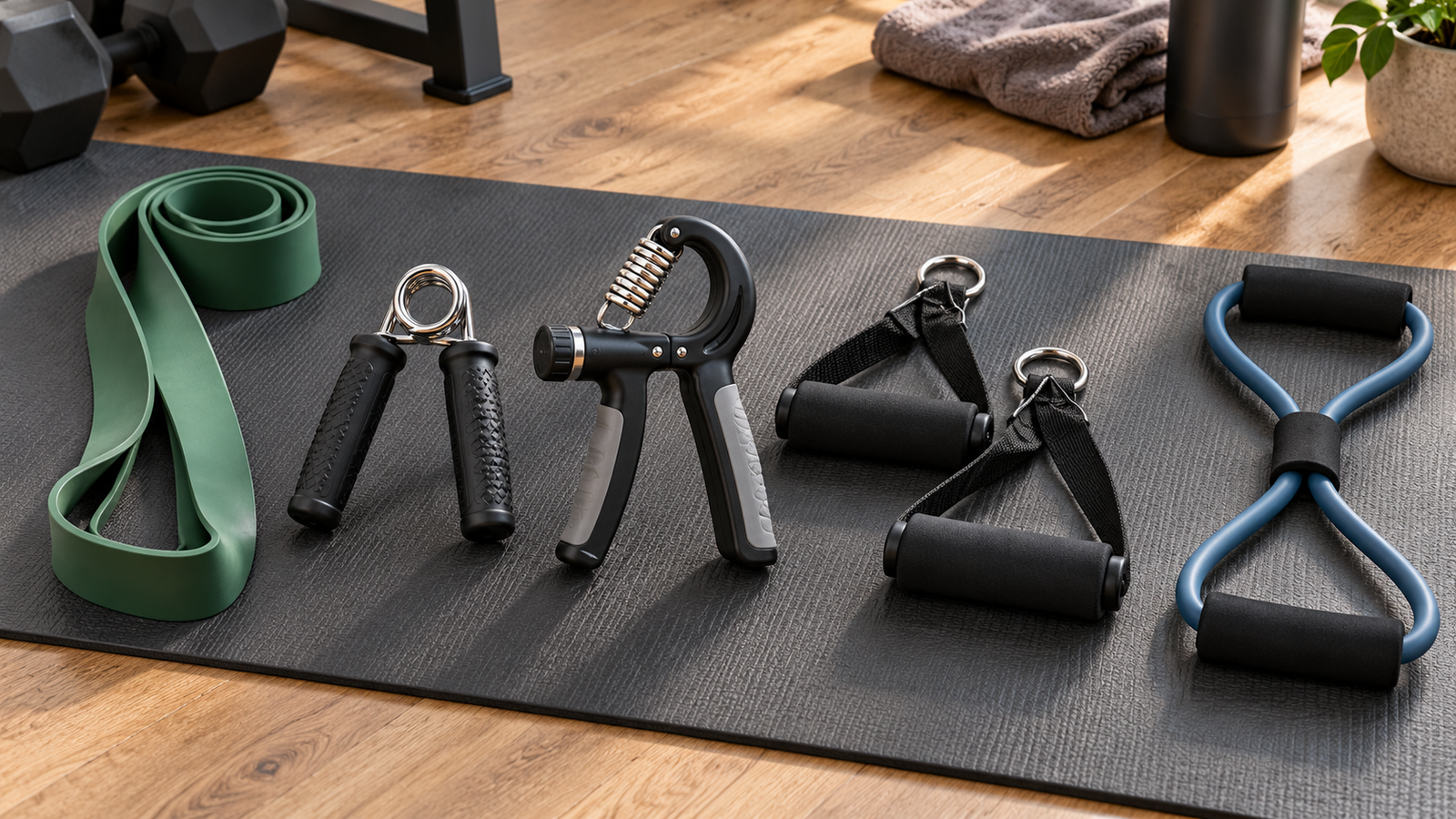
A handgrip trainer is a small resistance-training device designed primarily to exercise the muscles involved in gripping.
Most models contain two handles connected by a spring or another resistance mechanism.
When you squeeze the handles together, the device resists the movement.
As you release your grip, the spring helps return the handles toward their starting position.
Common types of handgrip trainers
Fixed-resistance handgrips
These devices have a preset resistance level.
They are generally simple to operate because there is no adjustment mechanism.
Adjustable handgrip trainers
These allow the user to change the resistance using a dial, screw or another adjustment system.
Some models offer a broad advertised resistance range.
Heavy-duty spring grippers
These typically use stronger springs and are intended for people pursuing more demanding grip-strength goals.
Ergonomic handgrip trainers
These feature contoured handles designed to accommodate the fingers and palm.
However, an ergonomic label does not guarantee that the device will fit every hand comfortably.
The most appropriate type depends on your goals, hand size and current strength.
2. Which Muscles Do Handgrip Trainers Work?
Handgrip trainers primarily challenge the muscles involved in finger flexion and gripping.
Several of these muscles are located in the forearm, with tendons extending into the hand and fingers.
Finger flexor muscles
These muscles help bend the fingers and generate gripping force.
Two important groups include:
- Flexor digitorum superficialis
- Flexor digitorum profundus
Both contribute to finger flexion during gripping activities.
Thumb muscles
The thumb helps stabilize the gripper and support the gripping action.
Its contribution depends on the design of the handles and how the device is held.
Wrist stabilizing muscles
Muscles around the wrist help maintain a controlled wrist position during squeezing.
However, a handgrip trainer is not necessarily a complete wrist-strengthening device.
Does a handgrip trainer train the entire forearm?
Not equally.
Handgrip trainers emphasize particular gripping movements, especially crushing grip strength.
They do not train every forearm muscle through its full range of motion.
For more balanced forearm training, other exercises may be useful, depending on your goals.
These might include appropriate wrist movements, finger-extension exercises and general resistance training.
3. Correct Wrist Position When Using a Handgrip Trainer
One of the most important technique considerations is maintaining a comfortable, controlled wrist position.
For general grip training, a neutral or near-neutral wrist is a useful starting point.
This means avoiding unnecessarily large bends in either direction.
What is a neutral wrist?
A neutral wrist is positioned approximately in line with the forearm rather than being markedly bent forward, backward or sideways.
A small natural variation is normal.
In standardized grip-strength testing, professional protocols use defined wrist and forearm positions because body position can influence measured grip strength.
However, standardized testing positions should not be confused with a universal requirement for every exercise or rehabilitation program.
Why wrist position matters
Excessive wrist bending can change muscle and tendon mechanics and may make gripping less comfortable.
A stable wrist position may also help you focus on the intended squeezing movement.
How to position your wrist
- Sit or stand comfortably.
- Relax your shoulders.
- Position your forearm in a comfortable orientation.
- Hold the handgrip trainer securely.
- Keep your wrist approximately aligned with your forearm.
- Squeeze using a controlled movement.
- Release gradually without forcing the wrist into an awkward angle.
Avoid repeatedly bending your wrist to help close a gripper that is too difficult.
If you need to twist your wrist, use momentum or change your entire arm position to close the handles, the resistance may be too high for controlled training.
4. How to Hold a Handgrip Trainer Correctly
Hand placement affects comfort and the amount of control you have over the device.
A poorly positioned gripper may press uncomfortably against the fingers or palm.
Step 1: Place one handle against your palm
Position the handle securely across the appropriate part of your palm.
The exact location depends on the device’s design.
Step 2: Wrap your fingers around the opposite handle
Your fingers should make comfortable contact with the handle.
Avoid positioning the handle so that it painfully presses into sensitive finger joints.
Step 3: Stabilize the device
Hold the gripper securely before squeezing.
Do not let it rotate unexpectedly in your hand.
Step 4: Squeeze smoothly
Bring the handles together as far as you can comfortably manage while maintaining control.
Not every beginner needs to fully close a heavy gripper.
Step 5: Release gradually
Allow the handles to reopen under control.
Avoid suddenly releasing the device and allowing the spring to snap open.
Step 6: Repeat with consistent technique
Maintain a similar hand position throughout the set.
Stop if your grip becomes unstable or uncomfortable.
5. Should You Completely Close the Handgrip Handles?
Not necessarily.
Some handgrip training methods define a complete repetition as bringing the handles fully together.
However, whether this is appropriate depends on the device, resistance level and training objective.
A heavy gripper may be impossible to close fully with your current strength.
Trying to force it closed can lead to compensatory wrist and arm movements.
For beginners
Start with a resistance you can control through a comfortable range.
If full closure is the intended movement, choose a lighter gripper that allows it.
For advanced training
Some training programs use partial-range gripping exercises.
However, these should be planned deliberately rather than performed because the resistance is uncontrollably heavy.
Controlled movement matters more than forcing a particular handle position.
6. Fixed vs Adjustable Handgrip Trainers
Both fixed and adjustable grippers can be useful.
Their suitability depends on your preferences and intended training.
| Feature | Fixed handgrip trainer | Adjustable handgrip trainer |
|---|---|---|
| Resistance | Preset | Adjustable |
| Mechanism | Usually simpler | Additional adjustment components |
| Progression | Often requires another gripper | May permit adjustments on one device |
| Portability | Usually compact | Usually compact |
| Maintenance | Inspect spring and handles | Inspect spring, adjustment mechanism and handles |
| Resistance accuracy | Model-dependent | Model-dependent |
| Beginner suitability | Depends on resistance | Depends on usable adjustment range |
An adjustable handgrip trainer may be convenient for someone who wants to increase resistance gradually.
However, its advertised resistance range should not automatically be treated as a precisely calibrated measurement.
7. What Do 10 kg, 20 kg and 40 kg Handgrip Ratings Mean?
Some handgrip strengtheners are advertised using kilograms of resistance.
This creates confusion because kilograms are commonly used to describe mass, while gripping resistance is a force.
Manufacturers may use kilogram-force terminology or simplified kilogram labels.
More importantly, the measurement method can differ between products.
Why ratings are difficult to compare
The advertised resistance may depend on:
- Spring design.
- Handle opening.
- Handle position.
- Adjustment setting.
- Distance between the handles.
- The force required at a particular point in the movement.
- Manufacturer testing methods.
Two devices labeled 20 kg may not provide identical resistance throughout a squeeze.
Is a 40 kg handgrip twice as difficult as a 20 kg handgrip?
You cannot reliably conclude that from the labels alone.
Without comparable measurements, the numbers do not necessarily indicate a precise two-to-one difference in practical difficulty.
Can a gripper measure your grip strength?
Most ordinary spring grippers are exercise tools, not calibrated grip-strength measurement instruments.
Clinical grip-strength testing typically uses a hand dynamometer under standardized conditions.
For consistent grip-strength measurement, healthcare professionals consider device calibration, handle position and testing posture.
Do not assume the setting displayed on an adjustable gripper equals your maximum measured grip strength.
8. How Many Handgrip Repetitions Should Beginners Do?
There is no universally established repetition prescription specifically for every recreational handgrip trainer.
The appropriate amount depends on resistance, training history, exercise goal and individual tolerance.
For general strength training, the NHS describes 8–12 repetitions as a commonly used range and recommends gradual progression.
However, that guidance covers general strengthening activities and is not a personalized prescription for hand rehabilitation.
A cautious beginner example
For a healthy adult without hand or wrist symptoms, a reasonable introductory trial could be:
| Exercise variable | Example starting approach |
|---|---|
| Resistance | Light and comfortably controllable |
| Repetitions | 8–10 per hand |
| Sets | 1–2 |
| Movement | Smooth squeeze and controlled release |
| Rest between sets | Enough to restore comfortable control |
| Frequency | Start with two or three nonconsecutive days per week |
| Progression | Gradual, based on comfort and recovery |
These are illustrative training parameters, not a proven optimal protocol.
If even this amount causes discomfort, use fewer repetitions or stop and seek advice.
If you have an injury, arthritis, nerve symptoms or a postoperative condition, follow a clinician’s individualized exercise instructions instead.
9. Should You Use Handgrip Trainers Every Day?
Daily gripping is part of normal life, but deliberate resistance exercise adds extra loading.
Whether daily handgrip training is appropriate depends on the intensity and volume.
Low-load movement prescribed as part of hand therapy is different from repeatedly squeezing a heavy spring gripper to fatigue.
Why recovery matters
Strength training places demands on muscles and associated tissues.
Recovery allows those tissues to adapt to the training stimulus.
If the training load increases too quickly, the hands and forearms may become uncomfortable.
Possible consequences include persistent soreness, tendon irritation and reduced exercise tolerance.
Do you need rest days?
For challenging strength-focused grip sessions, allowing recovery between sessions is a sensible approach.
The exact recovery period varies.
Some light exercises may be performed more frequently when appropriate, particularly within a prescribed rehabilitation program.
Do not assume that using a heavy handgrip trainer hundreds of times every day will produce faster results.
Training quality, suitable loading and recovery are more important than accumulating repetitions without a plan.
10. Grip Strength vs Grip Endurance
Grip strength and grip endurance are related but different qualities.
Grip strength
Grip strength describes the ability to generate gripping force.
Training for strength typically uses resistance that challenges force production while allowing appropriate technique.
Grip endurance
Grip endurance involves maintaining or repeatedly producing gripping force over time.
It may be relevant to activities that require prolonged holding or repeated gripping.
Why the difference matters
A person might be able to close a moderately challenging gripper a few times but struggle to maintain a lighter squeeze for an extended period.
Conversely, someone who performs many easy repetitions may not necessarily have high maximum gripping strength.
Which should you train?
Choose based on your needs.
For general recreation and hand fitness, controlled strength work may be sufficient.
For sports, occupations or activities with specific gripping demands, a more targeted training plan may be useful.
Avoid performing extremely high repetition counts simply because the gripper is easy to use.
11. Can Handgrip Trainers Improve Gym Performance?
Grip strength contributes to many exercises involving the hands.
Examples include:
- Dumbbell rows.
- Deadlifts.
- Farmer’s carries.
- Pull-ups.
- Certain kettlebell exercises.
However, grip strength is task-specific.
Closing a spring gripper emphasizes a different gripping pattern from hanging from a pull-up bar or supporting a heavy barbell.
Different types of grip
Crush grip: Closing the fingers forcefully around an object.
Support grip: Holding an object for a period of time.
Pinch grip: Holding an object between the thumb and fingers.
Handgrip trainers primarily emphasize crush-grip movements.
They may contribute to general gripping capacity, but they should not automatically be considered a complete replacement for exercise-specific grip training.
For example, someone wanting to improve barbell-holding ability may also benefit from appropriately programmed carries or holds.
12. Does a Handgrip Trainer Make Your Forearms Bigger?
Handgrip exercises challenge muscles in the forearm.
With sufficient training stimulus and recovery, resistance training can contribute to muscle adaptation.
However, the extent of visible forearm growth depends on several factors.
These include:
- Resistance level.
- Training volume.
- Exercise selection.
- Recovery.
- Overall resistance-training routine.
- Individual characteristics.
A handgrip trainer alone does not guarantee noticeable forearm muscle growth.
Some forearm muscles are involved in wrist and finger movements that may not be fully challenged by simple squeezing.
For broader forearm development, a balanced training program may be more appropriate.
Are high repetitions the best way to grow forearms?
Not necessarily.
Muscle development depends on progressive training demands rather than repetition count alone.
Hundreds of easy squeezes should not be assumed to outperform controlled resistance training.
13. What Are the Signs of Handgrip Trainer Overuse?
The hands and wrists contain multiple joints, tendons, nerves and other structures that can become symptomatic.
Possible warning signs include:
- Persistent hand or wrist pain.
- Pain around the thumb or finger joints.
- Increasing discomfort during gripping.
- Unusual swelling.
- Tenderness around the forearm or wrist.
- Reduced grip function.
- Tingling or numbness in the fingers.
- Pain that persists after exercise.
- Symptoms that worsen over successive sessions.
Mild temporary muscle fatigue can occur after unfamiliar exercise.
However, worsening or persistent pain should not be treated as a normal requirement for progress.
NHS Inform advises that exercise should not make existing hand, wrist or finger pain worse overall, and that discomfort should not be worse the morning after exercise.
When should you stop?
Stop using the handgrip trainer if you experience:
- Sharp or sudden pain.
- New numbness or tingling.
- Significant swelling.
- Loss of normal hand function.
- Increasing weakness.
- Unusual joint instability.
Seek medical assessment for persistent symptoms or concerning changes.
Sudden substantial weakness or symptoms following an injury deserve prompt medical attention.
14. Can Handgrip Trainers Cause Wrist Pain?
Handgrip training can aggravate symptoms when resistance, technique or training volume exceeds individual tolerance.
However, wrist pain can have many causes.
These may include tendon problems, joint conditions, nerve compression or injuries unrelated to the gripper.
Common training-related contributors
Excessive resistance
A difficult gripper may encourage compensatory wrist movement or excessive force.
Poor handle fit
A handle that does not fit comfortably may concentrate pressure in particular areas.
Repeated gripping without recovery
High repetition counts can increase cumulative loading.
Awkward wrist positioning
Repeated gripping with uncomfortable wrist deviation may aggravate symptoms.
Existing problems
A person with previous hand, wrist or forearm symptoms may tolerate gripping differently.
Do not attempt to diagnose the precise cause of pain based only on the location of discomfort.
If symptoms continue, consult an appropriate healthcare professional.
15. What About Carpal Tunnel Syndrome?
Carpal tunnel syndrome occurs when the median nerve is compressed at the wrist.
It may cause symptoms such as:
- Tingling.
- Numbness.
- Pain.
- Weakness.
- Difficulty gripping objects.
Symptoms commonly affect the thumb, index finger, middle finger and part of the ring finger.
Handgrip trainers are not a universal treatment for carpal tunnel syndrome.
Some people with nerve-related symptoms may need to modify or avoid particular gripping activities.
Should you strengthen your grip if you have carpal tunnel symptoms?
Do not assume that squeezing a heavy spring gripper will improve the condition.
A healthcare professional may recommend specific exercises, activity modifications, splinting or other treatment depending on the diagnosis.
Follow individualized guidance.
A general-purpose fitness gripper should not be substituted for a prescribed rehabilitation program.
16. Handgrip Trainers vs Therapy Putty
Handgrip trainers and therapy putty are both used in hand exercises, but they offer different possibilities.
Handgrip trainers
These primarily provide resistance against a closing grip.
They may suit recreational grip-strength training when used appropriately.
Therapy putty
Therapeutic putty can be manipulated through several hand movements.
Examples include:
- Whole-hand squeezing.
- Finger pinching.
- Thumb pressing.
- Finger spreading.
- Hook-grip movements.
Guy’s and St Thomas’ NHS Foundation Trust describes different putty exercises for hand and finger strengthening.
However, these exercises are intended to be selected and prescribed by a hand therapist when used for rehabilitation.
Comparison
| Feature | Handgrip trainer | Therapy putty |
|---|---|---|
| Main movement | Squeezing handles | Multiple gripping and finger movements |
| Resistance | Spring or adjustable mechanism | Putty material resistance |
| Finger isolation | Usually limited | Supports varied finger movements |
| Portability | Compact | Compact |
| Rehabilitation use | Only when appropriate | Frequently used in prescribed hand therapy |
| Resistance progression | Different devices or adjustments | Different putty grades or exercises |
Neither tool is automatically suitable for every injury or hand condition.
17. Should You Train Finger Extension Too?
Handgrip trainers primarily emphasize finger closing.
However, the hand also needs to open and release objects.
The muscles involved in finger extension serve different functions from the finger flexors.
Some exercise programs include finger-opening movements alongside gripping exercises.
For example, gentle finger spreading or controlled finger extension may be included in hand therapy.
Does everyone need finger-extension equipment?
No.
A healthy person does not necessarily need a dedicated finger-extension trainer.
The need for additional exercises depends on training goals, symptoms and professional recommendations where applicable.
For recreational grip training, it is reasonable to avoid building an entire routine around endless squeezing repetitions.
Balanced hand movement and overall upper-body training may be more practical.
18. How to Progress Handgrip Resistance Safely
Progression means gradually increasing training demands as your ability improves.
It does not require moving immediately to the highest resistance setting.
Stage 1: Learn the technique
Start with a light resistance.
Focus on a comfortable handle position, controlled squeezing and gradual release.
Stage 2: Improve consistency
Complete a manageable number of repetitions without losing control.
Observe how your hands feel during and after training.
Stage 3: Increase one variable
When the exercise becomes comfortably manageable, you might increase repetitions slightly or select a somewhat higher resistance.
Avoid increasing both resistance and total volume aggressively at the same time.
Stage 4: Monitor recovery
Pay attention to discomfort, fatigue and next-day symptoms.
If symptoms increase, reduce the training demand.
Stage 5: Reassess your goal
Higher resistance is not always necessary.
For some users, maintaining general grip function may be more important than closing increasingly difficult grippers.
The purpose of progression is to create a manageable challenge, not to force your hands through pain.
19. How to Choose a Handgrip Trainer for Beginners
A suitable beginner handgrip should be comfortable, controllable and appropriate for your hand dimensions.
Resistance range
Select a product that provides genuinely manageable resistance.
An adjustable model may be convenient, but advertised numbers should not be treated as independently verified force measurements.
Handle shape
Consider whether your fingers sit comfortably around the handles.
Sharp edges or uncomfortable pressure points are undesirable.
Adjustment mechanism
If you choose an adjustable trainer, check whether the resistance mechanism is easy to operate and remains secure.
Build quality
Inspect the spring, handles and adjustment components.
Avoid products with visible cracks, sharp exposed components or unstable moving parts.
Portability
A small gripper is easy to carry, but convenience should not encourage excessive training frequency.
Product information
Look for clear manufacturer instructions, resistance specifications and care guidance.
Avoid relying exclusively on claims of maximum resistance.
20. Handgrip Trainer Safety and Maintenance
Handgrip trainers contain moving mechanical components.
They should be inspected regularly.
Before exercising
Check for:
- Cracked handles.
- Loose adjustment screws.
- Damaged springs.
- Sharp edges.
- Unusual mechanical movement.
- Unstable or slippery grip surfaces.
During training
Keep fingers clear of unintended pinch points.
Do not modify the spring or adjustment mechanism.
Avoid suddenly releasing the device.
Stop if it makes unusual noises or behaves unpredictably.
After training
Wipe away sweat using an appropriate cleaning method.
Store the gripper in a dry location according to the manufacturer’s instructions.
Do not attempt to repair a damaged spring with improvised parts.
If an adjustment component fails, discontinue use until the device is repaired or replaced appropriately.
21. A Practical Beginner Handgrip Routine
For generally healthy adults without hand or wrist symptoms, the following is an illustrative introduction to recreational grip training.
It is not a rehabilitation prescription.
Warm-up
Begin with comfortable hand opening and closing.
Gently move the fingers and wrists through a pain-free range.
Avoid forceful stretching.
Main exercise
Choose a light gripper.
Perform 8 controlled repetitions with one hand.
Release the handles slowly after each squeeze.
Rest as needed, then perform 8 repetitions with the other hand.
If comfortable, complete a second set.
After the exercise
Relax your hands and gently open and close your fingers.
Notice whether your hands feel comfortable.
If you experience lingering discomfort, reduce the training volume or stop.
Example weekly schedule
| Day | Activity |
|---|---|
| Monday | Light handgrip session |
| Tuesday | No planned heavy gripper training |
| Wednesday | Light handgrip session |
| Thursday | Recovery or ordinary daily activity |
| Friday | Optional light handgrip session if fully comfortable |
| Saturday | No planned heavy gripper training |
| Sunday | Recovery |
This is an example of gradual recreational training, not an evidence-established optimal schedule.
Rehabilitation exercises may require different frequency, resistance and supervision.
22. Common Handgrip Training Mistakes
Mistake 1: Starting with excessive resistance
A very difficult gripper may encourage poor technique and unnecessary strain.
Mistake 2: Bending the wrist to close the handles
Try to maintain comfortable wrist control instead of using exaggerated movements to compensate.
Mistake 3: Releasing the spring abruptly
Control both the squeezing and opening phases.
Mistake 4: Performing hundreds of repetitions without a plan
High repetition counts are not automatically more effective.
Mistake 5: Ignoring persistent discomfort
Pain, tingling and increasing symptoms require attention.
Mistake 6: Assuming resistance labels are standardized
Different brands may use different rating methods.
Mistake 7: Treating the gripper as a medical rehabilitation device
Injuries and nerve conditions may require specialized exercise programs.
Mistake 8: Training only the dominant hand
If your objective is balanced general training, consider both hands while recognizing that natural strength differences are common.
Do not force an injured or symptomatic hand to match the other.
Mistake 9: Confusing gripping endurance with maximum strength
High repetitions at light resistance do not directly measure maximum grip strength.
Mistake 10: Ignoring equipment condition
A damaged spring or handle can create injury risk.
23. Frequently Asked Questions
How many handgrip repetitions should I do daily?
There is no universal daily repetition target. The appropriate amount depends on resistance, goals and tolerance. Beginners may prefer brief sessions with recovery rather than intensive daily squeezing.
Is 100 handgrip repetitions a day good?
Not necessarily. One hundred repetitions may be excessive for some individuals, particularly with challenging resistance. More repetitions do not automatically mean better progress.
Should I squeeze a handgrip trainer as hard as possible?
Not for every repetition. Maximum-effort training is demanding and may be unsuitable for beginners or people with symptoms. Start with controlled, manageable resistance.
Should my wrist be straight while using a handgrip?
A neutral or near-neutral wrist is a useful starting position for general training. Avoid exaggerated bending or uncomfortable positions. Clinical rehabilitation exercises may have different instructions.
Can handgrip trainers improve forearm strength?
They can challenge the finger-flexor muscles and related gripping structures. However, they do not train every forearm function equally.
Can handgrip trainers increase hand size?
They do not change adult hand-bone dimensions. Resistance training may influence muscle development, but visible changes vary.
Are adjustable grippers better than fixed grippers?
Neither is universally better. Adjustable devices provide convenient resistance changes, while fixed devices may offer simpler construction.
Is a 60 kg handgrip trainer suitable for beginners?
A device advertised at 60 kg may be too demanding if that is its actual operating resistance. If adjustable, check whether its lowest setting is manageable and reliable.
Does closing a 40 kg gripper mean my grip strength is 40 kg?
No. A gripper’s advertised resistance does not necessarily correspond to a standardized dynamometer measurement.
Can I train grip strength every day?
Frequency depends on training intensity, recovery and individual needs. Challenging strength sessions may benefit from rest between workouts, while clinician-prescribed rehabilitation routines can differ.
Do handgrip trainers help with carpal tunnel syndrome?
They are not a standard universal treatment. People with numbness, tingling or diagnosed nerve conditions should seek individualized professional advice.
Can handgrip trainers cause tendon problems?
Excessive or poorly tolerated repetitive gripping can aggravate tendons and related structures. Persistent pain should be evaluated rather than ignored.
Can women use the same handgrip trainers as men?
Yes. Choose resistance based on individual ability, comfort and goals rather than gender-based assumptions.
Are handgrip trainers suitable for older adults?
Some older adults may benefit from appropriate hand-strengthening activities. However, joint conditions, injuries and other health concerns may affect the choice of exercises and resistance.
What is the difference between a handgrip trainer and a dynamometer?
A handgrip trainer provides resistance for exercise. A dynamometer is designed to measure gripping force under specified conditions.
24. Final Takeaway
Handgrip trainers can be useful accessories for developing gripping strength, but they should be approached like other resistance-training equipment.
Start with manageable resistance, maintain a comfortable wrist position, squeeze and release under control, and allow adequate recovery.
Avoid excessive repetition counts, forced handle closure and resistance settings that require awkward movements.
Remember that advertised kilogram ratings are not necessarily standardized across manufacturers.
If you develop persistent hand pain, tingling, swelling or increasing weakness, stop training and seek appropriate medical advice.
A simple, consistent grip-training routine performed with control is generally a better foundation than chasing high resistance numbers or squeezing hundreds of times without considering recovery.
References and Further Reading
- NHS — How to Improve Your Strength and Flexibility
- NHS Inform — Exercises for Wrist, Hand and Finger Problems
- Guy’s and St Thomas’ NHS Foundation Trust — Therapeutic Putty Exercises for Hand and Finger Strength
- Shirley Ryan AbilityLab — Hand-Held Dynamometer and Grip Strength Measurement
- NHS — Wrist Pain: Causes and Self-Care
- Effects of Wrist Stability Training Combined with Grip Strength Exercise on Pain and Function (2024)
Editorial note: This article provides general fitness education and does not represent independently tested performance claims for specific handgrip trainers. The example training routine is not a medical rehabilitation prescription. People with hand injuries, nerve symptoms, arthritis or persistent wrist pain should follow guidance from a qualified healthcare professional.