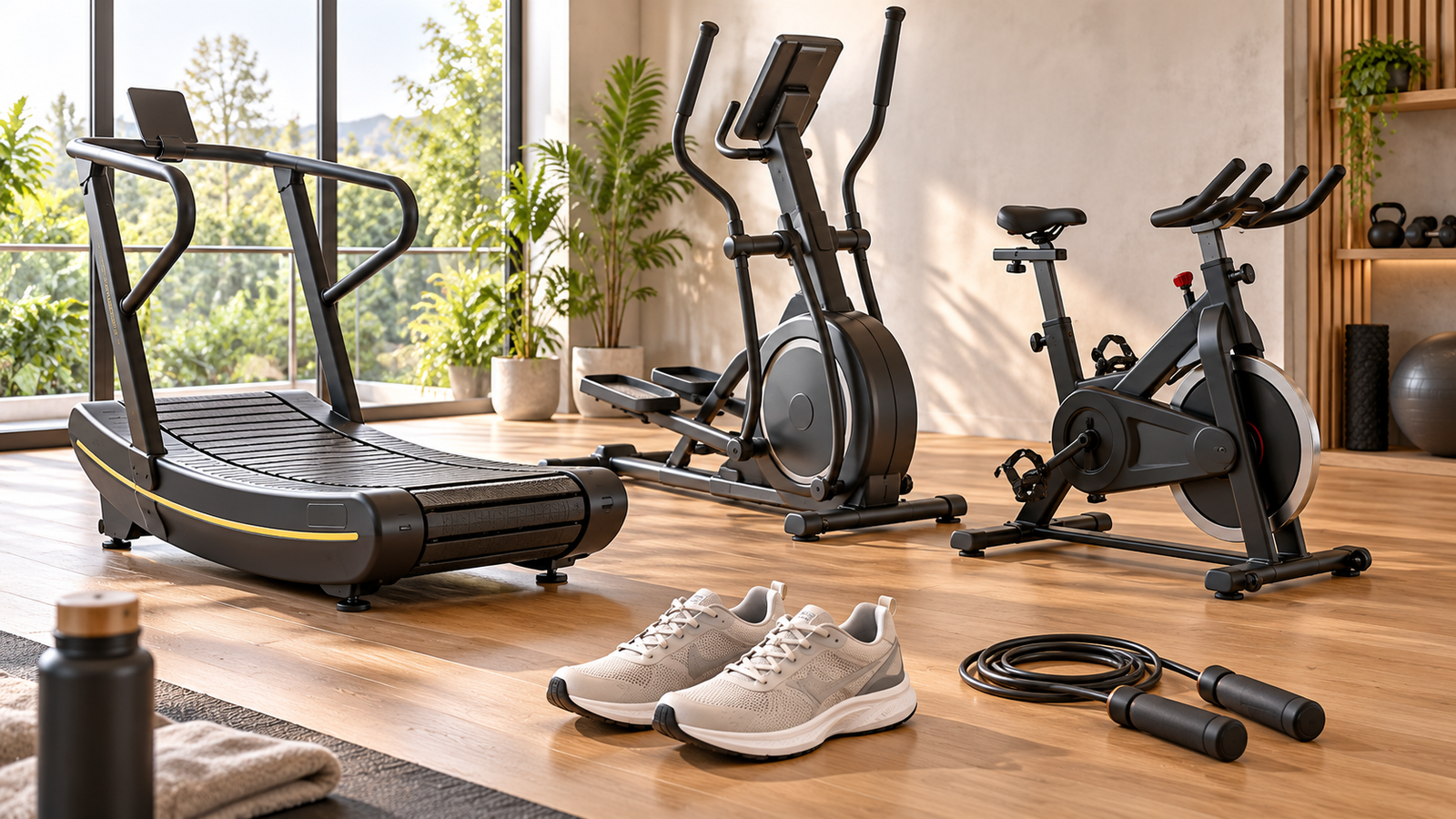
Curved Manual Treadmill Mechanics: How Self-Powered Belts Work
A curved manual treadmill looks similar to a conventional running machine, but its operating mechanism is fundamentally different.
Unlike a motorized treadmill, which uses an electric motor to move the running belt at a selected speed, a curved manual treadmill relies on the user’s own movement to power the belt.
When you walk or run, your feet interact with the curved running surface and cause it to rotate. Changing your running position and pace changes the speed of the belt.
This design creates a different exercise experience from running on a conventional electric treadmill.
But how exactly does a curved manual treadmill work? Why does moving forward make the belt accelerate? And does a self-powered treadmill actually require more effort than a motorized model?
The most important difference is that a curved manual treadmill does not set your running speed for you. You generate the belt movement, and the machine responds to your pace and body position.
Understanding its mechanics can help you operate the equipment safely, interpret performance claims and decide whether a curved treadmill is suitable for your home fitness routine.
1. What Is a Curved Manual Treadmill?
A curved manual treadmill is a non-motorized exercise machine with a running surface that curves upward toward the front and rear.
The treadmill generally uses a continuous belt supported by rollers, bearings and other mechanical components.
Many models have individual slats connected to form a flexible running surface, although designs vary.
Unlike a conventional electric treadmill, the running belt is not driven by an electric motor.
Instead, the user’s walking or running action causes the belt to move.
Main components
A curved manual treadmill commonly includes:
- Curved running belt or slatted running surface.
- Front and rear rollers.
- Bearings and supporting mechanical components.
- Steel or another structural frame.
- Side rails or handrails.
- A running-speed monitoring system, where provided.
- An electronic display on some models.
- Optional resistance or braking mechanisms on certain designs.
The exact mechanical arrangement varies by manufacturer.
Some products are designed primarily for running, while others support walking, controlled resistance work or specialized athletic training.
2. How Does a Curved Manual Treadmill Work?
The operating principle combines the shape of the running surface with the user’s movement and body position.
On a conventional motorized treadmill, an electric motor drives the belt backward.
The runner must maintain a suitable pace to remain in position.
On a curved manual treadmill, the runner supplies the energy needed to move the belt.
The basic process
Step 1: Your foot contacts the running surface.
As you step onto the treadmill, your body weight and foot movement interact with the curved belt.
Step 2: You begin walking or running.
Your stepping motion applies forces to the running surface, causing the belt to rotate.
Step 3: The belt moves beneath your feet.
The mechanical assembly allows the belt to circulate around its supporting rollers.
Step 4: Your movement determines the speed.
Changes in cadence, foot placement and body position influence belt rotation.
Step 5: Slowing down reduces belt speed.
As your pace decreases and your position changes, the belt slows toward a stop.
The machine does not need to electronically command the belt to accelerate or decelerate.
However, the belt may continue moving briefly because of its momentum.
That is why learning the correct stopping procedure is especially important.
3. Why Is the Running Surface Curved?
The curved profile is central to the machine’s speed-control mechanism.
Instead of walking on a flat horizontal belt, the user moves across a surface that rises toward the front.
This geometry allows changes in foot position and body weight distribution to influence the belt.
Moving forward generally increases speed
On many curved manual treadmills, moving farther toward the front of the curved running surface encourages the belt to accelerate.
The user steps onto the upward portion of the curve and continues propelling the belt through walking or running.
Moving backward generally reduces speed
As the runner reduces pace and shifts toward the rear of the running surface, the belt tends to slow.
This provides a way to control speed without using conventional electronic speed buttons.
Why the middle position matters
Many users find a comfortable position around the central portion of the running surface.
This allows them to maintain a relatively consistent pace without continuously accelerating.
However, there is no universally correct position for every person or treadmill.
The appropriate position depends on the particular curved design, body dimensions and running technique.
Understanding the three zones
| Position on running surface | Typical effect |
|---|---|
| Toward the front curve | Encourages acceleration |
| Near the central section | Can support a steadier pace |
| Toward the rear curve | Encourages deceleration |
These are general operating characteristics, not precise speed settings.
Always follow the manufacturer’s specific instructions.
4. What Actually Makes the Belt Move?
A curved treadmill does not operate purely because gravity pulls the belt downward.
The runner must do mechanical work.
Foot contact, propulsion, body position and the curve interact to move the belt against friction and other mechanical resistance.
The role of body weight
Body weight contributes to the forces acting on the running surface.
Because the treadmill is curved, the position of that weight can influence how the belt rotates.
However, body weight alone does not establish belt speed.
The role of foot movement
Walking and running involve forces applied through the feet.
These forces interact with the belt and contribute to its motion.
The role of bearings
Bearings help support rotating components while reducing mechanical friction.
Lower friction can make the belt easier to move, although resistance and inertia remain.
The role of belt construction
Different treadmill designs use different belt materials and structures.
For example, slatted running surfaces consist of multiple sections connected to form a continuous moving assembly.
Other designs may use different belt arrangements.
The quality of these components can influence durability, noise, resistance and the overall feel of the machine.
A self-powered treadmill still has mechanical resistance. It simply does not use a conventional drive motor to maintain belt speed.
5. Curved Manual Treadmill vs Motorized Treadmill
The two treadmill types can support indoor walking and running, but they behave differently.
| Feature | Curved manual treadmill | Motorized treadmill |
|---|---|---|
| Belt movement | Powered by the user | Powered by an electric motor |
| Speed control | Movement and body position | Electronic speed setting |
| Running surface | Curved | Usually flat |
| Acceleration | User-directed | Controlled by motor response |
| Deceleration | User slows the belt | Motor-controlled |
| Incline | Fixed curved geometry on many models | Often electronically adjustable |
| Belt-drive electricity | Not required | Required |
| Display power | May use a battery or another source | Usually integrated electrical system |
| Learning curve | Often requires familiarization | Usually familiar to many users |
| Emergency stopping | Model-specific; belt may coast | Often includes safety-key mechanisms |
| Maintenance | Mechanical inspection | Mechanical and electrical inspection |
Neither treadmill type is automatically better for everyone.
A motorized treadmill may be preferable for someone who wants precise preset speeds and controlled walking sessions.
A curved manual treadmill may appeal to users who prefer self-paced running and rapid changes in pace.
6. Is a Curved Manual Treadmill Harder Than a Regular Treadmill?
Research suggests that certain curved non-motorized treadmills can require more metabolic effort than motorized treadmills at comparable speeds.
A study published in Frontiers in Physiology in 2017 examined 14 trained runners performing exercise on curved non-motorized treadmills, conventional motorized treadmills and overground running surfaces.
The researchers found that running on the curved treadmill required greater relative oxygen consumption and produced higher heart rates at matched running speeds.
Another study published in Physical Therapy in Sport reported greater physiological demands during walking and running on a curved non-motorized treadmill compared with a conventional motorized treadmill.
Why might curved running require more effort?
Potential contributors include:
- The mechanical work required to move the belt.
- Resistance within the treadmill mechanism.
- Differences in running technique.
- The shape of the running surface.
- Changes in muscle activity and movement patterns.
- The absence of motor-driven belt assistance.
However, results depend on the specific treadmill and the characteristics of the participants.
Does it always burn 30% more calories?
No.
Some marketing materials suggest that curved treadmills increase energy expenditure by approximately 30%.
Research has found meaningful differences under certain experimental conditions, but those findings do not establish a universal calorie-burning advantage.
Actual energy expenditure depends on workload, duration, treadmill design, running technique and individual physiology.
Do not treat a manufacturer’s advertised calorie-burning percentage as a guaranteed personal result.
7. Why Does Running Feel Different on a Curved Treadmill?
People who are accustomed to motorized treadmills may initially find curved treadmills unfamiliar.
The reason is that the machine responds directly to their movement.
No preset belt speed
On a motorized treadmill, the belt continues at the selected speed until the setting changes or the machine stops.
On a curved treadmill, changes in your movement affect the belt.
This creates a more responsive experience, but it also requires the user to learn belt control.
Different acceleration behavior
A curved treadmill may respond rapidly when the runner increases pace.
Some athletes use this characteristic for acceleration and interval training.
However, rapid acceleration can be inappropriate for beginners who are still learning how the treadmill responds.
Different foot placement
A runner’s position along the curve influences the machine’s behavior.
Foot placement may feel different from running on a flat belt.
Greater perceived effort
Some research participants have reported higher perceived exertion on curved non-motorized treadmills.
This means a pace that feels comfortable on a motorized treadmill may feel more demanding on a curved model.
Begin conservatively rather than trying to match your usual treadmill speed immediately.
8. Does a Curved Treadmill Improve Running Form?
Manufacturers sometimes promote curved treadmills as tools for developing running technique.
They may claim that curved surfaces encourage particular stride patterns or improve body positioning.
However, these claims require careful interpretation.
What research shows
A study published in 2024 examined how curved non-motorized treadmill running compared with overground and motorized treadmill running.
The researchers found that curved treadmill running did not reproduce overground running biomechanics more closely than motorized treadmill running.
In several measured joint-motion characteristics, curved treadmill running differed more from overground running.
This challenges the assumption that running on a curved treadmill automatically creates a more natural running pattern.
Does that mean curved treadmills are bad for technique?
No.
Different running surfaces can produce different movement patterns.
A curved treadmill may still be useful for particular training purposes.
However, it should not automatically be described as a machine that corrects running form or prevents injuries.
Training technique depends on individual mechanics, exercise goals and appropriate instruction.
9. Is a Curved Manual Treadmill Safer for Your Knees?
There is insufficient evidence to claim that curved manual treadmills are universally safer for the knees than motorized treadmills.
Some curved treadmill designs may influence stride mechanics, but that does not guarantee lower joint loading or reduced injury risk.
Factors that affect comfort
These may include:
- Running speed.
- Exercise duration.
- Running technique.
- Current fitness.
- Previous injuries.
- Footwear.
- Treadmill design.
- Individual joint tolerance.
The greater metabolic demand observed in some studies also means curved running may be more strenuous than expected.
People with knee pain, balance difficulties or other musculoskeletal concerns should not assume that a curved treadmill is automatically a safer alternative.
Seek individualized guidance when appropriate.
10. How to Start Walking on a Curved Manual Treadmill
Using a curved manual treadmill safely begins with learning its mounting and belt-control procedure.
Unlike a motorized treadmill, the belt may move as soon as your weight or feet interact with it.
Step 1: Read the user manual
Identify the approved mounting position, handrails, stopping procedure and permitted user weight.
WOODWAY, for example, instructs users to mount and dismount certain Curve models from the rear while holding the rails.
Other equipment may use different procedures.
Step 2: Inspect the treadmill
Check for visible damage, loose components, obstruction around the running surface or unusual belt behavior.
Do not use a machine with suspected mechanical problems.
Step 3: Enter using the approved mounting method
Hold the handrails as instructed.
Do not assume that a stopped manual belt will remain stationary when you step onto it.
Step 4: Start with gentle steps
Begin walking slowly and observe how the belt responds.
Avoid immediately moving toward the front of the curve.
Step 5: Find a comfortable position
Learn how small changes in pace and position affect the running surface.
Do not attempt to match your usual motorized treadmill speed.
Step 6: Maintain control
Keep your movements smooth and avoid sudden acceleration.
If you feel unstable, use the handrails as directed and stop the session safely.
Step 7: Learn how to stop before increasing intensity
Practice the model’s normal stopping procedure at a low speed.
A beginner should understand how the belt slows and where to place their feet before attempting running intervals.
11. How Do You Stop a Curved Manual Treadmill?
Stopping is one of the most important differences between manual and motorized treadmills.
On many motorized machines, pressing a stop button or activating a safety key stops the motor-driven belt.
A curved manual treadmill may not have an equivalent motor-controlled stopping system.
Slowing the belt
On many curved models, gradually reducing walking or running pace and shifting toward the rear causes the belt to decelerate.
However, the belt may continue moving for some time.
Using handrails
The manufacturer’s instructions may require or recommend using handrails during stopping.
Follow the specified technique rather than improvising.
Stepping onto side platforms
Some models provide side platforms or rails that allow users to safely move off the running belt.
For certain WOODWAY models, the manual describes moving onto the stationary side areas while the belt coasts to a stop.
This procedure must not be generalized to every treadmill.
Avoid sudden uncontrolled stopping
Do not attempt to stop a rapidly moving belt by placing your hands or feet against moving mechanisms.
Do not jump backward from the treadmill while the belt is moving.
The correct stopping method depends on the exact model.
The absence of a drive motor does not mean the belt stops instantly when you stop exerting effort.
12. Can a Curved Manual Treadmill Be Used for Walking?
Yes, many curved manual treadmills support walking as well as running.
However, suitability varies considerably.
Some designs are optimized for athletic running and may feel demanding during slow walking.
Others are designed for a wider range of speeds.
Why slow walking can feel unusual
At lower speeds, maintaining smooth belt movement may require practice.
The user’s walking position and the treadmill’s friction characteristics can affect how easily the belt moves.
Is walking on a curved treadmill easier?
Not necessarily.
Research comparing walking on curved non-motorized and motorized treadmills has found greater physiological demands on curved models under certain test conditions.
For beginners, this means even comfortable-looking walking speeds may feel surprisingly challenging.
Who might prefer a motorized treadmill?
A motorized model may be more convenient when the main goal is:
- Walking at a consistent prescribed speed.
- Following a specific rehabilitation program.
- Using electronically controlled incline.
- Performing longer low-intensity sessions.
- Avoiding the need to regulate belt speed manually.
These are practical considerations rather than universal restrictions.
13. What About Sprinting and Interval Training?
Curved manual treadmills can be useful for certain self-paced interval workouts.
Because the user controls the belt directly, the machine can respond quickly to changes in running pace.
This may appeal to experienced runners and athletes.
Example of a simple interval structure
An experienced user familiar with the equipment might perform:
- Easy walking or jogging.
- A controlled increase in running pace.
- A short running interval.
- Gradual deceleration.
- Comfortable recovery.
- Repetition as appropriate.
The interval intensity and duration should match the person’s fitness and the equipment’s instructions.
Are curved treadmills ideal for sprinting?
They can be used for sprint-oriented training when the specific equipment permits it.
However, sprinting requires substantial physical effort and control.
A beginner should not attempt maximum-speed intervals during the first familiarization session.
The rapid response of the belt increases the importance of correct technique and safe stopping.
14. Do Curved Manual Treadmills Need Electricity?
The running belt of a conventional non-motorized curved treadmill does not require electricity from a drive motor.
However, that does not necessarily mean every component operates without power.
Some models include electronic displays or sensors powered by:
- Replaceable batteries.
- Rechargeable batteries.
- Internal generators.
- External power supplies.
What about electricity costs?
A curved treadmill without a drive motor may use considerably less electricity than a motorized treadmill.
However, exact electricity consumption depends on whether its display, monitoring system or other features use external power.
Do not assume every curved treadmill is completely electricity-free.
Check the manufacturer’s technical specifications.
15. What Do Curved Treadmill Speed and Distance Displays Measure?
Some curved treadmills display:
- Speed.
- Distance.
- Exercise time.
- Pace.
- Calories.
- Heart rate.
- Interval information.
Because the running belt is not driven by a motor, speed must be measured or estimated using a suitable sensor.
For example, the machine may monitor belt rotation and calculate speed based on its mechanical dimensions.
Are displayed calories accurate?
Calorie values may be estimates derived from belt speed, time and other assumptions.
They should not automatically be treated as exact personal energy-expenditure measurements.
Can you compare treadmill distances directly?
A curved treadmill may provide useful workout tracking, but differences in mechanics and physiological demand mean that the same displayed speed or distance does not necessarily represent the same effort as on another treadmill.
Use displayed data as one part of training assessment, alongside perceived exertion and other appropriate measures.
16. Curved Manual vs Flat Manual Treadmills
Not all non-motorized treadmills have curved running surfaces.
Some manual treadmills use flatter belts or inclined decks.
Their operating mechanisms and exercise characteristics can differ substantially.
| Feature | Curved manual treadmill | Conventional flat manual treadmill |
|---|---|---|
| Running surface | Curved | Flat or inclined |
| Belt movement | User-powered | User-powered |
| Speed control | Foot movement and position | User movement and mechanical design |
| Running suitability | Many are designed for running | Varies considerably |
| Resistance | Depends on mechanism | Depends on mechanism |
| Belt design | Often slatted | Commonly continuous belt |
| Cost | Often relatively high | Some models are more affordable |
| Size and weight | Often substantial | Varies widely |
A flat manual treadmill should not automatically be expected to provide the same running experience as a premium curved model.
Likewise, a curved treadmill is not automatically superior because it has a distinctive running surface.
17. Does a Curved Treadmill Have Incline Settings?
The curved running surface is not the same as electronically adjustable incline.
Many curved manual treadmills have a fixed curved deck.
The treadmill’s geometry creates an upward curve, but there may be no mechanism to select a conventional incline percentage.
Why is this distinction important?
On a motorized treadmill, changing the incline generally changes the angle of the entire running deck.
On a curved treadmill, the running surface itself has a varying local slope.
These are mechanically different situations.
Is curved running equivalent to hill running?
Not precisely.
A 2020 study compared running on a curved non-motorized treadmill with motorized treadmill running at different incline grades.
Under the study’s conditions, the metabolic response on the curved treadmill was approximately comparable to motorized treadmill running at a moderately steep grade.
However, this was an estimate from a specific experimental setup.
It does not mean every curved treadmill has an equivalent fixed incline or that curved running is biomechanically identical to running uphill.
18. How Much Space Does a Curved Treadmill Need?
Curved treadmills can be large and heavy.
Some models have substantial metal frames and long slatted running surfaces.
Before purchasing, measure the available space.
Check the equipment footprint
Review the manufacturer’s stated:
- Length.
- Width.
- Height.
- Equipment weight.
- Running surface dimensions.
- User weight capacity.
Allow sufficient clearance
You need space for safe mounting, dismounting and possible loss of balance.
Clearance requirements vary by manufacturer.
Some manuals specify particular distances behind the treadmill.
Follow the clearance dimensions in the manual for the exact machine rather than relying on a generic minimum.
Check flooring
Install the treadmill on a suitable level, stable surface.
Avoid loose rugs, unstable platforms or floors that cannot safely support the equipment.
Consider delivery and installation
A heavy treadmill may require assistance during transportation and assembly.
Confirm access through doors, stairs and other narrow areas before purchasing.
19. How to Maintain a Curved Manual Treadmill
A curved treadmill does not have a conventional drive motor, but it still contains moving mechanical components.
These require inspection and maintenance.
Before each workout
Inspect the running surface for visible damage or obstruction.
Check the handrails and frame.
Make sure the area around the treadmill is clear.
Pay attention to unusual belt movement.
After each workout
Clean sweat and dirt from permitted surfaces.
Follow manufacturer-approved cleaning instructions.
Avoid allowing excess liquid to enter bearings, sensors or other sensitive components.
Periodic maintenance
Depending on the design, the manufacturer may recommend inspecting:
- Running belt or slats.
- Bearings and rollers.
- Frame fasteners.
- Belt tracking.
- Mechanical resistance components.
- Sensors and display connections.
- Handrail attachments.
Should you lubricate a curved treadmill belt?
Not automatically.
Some curved treadmill systems use specialized bearings and slatted running surfaces.
Applying lubricant without authorization may damage the mechanism or create unsafe conditions.
Follow the maintenance instructions for your specific model.
What if the belt becomes unusually stiff?
Stop using the treadmill.
Unusual resistance, grinding, misalignment or unexpected belt movement may indicate a mechanical issue.
Do not attempt improvised repairs.
Contact the manufacturer or an authorized technician.
20. Common Mistakes When Using a Curved Manual Treadmill
Mistake 1: Starting too fast
The belt responds to your own movement.
Begin slowly and learn how speed control works.
Mistake 2: Moving too far forward immediately
On many models, moving toward the front encourages acceleration.
Beginners should avoid abrupt changes in position.
Mistake 3: Assuming the belt stops instantly
A manual belt can continue rotating because of momentum.
Learn the correct stopping procedure.
Mistake 4: Comparing speeds directly with motorized treadmills
The same displayed speed may require different effort.
Use perceived exertion and an appropriate training plan.
Mistake 5: Ignoring the handrails
Some manufacturers require handrail use during mounting and dismounting.
Follow the equipment-specific instructions.
Mistake 6: Assuming curved running prevents injuries
There is insufficient evidence to guarantee that curved treadmills are safer for every runner.
Mistake 7: Sprinting without familiarization
High-speed running requires experience with the treadmill’s response and stopping behavior.
Mistake 8: Ignoring equipment maintenance
Even without a drive motor, bearings, rollers and belt components require attention.
Mistake 9: Wearing unsuitable footwear
Use appropriate exercise footwear with securely tied laces.
Loose laces can create hazards near moving equipment.
Mistake 10: Leaving children or pets near the running belt
The treadmill can move without an electric motor.
Keep children and pets away from the equipment during use.
21. Are Curved Manual Treadmills Good for Beginners?
They may be suitable for some beginners, but they are not automatically the easiest treadmill option.
The absence of electronic speed controls means beginners must learn to regulate the belt through their own movement.
This can feel unfamiliar initially.
Potential advantages
- Self-paced movement.
- No conventional drive motor.
- Quick speed response.
- Potential usefulness for walking and running.
- Reduced dependence on electronic speed settings.
Potential challenges
- Learning to control belt speed.
- Higher exercise effort at some comparable speeds.
- Different stopping procedures.
- Possible difficulty maintaining a slow, consistent walking pace.
- Large equipment footprint.
- Higher purchase cost on some models.
A beginner who mainly wants predictable walking sessions may prefer a motorized treadmill with well-defined speed controls.
Someone interested in learning self-paced running may find a curved treadmill appealing.
The correct choice depends on goals, mobility, fitness level and access to appropriate instruction.
22. A Beginner Familiarization Routine
This example is intended for generally healthy adults who can safely use the equipment.
It is not a rehabilitation prescription or a required manufacturer procedure.
Always follow the specific treadmill manual.
| Stage | Suggested duration | Main objective |
|---|---|---|
| Equipment inspection | Before starting | Check safety and controls |
| Mounting practice | As needed | Learn safe entry |
| Gentle walking | 2–3 minutes | Understand belt movement |
| Comfortable walking | 3 minutes | Maintain controlled pace |
| Slight pace variation | 2 minutes | Learn speed response |
| Gentle walking | 2 minutes | Practice deceleration |
| Safe stop and dismount | As needed | Follow model instructions |
A comfortable introductory session may take around 10 minutes of movement, excluding setup and stopping practice.
Do not increase speed merely to complete the suggested stages.
Use the talk test
During moderate aerobic activity, you should generally be able to talk but not sing comfortably.
If you become unusually breathless or cannot maintain control, reduce the intensity.
Stop if symptoms occur
Stop exercising safely if you experience dizziness, chest pain, faintness, unusual breathlessness or significant pain.
Seek medical attention when appropriate.
People with relevant health conditions should obtain individualized exercise guidance.
23. How to Choose a Curved Manual Treadmill for Home Use
Before purchasing, examine the complete equipment design.
Running belt construction
Check whether the treadmill uses a slatted surface or another belt arrangement.
Look for manufacturer documentation on durability and maintenance.
Belt resistance
Some curved treadmills have low-resistance running surfaces.
Others provide additional adjustable resistance for specialized training.
Determine which type matches your needs.
Frame stability
Check the manufacturer’s rated user capacity and installation requirements.
Running surface dimensions
A longer or wider running surface may provide more room for certain users, but suitability depends on individual stride characteristics.
Handrail design
Handrails should support the manufacturer’s required mounting, stopping and dismounting procedures.
Display features
Decide whether speed, distance, heart rate or interval tracking is important for your routine.
Noise
Mechanical operation can produce sound even without a motor.
Space
Measure the actual equipment footprint and required clearance.
Maintenance support
Check whether replacement components and authorized servicing are available.
Warranty
Review warranty coverage for the frame, running surface and mechanical components separately.
A large advertised weight capacity or premium appearance does not independently establish product quality.
24. Frequently Asked Questions
How does a curved manual treadmill move without electricity?
The user’s walking or running forces cause the belt to rotate. The curved running surface and mechanical system allow changes in movement and body position to influence belt speed.
Does a curved treadmill have a motor?
A conventional curved manual treadmill does not use a motor to drive the running belt. However, electronic displays or other features may require power.
Why does moving forward make the treadmill faster?
On many curved designs, moving toward the front changes how your stepping forces and weight interact with the curved surface, encouraging belt acceleration.
How do you slow down a curved treadmill?
Typically by reducing pace and shifting toward the rear of the running surface. Follow the specific manufacturer’s stopping instructions because belt movement may continue briefly.
Does a curved treadmill stop immediately?
Not necessarily. The belt can continue moving because of momentum. Learn the manufacturer’s recommended stopping procedure.
Is a curved treadmill harder than a normal treadmill?
Research has found greater physiological demands on some curved non-motorized treadmills at comparable speeds. However, the difference varies with the equipment and individual user.
Does a curved treadmill burn more calories?
It may require more energy under certain comparable exercise conditions, but no universal calorie-burning percentage applies to every machine or user.
Is curved treadmill running better for your knees?
There is insufficient evidence to conclude that curved treadmills are universally safer or better for knee health.
Can you walk slowly on a curved treadmill?
Many models support walking, although maintaining slow movement may require practice. Some models are more suitable for slow walking than others.
Is a curved treadmill suitable for elderly users?
Suitability depends on balance, mobility, fitness, health conditions and the specific equipment. A predictable motorized treadmill or another exercise option may be more appropriate for some individuals.
Can you sprint on a curved treadmill?
Some curved treadmills are designed for sprint-oriented training. However, high-speed use requires appropriate experience, technique and familiarity with the stopping procedure.
Is a curved treadmill the same as running outdoors?
No. Research has found biomechanical differences between curved treadmill running and overground running.
Can I change the incline on a curved manual treadmill?
Many models have fixed curved surfaces rather than adjustable incline settings. Check whether the specific product offers any additional adjustment.
Do curved treadmills require maintenance?
Yes. Running belts, bearings, rollers, frames and other components may require inspection and manufacturer-specified maintenance.
Can I use a curved treadmill without wearing shoes?
Only if the manufacturer explicitly permits it. Appropriate exercise footwear is generally a safer default.
Is a curved treadmill good for weight loss?
It can contribute to physical activity and energy expenditure, but weight management depends on multiple factors, including overall activity, dietary intake and individual circumstances.
Which is better for home use: curved or motorized?
Neither is universally better. Curved treadmills offer self-paced belt control, while motorized machines offer preset speeds and often adjustable inclines. Choose according to your goals, fitness level, space and budget.
25. Final Takeaway
Curved manual treadmills work differently from conventional motorized treadmills.
Instead of relying on an electric motor to maintain a selected belt speed, they use the runner’s own movement to power the running surface.
The curve allows body position and pace to influence acceleration and deceleration.
Research suggests that some curved treadmills require greater effort at comparable speeds, but this does not mean they automatically burn a fixed percentage more calories or prevent running injuries.
The three most important things to understand are how the belt moves, how your position controls its speed and how to stop safely.
For experienced runners, a curved treadmill may offer an interesting option for self-paced workouts and intervals.
For beginners, the priority should be gradual familiarization, controlled walking and learning the equipment’s operating instructions.
Ultimately, a treadmill is valuable when it supports safe, comfortable and consistent exercise—not simply because its design is unusual or its marketing promises greater intensity.
References and Further Reading
- Edwards et al. (2017) — Non-Motorized Treadmill Running and Cardiometabolic Demands
- Smoliga et al. (2015) — Increased Physiologic Intensity During Walking and Running on a Non-Motorized Curved Treadmill
- Curved Non-Motorized Treadmills and Overground Running Biomechanics (2024)
- Schoenmakers et al. (2020) — Physiological and Perceptual Demands of Curved Treadmill Running
- WOODWAY — Curve Treadmill Product Information
- American Council on Exercise — Branch Out With Cardio Equipment
- CDC — Adult Physical Activity Guidelines
Editorial note: This article provides general fitness education. It does not represent independent testing of any specific treadmill. Product features, safety procedures and mechanical characteristics vary by model. Always follow the manufacturer’s instructions, and seek professional guidance when health conditions or physical limitations affect exercise safety.