Smart Scale Fluctuations: Weigh-In Timing, Hydration and Floor Placement
You step onto your smart weighing scale in the morning and record your weight. The following day, the number is different—even though your routine has barely changed.
Sometimes the difference is small. On other days, it can seem surprisingly large.
You may notice a higher reading after eating a restaurant meal, a lower reading after sweating heavily or different results when you move the scale from one part of the bathroom to another.
This can leave you wondering: Why does smart scale weight change daily, and which changes actually matter?
The answer is that body weight is not a fixed number throughout the day.
Water, food, digestion, normal physiological processes and measurement conditions can all influence what appears on the scale.
Smart scales introduce another layer of complexity. Some models estimate body fat, muscle mass and body water using bioelectrical impedance analysis. These estimates can also change with hydration, skin conditions and measurement technique.
Understanding these limitations helps prevent overinterpreting a single result.
A smart scale can be a useful recordkeeping tool when monitoring weight serves a particular health purpose. But it cannot diagnose body composition, explain every weight change or determine your overall health.
This guide explains why smart scale readings fluctuate, how to choose consistent weigh-in conditions, why floor placement matters, what body-composition measurements can and cannot tell you, and when tracking weight may be unnecessary or unhelpful.
Why a Single Daily Reading Can Be Noisy
A weighing scale measures the total weight acting on its platform.
It does not directly distinguish how much of that weight comes from body fat, muscle, water, food or other contents of the body.
That distinction matters because body weight changes for many reasons.
Body weight includes more than body fat
Your body’s total weight reflects several components.
These include:
- Body water.
- Muscle and other lean tissues.
- Body fat.
- Bones and organs.
- Food and fluid within the digestive system.
- Other physiological contents.
Not all of these components remain constant during the day.
Drinking water adds mass to the body.
Eating a meal temporarily adds the mass of the food and drink consumed.
Urination and bowel movements reduce the mass of material present.
Sweating changes body water.
Consequently, an increase or decrease in measured weight does not automatically represent a change in body fat.
Why weight may differ overnight
During the night, you continue to lose some water through breathing and perspiration.
You also spend several hours without eating or drinking.
When you wake up, your weight may therefore differ from the previous evening.
However, morning readings do not always decrease.
Fluid retention, digestion, medication and other influences may affect the result.
A morning increase is not automatic evidence that body fat has increased overnight.
Cleveland Clinic identifies water retention, food intake, hormonal changes, medications and other factors as common explanations for day-to-day fluctuations.
What does a single reading actually mean?
An individual measurement tells you what the scale displayed at that particular moment.
It does not explain the cause of a change.
For example, suppose a scale shows a higher reading than the previous morning.
That information alone cannot determine whether the change relates to body water, food intake, longer-term tissue changes or measurement error.
Additional context may be necessary.
Why a trend can be more informative
When weight monitoring is medically appropriate or personally useful, measurements collected under reasonably consistent conditions may help show longer-term patterns.
The NHS recommends consistency in the time of day, scale and measurement location.
However, recording more measurements is not automatically better.
The NHS’s general guidance describes regular weekly-to-monthly weighing, rather than requiring everyone to weigh themselves every day.
Follow any individualized schedule recommended by your healthcare professional.
The main principle is to interpret weight in context rather than treating every daily change as a significant health event.
Time of Day, Meals and Hydration
Time of day and recent food or fluid intake are among the most practical variables to consider when using a home scale.
These factors influence actual body mass as well as some smart-scale estimates.
Morning versus evening
For people who have a reason to monitor weight, the NHS recommends weighing consistently at the same time of day, preferably in the morning.
A morning routine may reduce some of the variation associated with meals and activities later in the day.
However, morning weighing is a consistency method, not a biological requirement.
A person following a medical monitoring plan should use the schedule provided by their clinician.
Food and drink
When you eat or drink, the material consumed contributes to your total body weight until it is processed and eliminated.
This is one reason a reading after a meal may differ from an earlier measurement.
It does not follow that all of the difference represents additional body fat.
Avoid interpreting a post-meal reading as a direct measure of changes in body composition.
Hydration
Water balance influences short-term weight changes.
Fluid intake, sweating, urination and other processes affect the amount of water present in the body.
For example, prolonged exercise in hot conditions can lead to fluid loss through sweat.
A lower reading immediately afterward may partly reflect reduced body water.
It should not automatically be interpreted as fat loss.
Similarly, a higher reading after drinking fluids does not mean that body fat has increased.
Sodium and temporary fluid retention
Meals containing relatively high amounts of sodium can contribute to temporary changes in fluid retention.
This may cause a higher scale reading on a subsequent day.
However, the size and duration of the change vary.
You cannot determine exactly how much water someone is retaining from a scale reading alone.
Carbohydrates and stored glycogen
The body stores carbohydrates partly as glycogen.
Glycogen is associated with water in body tissues.
Changes in glycogen storage can therefore influence body water and scale weight.
This is another reason that short-term changes in eating patterns may affect body weight without representing equivalent changes in body fat.
It is not necessary to manipulate carbohydrate intake simply to make scale readings more consistent.
Digestion and bowel movements
Food and other digestive contents can contribute to daily weight variation.
Constipation or changes in bowel habits may also influence readings.
These effects do not necessarily reflect changes in body composition.
If digestive symptoms are persistent or concerning, seek appropriate medical advice rather than relying on the scale to explain them.
Exercise, Hormones and Other Sources of Variation
Exercise and hormonal changes can influence weight measurements.
However, the relationship is not always straightforward.
Exercise-related fluid changes
Physical activity can cause fluid loss through sweating.
In warm conditions, this may be especially noticeable.
A lower scale reading after exercise may reflect water loss.
It is not a reliable way to measure how much body fat was used during the workout.
Avoid intentionally dehydrating yourself to obtain a lower reading.
Changes during strength training
Resistance exercise can affect muscle tissue, energy stores and fluid balance.
Following unfamiliar or demanding exercise, the body may experience temporary changes related to recovery.
These processes can influence measured weight.
A small increase after a workout does not prove that muscle has been gained, just as a decrease does not establish fat loss.
Changes in muscle tissue generally require longer-term evaluation rather than interpretation of one day’s measurement.
Menstrual-cycle-related variation
People who menstruate may experience weight fluctuations associated with hormonal changes, fluid retention and other factors.
Cleveland Clinic notes that changes around the menstrual cycle can affect weight, though the amount and timing vary.
Not everyone experiences the same pattern.
A menstrual-cycle-related change should not automatically be considered abnormal.
However, significant or unexplained changes, especially when accompanied by concerning symptoms, deserve medical assessment.
Medications
Some medications may affect fluid retention, appetite or body weight.
If you notice an unexpected change after beginning a prescribed medication, discuss it with your healthcare professional.
Do not stop or change the dose merely because a scale reading has changed.
Illness and medical conditions
Illness can affect hydration, appetite and body weight.
Some conditions can also cause fluid accumulation or unexpected weight changes.
These possibilities matter because not every increase or decrease can be explained by a recent meal.
If a change is substantial, persistent, unexplained or accompanied by swelling, breathlessness or other concerning symptoms, seek medical advice.
Do not assume that all weight fluctuations are harmless.
Stable Hard Flooring and Correct Scale Placement
Body-related variation is only one explanation for changing measurements.
The scale itself can also produce inconsistent results when placed incorrectly.
Bathroom scales are designed to operate under particular physical conditions.
The supporting surface matters.
Use a firm, level floor
NHS England recommends using a firm, level floor when weighing yourself.
A hard, stable surface helps the scale operate according to its design.
Suitable surfaces may include certain bathroom tiles or another solid, level floor.
However, not every tiled surface is perfectly flat.
A scale that rocks or sits unevenly may not provide consistent measurements.
Why carpet can cause problems
Soft flooring can affect how a weighing scale is supported.
A scale placed on thick carpet may behave differently from the same scale placed on a hard floor.
Some manufacturers provide special carpet feet for particular models.
For example, Withings provides model-specific guidance about using carpet feet with supported scales.
However, this does not mean that every smart scale is suitable for carpet use.
Follow the instructions for your exact model.
Avoid uneven tile joints
A scale may sit partly over a raised tile edge or uneven joint.
This can cause instability.
Choose a location where all supporting feet rest securely.
Do not try to correct an uneven surface using folded towels, cardboard or random objects.
Improvised supports may introduce additional instability.
Keep the scale in one location
Moving a scale frequently may change the conditions under which it operates.
Some models also require calibration or a settling period after being moved.
Withings advises users of certain models to wait briefly after moving the scale before weighing.
That recommendation is specific to the relevant products.
Use your manufacturer’s instructions rather than assuming every digital scale requires the same waiting time.
Avoid placing the scale against objects
Ensure that the platform is not touching a wall, cabinet or another object that might interfere with movement or support.
The scale should rest on its intended feet.
Do not place it partly under furniture or use it where you cannot stand safely.
Bathroom moisture
Bathrooms can become wet or slippery.
Keep the surrounding floor safe.
Do not stand on a wet or slippery scale unless the manufacturer’s instructions specifically permit the relevant conditions.
Even a device with some moisture protection may have restrictions concerning immersion, cleaning or storage.
Preventing slips is more important than collecting a measurement.
Foot Placement and Standing Still
How you stand on a scale can influence the quality of a measurement.
The NHS recommends standing with both feet on the scale, distributing weight evenly and remaining still until the number stabilizes.
These are simple steps, but they are easy to overlook.
Distribute weight evenly
Stand naturally with your weight supported by both feet.
Avoid leaning toward one side or placing substantially more weight on one part of the platform.
Some smart scales display directional indicators to help users adjust their position.
For example, Withings provides positioning guidance for compatible devices.
Follow the device’s instructions.
Remain still
Movement can interfere with the stabilization of a digital measurement.
Avoid shifting repeatedly from one foot to the other.
Wait until the scale completes the measurement before stepping away.
Some smart scales provide a sound, symbol or display change when the reading has been recorded.
Do not hold onto furniture unless necessary for safety
Leaning on a wall, countertop or another object can change how much weight is supported by the scale.
This may affect the reading.
However, balance and personal safety take priority.
If standing unsupported is unsafe, do not attempt to use an ordinary bathroom scale without appropriate assistance or a suitable alternative device.
Healthcare professionals can recommend accessible weighing options when needed.
Footwear and clothing
The NHS recommends wearing little or no clothing where appropriate and being consistent in what you wear.
Shoes and heavy objects can affect the displayed total.
For privacy and convenience, using similar lightweight clothing at each measurement may be sufficient.
There is no need to remove clothing in an unsafe or inappropriate environment simply to obtain a scale reading.
Bare feet for body-composition measurements
Many smart scales use metal electrodes to estimate body composition.
These devices commonly require direct contact between bare feet and electrodes.
Socks or shoes may prevent the body-composition measurement from working correctly.
Check the instructions for your model.
For ordinary weight-only measurement, footwear requirements may differ.
What Body-Composition Estimates Can and Cannot Measure
Some smart scales report much more than total body weight.
Depending on the model, the display or companion application may include estimates of:
- Body fat percentage.
- Muscle mass.
- Body water.
- Bone mass.
- Other manufacturer-specific body-composition indicators.
These numbers can appear precise.
However, it is important to understand how they are generated.
What is bioelectrical impedance analysis?
Bioelectrical impedance analysis, abbreviated BIA, is a method of estimating aspects of body composition using electrical measurements.
A compatible device passes a small electrical signal through part of the body and measures electrical impedance.
The device then uses mathematical models to estimate body water and other composition-related values.
It does not directly observe individual fat cells or measure every muscle in the body.
How body fat is estimated
Body-composition algorithms use measured electrical properties together with assumptions and additional information.
Depending on the device, these may include weight, height, age and other user-profile details.
The result is an estimate based on the manufacturer’s model.
It is not equivalent to directly measuring the mass of every tissue.
Why hydration affects the estimate
Body water strongly influences electrical impedance.
The National Institutes of Health’s technology-assessment statement explains that BIA results are affected by factors including hydration status, food and drink consumption, recent physical activity, body position and temperature.
This means that a change in hydration may influence the scale’s estimated body composition even when actual body fat has not changed meaningfully.
Why body-fat percentages can change suddenly
Suppose a smart scale displays one body-fat percentage today and another tomorrow.
The difference does not necessarily establish that a corresponding amount of fat tissue was gained or lost overnight.
The estimate may have been influenced by:
- Hydration.
- Recent exercise.
- Meal timing.
- Skin temperature.
- Electrode contact.
- Body position.
- Device algorithms.
Consequently, small short-term changes in smart-scale body-fat percentages should not be interpreted as precise tissue changes.
What about muscle-mass estimates?
Consumer smart scales may display estimated muscle mass.
However, they do not directly measure individual muscle groups.
Their estimates depend on body-composition models.
A sudden increase in the displayed muscle-mass number does not prove that substantial new muscle tissue developed overnight.
Similarly, a short-term decrease does not automatically establish muscle loss.
Can a smart scale diagnose obesity or another medical condition?
No consumer body-composition estimate should be treated as a standalone diagnosis.
Medical evaluation may require history, physical examination and other appropriate assessments.
Body weight and body composition are only parts of the overall health picture.
Avoid using a smart-scale output to diagnose disease or make medication decisions.
Why Body-Composition Results Change With Conditions
Because BIA responds to electrical properties of body tissues, measurement conditions affect reproducibility.
This explains why a smart scale may produce changing body-composition estimates even when its basic weight measurement appears stable.
Recent meals and drinks
Food and fluid intake can influence body water distribution and measurement conditions.
For consistent BIA estimates, manufacturers may recommend measuring under similar circumstances.
However, do not restrict necessary food or water intake solely to improve a device’s numerical consistency.
If you have diabetes, are pregnant, have a medical condition or follow specific dietary or hydration instructions, those needs take priority.
Recent physical activity
Exercise can alter hydration, skin temperature and physiological conditions.
These changes may affect impedance-based estimates.
Avoid interpreting immediate post-workout body-composition results as accurate measurements of newly gained or lost tissue.
Skin temperature and contact
Electrical contact depends partly on the conditions at the electrode surfaces.
Some manufacturers specify that feet should be clean and bare.
Follow the device’s instructions for foot placement and skin contact.
Do not apply liquids, creams or other substances to alter electrical conductivity unless the manufacturer explicitly instructs you to do so.
Different measurement algorithms
Two smart scales can display different body-fat percentages even when both produce similar weight readings.
Their algorithms and sensor designs may differ.
A particular estimate should not be assumed to be more accurate simply because the device displays more decimal places.
More digits do not automatically mean better measurement validity.
Comparing models
A foot-to-foot BIA scale is not necessarily equivalent to a model using additional hand electrodes or other sensors.
Differences in measurement pathways and algorithms may affect results.
However, a device with more electrodes should not automatically be described as clinically accurate without appropriate validation.
For medical body-composition assessment, ask a qualified healthcare professional which measurement method is suitable.
Pacemakers, Pregnancy and Other Device Restrictions
Some smart scales use electrical signals for body-composition features.
Although these signals are designed for the device’s intended measurement process, manufacturers may specify important restrictions.
Implanted medical devices
Withings advises people with pacemakers or certain other implanted medical devices not to use impedance-based measurements on specified smart scales.
Some models provide a Weight-Only Mode that disables BIA-related features.
However, the available safety settings depend on the exact product.
If you have a pacemaker or another implanted medical device, do not assume that a smart scale’s body-composition mode is suitable.
Check the manufacturer’s restrictions and consult your healthcare professional.
Pregnancy
Pregnancy changes body water and body composition in ways that can affect BIA interpretation.
Some manufacturers recommend disabling impedance-based measurements during pregnancy.
Withings provides pregnancy-related precautions for certain models.
These instructions vary by device.
Do not assume that body-fat estimates during pregnancy are accurate or clinically useful.
Follow pregnancy care guidance and any manufacturer-specific restrictions.
Children and adolescents
Many consumer body-composition algorithms are designed for specified age ranges.
The estimates may not be validated for children.
Weight and growth in children require age-appropriate interpretation.
Do not use adult body-fat thresholds or consumer scale estimates to diagnose a child’s health.
Consult a pediatric healthcare professional when monitoring is clinically needed.
Medical fluid-balance monitoring
Some medical conditions require structured weight monitoring because changes in fluid balance may be clinically important.
For example, a person with certain heart or kidney conditions may receive individualized instructions on when to weigh and what changes require contacting a clinician.
These personalized instructions take priority over general lifestyle advice.
Do not ignore a change that crosses a threshold specified in your medical care plan.
Watching Longer Patterns Without Obsessive Checking
A weight record is useful only when it serves a meaningful purpose.
For some people, a clinician may recommend regular measurements.
Others may choose occasional check-ins.
Many people do not need to weigh themselves frequently.
Decide whether you need a scale routine
Before creating a schedule, consider why you want the measurement.
Possible reasons include:
- Following a clinician-directed monitoring plan.
- Recording a medically relevant weight trend.
- Checking equipment measurements for a particular purpose.
- Occasional personal recordkeeping.
If you do not have a meaningful reason to measure regularly, there is no requirement to do so.
How often should you weigh yourself?
The NHS’s general advice recommends consistent weighing at weekly-to-monthly intervals.
That is different from individualized medical instructions, which may require more frequent monitoring.
There is no universally appropriate frequency.
Daily weighing is not necessary for everyone.
If a healthcare professional has prescribed a specific schedule, follow that plan.
Look at the context rather than one number
When reviewing a record, consider whether the measurement conditions were consistent.
For example, a reading taken after dinner should not be treated as directly equivalent to a morning measurement without noting the difference.
Similarly, weight readings from two different scales may not be perfectly comparable.
Longer-term patterns may be easier to interpret when equipment and timing remain consistent.
Avoid making immediate decisions from minor changes
A single higher or lower reading is not a reason to make sudden, restrictive changes to eating, fluid intake or exercise.
These changes may be inappropriate or harmful, particularly if they are intended only to influence the next scale reading.
If weight management is part of a medical plan, discuss appropriate goals and methods with your healthcare professional.
Do not let notifications dictate your routine
Smart-scale applications may display charts, reminders and automatic summaries.
These features can be convenient.
However, they should not pressure you into checking more often than is helpful.
Disable unnecessary reminders if they encourage unproductive attention to normal fluctuations.
A scale should support your health-related decisions, not control your daily activities.
When Scale Use Is Unhelpful or Causes Distress
Weight monitoring is not emotionally neutral for everyone.
Some people find numerical tracking practical.
Others experience anxiety, preoccupation or distress related to weighing.
If checking your weight repeatedly affects your mood, eating habits or relationship with exercise, the tracking routine itself may deserve reconsideration.
Frequent checking can become compulsive
Repeatedly weighing throughout the day may create the impression that every change requires action.
However, normal physiological variation makes multiple daily readings difficult to interpret meaningfully.
The National Eating Disorders Association identifies preoccupation with weight, food and body shape among possible warning signs of disordered eating.
Frequent weighing may be part of that pattern for some people.
It is not possible to diagnose an eating disorder from weighing frequency alone.
However, distress and compulsive behaviours should not be ignored.
A number should not determine self-worth
Body weight is a measurement.
It does not provide a complete assessment of fitness, strength, health, personal value or appearance.
A scale cannot measure whether you slept well, feel supported, maintain satisfying relationships or enjoy physical activity.
It also cannot determine the quality of your nutrition or your overall medical condition from weight alone.
When taking a break may be appropriate
If scale use consistently causes distress, consider whether monitoring is necessary.
For someone who is not following a clinical monitoring plan, stopping or reducing weighing may be reasonable.
If regular weighing has been prescribed for a medical condition, discuss alternatives or ways to reduce distress with the treating clinician rather than independently abandoning important monitoring.
Seek support when needed
If weight or body-composition numbers lead to restrictive eating, compensatory exercise, persistent anxiety or other concerning behaviours, speak with a qualified healthcare or mental-health professional.
A supportive assessment can help determine what kind of monitoring, if any, is appropriate.
The purpose of wellness technology should be to support well-being rather than create additional harm.
Troubleshooting Inconsistent Smart Scale Readings
If your scale repeatedly gives unexpectedly different measurements, start by checking its setup.
Not every inconsistency reflects a change in your body.
Check the floor
Place the scale on a stable, level surface.
Avoid thick carpeting unless your model specifically supports it with the appropriate accessories.
Check that all supporting feet are positioned correctly.
Keep the scale in the same place
Use the same location when practical.
If the scale has been moved, follow its calibration procedure.
Some devices need a brief interval to recalibrate or reset after movement.
Check batteries and power
Weak batteries can sometimes cause electronic devices to behave unexpectedly.
Follow the manufacturer’s instructions for replacing batteries or charging the scale.
Use the approved power source.
Do not open sealed components or attempt electrical repairs.
Verify units
Check whether the scale displays kilograms, pounds or another supported unit.
An accidental unit change can make a measurement appear dramatically different.
Before interpreting a value, confirm the displayed unit.
Stand still and distribute weight evenly
Use both feet and follow the manufacturer’s positioning instructions.
Remain still until the measurement is complete.
If the device displays a positioning warning or error, correct it according to the manual.
Check calibration instructions
Different scales have different calibration procedures.
Some models calibrate automatically.
Others require a particular startup sequence.
Do not assume tapping or stepping on every scale has the same effect.
Follow the official instructions.
Check the user profile
Multi-user smart scales may attempt to assign readings automatically.
If the wrong profile is selected, a measurement may appear in another person’s history.
Body-composition algorithms may also use profile information.
Check that the correct user, height, age and other requested information are configured.
Do not create misleading personal information simply to alter the displayed body-fat estimate.
Check the application
Bluetooth or Wi-Fi synchronization problems can affect whether readings appear in the correct account.
However, a sync failure is not necessarily evidence that the scale’s weight sensor is inaccurate.
Distinguish measurement problems from data-transfer problems.
If measurements are missing, check the manufacturer-supported connection and synchronization process.
When to contact support
Seek manufacturer support if the scale:
- Repeatedly displays errors.
- Gives inconsistent readings under stable conditions.
- Does not calibrate according to the manual.
- Has visibly damaged feet or housing.
- Produces incorrect user assignments that cannot be resolved.
- Has electrical or battery-related problems.
Do not dismantle or modify the weighing mechanism.
Smart Scale Data Privacy and Household Use
A smart scale may store health-related information in a companion application.
Depending on the product, measurements may be associated with user profiles and synchronized to online services.
This creates privacy considerations.
Review account settings
Check which users can view the recorded measurements.
If several household members share one device, configure the user profiles appropriately.
Do not assume that every smart scale automatically keeps each person’s information private.
Use appropriate access controls
Protect the companion application with available account-security features.
Review who can access the smartphone or account.
Avoid sharing passwords or exposing personal measurement histories unnecessarily.
Understand cloud synchronization
Some smart scales store data in manufacturer-operated services.
Others may support integrations with health applications.
Review the privacy policy and data-sharing settings if these features matter to you.
Do not assume that deleting a reading from the device display removes it from every connected account.
Is a connected scale necessary?
No.
A basic digital scale can provide weight measurements without requiring an application.
If you do not need automatic graphs, profile management or body-composition estimates, a simpler device may be sufficient.
The appropriate choice depends on what information you actually need.
Smart Scale Versus Other Home Wellness Devices
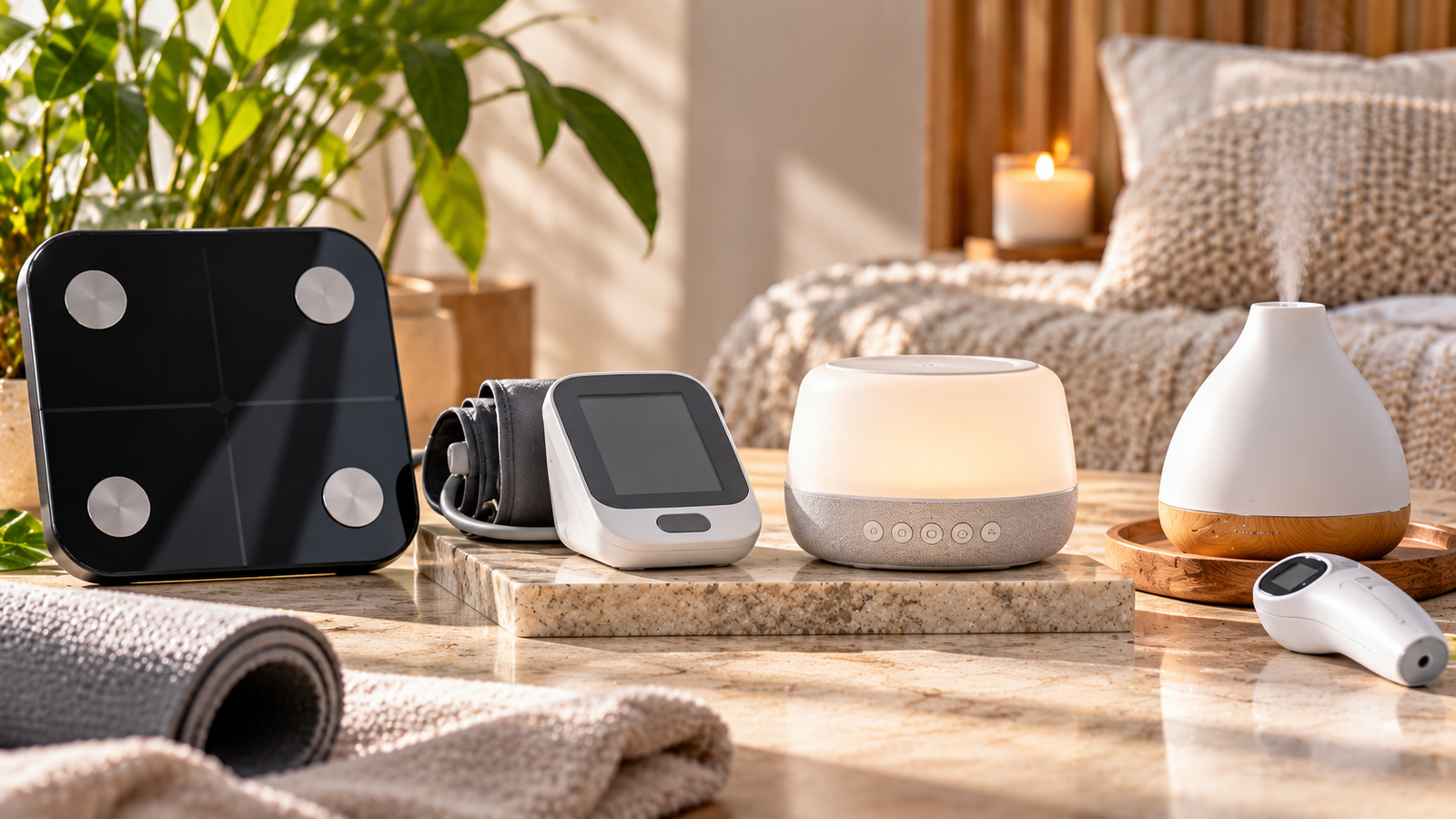
Smart scales are often marketed alongside blood pressure monitors, pulse oximeters, sleep accessories and other home wellness products.
However, these products serve different purposes.
They should not be evaluated as though they measure the same thing.
Smart weighing scales
A scale measures weight.
Certain models also estimate body composition through BIA.
These estimates have limitations and are not equivalent to a complete medical assessment.
Blood pressure monitors
A blood pressure monitor measures arterial blood pressure.
Its appropriate use depends on measurement technique, suitable cuff size and clinical context.
It does not provide a substitute for a weighing scale, and weight readings cannot determine blood pressure.
Sleep sound machines
A sleep sound machine produces background audio.
It does not measure body weight, body fat or blood pressure.
Its potential usefulness relates to the acoustic environment rather than physiological measurement.
Why the distinction matters
| Product | Primary role | What it cannot establish |
|---|---|---|
| Smart scale | Measures weight; may estimate body composition | Complete health status or medical diagnosis |
| Blood pressure monitor | Measures blood pressure | Body composition or overall cardiovascular diagnosis by itself |
| Sleep sound machine | Produces background sound | Physiological measurements or guaranteed sleep improvement |
| Basic digital scale | Measures weight | Body-fat percentage or muscle mass |
| Fitness tracker | Records selected activity-related data | Clinical diagnosis from ordinary consumer metrics |
Owning more wellness devices does not automatically improve health.
Each product should serve a clear purpose.
For a comparison of the different formats, read Physical Glow’s Smart Scale vs BP Monitor vs Sleep Sound Machine: Five Home Wellness Roles.
That guide discusses the practical roles of different home wellness products.
This article focuses specifically on smart-scale measurements, consistency and interpretation.
A Practical Smart Scale Measurement Checklist
If weighing is appropriate for your needs, the following checklist can help reduce avoidable measurement inconsistency.
| Check | What to do |
|---|---|
| Purpose | Know why and how often the measurement is needed |
| Time | Use a consistent time according to your routine or medical plan |
| Scale | Use the same device where practical |
| Floor | Choose a firm, level and stable surface |
| Position | Stand with both feet evenly supported |
| Movement | Remain still until the reading stabilizes |
| Clothing | Keep clothing conditions reasonably consistent |
| Units | Confirm kilograms, pounds or other displayed units |
| BIA contact | Follow bare-foot and electrode instructions if applicable |
| Safety | Observe restrictions for implanted devices, pregnancy and other conditions |
| Records | Keep only the information needed for the intended purpose |
| Interpretation | Avoid overreacting to a single reading |
This checklist is not a recommendation to weigh every day.
Use it only when monitoring serves a meaningful purpose.
Common Smart Scale Mistakes
Mistake 1: Treating every daily increase as fat gain
Short-term changes can reflect hydration, digestion and other factors.
A scale cannot identify the exact cause from one reading.
Mistake 2: Comparing morning and evening measurements directly
Different timing introduces additional variation.
Use consistent conditions when a comparison is needed.
Mistake 3: Placing the scale on thick carpet
Soft flooring may affect accuracy.
Follow the manufacturer’s floor-placement instructions.
Mistake 4: Moving the scale before every measurement
Repeated movement can change the setup and may require recalibration.
Keep it in a consistent location when possible.
Mistake 5: Leaning on furniture while weighing
External support can affect how much weight acts on the scale.
However, personal safety takes priority if unsupported standing is unsafe.
Mistake 6: Assuming body-fat estimates are exact
BIA-based values depend on algorithms and measurement conditions.
They should not be treated as direct measurements of tissue composition.
Mistake 7: Comparing different smart scales as though they use identical algorithms
Models may use different sensors, assumptions and calculation methods.
Results are not necessarily interchangeable.
Mistake 8: Ignoring restrictions on impedance-based measurements
People with pacemakers or other relevant medical circumstances must follow manufacturer precautions and professional advice.
Mistake 9: Weighing repeatedly to find a preferred result
This can create confusion and may encourage unhealthy preoccupation.
Follow an appropriate monitoring schedule.
Mistake 10: Changing eating or exercise habits because of one number
An isolated reading does not establish the need for sudden behaviour changes.
Seek individualized professional advice when weight management is medically relevant.
Frequently Asked Questions
Why does smart scale weight change daily?
Daily weight changes can reflect differences in hydration, food intake, digestion, hormonal factors and other physiological processes.
Measurement conditions can also influence results.
A short-term change does not automatically mean that body fat has increased or decreased.
Is it normal for weight to fluctuate from one day to the next?
Yes.
Short-term fluctuations are common.
However, the amount varies between people.
Unexpected, substantial or persistent changes, particularly with concerning symptoms, deserve medical attention.
Should I weigh myself every morning?
Not necessarily.
The NHS recommends consistent timing, preferably in the morning, when weighing is appropriate.
Its general guidance suggests regular weekly-to-monthly measurements.
Follow individualized medical instructions when applicable.
Is morning weight more accurate than evening weight?
Morning measurements may be easier to standardize because fewer daily meals and activities have occurred.
However, that does not make every morning reading perfectly accurate.
Consistency of conditions is the main consideration.
Why do I weigh more after eating?
Food and fluids contribute mass while they are in the body.
A higher reading after eating does not automatically represent increased body fat.
Why does my weight increase after a salty meal?
Sodium intake can influence water retention.
This may cause temporary changes in scale weight.
The response varies between individuals.
Why does my weight decrease after exercise?
Fluid loss through sweating may contribute to a lower reading.
This should not automatically be interpreted as fat loss.
Do not intentionally dehydrate yourself to reduce the displayed number.
Does drinking water increase scale weight?
Drinking water adds mass temporarily.
The body subsequently regulates water through normal physiological processes.
A short-term increase after drinking does not establish body-fat gain.
Can menstrual cycles affect scale weight?
Yes.
Hormonal changes and fluid retention may contribute to fluctuations around the menstrual cycle.
However, individual patterns vary.
Should a smart scale be used on tile or carpet?
A firm, level surface is generally recommended.
Some devices support specific carpet accessories, but not all models do.
Follow the manufacturer’s instructions.
Can moving a scale change the reading?
It can affect the measurement setup.
Some scales require recalibration or a brief settling period after movement.
Follow the model-specific procedure.
Why do I get different readings when I step on the scale twice?
Differences may reflect movement, positioning, calibration, floor stability or other factors.
Check the manufacturer’s instructions.
Avoid repeatedly weighing without a useful reason.
Why does my smart scale show a different body-fat percentage each day?
Body-composition estimates may change with hydration, recent food intake, physical activity, skin temperature and measurement conditions.
A changed estimate does not necessarily represent an equivalent change in body fat tissue.
Are smart-scale body-fat readings accurate?
They are estimates derived from measurement techniques such as bioelectrical impedance and mathematical models.
Accuracy varies by device and circumstances.
They should not be treated as a medical diagnosis or exact tissue measurement.
Can a smart scale accurately measure muscle mass?
Consumer smart scales estimate muscle-related measurements using algorithms.
They do not directly measure each muscle.
Small daily changes should not be interpreted as precise muscle gain or loss.
Do I need bare feet on a smart scale?
Many BIA scales require bare-foot contact with their electrodes.
Check the instructions for your model.
Ordinary weight-only measurements may have different requirements.
Can people with pacemakers use smart scales?
Some impedance-based body-composition functions are contraindicated for people with pacemakers or other implanted medical devices.
Certain models provide a weight-only mode.
Follow manufacturer-specific precautions and consult your healthcare professional.
Are body-fat readings reliable during pregnancy?
Pregnancy can affect hydration and body-composition interpretation.
Some manufacturers recommend disabling impedance-based features during pregnancy.
Use the device only according to its safety instructions and appropriate medical guidance.
Is a smart scale better than a basic digital scale?
Not necessarily.
A smart scale may provide convenient records and additional estimates.
A basic digital scale may be sufficient if only weight measurement is required.
Choose according to the intended purpose.
Can a scale tell me whether I am healthy?
No.
Body weight is only one measurement.
Health assessment depends on many factors, including medical history, physical examination and other appropriate information.
How often should I review smart-scale trends?
Review frequency should match your purpose and any clinical advice.
More frequent checking is not automatically more useful.
If the numbers cause distress or unproductive preoccupation, reconsider the monitoring routine.
Should I stop weighing myself if it causes anxiety?
If weighing is not medically necessary and causes distress, reducing or stopping may be appropriate.
If monitoring is part of a medical care plan, discuss alternatives with your clinician.
Seek support if weight-related thoughts or behaviours become persistent or harmful.
When should I see a doctor about changing weight?
Seek medical advice for substantial, unexplained or persistent changes, especially when accompanied by swelling or other concerning symptoms.
If you have a medical monitoring plan, follow its specified action thresholds.
For severe breathlessness, chest pain or other emergency symptoms, seek urgent medical care.
Final Takeaway
Smart scale readings fluctuate because body weight and measurement conditions are not perfectly constant.
Meals, hydration, digestion, hormonal changes, activity and other factors can influence the number displayed from one day to the next.
Floor placement, foot position and device calibration can introduce additional variation.
A firm, level surface and consistent measurement conditions can help improve comparability when weighing is appropriate.
However, one reading cannot identify whether a change comes from body fat, muscle, water or ordinary physiological variation.
Smart scales that provide body-composition estimates introduce further limitations.
Their BIA-based calculations depend on assumptions and can be affected by hydration, temperature, activity and measurement technique.
These numbers should not be treated as precise tissue measurements or medical diagnoses.
Most importantly, weight monitoring should serve a useful purpose.
Daily checking is not necessary for everyone, and a scale should not become a source of compulsive behaviour or distress.
When monitoring is medically important, follow your clinician’s schedule and action plan.
For a broader comparison of home wellness products, read Physical Glow’s Smart Scale vs BP Monitor vs Sleep Sound Machine: Five Home Wellness Roles.
The most useful smart scale is not the one that provides the largest number of metrics. It is one that provides appropriately reliable measurements for a clear purpose—without encouraging overinterpretation or unnecessary checking.
Physical Glow’s editorial principle: Weight and body-composition guidance should distinguish normal physiological variation from measurement limitations, avoid unsupported body-fat claims, and never encourage compulsive weighing, unsafe weight-loss practices or self-diagnosis.
References and Further Reading
- NHS England — How to Record Your Weight
- Cleveland Clinic — Why Does My Weight Fluctuate So Much?
- Cleveland Clinic — Weight Changes Around Your Period
- National Institutes of Health — Bioelectrical Impedance Analysis in Body Composition Measurement
- NCBI Bookshelf — Bioelectrical Impedance: Research Issues and Consensus
- Withings — Troubleshooting Inaccurate Weight Measurements
- Withings — Body Composition Accuracy Issues
- Withings — Weight-Only Mode and Medical Implant Precautions
- National Eating Disorders Association — Warning Signs and Symptoms