Cleansing Balm vs Cleansing Oil: Texture, Emulsification and Routine Fit
Cleansing balms and cleansing oils are designed to do a similar job: dissolve oil-soluble residue such as sunscreen, makeup, excess sebum and other products that may be difficult to remove with a water-based cleanser alone. The biggest difference is not necessarily how “strong” they are, but how they feel, dispense, spread and fit into your routine.
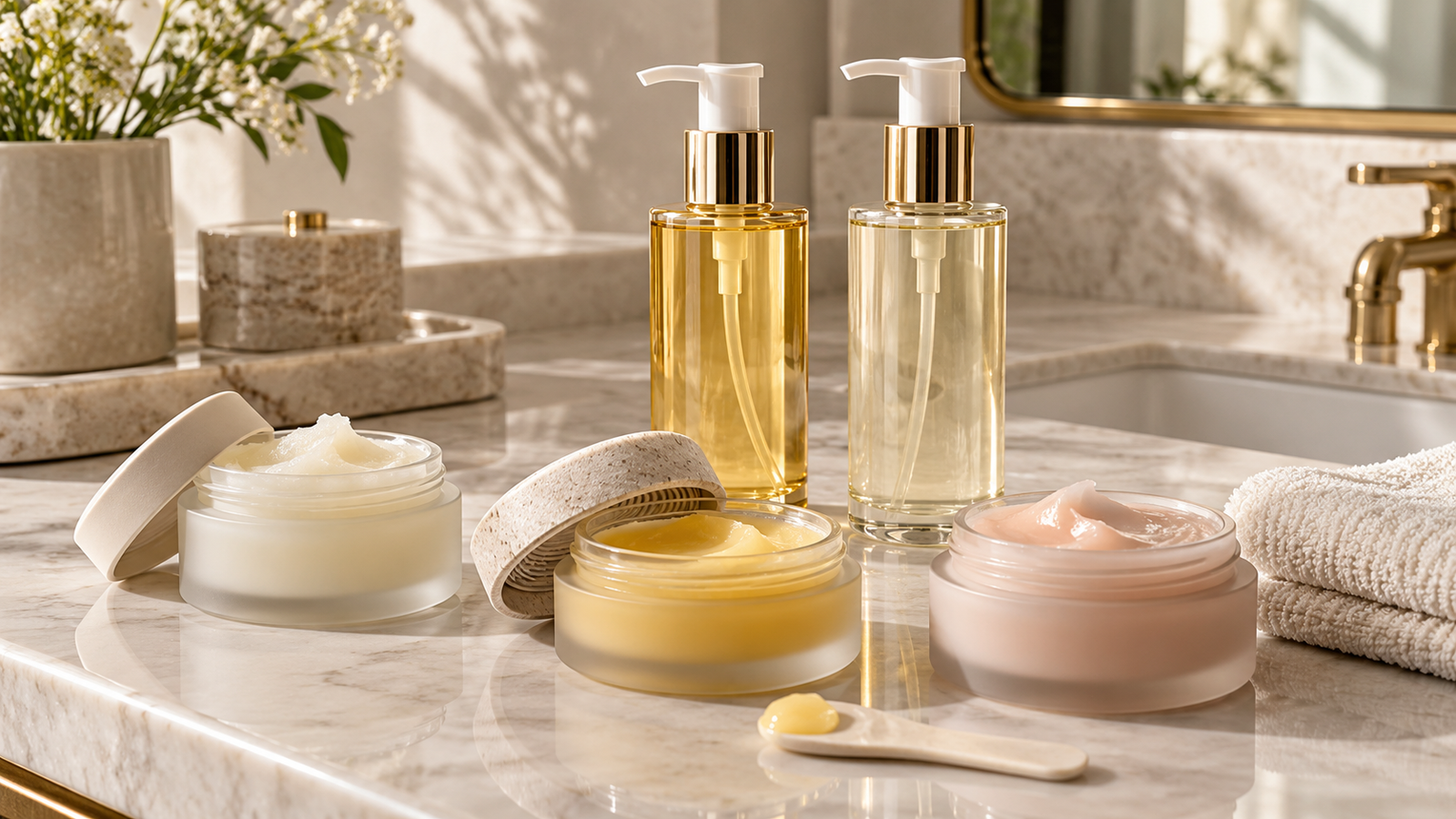
A cleansing oil starts as a liquid, usually from a pump bottle. A cleansing balm begins as a solid or semi-solid product that melts as you massage it over the skin. Both can work as the first step of a double-cleansing routine, but the better choice depends on your preferences, the products you wear and how much effort you want from your evening cleanse.
This guide explains the practical differences between cleansing balms and cleansing oils, including texture, emulsification, rinsing, packaging, travel convenience and suitability for different routines.
Cleansing Balm vs Cleansing Oil at a Glance
| Feature | Cleansing Balm | Cleansing Oil |
|---|---|---|
| Starting texture | Solid or semi-solid | Liquid |
| How it changes during use | Melts into an oily texture | Remains fluid and oily |
| Typical packaging | Jar, tub or grinding dispenser | Pump bottle |
| Application control | Easy to scoop a measured amount | Fast to dispense and spread |
| Travel convenience | Usually less likely to leak | Pump bottles need more care when travelling |
| Best suited to | People who enjoy a richer, massage-like cleansing step | People who prefer a quick, lightweight first cleanse |
What Is a Cleansing Balm?
A cleansing balm is an oil-based cleanser formulated in a solid or semi-solid form. It may look similar to a thick cream, waxy balm or soft butter inside the container.
When you massage it between your fingers and over dry skin, the balm softens and melts into an oily layer. That oil phase helps loosen makeup, sunscreen and other oil-soluble residue.
Most cleansing balms also contain emulsifying ingredients. When water is added, the oily layer becomes milky and can be rinsed away more easily.
What makes a balm convenient?
The solid starting texture gives you more control over how much product you remove from the container. A small scoop can be distributed across the face without immediately running between the fingers.
Balms can also be useful for travel because a solid product is generally less likely to leak than a thin cleansing oil. Packaging still matters, however, and jars should always be closed securely.
Possible downsides of cleansing balms
Traditional balm jars usually require you to scoop the product out with your fingers or a spatula. That adds an extra step and requires keeping the applicator reasonably clean.
Some newer balm containers use twist-up or grinding-style dispensers that release a measured amount without requiring you to reach into the jar.
What Is a Cleansing Oil?
A cleansing oil performs the same general first-cleanse function but begins as a liquid. Most come in pump bottles and can be applied directly to dry hands before being massaged onto dry skin.
The fluid texture allows cleansing oil to spread quickly across the face, which can make it convenient when you want a fast evening routine.
Why some people prefer cleansing oil
The pump format is simple. There is no spatula to store, no product to scoop and very little preparation required.
A lightweight oil can also feel easier to distribute around areas where sunscreen and makeup collect, such as around the nose, hairline and jaw.
Possible downsides of cleansing oils
Because the product is liquid, it can drip if too much is dispensed. Pump bottles may also be less convenient for travel unless the pump can be locked securely.
Another common mistake is using far more oil than necessary. More product does not automatically mean better cleansing and can simply make the rinsing stage longer.
How Both Cleansers Remove Sunscreen and Makeup
Many sunscreens, foundations and long-wear cosmetics contain oils, waxes, silicones or film-forming ingredients that are designed to stay on the skin for extended periods.
An oil-based first cleanser helps loosen these materials by mixing with the oily and water-resistant components on the skin.
This is why both cleansing oils and cleansing balms can be useful before a water-based cleanser, particularly after wearing heavier sunscreen or makeup.
Neither format should be considered automatically more powerful simply because it feels richer or more fluid. The finished formula and how well it emulsifies are more important than whether the product started as a balm or an oil.
What Does Emulsification Mean?
Emulsification is one of the most important parts of using an oil-based cleanser correctly.
After the cleansing oil or melted balm has been massaged over dry skin, adding a small amount of water allows the emulsifiers in the formula to mix the oil phase with water. The cleanser often changes from transparent or oily to a cloudy, milky texture.
This step helps the cleanser rinse away more cleanly.
A simple emulsification routine
- Start with dry hands and a dry face unless the product instructions say otherwise.
- Apply the recommended amount of cleansing balm or oil.
- Massage gently across the face.
- Add a small amount of water to your fingertips.
- Massage again until the cleanser becomes milky.
- Rinse thoroughly with lukewarm water.
Avoid excessively long or aggressive massage. More rubbing is not automatically better and may simply irritate the skin.
Do You Need a Second Cleanser?
Not everyone needs to double cleanse every time they wash their face.
A second water-based cleanser can be useful when you have worn heavy makeup, water-resistant sunscreen or several layers of products and want to make sure the skin feels clean after the first cleanse.
However, if your first cleanser rinses cleanly and your skin feels comfortable, an additional cleanser may not always be necessary.
The goal is clean, comfortable skin—not a tight or squeaky feeling.
Cleansing Balm vs Cleansing Oil for Oily Skin
Having oily skin does not automatically mean you need to avoid oil-based cleansers.
A well-formulated cleansing oil or balm is designed to be rinsed away rather than remain as a facial oil. For oily skin, the more important considerations are how completely the cleanser emulsifies, how the skin feels after rinsing and whether the overall routine becomes too heavy.
Some people with oily skin prefer lightweight cleansing oils because they spread quickly and rinse easily. Others prefer a balm because it allows more controlled application.
The starting texture alone does not determine whether a cleanser will suit oily skin.
Cleansing Balm vs Cleansing Oil for Dry Skin
People with dry skin may prefer the richer sensory experience of a cleansing balm, particularly when foaming cleansers tend to leave their skin feeling tight.
However, a lightweight cleansing oil can also work well because both categories are generally designed to remove residue without relying entirely on strong surfactant cleansing.
What matters most is how the complete formula behaves after rinsing and what cleanser, if any, follows it.
Which Is Better for Heavy Makeup?
Both formats can work well for makeup removal.
A balm can be particularly convenient when you want to massage product carefully around stubborn foundation, lip products or heavier makeup because the thicker starting texture gives more application control.
A liquid oil may be faster when you want to spread cleanser over a larger area quickly.
For waterproof eye makeup, avoid aggressive rubbing. Follow the product’s directions and keep the cleanser out of the eyes.
Which Is Better for Sunscreen Removal?
Either cleansing format can be used to remove sunscreen.
If you wear a water-resistant or high-adhesion sunscreen, an oil-based first cleanse may make removal easier at the end of the day.
The important part is using enough cleanser to cover the face, massaging gently and emulsifying completely before rinsing.
If you want to compare specific first-cleansing options, see our guide to the Top 5 Cleansing Oils & Balms in India.
Cleansing Balm vs Cleansing Oil for Travel
A cleansing balm usually has the advantage for travel because its solid texture is less likely to leak inside a toiletry bag.
That does not mean every balm container is travel-proof. Large jars can still be bulky, and loosely fitted lids may open during transport.
For cleansing oils, look for a pump that can be locked or use a secure travel container approved for liquids.
Packaging Can Matter More Than You Think
Packaging changes how convenient an oil cleanser feels in everyday use.
Pump bottles
Pumps are fast and hygienic because the remaining product stays inside the bottle. They are especially useful when cleansing is the last thing you want to spend time measuring at night.
Traditional balm jars
Jars provide easy access to the product but are best used with clean, dry hands or a cosmetic spatula.
Grinding or twist dispensers
Some cleansing balms use a rotating dispenser that releases balm from the top of the container. This format can reduce direct contact with the product inside the jar and provide more controlled dispensing.
Common Mistakes When Using Oil-Based Cleansers
Applying them to very wet skin
Most cleansing oils and balms are intended to begin on dry skin. Starting with too much water can interfere with the initial oil-based cleansing stage. Always check the label because individual formulas can differ.
Skipping emulsification
Immediately rinsing away the cleanser without adding water gradually can make some formulas harder to remove.
Using too much product
More cleanser is not automatically more effective. Excess product can make rinsing slower and increase waste.
Massaging aggressively
The cleanser should do most of the work. Vigorous rubbing is unnecessary and may irritate sensitive skin.
Choosing by skin type alone
Labels such as oily, dry or combination can be useful, but cleanser texture, fragrance, emulsification, routine compatibility and personal preference are also important.
Do Cleansing Oils Cause Breakouts?
An oil cleanser does not automatically cause acne simply because it contains oils.
Breakouts are influenced by many factors, including the complete formula, individual sensitivity, how thoroughly the cleanser is removed and the rest of the skincare routine.
If a new cleanser repeatedly seems to coincide with irritation or breakouts, stop using it and reassess the routine rather than assuming all cleansing oils or balms will behave the same way.
Can You Use a Cleansing Balm or Oil Every Day?
Many people use an oil-based cleanser daily, particularly in the evening when removing sunscreen or makeup.
But there is no requirement to use one every day. If you have worn little product and your normal cleanser removes everything comfortably, a first cleanse may not be necessary.
Frequency should follow your routine rather than a fixed skincare rule.
How to Choose Between Cleansing Balm and Cleansing Oil
Consider the following practical questions before deciding:
- Do you prefer a solid product or a liquid product?
- Do you want a pump or a jar?
- Will you travel with the cleanser regularly?
- Do you wear heavy makeup or mostly sunscreen?
- Do you enjoy spending time massaging in a balm, or do you want a faster cleanse?
- Does the product emulsify and rinse comfortably for your skin?
- Will you use a second cleanser afterward?
Cleansing Balm vs Cleansing Oil: Which Should You Choose?
Choose a cleansing balm if you prefer a thicker starting texture, controlled scooping, travel-friendly packaging and a more deliberate massage-style cleansing step.
Choose a cleansing oil if you prefer a lightweight liquid, pump-bottle convenience and fast distribution across the face.
Neither format is automatically better. Both can perform the same fundamental first-cleansing role when properly formulated and used correctly.
The most useful choice is the one that removes the products you wear, rinses comfortably and is easy enough that you will actually use it consistently.
Frequently Asked Questions
Is cleansing balm better than cleansing oil?
Not universally. They perform a similar first-cleanse function but differ mainly in texture, packaging and application experience.
Can I use cleansing balm without double cleansing?
Yes, depending on the product and your routine. If it rinses cleanly and your skin feels comfortable, a second cleanser may not always be necessary.
Can oily skin use cleansing balm?
Yes. Oily skin does not automatically need to avoid balm or oil cleansers. Formula quality, emulsification and how the skin feels after rinsing are more important than the starting texture.
Which removes sunscreen better: balm or oil?
Both can remove sunscreen effectively when formulated for first cleansing. The exact formula and correct emulsification matter more than whether it begins as a balm or liquid oil.
Should cleansing oil be applied to wet or dry skin?
Most are intended for dry skin first, followed by water for emulsification, but always follow the instructions for the specific product.
Related Reading
If you are deciding between different cleansing formats rather than only oil and balm, read our guide to Cleansing Oil vs Micellar Water vs Face Wash.
For specific products currently shortlisted by Physical Glow, see Top 5 Cleansing Oils & Balms in India.
Physical Glow publishes educational content to help readers understand beauty, fitness and wellness products. This article is informational and is not a substitute for professional medical or dermatological advice.