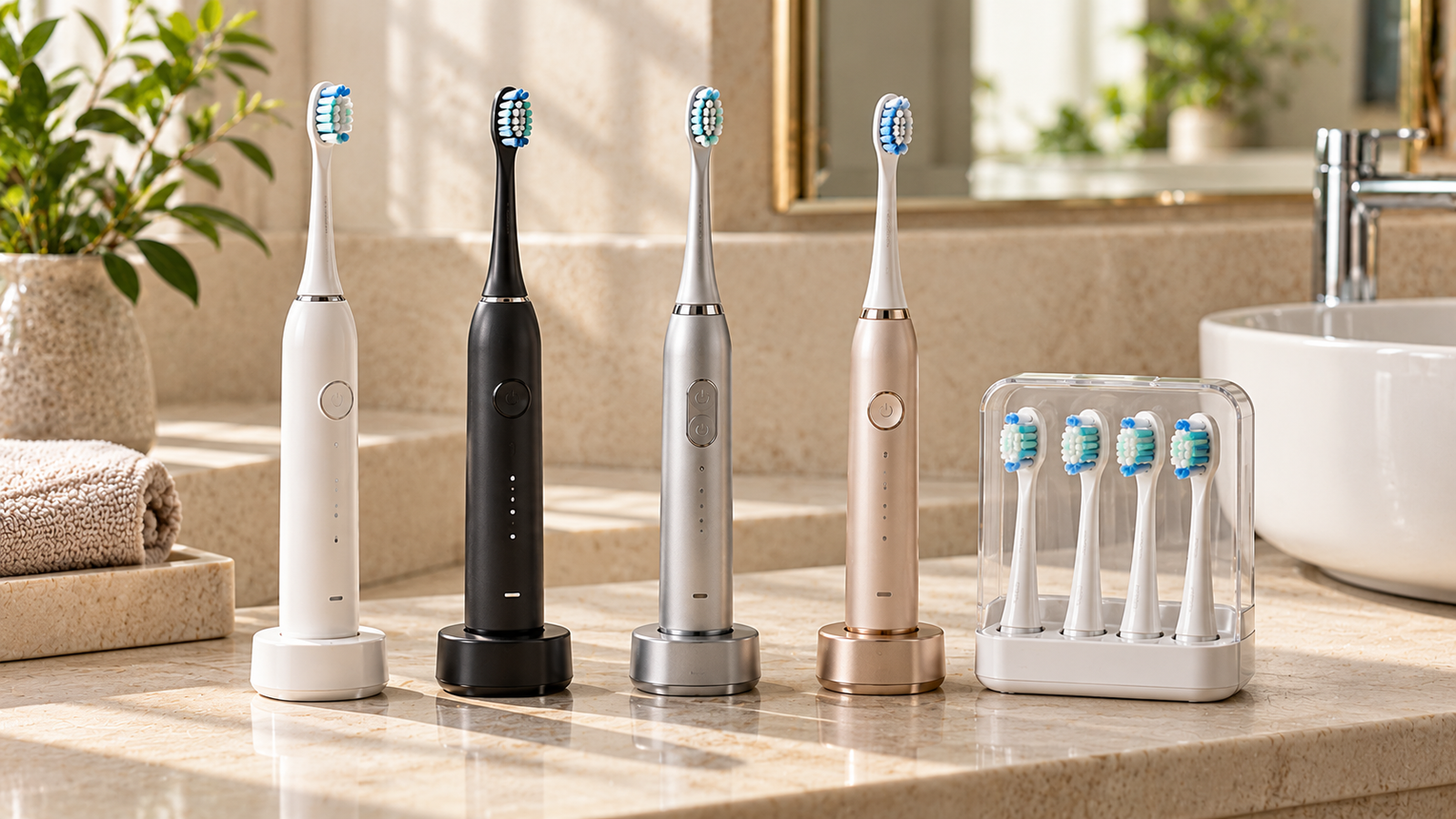
Electric Toothbrush Head Compatibility: What to Check Before Buying
Electric toothbrushes are designed for repeated use, but their brush heads need regular replacement. Whether you use a sonic toothbrush, an oscillating-rotating model or a premium smart toothbrush, choosing the correct replacement head is an important part of maintaining your oral hygiene routine.
However, buying replacement brush heads is not always straightforward.
Two brush heads may look almost identical but use completely different attachment mechanisms. A replacement head designed for one toothbrush series may not fit another model from the same manufacturer.
For example, Philips Sonicare toothbrushes commonly use click-on replacement heads, but Philips One and some older Sonicare models use different designs.
Similarly, Oral-B iO toothbrushes require iO-specific replacement heads rather than the standard heads used by many older Oral-B models.
The safest way to buy replacement brush heads is to identify your exact toothbrush handle model and confirm compatibility using the manufacturer’s official information.
The appearance of the brush head, the brand name or a seller’s claim of universal compatibility is not enough.
This guide explains how to identify compatible replacement heads, understand different attachment systems, choose appropriate bristles and avoid common purchasing mistakes.
1. Why Electric Toothbrush Head Compatibility Matters
An electric toothbrush has two main components:
- The powered handle, which contains the motor and control system.
- The removable brush head, which transfers movement to the bristles.
These components must work together correctly.
Depending on the design, the brush head connects to the handle through a shaft, coupling or another attachment mechanism.
During brushing, the handle generates mechanical movement that is transmitted to the brush head.
The connection must allow the intended movement while keeping the brush head securely attached.
What happens when you use an incompatible brush head?
Possible problems include:
- The head not fitting onto the handle.
- A loose or unstable connection.
- Excessive vibration or rattling.
- Reduced movement of the brush head.
- An attachment that becomes difficult to remove.
- Damage to the connection mechanism.
- Failure of smart replacement reminders.
- Unexpected detachment during use.
Not every incorrectly fitting brush head will cause all these problems.
However, a replacement head that appears to fit physically is not necessarily designed to function correctly with the handle.
Compatibility means more than simply being able to push a brush head onto a toothbrush.
2. How to Find Your Electric Toothbrush Model Number
Before purchasing replacement heads, identify the exact model of your toothbrush.
This is the single most useful step in preventing compatibility mistakes.
Step 1: Examine the handle
Look for a model number printed or engraved on the toothbrush.
It may appear:
- Near the bottom of the handle.
- On the underside.
- Close to the charging connection.
- On a product identification label.
For example, Philips states that Sonicare model numbers can often be found on the bottom of the toothbrush handle.
Step 2: Check the original packaging
If you still have the retail box, look for the model and product identification number.
Do not confuse the handle model with a brush-head replacement code.
Step 3: Review the user manual
The manual may identify compatible replacement-head families.
Some manuals also describe how to remove and install the brush head.
Step 4: Check the purchase invoice
Your original online order may include the toothbrush’s model designation.
Be aware that online product titles are sometimes incomplete.
Step 5: Use the official compatibility guide
Search the manufacturer’s website using the exact model.
For example, a Philips Sonicare handle identified by an HX-series code can be checked against Philips’ official compatibility tables.
Important distinction
A marketing name such as Sonicare DiamondClean or Oral-B Pro may cover several models.
When official information is available, use the exact handle model rather than relying on the product family name alone.
3. Are All Philips Sonicare Brush Heads Compatible?
No.
Most modern Philips Sonicare rechargeable toothbrushes use standard click-on brush heads.
However, Philips identifies several exceptions.
These include certain older models and the Philips One product family.
Philips Sonicare compatibility overview
| Toothbrush family | Common attachment type | What to check |
|---|---|---|
| Sonicare 1000–4000 series | Standard click-on on listed models | Exact handle model |
| Sonicare ProtectiveClean | Standard click-on on listed models | HX-series identification |
| Sonicare ExpertClean | Standard click-on on listed models | Compatible head listing |
| Sonicare DiamondClean | Standard click-on on listed models | Handle model and optional smart features |
| Sonicare Prestige 9900 | Standard click-on on listed models | Exact model and head features |
| Philips One | Proprietary Philips One head | Philips One model compatibility |
| Selected older Essence/Xtreme models | Larger screw-on head | Exact model and attachment |
This table is a general summary of Philips’ official compatibility guidance, not an exhaustive list.
The manufacturer maintains specific model-number tables that should be checked before purchasing.
Standard click-on Sonicare heads
Philips states that standard click-on brush heads fit most compatible rechargeable Sonicare handles.
Examples listed in its compatibility guide include various ProtectiveClean, DiamondClean and Prestige models.
However, the exact handle code remains important.
Philips One brush heads
Philips One and Philips One for Kids have their own replacement-head systems.
They should not be assumed to accept standard Sonicare click-on heads.
Older Sonicare models
Certain older Essence and Xtreme models use larger screw-on attachments.
A standard click-on replacement head may therefore be unsuitable.
The safest approach
Find the HX, HY or other model identification printed on your toothbrush and check it against Philips’ current official compatibility information.
See: Philips Sonicare — Which Brush Head Fits My Toothbrush?
4. Are All Oral-B Replacement Heads Interchangeable?
No.
Oral-B currently has different replacement-head families, including iO and conventional non-iO models.
The distinction is particularly important because both categories can include round-looking brush heads.
Oral-B iO replacement heads
Oral-B iO toothbrushes require brush heads designed specifically for the iO system.
According to Oral-B’s official India website, ordinary non-iO replacement heads are not compatible with iO handles.
Conventional Oral-B replacement heads
Many conventional Oral-B electric toothbrushes in the following ranges use the non-iO replacement-head family:
- Vitality
- Pro
- Smart
- Genius
However, additional exceptions exist, including certain Sonic or Pulsonic toothbrush systems.
Check the exact model.
Compatibility comparison
| Oral-B handle family | Replacement-head family |
|---|---|
| Oral-B iO | Oral-B iO heads |
| Oral-B Pro | Compatible non-iO heads |
| Oral-B Vitality | Compatible non-iO heads |
| Oral-B Smart | Compatible non-iO heads |
| Oral-B Genius | Compatible non-iO heads |
| Selected Sonic/Pulsonic models | Model-specific heads |
Why the distinction matters
A standard Oral-B round replacement head may resemble an iO brush head.
However, the attachment and movement systems differ.
Do not force a non-iO head onto an iO handle or the reverse.
See: Oral-B India — Replacement Brush Heads
5. What About Laifen Wave Replacement Brush Heads?
Some newer electric toothbrush brands also use proprietary replacement systems.
Laifen Wave is an example.
The manufacturer offers several replacement-head formats for its Wave toothbrush family.
These include versions marketed for:
- Gum care
- General cleaning
- Whitening-oriented cleaning
However, these differences in intended use do not mean the heads are interchangeable with other brands.
Laifen’s official product guidance states that its Wave toothbrush is not compatible with brush heads from other manufacturers.
What should Laifen users check?
Verify:
- The exact Wave toothbrush model.
- The replacement-head product family.
- Whether the head is an official or explicitly compatible replacement.
- The head’s bristle design.
- The seller and package contents.
Do not assume that a similar-looking sonic brush head will fit.
The same principle applies to other brands using proprietary attachment systems.
6. Click-On vs Screw-On vs Proprietary Brush Heads
Electric toothbrush heads can use different physical connection systems.
Click-on brush heads
These usually attach by pushing the replacement head onto a compatible shaft.
The head is removed by pulling it away according to the manufacturer’s instructions.
Some Philips Sonicare handles use this method.
Screw-on brush heads
These use a threaded attachment that must be installed in a specified direction.
Certain older Sonicare models use this approach.
Proprietary coupling systems
Some manufacturers use specialized connectors designed for a particular range.
Examples include Oral-B iO and Philips One.
Why the attachment method matters
| Attachment | Main characteristic | Buying consideration |
|---|---|---|
| Click-on | Push-fit connection | Confirm shaft and head compatibility |
| Screw-on | Threaded connection | Confirm the correct thread and model |
| Proprietary coupling | Brand- or series-specific connection | Use the officially compatible replacement |
| Other specialized designs | Mechanism varies | Follow model-specific instructions |
Do not modify brush heads or adapters to make an incompatible product fit.
An improvised connection may interfere with the intended brush movement or damage the handle.
7. Does Every Compatible Brush Head Support Smart Features?
Not necessarily.
Some modern electric toothbrushes have features that communicate with compatible replacement heads.
Philips Sonicare’s BrushSync system is one example.
On supported combinations, certain brush heads and handles can provide functions such as:
- Brush-head recognition.
- Mode pairing.
- Usage tracking.
- Replacement reminders.
However, the availability of these features depends on both the handle and brush head.
Mechanical compatibility vs electronic compatibility
A replacement head may physically fit a supported toothbrush but lack the components needed for a particular smart feature.
For example, a standard compatible Sonicare brush head may function mechanically with certain handles without necessarily supporting every BrushSync capability.
Before buying a smart brush head
Check:
- Does your handle support the smart feature?
- Does the replacement head include the necessary technology?
- Is that particular function available with your handle?
- Does the manufacturer specify any limitations?
Do not purchase expensive smart replacement heads solely because your toothbrush is described as premium.
The specific handle model determines which features can operate.
8. Soft vs Medium vs Hard Bristles: Which Should You Choose?
Bristle stiffness is another important factor.
The American Dental Association recommends using a toothbrush with soft bristles.
Soft bristles are generally preferred because they can clean effectively while reducing the risk of damage associated with excessive pressure and harder bristles.
Soft bristles
Soft bristles are a practical default for everyday brushing.
They are particularly relevant for people who experience gum sensitivity or tend to brush aggressively.
Extra-soft bristles
Some replacement heads are designed with extra-soft filaments.
These may be worth discussing with your dentist if you experience sensitivity or have particular gum-care needs.
Medium bristles
Some manufacturers offer medium-bristle brush heads.
However, stronger bristles should not automatically be interpreted as providing better cleaning.
Brushing technique, pressure and coverage are important.
Hard bristles
Hard bristles are generally not recommended for routine brushing because of the potential for gingival abrasion and other damage when used improperly.
Practical comparison
| Bristle type | General consideration |
|---|---|
| Extra-soft | Gentle option for selected needs |
| Soft | Recommended general-purpose starting point |
| Medium | Not automatically more effective |
| Hard | Generally unsuitable as a default for routine brushing |
A brush head should help you clean your teeth thoroughly without requiring aggressive pressure.
9. Small vs Large Brush Heads
Brush heads also vary in size.
Some have compact cleaning surfaces, while others are longer or broader.
Smaller heads
A smaller brush head may make it easier to reach certain areas of the mouth, particularly around the back teeth.
However, this depends on the toothbrush movement and the user’s mouth dimensions.
Larger heads
Larger heads cover a broader area, but may be less comfortable for people with limited space inside the mouth.
What does the ADA recommend?
The American Dental Association advises choosing a toothbrush with a shape and size that allows you to reach all areas of your mouth.
The correct size is therefore a matter of comfortable access, not simply choosing the largest brush head.
If you find it difficult to clean the back molars, discuss appropriate brush-head size and technique with your dentist.
10. Sonic vs Oscillating Brush Heads: Can They Be Interchanged?
Not generally.
Sonic and oscillating-rotating toothbrushes use different movement mechanisms.
Sonic toothbrushes
These typically use rapid side-to-side or other oscillatory bristle movements generated through the handle’s drive system.
Philips Sonicare is a familiar example.
Oscillating-rotating toothbrushes
These commonly use compact round heads that move through a controlled oscillating or rotating action.
Many Oral-B models use this approach.
Why the difference matters
A sonic brush head is not designed to function as a conventional Oral-B round replacement head.
Similarly, an oscillating-rotating head cannot simply be installed on a Sonicare handle.
The shape, connector and motion-transmission system must all be compatible.
A manufacturer’s compatible product line should determine the replacement choice.
11. How Often Should Electric Toothbrush Heads Be Replaced?
The American Dental Association recommends replacing toothbrushes approximately every three to four months, or sooner when the bristles become matted or frayed.
For many electric toothbrush manufacturers, the usual recommendation is approximately three months of normal use.
Why replacement matters
Over time, bristles can:
- Become bent.
- Spread outward.
- Lose their intended shape.
- Become worn.
- Provide less effective cleaning.
A worn brush head may not clean as intended.
Replace earlier if necessary
Do not wait for the end of the normal replacement interval if the head is visibly damaged.
Replace it if:
- Bristles are significantly frayed.
- The head is cracked.
- The connector becomes loose or damaged.
- The head produces unusual movement.
- The manufacturer identifies another condition requiring replacement.
What if the head still looks new?
Visual condition is useful, but it is not the only consideration.
Follow the manufacturer’s replacement interval and any applicable device reminder.
A head that looks acceptable from a distance may still have wear that is difficult to assess.
12. What Are Brush-Head Replacement Indicator Bristles?
Some electric toothbrush heads contain bristles that change or fade in color with use.
Their purpose is to help users recognize when replacement may be appropriate.
For example, certain Oral-B heads contain colored indicator bristles.
Some Philips Sonicare heads also include fading bristles.
Are indicator bristles perfectly accurate?
Not necessarily.
Color changes can provide useful guidance, but they should be interpreted alongside:
- Actual bristle condition.
- Time since installation.
- Brushing frequency.
- Manufacturer instructions.
Do not assume every product uses the same color-change mechanism.
Do smart reminders eliminate the need for inspection?
No.
A replacement reminder is useful, but you should still inspect the brush head.
If it becomes damaged before the reminder activates, replace it sooner.
13. How to Remove and Replace a Brush Head
The exact method depends on the attachment design.
For a typical compatible Philips Sonicare click-on system, the process commonly involves removing the previous head and installing the new one on the handle shaft.
General replacement procedure
- Switch off the toothbrush.
- Remove the existing brush head according to the manual.
- Inspect the connection area for residue or visible damage.
- Clean the connection area using the approved procedure.
- Position the compatible replacement head correctly.
- Attach it using the specified method.
- Check that it is secure.
- Test the toothbrush according to its instructions before normal use.
Should the brush head touch the handle completely?
Not always.
Philips explains that a small gap between certain Sonicare brush heads and the handle can be normal and necessary for proper movement.
Therefore, do not assume a visible gap always means incorrect installation.
However, the expected gap depends on the design.
A head that feels unstable, detaches unexpectedly or moves abnormally should not be used until the issue is resolved.
What if the head does not fit?
Stop.
Do not use excessive force, glue, tape or an improvised adapter.
Recheck the exact compatibility information.
14. Why a Replacement Brush Head May Feel Loose
A loose brush head can have several possible causes.
Incorrect replacement head
The head may belong to a different toothbrush series.
Incomplete attachment
The head may not be installed according to the manufacturer’s procedure.
Residue around the connector
Dried toothpaste or debris may interfere with correct installation.
Damaged brush-head coupling
The replacement head itself may have a defective or damaged connector.
Damaged toothbrush handle
The handle’s shaft or internal assembly may have developed a fault.
What should you do?
First, verify the exact brush-head model.
Then follow the manufacturer’s cleaning and installation instructions.
If the head remains unstable, stop using it and contact the manufacturer or authorized service provider.
Do not attempt to repair a damaged electric toothbrush shaft with household adhesives or improvised components.
15. Genuine vs Third-Party Compatible Brush Heads
Replacement brush heads are available from original manufacturers and third-party sellers.
Some third-party products are marketed as compatible with popular toothbrush handles.
However, compatibility and quality are separate questions.
Genuine replacement heads
These are produced or officially supplied by the toothbrush manufacturer.
They are designed for the specified product family.
Third-party compatible heads
These are made by independent manufacturers.
Some may be designed to fit particular toothbrush handles, but the quality and fit can vary.
What should you check?
| Factor | Genuine head | Third-party compatible head |
|---|---|---|
| Manufacturer | Original toothbrush brand | Independent manufacturer |
| Model compatibility | Defined by official manufacturer | Must be independently verified |
| Smart features | Depends on supported head and handle | May be unavailable |
| Product quality | Manufacturer-specific standards | Varies by supplier |
| Price | Depends on pack and seller | May be cheaper |
| Warranty considerations | Check terms | Check handle and accessory warranty terms |
Are third-party brush heads always unsafe?
No universal conclusion can be made about every third-party product.
However, neither a low price nor a physical resemblance establishes proper fit, cleaning performance or quality.
If you choose a third-party replacement, look for clear model-specific compatibility information and credible product documentation.
Check warranty terms as well.
For the lowest uncertainty about compatibility, an authentic manufacturer-approved head is generally the more straightforward choice.
16. How to Identify Suspicious or Counterfeit Brush-Head Listings
Counterfeit or misleading listings can create problems when purchasing replacement accessories online.
However, no single packaging detail proves that an item is authentic.
Common warning signs
- Unusually low prices without a clear explanation.
- Missing manufacturer information.
- Poor-quality or inconsistent packaging.
- Product titles that combine several incompatible model ranges.
- Unclear pack quantities.
- Missing model numbers.
- Inconsistent product photographs.
- Seller claims that contradict official compatibility guidance.
Check the exact product code
A genuine-looking listing should still identify the intended brush-head variant.
For example, Philips replacement heads commonly use HX-series product codes.
The exact code can help distinguish head families, bristle types and pack sizes.
Compare with the official listing
Review:
- Product name.
- Replacement-head model.
- Compatible handle families.
- Number of heads in the package.
- Packaging details.
- Seller information.
Avoid assuming that the phrase original quality means the product is an authentic manufacturer accessory.
What if you receive the wrong product?
Do not force it onto your toothbrush.
Follow the seller’s return or replacement process.
17. How to Compare Replacement Brush-Head Prices
Replacement heads are sold individually or in multipacks.
The lowest total selling price does not always represent the best value.
Calculate the cost per head.
Formula
Cost per brush head = Total selling price ÷ Number of brush heads
Imagine two hypothetical listings:
| Pack | Selling price | Heads included | Cost per head |
|---|---|---|---|
| Pack A | ₹720 | 2 | ₹360 |
| Pack B | ₹900 | 3 | ₹300 |
Pack B costs more upfront but provides a lower price per head.
Assuming each head is suitable for approximately three months of normal use:
Pack A: ₹360 ÷ 3 = ₹120 per month.
Pack B: ₹300 ÷ 3 = ₹100 per month.
In this example, Pack B has the lower estimated replacement cost.
These prices are illustrative and are not live retail quotations.
What about a six-pack?
A larger multipack may reduce unit cost, but only if:
- The heads fit your toothbrush.
- You expect to continue using that handle.
- The products can be stored appropriately.
- The seller and product condition are satisfactory.
- The total cost is within your budget.
Buying a large pack of incompatible heads does not save money.
18. Should You Buy a Multipack for the Whole Family?
Multipacks can be convenient when several family members use compatible electric toothbrushes.
However, sharing toothbrush equipment requires hygiene considerations.
Each person needs their own brush head
The American Dental Association advises against sharing toothbrushes because doing so can transfer bodily fluids and microorganisms.
If a compatible powered handle is shared under the manufacturer’s permitted use conditions, each person should have a separate, identifiable brush head.
Check handle and storage instructions
Not every manufacturer recommends sharing a powered handle.
Follow the product instructions and any specific hygiene precautions.
Keep replacement schedules separate
Different people may wear out their brush heads at different rates.
Do not assume a single replacement date is appropriate for everyone.
Confirm head compatibility
Two family members may own different toothbrush models, even when both are manufactured by the same brand.
Before purchasing a large pack, verify that every intended handle supports that head.
19. How to Clean Electric Toothbrush Heads
Regular cleaning helps remove toothpaste residue and debris.
The ADA recommends rinsing toothbrushes thoroughly after use and allowing them to air-dry.
After each brushing session
- Rinse the brush head thoroughly.
- Remove visible toothpaste residue.
- Follow the manufacturer’s instructions for cleaning the connection area.
- Allow the head to air-dry.
- Store it so that it does not unnecessarily contact other brush heads.
Cleaning the toothbrush handle
Some manufacturers recommend periodically removing the brush head and cleaning around the connection shaft.
Philips Sonicare, for example, provides instructions for rinsing certain shaft areas and wiping the handle with a damp cloth.
However, cleaning procedures vary.
Do not submerge electrical components unless the manufacturer expressly permits it.
Avoid unsuitable cleaning methods
The ADA advises against cleaning toothbrushes in a microwave or dishwasher.
Excessive heat can damage toothbrush components.
Do not use bleach, boiling water or harsh cleaning chemicals unless they are specifically approved for the device.
Should you use a toothbrush sanitizer?
A sanitizer is not automatically necessary.
If you choose one, check that it is suitable for the toothbrush components and has appropriate regulatory clearance where relevant.
Good everyday cleaning and correct storage remain important.
20. How to Store Spare Brush Heads
Replacement heads should be kept clean and protected until needed.
Keep unused heads in suitable packaging
Retain their original packaging when practical.
This helps identify the product model and limits unnecessary contact with other objects.
Avoid damp storage
Do not store used wet brush heads indefinitely in closed, poorly ventilated containers.
Allow them to dry properly.
Protect against damage
Avoid storing brush heads under heavy objects or alongside sharp accessories.
Bent bristles and damaged connectors can affect usability.
Check packaging before use
Inspect spare heads for visible defects before installation.
Discard or return products with cracked housings, damaged attachment points or abnormal bristle condition.
21. Can Children’s Electric Toothbrushes Use Adult Brush Heads?
Sometimes, but physical compatibility does not automatically mean age suitability.
Certain Philips Sonicare for Kids brush heads use the click-on system and may physically fit other compatible click-on handles.
However, age-appropriate bristle size, product instructions and the child’s ability to brush safely still matter.
What should parents check?
- The manufacturer’s recommended age range.
- Brush-head dimensions.
- Bristle softness.
- Handle compatibility.
- Whether adult supervision is recommended.
- The child’s brushing technique.
The American Academy of Pediatric Dentistry recommends age-appropriate supervision and brushing practices.
Do not replace a child’s recommended head with an adult-oriented head merely because the connector fits.
For young children, consult pediatric dental guidance and use products designed for the child’s developmental stage.
22. Can You Use Whitening Brush Heads Every Day?
Some replacement heads are marketed for whitening or stain removal.
Their design may include special bristle arrangements or polishing elements.
However, a whitening brush head should not automatically be assumed to whiten teeth through chemical bleaching.
Many such products are designed primarily to help remove surface stains.
What should you consider?
- Bristle stiffness.
- Manufacturer’s instructions.
- Gum comfort.
- Existing tooth sensitivity.
- Brushing pressure.
- Your dentist’s recommendations.
Avoid increasing brushing force in an attempt to remove stains more quickly.
Aggressive brushing can irritate gums and contribute to tooth wear.
Persistent tooth discoloration may require professional assessment rather than a different brush head.
23. Do Brush Heads for Sensitive Gums Work Differently?
Some manufacturers offer replacement heads designed for gentler cleaning.
They may feature:
- Extra-soft bristles.
- Different bristle patterns.
- Smaller head dimensions.
- Designs intended to reduce harsh contact.
However, a sensitive-care label does not mean the product treats gum disease.
Gum bleeding, swelling or persistent discomfort can have underlying causes.
What matters most?
Use appropriate brushing pressure and technique.
The ADA recommends soft bristles and gentle brushing.
If your gums bleed repeatedly or remain painful, consult a dentist rather than relying on a new brush-head design as treatment.
24. Are Expensive Replacement Heads Worth Buying?
Price alone does not establish cleaning effectiveness.
Some more expensive heads include specialized bristle designs or compatibility with smart features.
These features may be valuable to certain users.
However, the main requirements remain:
- Correct fit.
- Suitable bristles.
- Good manufacturing quality.
- Effective cleaning with proper technique.
- Regular replacement.
- Reasonable ongoing cost.
When a premium head may make sense
A higher-priced replacement may be useful when it supports a feature you actually use, fits your toothbrush correctly and offers an appropriate brushing experience.
When a simpler head may be enough
If a standard compatible soft-bristled replacement head meets your needs, an expensive specialized head is not automatically necessary.
Focus on oral hygiene fundamentals before paying more for additional marketing features.
25. How to Buy Replacement Brush Heads on Amazon India
Online marketplaces offer many replacement-head listings.
Use a structured compatibility check before purchasing.
Step 1: Identify the handle model
Read the model code on your electric toothbrush.
Step 2: Identify the required head family
Determine whether the model uses:
- Philips Sonicare standard click-on.
- Philips One proprietary heads.
- A compatible older Sonicare screw-on system.
- Oral-B iO.
- Conventional compatible Oral-B heads.
- Another manufacturer-specific system.
Step 3: Check official compatibility
Compare the exact handle model with the manufacturer’s published information.
Step 4: Confirm the replacement-head code
Do not rely solely on a listing title containing familiar brand names.
Step 5: Check bristle softness
Soft bristles are generally a good starting point.
Step 6: Confirm pack quantity
Check whether the listing contains one, two, three or more heads.
Step 7: Calculate cost per head
Compare the actual checkout price against the number of usable compatible heads.
Step 8: Review the seller
Check seller information, product condition and return terms.
Step 9: Verify authenticity claims
Prefer manufacturer-authorized or otherwise reliable sources for genuine accessories.
Step 10: Inspect before using
Once the package arrives, check the head’s construction and fit before normal brushing.
This process is more reliable than choosing the first listing advertising universal compatibility.
26. Common Electric Toothbrush Head Buying Mistakes
Mistake 1: Assuming every head from the same brand fits
Different product families can use different connectors.
Mistake 2: Confusing Oral-B iO and conventional Oral-B heads
The iO system requires its own compatible replacement-head family.
Mistake 3: Assuming all Sonicare products use click-on heads
Philips One and certain older models use different connections.
Mistake 4: Forcing an incompatible head onto the handle
This may damage components or produce an unsafe connection.
Mistake 5: Choosing hard bristles for stronger cleaning
The ADA recommends soft bristles for routine oral care.
Mistake 6: Using a head beyond its recommended replacement period
Bristles wear with use.
Mistake 7: Buying multipacks before checking compatibility
A cheap six-pack is poor value when none of the heads fits properly.
Mistake 8: Assuming third-party compatibility guarantees smart features
Mechanical fit does not automatically provide electronic recognition or replacement tracking.
Mistake 9: Ignoring unusual rattling or looseness
Stop using a head that moves or detaches unexpectedly.
Mistake 10: Sharing the same brush head
Toothbrush heads should not be shared between people.
27. Quick Compatibility Checklist
Before making a purchase, confirm the following.
| Question | Required check |
|---|---|
| What toothbrush do I own? | Exact handle model |
| What attachment does it use? | Click-on, screw-on or proprietary |
| Does the manufacturer list compatibility? | Official model confirmation |
| Does it support smart features? | Head and handle compatibility |
| Are the bristles appropriate? | Prefer soft, unless advised otherwise |
| Is the pack authentic? | Seller and product verification |
| How many heads are included? | Exact pack quantity |
| What is the unit price? | Total price ÷ number of heads |
| When should I replace the head? | Manufacturer guidance and bristle condition |
| Can I clean and store it properly? | Follow the care instructions |
A replacement head should meet all relevant compatibility and condition requirements before use.
28. Frequently Asked Questions
Are all Philips Sonicare brush heads interchangeable?
No. Most modern compatible Sonicare rechargeable handles use click-on heads, but Philips One and some older Sonicare models require different head designs.
Can Philips Sonicare 9000 use standard click-on brush heads?
Certain DiamondClean 9000 handles are listed by Philips as compatible with standard click-on heads. Confirm the exact HX-series handle model before purchasing.
Can Philips Sonicare 7900 and 9000 use the same heads?
They may use the same head family if both exact handles are listed as click-on compatible. Confirm their model numbers rather than assuming compatibility from the series names.
Do Oral-B iO heads fit Oral-B Pro toothbrushes?
No. Oral-B iO brush heads are designed for iO handles and are not interchangeable with the conventional Pro replacement-head family.
Can regular Oral-B heads fit an Oral-B iO toothbrush?
No. The iO series requires iO-specific heads.
Are Oral-B Pro and Vitality brush heads interchangeable?
Many conventional non-iO Oral-B brush heads are compatible with both ranges, but check the exact handle and head specifications.
Do Laifen Wave toothbrushes use Sonicare heads?
No. Laifen states that Wave toothbrushes are not compatible with replacement heads from other brands.
Is a click-on brush head the same as a screw-on head?
No. Their attachment mechanisms differ and should not be treated as interchangeable.
Is a small gap between the brush head and handle normal?
On certain Philips Sonicare models, a small gap is normal and necessary for movement. Consult the manufacturer’s instructions for your model.
How often should I replace an electric toothbrush head?
Generally every three to four months, or sooner if the bristles become frayed or the head becomes damaged. Some manufacturers recommend approximately three months.
Are soft bristles better than hard bristles?
The ADA recommends soft bristles because they support effective cleaning while reducing the risk of gingival abrasion.
Can I use a third-party compatible head?
Some third-party heads may be designed for particular handles, but fit, quality and support for smart features vary. Verify compatibility and review the manufacturer’s warranty terms.
Does BrushSync work with every Sonicare head?
No. BrushSync features require a supported toothbrush handle and compatible brush head. Physical attachment alone does not guarantee those functions.
Can I share one electric toothbrush handle with my family?
Follow the manufacturer’s instructions. Each person should have a separate brush head, and toothbrush heads should never be shared.
Why is my electric toothbrush head rattling?
Possible causes include incorrect installation, incompatible parts, debris or damage. Stop using it and follow the manufacturer’s troubleshooting guidance.
Are whitening brush heads better for removing plaque?
Not automatically. Whitening-oriented heads and standard heads can have different designs, but cleaning effectiveness depends on the product, brushing technique and individual circumstances.
Should I replace a brush head after recovering from an illness?
There is no universal rule requiring replacement after every ordinary illness. Follow dental or medical guidance when appropriate, and replace the head if it is damaged, worn or otherwise unsuitable.
Is a four-pack better value than a two-pack?
It can be if the cost per head is lower and all the heads are compatible and likely to be used. Compare actual prices rather than total pack costs alone.
29. Final Takeaway
Choosing an electric toothbrush replacement head is not simply a matter of selecting the correct brand.
Different toothbrush families may use different connectors, movement systems and smart features.
Always identify the exact toothbrush handle model and verify its compatible replacement-head family before buying.
For Philips Sonicare users, pay particular attention to standard click-on systems, Philips One heads and older screw-on models.
For Oral-B users, distinguish the iO system from conventional non-iO replacement heads.
For other brands, such as Laifen, confirm whether the toothbrush uses a proprietary replacement mechanism.
Once compatibility is established, prioritize suitable bristle softness, genuine product information, regular replacement and proper cleaning.
The American Dental Association recommends brushing twice daily for two minutes using a soft-bristled toothbrush and replacing worn toothbrushes or heads approximately every three to four months.
A correctly fitting, well-maintained replacement head used with proper brushing technique is generally more valuable than an expensive head chosen solely because of premium marketing claims.
References and Further Reading
- Philips India — Which Brush Head Fits My Sonicare Toothbrush?
- Oral-B India — Replacement Brush Heads and Compatibility
- Oral-B — Official Brush Head Compatibility Information
- American Dental Association — Toothbrushes
- American Dental Association — Brushing Your Teeth
- Philips India — How to Clean My Sonicare Toothbrush
- Philips India — How Often Should I Replace My Sonicare Brush Head?
- Philips India — My Brush Head Falls Off My Sonicare Toothbrush
Editorial note: This article provides general oral-health and product-compatibility education. Manufacturer specifications and supported models may change. Always confirm the exact handle and replacement-head combination before purchasing. Product mentions are illustrative, not evidence of independent hands-on testing. Consult a qualified dentist about persistent tooth sensitivity, gum bleeding or other oral-health concerns. Physical Glow may earn commissions from qualifying affiliate purchases at no additional cost to readers.