Air Purifier Noise at Night: Fan Speeds, Sleep and Room Comfort
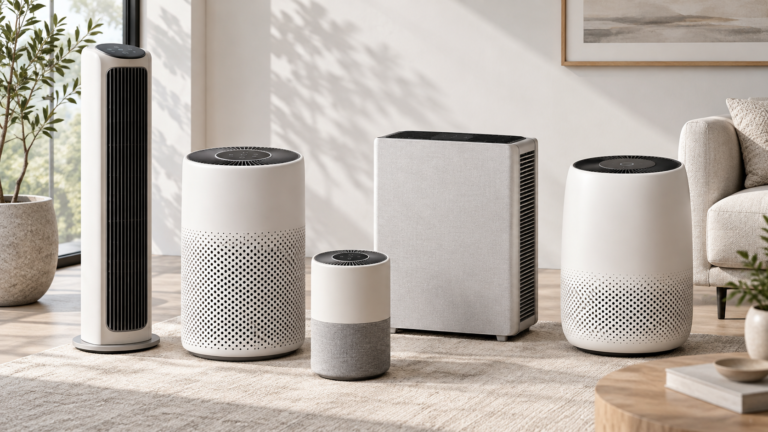
An air purifier can be useful in a bedroom, especially when outdoor dust, pollen, smoke or other airborne particles are a concern. But an appliance intended to improve indoor air quality can create another problem if its fan is too noticeable while you are trying to sleep.
Some air purifiers produce a steady, gentle airflow sound. Others become noticeably louder at higher fan speeds. You may also hear a low hum, intermittent vibration or sudden changes in noise when an automatic mode increases the fan speed.
This creates an important practical question: How can you reduce air purifier noise at night without unnecessarily reducing its air-cleaning performance?
The answer involves understanding two different aspects of an air purifier: how much noise it produces and how much filtered air it delivers.
A quiet setting may be comfortable for sleeping, but it may move less air through the filter than a higher setting. Conversely, running an air purifier at maximum speed may provide more particle filtration while creating sound that some people find distracting.
Neither extreme is automatically the right choice.
The best approach is to select an appropriately sized air purifier, understand its operating modes, place it correctly and choose a fan setting that balances your air-cleaning needs with bedroom comfort.
This guide explains why air purifiers make noise, how sleep mode affects airflow, what decibel ratings actually mean, how placement and maintenance can influence unwanted sounds, and how to create a practical nighttime setup.
What Fan Noise Comes From and Why Modes Differ
Most conventional portable air purifiers use a fan to pull room air into the appliance.
The air passes through one or more filters before being released back into the room.
The fan is essential because a filter cannot remove airborne particles from across a room without air moving through it.
This airflow is also responsible for much of the sound produced during operation.
Fan motor noise
The electric motor turns the fan.
Depending on its design, speed and condition, the motor may produce an audible hum.
Some motors sound relatively smooth and consistent.
Others may produce more noticeable tones at certain operating speeds.
Motor noise is only one part of the overall sound.
The fan blades, airflow passages and surrounding housing also influence what you hear.
Airflow noise
As air moves through the purifier, it encounters openings, filters, grilles and internal passages.
This movement can produce a rushing or whooshing sound.
Higher airflow may create more noticeable noise, although the exact relationship depends on the design.
Two purifiers moving a similar amount of air may not sound identical because their fans and internal structures differ.
Filter resistance
Air filters create resistance to airflow.
A fan must work within the appliance’s design to move air through the filtration system.
Filter type, surface area, condition and the overall air path influence how the purifier operates.
However, a filter becoming dirty does not guarantee that every purifier will become louder.
The effect depends on fan controls, design and how the device responds to airflow restriction.
Housing vibration
Some appliances transmit motor or fan vibration into their outer housing.
This can create a buzzing or rattling sound.
The surface supporting the purifier may also contribute.
For example, a lightweight table or loosely fitted shelf can vibrate along with the appliance.
In this situation, some of the noise you hear may come from the supporting furniture rather than directly from the fan.
Why different fan speeds sound different
Air purifiers commonly provide multiple operating speeds.
A low setting generally moves less air and often produces less noise.
A higher setting typically moves more air through the filter and may produce a stronger airflow sound.
The US Environmental Protection Agency explains that noise levels depend partly on fan speed.
This is why the sound of an air purifier may change substantially when you switch between low, medium and high settings.
However, the quietest setting is not necessarily the setting that delivers the most effective particle removal for your room.
Why a Low-Noise Setting May Move Less Air
Air-cleaning effectiveness depends partly on how much air the purifier moves through its filters.
Running a fan more slowly often reduces airflow.
This can make the device more comfortable to listen to, but it may also reduce the amount of air being cleaned over a given period.
Understanding airflow and filtration
A particle-filtering air purifier works by bringing airborne particles into contact with its filter media.
When more room air passes through an effective filter, more particles can potentially be captured over time.
The EPA explains that higher fan speeds and longer operating periods generally increase the amount of air filtered.
At lower fan speeds, a portable air cleaner usually filters less air.
This is a key consideration when evaluating nighttime settings.
What happens in sleep mode?
Many air purifiers include a setting called Sleep Mode, Night Mode or Quiet Mode.
However, manufacturers do not use these names identically.
Depending on the model, sleep mode may:
- Reduce fan speed.
- Dim or switch off display lights.
- Silence button sounds.
- Restrict automatic speed increases.
- Change the behaviour of notifications or indicators.
Some models combine several of these functions.
Others primarily reduce fan speed.
The name Sleep Mode does not establish how much filtered air the purifier delivers.
You need to check the manufacturer’s operating specifications.
Does sleep mode still clean the air?
Yes, if the fan continues moving air through an effective filter.
However, its cleaning rate may be lower than at a faster setting.
For example, a purifier operating slowly may continue removing some airborne particles throughout the night.
That does not mean it removes them as quickly as it would at its rated maximum speed.
The difference depends on the specific device.
Avoid assuming that all purifiers provide the same amount of filtration in sleep mode.
Can running longer compensate for lower speed?
Longer operation can increase the total amount of air passing through a filter.
However, it does not always compensate fully for insufficient airflow at a particular moment, especially when particles continue entering the room.
The effectiveness of a purifier depends on the interaction between filtration, pollution sources, room conditions and operating time.
Leaving an undersized purifier on its quietest setting all night should not automatically be considered equivalent to using an appropriately sized unit at a higher effective airflow rate.
Is maximum speed necessary throughout the night?
Not necessarily.
The suitable setting depends on room size, indoor particle sources, outdoor pollution entering the space and the appliance’s capabilities.
Some people may choose to run their purifier at a higher speed before bedtime and use a quieter setting while sleeping.
This can be a practical comfort strategy.
However, a period of stronger filtration before bed does not guarantee that particle levels will remain low throughout the night.
Pollutants may continue entering or being generated in the room.
If continuous filtration is important, consider how much air the purifier can clean at the speed you intend to use overnight.
Reading Decibel Claims Without Ignoring Test Conditions
Manufacturers sometimes advertise air purifier noise using decibels.
You may see a number associated with the lowest fan speed, sleep mode or a range covering several operating settings.
These figures can be useful, but they require context.
What is a decibel?
A decibel, abbreviated dB, is a unit used to describe sound levels.
The decibel scale is logarithmic rather than linear.
According to the US National Institute for Occupational Safety and Health, an increase of 10 dB corresponds to a tenfold increase in sound intensity.
However, perceived loudness does not change in exactly the same way as physical sound intensity.
Human hearing responds differently depending on the sound’s frequency, duration and other characteristics.
A simple numerical difference does not fully describe how distracting a sound may feel.
What does dB(A) mean?
You may see noise figures expressed as dB(A) or dBA.
This refers to A-weighted sound measurement.
A-weighting adjusts the measurement to reflect certain aspects of human hearing sensitivity across frequencies.
However, a dBA measurement still needs context.
Distance, room acoustics, background noise and measurement method influence the recorded value.
Why the measuring distance matters
A published sound level may have been measured at a particular distance from the appliance.
A test conducted close to the purifier is not directly comparable to one performed farther away without accounting for the conditions.
The acoustic environment matters too.
A quiet testing room may produce different measurements from a furnished bedroom with other appliances running.
For a meaningful comparison, look for information about how the manufacturer measured the sound.
If the measurement conditions are not disclosed, avoid treating small numerical differences between products as definitive.
Lowest-speed figures can be misleading
A manufacturer may advertise the device’s quietest operating figure.
This can be useful for understanding its minimum-noise operation.
But it does not necessarily describe the sound at the speed needed for your room.
For example, a purifier may have an exceptionally quiet low setting while producing considerably more noise at medium or high speed.
If you intend to operate the appliance at medium speed during the night, the minimum-speed noise figure may not describe your actual experience.
The importance of sound character
Two appliances with similar published sound levels can be perceived differently.
One may produce smooth, steady airflow noise.
Another may have a distinct tonal hum or periodic vibration.
Some people find steady background sound less distracting than intermittent rattling.
Others prefer almost complete silence.
These preferences vary.
A published decibel number is therefore useful, but it does not describe every aspect of acoustic comfort.
Is there a perfect decibel target for a bedroom?
There is no universal product-specific noise figure that guarantees comfortable sleep for everyone.
The World Health Organization’s community-noise guidance recommends less than 30 dB(A) in bedrooms at night for good sleep quality.
However, that recommendation concerns bedroom noise exposure.
It should not be treated as a direct pass-or-fail rating for an individual air purifier measured at an unspecified distance.
The combined noise from outdoor traffic, air conditioning, fans and other sources also matters.
A purifier’s published sound level cannot be directly equated with total noise exposure at your pillow.
What to compare before buying
| Specification | Why it matters |
|---|---|
| Lowest-speed noise | Helps estimate quiet-mode operation |
| Medium-speed noise | Useful if you expect to use a moderate airflow setting |
| Highest-speed noise | Indicates potential sound during stronger filtration |
| Measurement distance | Helps interpret published values |
| dB or dB(A) description | Clarifies the stated measurement |
| CADR at the intended speed | Helps evaluate actual particle-cleaning performance |
| Sleep-mode behaviour | Shows which features change overnight |
Not every manufacturer publishes all these details.
When information is unavailable, avoid assuming that missing specifications are favourable.
What CADR Tells You About Air Cleaning
Noise is only one part of air purifier selection.
For particle removal, Clean Air Delivery Rate, or CADR, is a more directly relevant performance metric.
CADR indicates how quickly a portable air cleaner delivers air cleaned of certain airborne particles under standardized testing conditions.
Understanding CADR
The Association of Home Appliance Manufacturers uses CADR ratings to help consumers compare room air cleaners.
Ratings may be provided for categories such as smoke, dust and pollen.
A higher CADR generally indicates faster particle removal under the relevant test conditions.
The EPA recommends choosing a purifier with a CADR appropriate for the room size.
Why room size matters
An air purifier designed for a small bedroom may not provide sufficient air cleaning in a much larger space.
Similarly, a higher-capacity purifier may be able to provide useful filtration at a lower fan setting in certain conditions.
However, this should not be assumed without relevant performance data.
A large maximum CADR does not tell you exactly what CADR the purifier achieves on its quietest setting.
CADR is commonly measured at high speed
The EPA notes that portable air-cleaner CADR ratings are typically measured at the highest fan speed.
This creates an important comparison problem.
A model with a high advertised CADR may achieve that result while operating relatively loudly.
When switched to sleep mode, it may deliver a lower effective airflow.
A buyer who compares only the maximum CADR with the minimum noise rating may accidentally compare two different operating conditions.
For bedroom use, the most useful information is how much air the purifier cleans at a fan speed you are comfortable running.
Room dimensions versus marketing coverage
To estimate room area, multiply its length by its width.
For example, a rectangular bedroom measuring 4 metres by 3 metres has an area of 12 square metres.
However, room volume also matters, especially when ceilings are unusually high.
The EPA provides guidance for selecting CADR according to room size and notes that larger rooms or higher ceilings may require greater capacity.
Do not select a device based only on a very large advertised coverage number.
Check the conditions underlying that coverage claim.
What about HEPA filters?
High-efficiency particulate air filtration is relevant to particle removal.
However, the presence of a HEPA filter does not establish the appliance’s total clean-air delivery rate.
A high-efficiency filter combined with very low airflow may clean room air more slowly than expected.
The complete appliance design matters.
Similarly, particle CADR does not establish performance against every gaseous pollutant or odour.
Different filter technologies address different pollutants.
Can CADR establish that an air purifier improves sleep?
No.
CADR measures particle-cleaning performance under specified conditions.
It is not a clinical measurement of sleep quality.
An appliance may remove airborne particles effectively while producing sound that a particular person finds uncomfortable.
Evaluate filtration and sleep comfort as separate considerations.
Practical Bedroom Placement and Vibration Checks
Where you place an air purifier can influence both its airflow and how noticeable its sound becomes.
A poorly positioned appliance may create unnecessary vibration or direct airflow toward the bed.
However, moving the purifier should not block its air intake or outlet.
Use a stable surface
Place the purifier on a firm, stable surface approved by the manufacturer.
Many larger portable units are designed to stand on the floor.
Some compact models are intended for suitable tabletops.
Follow the manufacturer’s placement instructions.
An unstable table or lightweight shelf may amplify vibrations.
If the purifier rocks, rattles or shifts during operation, stop and check its installation.
Do not improvise an unstable stand.
Keep intake and outlet openings clear
The EPA advises keeping air purifiers away from curtains and other obstructions.
Blocked airflow can reduce the device’s effectiveness.
Do not place the unit inside a cupboard or behind furniture where its intake or outlet cannot function properly.
Avoid putting clothing, towels or blankets over the purifier to muffle its sound.
Covering an electrical appliance can create airflow restrictions and potential safety problems.
Avoid direct drafts across the bed
Some people find a continuous stream of air blowing toward their face uncomfortable.
If the purifier creates an unwanted draft, reposition it within the manufacturer’s permitted placement requirements.
The EPA recommends redirecting airflow when drafts cause discomfort.
However, moving the device into a corner or behind furniture may compromise air circulation.
Find a position that preserves clear airflow.
Check for nearby vibrating objects
Sometimes the purifier is not the only source of the noise you hear.
Objects near the appliance may vibrate during operation.
Examples include loose decorations, lightweight shelves or objects touching the outer housing.
Remove unnecessary items from the immediate area.
Check that the purifier is not resting against furniture or other objects unless its installation instructions explicitly permit that arrangement.
Keep the device accessible
You should be able to reach the controls and perform necessary maintenance without moving heavy furniture.
The power cable should not create a tripping hazard.
Follow the manufacturer’s electrical safety requirements.
Do not place the purifier where bedding, curtains or other materials can interfere with its ventilation openings.
Does placing it farther from the bed help?
Increasing the distance between you and the appliance may reduce how prominent its sound seems.
However, sound perception depends on room acoustics and other factors.
Moving a purifier farther away is not automatically better if the new position blocks airflow.
Try a different suitable location while maintaining the manufacturer’s required clearances.
Filters, Rattles and Maintenance-Related Noise
A noticeable change in noise can sometimes indicate a maintenance issue.
However, not every sound means the purifier is defective.
The objective is to distinguish ordinary fan operation from unusual behaviour that deserves attention.
Why dirty filters matter
Filters accumulate particles during use.
Over time, a loaded filter can restrict airflow.
The EPA advises replacing filters according to manufacturer instructions because dirty, overloaded filters do not work well.
The effect on noise depends on the appliance.
Some devices may change fan behaviour when airflow resistance increases.
Others may not become noticeably louder.
Do not use noise alone as a filter-replacement indicator.
Check filter installation
If unusual rattling begins immediately after changing a filter, review the installation.
The replacement may not be seated correctly.
A cover or access panel may also be improperly fitted.
Switch the device off and follow the manufacturer’s instructions before inspecting accessible components.
Do not reach into moving fan assemblies.
Remove protective packaging
Some purifiers are supplied with filters wrapped in plastic protective packaging.
The manufacturer may require this packaging to be removed before operation.
Follow the initial setup instructions carefully.
Operating the appliance with packaging left around the filter may obstruct airflow.
Do not assume that the factory-installed filter is automatically ready for use without checking the manual.
Unusual rattling or clicking
A new mechanical rattle may be caused by a loose cover, incorrectly installed component or another fault.
However, the exact cause cannot be identified reliably from sound alone.
If the purifier produces abnormal grinding, clicking or vibration:
- Switch it off.
- Disconnect it safely where required by the manual.
- Inspect only user-accessible parts.
- Check approved filter installation and cover fit.
- Follow official troubleshooting guidance.
If the problem persists, contact the manufacturer or authorized service provider.
Do not dismantle electrical or motor components.
What if the purifier becomes unusually loud?
If the sound changes significantly without a deliberate fan-speed adjustment, investigate.
Possible explanations include automatic fan changes, loose components or maintenance needs.
Check the displayed operating mode first.
If the fan speed has not changed and the noise is abnormal, stop using the purifier until you have assessed it safely.
A sudden loud mechanical sound should not be dismissed as ordinary air-cleaning noise.
Filter-cleaning instructions vary
Some purifiers have washable pre-filters.
Others use replaceable HEPA or carbon filters that must not be washed.
Do not assume that vacuuming, washing or brushing every filter restores its performance.
Follow the manufacturer’s exact instructions.
Using water on a non-washable filter can damage the filter media.
Similarly, reinstalling a damp component contrary to the instructions may create additional problems.
Auto Mode Versus Sleep Mode at Night
Many air purifiers include an automatic operating mode.
Depending on the model, sensors may estimate certain aspects of indoor air quality and adjust fan speed.
This can be convenient, but it may also create unexpected noise changes during sleep.
How automatic mode works
An automatic mode may use information from a built-in particle sensor or another manufacturer-specific system.
When the device detects a change, it may increase or decrease its fan speed.
The sensor’s measurements and operating logic depend on the product.
A purifier that responds to particle levels does not necessarily measure every pollutant present in the room.
Why fan speed may increase unexpectedly
Indoor particle concentrations can change because of outdoor air entering the room, household activities or other conditions.
If automatic mode increases the fan speed, the purifier may become louder.
Someone trying to sleep may notice the sudden change more than a continuous low-level sound.
This is one reason some users prefer fixed fan speeds overnight.
Does sleep mode disable automatic operation?
Sometimes, but not always.
Some products use a fixed low fan speed in sleep mode.
Others have a quiet automatic mode that limits or changes fan-speed behaviour.
Some may allow the display to dim while retaining a different automatic-control system.
Check the manual.
Do not assume that all sleep modes behave identically.
Which mode is better?
Neither mode is universally better.
A fixed speed may produce more consistent sound.
An automatic mode may respond to changes detected by its sensors.
The trade-off depends on the room, the appliance and your preferences.
If a device is too noisy in automatic mode, determine whether a suitable fixed setting can provide the required airflow at a more comfortable sound level.
Do not assume the lowest setting is always sufficient.
Can you run high speed before sleep?
Some people use a higher fan speed before bedtime, then switch to a quieter mode.
This may help reduce existing airborne particle levels before sleeping.
However, the strategy’s effectiveness depends on the device, room and continuing particle sources.
It does not guarantee adequate overnight filtration.
Where particle exposure is a significant concern, ensure the chosen overnight mode provides appropriate air cleaning rather than relying entirely on earlier operation.
Balancing Sleep Comfort With Your Air-Cleaning Goal
A bedroom purifier needs to be comfortable enough that you will actually use it.
However, noise should not be the only measure of suitability.
Identify why you want an air purifier
Your air-cleaning objective influences how you should choose and operate the appliance.
Common concerns include:
- Outdoor particulate pollution entering the home.
- Pollen.
- Airborne dust.
- Smoke particles.
- Certain indoor particle sources.
Different filters are designed for different pollutants.
An air purifier intended to remove particles does not automatically remove every gas or odour.
Do not overlook source control
The EPA emphasizes that reducing or removing pollution sources is one of the most effective ways to improve indoor air.
Filtration is a supplement to source control and appropriate ventilation.
For example, an air purifier cannot fully compensate for ongoing indoor smoking or a major unresolved pollution source.
If the concern involves dampness or mold, addressing the moisture problem is essential.
A purifier does not repair water leaks or prevent mold growth simply by filtering the air.
Consider outdoor conditions
In many Indian cities, outdoor particulate pollution can vary substantially across seasons and days.
When outdoor air quality is poor, the amount of pollution entering the bedroom may affect the required filtration.
However, the appropriate ventilation strategy depends on outdoor air quality, indoor sources and building conditions.
Do not assume that leaving windows open or closed is always best in every circumstance.
Use trustworthy local air-quality information and relevant public-health advice where appropriate.
Sleep comfort matters
Noise that repeatedly interrupts sleep is an important consideration.
The World Health Organization identifies environmental noise as a factor associated with sleep disturbance.
But it is not possible to predict an individual’s sleep experience solely from one air purifier specification.
Some people tolerate steady background airflow well.
Others find even relatively quiet appliances distracting.
Choose a practical setting based on both performance and actual comfort.
Avoid intentionally ozone-generating devices
The EPA advises against using air-cleaning devices that intentionally produce ozone in occupied spaces.
Ozone is a respiratory irritant.
Do not confuse ozone generation with conventional mechanical particle filtration.
Some air purifiers also offer optional ionizing or other electronic features.
Check the technology and relevant safety information rather than assuming that more purification modes always mean better air cleaning.
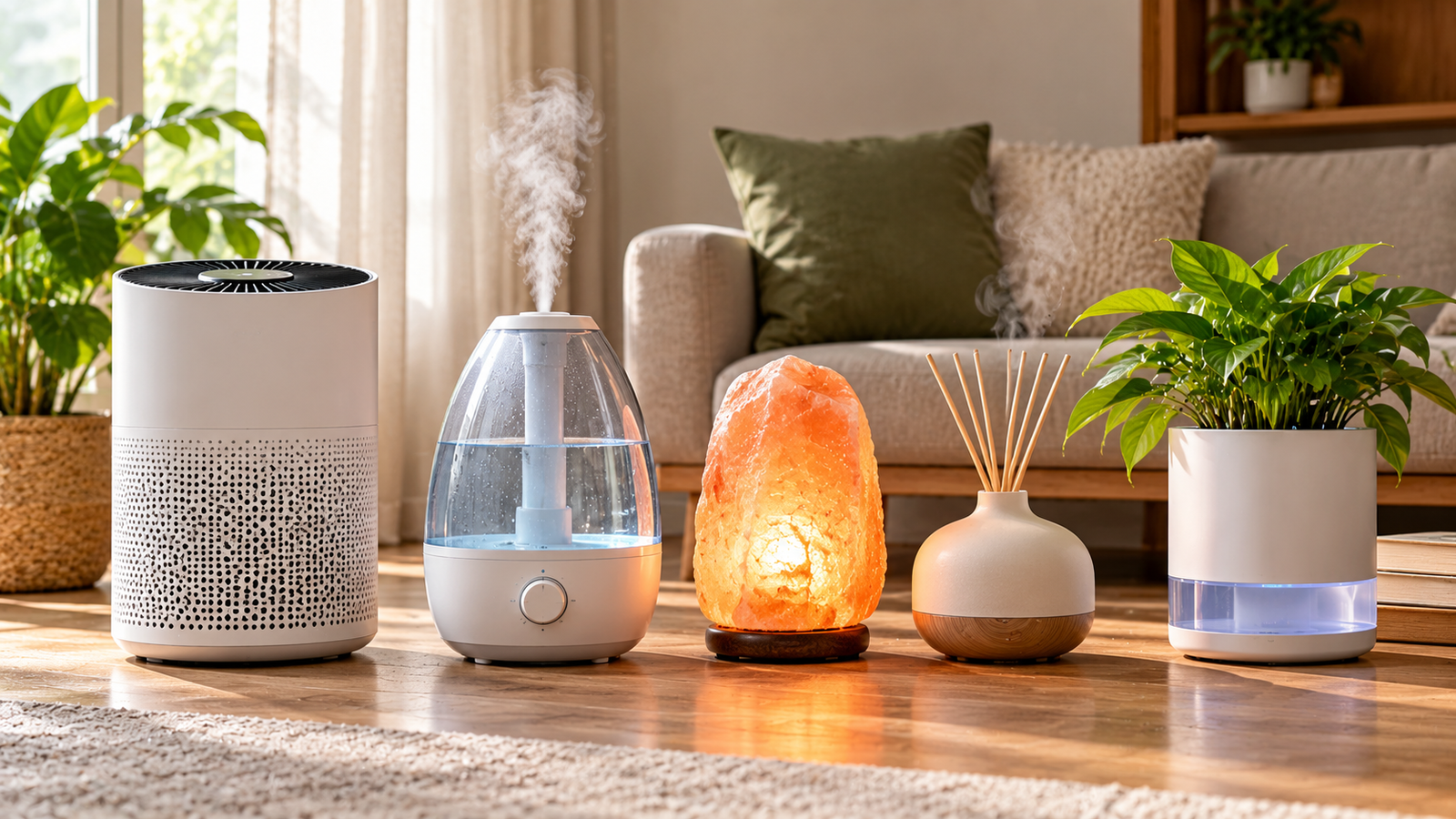
Air Purifier Versus Humidifier Versus Salt Lamp
Several products are marketed for bedroom comfort, but they do not perform the same functions.
An air purifier is primarily intended to remove certain airborne pollutants.
A humidifier adds moisture to indoor air.
A salt lamp is primarily a decorative lighting product and should not be considered a proven substitute for an effective air purifier.
Air purifier
A conventional filtering air purifier moves room air through filtration media.
Its performance depends on factors including CADR, filter type, room size, operating speed and placement.
It does not automatically control indoor humidity.
Humidifier
A humidifier adds moisture to indoor air.
This may be useful in certain dry indoor environments when humidity is appropriately managed.
However, humidifiers do not serve the same role as particle-filtering air purifiers.
Excessive humidity can also contribute to indoor moisture problems.
A humidifier should not be used as a substitute for suitable air filtration.
Salt lamp
Salt lamps are often promoted using claims about air purification or negative ions.
However, decorative salt lamps should not be treated as equivalent to a tested portable air cleaner with suitable particle-filtration performance.
A salt lamp’s appearance or marketing claims do not establish a meaningful CADR.
Why this distinction matters
| Product | Main function | Does it replace an air purifier? |
|---|---|---|
| Filtering air purifier | Removes certain airborne pollutants | It is the air-cleaning device being considered |
| Humidifier | Adds moisture to the air | No |
| Salt lamp | Decorative lighting | No |
| Sound machine | Produces background sound | No |
A sound machine may affect the bedroom’s acoustic environment, but it does not filter particles from the air.
For a fuller comparison of the product categories, read Physical Glow’s Air Purifier vs Humidifier vs Salt Lamp: Five Indoor Air Products Compared.
That guide examines the different purposes of common indoor wellness products.
This article focuses specifically on air purifier operating noise and nighttime use.
Setting Up an Air Purifier for a Quieter Night
You do not need specialized acoustic equipment to make basic improvements.
Begin with the manufacturer’s instructions and the actual conditions of your bedroom.
Step 1: Confirm the purifier is correctly sized
Check the recommended room size and available CADR information.
Avoid relying solely on a broad marketing coverage claim.
An undersized appliance may need to run at a higher speed than you find comfortable.
Step 2: Choose a suitable location
Place the unit on a stable, approved surface.
Keep intake and outlet openings clear.
Avoid curtains, bedding and furniture that obstruct airflow.
Step 3: Review the fan settings
Listen to the available speeds in the actual bedroom.
Notice whether the sound is steady or whether certain settings produce a distracting hum.
Do not assume that the quietest speed offers adequate filtration.
Step 4: Check sleep-mode behaviour
Determine whether sleep mode changes fan speed, display brightness, automatic control or a combination of these features.
Review the manufacturer’s documentation.
Step 5: Check for vibration
If the purifier rattles, make sure it is correctly installed and not touching nearby objects.
Check accessible covers and filter seating according to the manual.
Do not open the motor assembly.
Step 6: Inspect filter condition
Review the filter-maintenance schedule.
Replace dirty or expired filters as directed.
Do not wash filters unless the manufacturer permits that procedure.
Step 7: Test the setup during a normal night
Evaluate the actual comfort of the sound.
Consider whether automatic speed changes interrupt you.
Also consider whether the selected speed provides the intended air-cleaning performance.
Step 8: Reassess when conditions change
Bedroom conditions can vary with outdoor pollution, weather, ventilation and household activity.
A setup that feels suitable on one day may require adjustment on another.
Avoid treating one fan setting as permanently optimal under every condition.
A Practical Noise-and-Performance Checklist
| What to check | Practical question |
|---|---|
| Fan speed | Is this setting quiet enough while providing appropriate airflow? |
| Published noise rating | Which fan speed and test conditions does the figure represent? |
| CADR | Is the purifier appropriately sized for the room? |
| Sleep mode | Does it reduce fan speed, dim lights or alter automatic behaviour? |
| Placement | Are intake and outlet openings unobstructed? |
| Surface | Is the appliance stable without abnormal vibration? |
| Filter | Is it installed correctly and within its recommended service period? |
| Automatic operation | Are unexpected speed changes disturbing sleep? |
| Safety | Does the device use suitable air-cleaning technology without intentionally generating ozone? |
| Comfort | Can the purifier run consistently without unacceptable disturbance? |
This checklist can help identify simple problems before deciding that a device needs replacement.
Common Air Purifier Noise Mistakes
Mistake 1: Buying based only on the lowest decibel rating
A purifier’s minimum noise figure may refer to a setting with limited airflow.
Compare filtration capability and the noise produced at the speed you intend to use.
Mistake 2: Assuming sleep mode provides maximum cleaning
Sleep mode may reduce fan speed and therefore reduce particle filtration.
Check the product’s actual operating specifications.
Mistake 3: Blocking airflow to reduce sound
Covering the purifier or placing it behind furniture can obstruct intake or outlet airflow.
Follow safe placement instructions instead.
Mistake 4: Ignoring room size
A purifier intended for a small room may struggle to provide sufficient clean-air delivery in a larger space.
Review CADR and room dimensions.
Mistake 5: Treating every rattle as normal
Unusual mechanical sounds may indicate loose components, incorrect installation or another issue.
Stop and inspect the appliance safely when necessary.
Mistake 6: Ignoring filter maintenance
Dirty or overloaded filters can reduce performance.
Follow replacement and cleaning instructions.
Mistake 7: Assuming a quiet unit is always efficient
Noise and filtration are separate performance characteristics.
A low sound rating alone does not establish high CADR or adequate particle removal.
Mistake 8: Confusing an air purifier with a humidifier
These devices perform different functions.
A humidifier cannot substitute for an effective particle-filtering purifier.
Mistake 9: Assuming a salt lamp cleans bedroom air
Decorative lighting products should not be treated as substitutes for tested air filtration.
Mistake 10: Expecting an air purifier to solve every indoor air problem
Air filtration does not replace source control, appropriate ventilation or remediation of moisture problems.
Frequently Asked Questions
Why is my air purifier noisy at night?
Air purifier noise can come from its fan motor, airflow, housing vibration or other components.
Higher fan speeds often produce more sound.
Unexpected rattling may also indicate a loose cover, incorrectly seated filter or maintenance issue.
Does sleep mode reduce air purifier noise?
It often does, but the exact behaviour depends on the model.
Some devices reduce fan speed, while others also dim lights or change automatic operation.
Check the manufacturer’s instructions.
Does an air purifier still clean the air in sleep mode?
Yes, if the fan continues moving air through an effective filter.
However, the amount of filtered air may be lower than at higher speeds.
The cleaning rate depends on the device and setting.
Is a quieter air purifier always better?
No.
A quieter device may be more comfortable, but sound level alone does not establish cleaning effectiveness.
Compare CADR, room suitability and the noise at the speed you expect to use.
What is a good decibel level for a bedroom air purifier?
There is no universal device-specific figure that guarantees comfortable sleep.
Published sound ratings depend on test conditions and operating speed.
The WHO’s nighttime bedroom-noise recommendations concern overall environmental exposure rather than a direct pass-or-fail rating for a single appliance.
Is 30 dB quieter than 40 dB?
Yes, when the figures are measured on a comparable basis.
The decibel scale is logarithmic.
However, perceived loudness also depends on sound frequency, background noise and other factors.
The figures should be compared using equivalent measurement conditions.
Can I keep an air purifier running all night?
Many portable purifiers are designed for extended operation, subject to their manufacturer’s instructions.
The EPA notes that longer run times generally increase the amount of air filtered.
Ensure the device is correctly installed, maintained and operated safely.
Should I run my air purifier on maximum speed before sleeping?
That may help reduce existing airborne particle levels.
However, it does not guarantee adequate filtration throughout the night if additional particles continue entering or being generated.
Choose an overnight setting appropriate for the room and your air-cleaning goals.
Does Auto Mode make an air purifier louder?
It can.
Some automatic modes increase fan speed in response to sensor readings.
This may create noticeable noise changes.
The behaviour depends on the model and its control settings.
Why does my air purifier suddenly speed up at night?
An automatic mode may respond to a change detected by its sensors.
Other possibilities include programmed operation or device-specific behaviour.
Check the displayed mode and the manual before assuming that the purifier is malfunctioning.
Why does my air purifier rattle?
Possible causes include an unstable supporting surface, loose housing components, incorrect filter installation or a mechanical problem.
Switch off the device and follow approved troubleshooting instructions.
Do not open electrical or motor components.
Can dirty filters make an air purifier louder?
They may influence airflow and operation on some models.
However, not every dirty filter causes an audible increase in noise.
Replace filters according to manufacturer guidance rather than relying only on sound.
Where should I place an air purifier in my bedroom?
Use a stable, manufacturer-approved location with clear intake and outlet airflow.
Avoid blocking the device with curtains, bedding or furniture.
Redirect uncomfortable drafts without compromising the required clearances.
Can I put an air purifier inside a cupboard to make it quieter?
No.
Enclosing a conventional portable purifier in a cupboard can restrict airflow and reduce its usefulness.
Follow the manufacturer’s placement instructions.
Does a bigger air purifier mean less noise?
Not necessarily.
A larger-capacity model may provide useful airflow at a lower speed under certain conditions.
However, size alone does not establish acoustic performance.
Compare the actual model’s specifications and operating characteristics.
Does HEPA filtration make an air purifier quiet?
No.
HEPA describes a filtration characteristic, not a guaranteed sound level.
Noise depends on the fan, housing, airflow and operating speed.
Can an air purifier replace a humidifier?
No.
An air purifier removes certain pollutants.
A humidifier adds moisture to the air.
The appropriate device depends on the problem you are trying to address.
Does an air purifier improve sleep quality?
An air purifier may improve certain aspects of indoor air quality, but it cannot guarantee better sleep.
Noise, room conditions, individual sensitivities and many other factors influence sleep.
Do not treat an air purifier as a treatment for insomnia or another medical condition.
Should I switch off an air purifier if it is disturbing my sleep?
If the sound is unacceptable, consider a more comfortable setting, safe repositioning or a different device.
However, reducing fan speed can also reduce filtration.
If air cleaning is particularly important, assess the trade-off rather than assuming the lowest setting is always sufficient.
When should I replace my air purifier?
A purifier does not automatically require replacement simply because it is noisy at high speed.
First check whether the noise is normal for that setting.
Consider replacement or authorized repair if the appliance is damaged, malfunctioning or unable to meet your room’s practical filtration and comfort needs.
Final Takeaway
Air purifier noise at night is a practical issue involving fan design, operating speed, room conditions and personal comfort.
Lower fan speeds often make an appliance quieter.
However, they generally move less air through the filter.
This means that the quietest operating mode is not automatically the best air-cleaning mode.
When choosing a bedroom air purifier, consider its clean air delivery rate, room suitability, published noise information and the behaviour of its sleep and automatic modes.
Place it on a stable surface, keep airflow openings clear and follow the manufacturer’s filter-maintenance instructions.
If the appliance produces unusual rattling or mechanical sounds, investigate safely rather than assuming all noise is normal.
A comfortable bedroom setup should balance adequate particle filtration with acceptable sound.
For a comparison of different indoor wellness products, read Physical Glow’s Air Purifier vs Humidifier vs Salt Lamp: Five Indoor Air Products Compared.
That guide explains why these devices serve different purposes and should not be treated as interchangeable solutions.
The best nighttime air purifier setup is one that delivers useful filtration at a sound level you can comfortably live with—not simply the lowest decibel figure printed on a product box.
Physical Glow’s editorial principle: Air purifier recommendations should distinguish verified filtration performance from acoustic comfort. Quiet operation should not be presented as proof of effective air cleaning, and manufacturer-specific decibel or CADR figures should never be invented.
References and Further Reading
- US EPA — Guide to Air Cleaners in the Home
- US EPA — Air Cleaners and Air Filters in the Home
- US EPA — Air Cleaners, HVAC Filters, and Respiratory Viruses
- Association of Home Appliance Manufacturers — Tips for Choosing the Ideal Portable Room Air Cleaner
- World Health Organization — Noise
- World Health Organization — Night Noise Guidelines for Europe
- CDC/NIOSH — About Occupational Hearing Loss and Noise Measurement
- US EPA — Ozone Generators That Are Sold as Air Cleaners