Massage Gun Contraindications: Areas and Symptoms to Avoid
Massage guns have become popular tools for managing everyday muscle tightness and post-workout discomfort. They are portable, relatively easy to use and available in a wide range of designs, from compact travel devices to larger percussion massagers.
However, the fact that a massage gun feels comfortable on one muscle does not mean it is safe to use everywhere.
A massage gun repeatedly strikes the skin through a moving attachment, transferring mechanical force into the underlying tissues. Depending on the device, speed, amplitude and pressure, this can create a substantial amount of localized stimulation.
Used appropriately, percussion massage may provide short-term relief from perceived muscle tightness and improve movement comfort. But using excessive pressure, applying the device over vulnerable anatomical structures or ignoring warning symptoms can cause harm.
The most important rule is to use massage guns on appropriate muscle areas—not directly over bones, joints, major blood vessels, injured tissues or unexplained painful areas.
This guide explains where massage guns should not be used, which medical conditions require additional caution, the symptoms that mean you should stop immediately and how to build a safer home-recovery routine.
1. How Does a Massage Gun Work?
A massage gun is a handheld percussion device that moves an attachment rapidly back and forth.
Unlike a traditional vibrating massager, many massage guns produce a noticeable percussive movement that applies repeated mechanical pressure to a localized area.
The sensation depends on several factors:
- Amplitude: How far the attachment moves back and forth.
- Speed: How frequently the attachment strikes the tissue.
- Stall force: The resistance the motor can tolerate before slowing or stopping.
- Attachment shape: How force is distributed over the contact area.
- User pressure: How firmly the device is pressed against the body.
- Treatment duration: How long the device remains in contact with an area.
A large, soft attachment may distribute pressure more broadly than a narrow, pointed attachment.
However, a softer attachment does not make every anatomical area safe.
What Massage Guns May Help With
Limited research suggests that percussion devices may temporarily improve range of motion, perceived flexibility and muscle comfort in some situations.
They may also provide short-term relief from certain sensations of post-exercise tightness.
However, the evidence varies by outcome, device and study design.
Massage guns should not be considered proven treatments for all muscle injuries, chronic pain conditions or circulation problems.
They also do not replace physiotherapy, medical assessment or appropriate rehabilitation.
2. Why Massage Gun Placement Matters
The body contains muscles, bones, tendons, nerves, blood vessels and internal organs.
Not all these structures tolerate direct mechanical percussion in the same way.
Large, healthy muscle groups can often accommodate gentle, controlled stimulation.
By contrast, areas containing superficial nerves or major blood vessels may be more vulnerable.
Applying a massage gun directly over a bony prominence may also be uncomfortable because there is little soft tissue to cushion the repeated impact.
The problem becomes more significant when people:
- Use high speed with excessive pressure.
- Hold a device on one spot for too long.
- Treat sharp pain as a muscle knot.
- Apply percussion over bruised or injured tissue.
- Use pointed attachments over sensitive structures.
- Ignore numbness, unusual pain or swelling.
A massage gun is not a tool for forcing pain out of the body.
If an area is unusually painful, the correct response is to understand why—not automatically increase percussion intensity.
3. Where Should You Never Use a Massage Gun?
Certain anatomical areas should be avoided during routine self-massage because of the structures underneath them.
Front and sides of the neck
The neck contains major blood vessels, nerves and other sensitive structures. Do not apply a percussion device directly over the throat, carotid artery region or cervical spine.
Avoid self-treating unexplained neck pain or headaches with a massage gun.
Directly over the spine
Vertebrae are bony structures, not large muscle bellies. Direct percussion over the spinal column should be avoided, including the prominent bones at the back of the neck and along the lower back.
Do not use a forked attachment around the spine without appropriate professional guidance.
Bones and joints
Avoid directly massaging kneecaps, elbows, ankles, the shinbone and other bony prominences. These areas offer less cushioning and may contain sensitive tendons or bursae.
Aim at appropriate surrounding muscle tissue rather than the joint itself.
Groin and sensitive vascular regions
The groin contains major blood vessels and nerves. Avoid direct percussion in this area.
Also avoid the armpits, genital region and other locations with superficial vulnerable structures.
Clinical guidance from the University of Utah and Hospital for Special Surgery specifically emphasizes avoiding bony regions, the neck, injured skin, bones, nerves and joints.
University of Utah Health
+1
What About the Chest and Abdomen?
Massage guns intended for muscle treatment should not be used directly over the sternum, ribs or abdominal organs.
The chest and abdominal wall contain structures that require more caution than large muscle groups such as the quadriceps or glutes.
Do not use a massage gun to treat chest pain, abdominal discomfort or unexplained pain near internal organs.
What About the Head and Face?
Routine percussion devices should not be applied directly to the face, skull, eyes or ears.
Products specifically designed for facial vibration or massage are a different category and should be evaluated according to their own instructions.
Do not assume that lowering the speed makes a powerful muscle massage gun suitable for facial use.
4. Massage Gun Placement: Quick Safety Reference
| Body area | General guidance | Main consideration |
|---|---|---|
| Quadriceps | Usually suitable on healthy muscle | Avoid kneecap and injured regions |
| Hamstrings | Usually suitable on healthy muscle | Avoid the sensitive area behind the knee |
| Glutes | Often suitable | Avoid bony points and radiating nerve pain |
| Calves | May be suitable on healthy muscle | Never massage suspected blood clot symptoms |
| Upper trapezius | Use caution and avoid the neck itself | Superficial nerves and nearby cervical structures |
| Upper back | Target suitable muscle only | Avoid spine, ribs and shoulder blade bones |
| Lower back | Not recommended for unsupervised direct percussion | Spine, kidneys and other vulnerable structures |
| Neck | Avoid | Major vessels, nerves and cervical spine |
| Groin | Avoid | Major vessels and nerves |
| Chest and abdomen | Avoid direct percussion | Ribs and underlying organs |
| Bruised, swollen or injured area | Avoid | Risk of worsening injury |
This is general anatomical guidance, not a clearance to use percussion on an area simply because it contains muscle. Medical conditions and symptoms can change what is safe.
5. Medical Conditions That Require Extra Caution
Certain health conditions increase the potential risks of percussion massage.
Some situations are clear reasons to avoid using a massage gun on the affected area. Others require individualized medical advice before any use.
Deep Vein Thrombosis (DVT) or Suspected Blood Clots
Deep vein thrombosis occurs when a blood clot forms in a deep vein, frequently in the leg.
Possible symptoms include:
- Swelling in one leg.
- New pain or tenderness.
- Warmth.
- Redness or discoloration.
A suspected blood clot is not a muscle knot.
Do not use a massage gun on a leg with suspected DVT. Seek urgent medical assessment.
If symptoms are accompanied by sudden breathlessness, chest pain, coughing blood or fainting, seek emergency care.
Blood-Thinning Medication or Bleeding Disorders
People taking anticoagulants or living with bleeding disorders may bruise or bleed more easily.
Percussion pressure can increase the risk of soft-tissue injury.
Seek medical guidance before using a massage gun if you take blood-thinning medication or have a condition affecting clotting.
Osteoporosis or Recent Fractures
Osteoporosis can increase the risk of fractures.
A recent fracture or healing bone should not be subjected to direct percussion.
Even if pain has improved, that does not necessarily mean the underlying tissue has completely healed.
Avoid use in the affected region until medically cleared.
Peripheral Neuropathy or Reduced Sensation
Peripheral neuropathy can reduce the ability to detect pressure, temperature or pain.
If you cannot reliably feel how strongly the device is pressing, you may not recognize excessive force.
This is relevant for some people with diabetes, neurological disorders or nerve injuries.
Recent Surgery or Joint Replacement
Recently operated tissues, healing surgical sites, implanted hardware and joint-replacement areas may require specific restrictions.
Do not apply a massage gun directly over a surgical site or replacement joint without approval from the treating professional.
Pregnancy
Pregnancy does not automatically mean that every form of gentle massage is unsafe.
However, high-force percussion is not equivalent to ordinary gentle massage, and safety depends on the individual and treatment area.
If pregnant, seek advice from an appropriate healthcare professional before using a massage gun, particularly when there are complications or higher-risk circumstances.
Cancer, Tumors or Unexplained Masses
Do not apply direct percussion to a known or suspected tumor or an unexplained lump.
People undergoing cancer treatment may have additional risks relating to bones, clotting, sensation or treatment effects.
Their oncology team should guide suitability.
The manufacturer Therabody identifies numerous precautions and contraindications, including DVT, fractures, altered sensation, bleeding disorders, recent surgery and direct application over sensitive structures. Mayo Clinic similarly recommends special caution with conditions affecting clotting, bone strength and wound healing.
Therabody US
+1
6. When Should You Stop Using a Massage Gun Immediately?
Some discomfort can occur with pressure-based treatments, but sharp pain or unusual neurological symptoms should never be interpreted as proof that the device is working.
Stop the device immediately if you experience:
- Sharp, stabbing or rapidly increasing pain.
- Pins and needles.
- Numbness.
- Burning or electric-shock sensations.
- New muscle weakness.
- Dizziness or faintness.
- Significant skin redness or bruising.
- Sudden swelling.
- Pain that begins radiating into another limb.
Do not attempt to overcome these symptoms by increasing speed, changing to a pointed attachment or pressing harder.
Warning Signs Requiring Medical Assessment
| Symptom | Recommended response |
|---|---|
| Mild temporary discomfort that resolves after stopping | Do not continue on the same area; reassess technique |
| New bruising or persistent tenderness | Stop using the device and seek advice if significant or persistent |
| Numbness, tingling or weakness | Stop and seek medical evaluation |
| Sudden severe pain | Stop; obtain prompt medical evaluation |
| One-sided swollen, painful leg | Do not massage; seek urgent assessment for possible DVT |
| Chest pain, breathlessness or fainting | Seek emergency medical care |
| Severe muscle pain with swelling, weakness or dark urine after intense percussion | Seek urgent medical evaluation |
Rare serious tissue injuries have been reported following aggressive massage or prolonged high-intensity percussion. These events should not be treated as typical outcomes of responsible use, but they reinforce the importance of stopping when concerning symptoms appear.
Health
+1
7. Does More Pressure Mean Better Results?
No.
One of the most persistent misconceptions about massage guns is that deeper, harder pressure delivers better recovery.
In practice, excessive force may produce more discomfort without delivering additional benefit.
It can also make the attachment bounce, irritate the tissue or increase bruising risk.
Use a Comfortable Pressure Level
For healthy muscle areas:
- Begin at the lowest comfortable setting.
- Let the device make light contact with the muscle.
- Avoid pressing your full body weight into it.
- Move gently across the muscle.
- Stop if pressure becomes unpleasant or painful.
The objective is comfortable muscle stimulation, not forcing the attachment as deeply as possible.
Why a High Stall Force Is Not Always Useful
Some products advertise very high stall-force ratings.
These specifications indicate how the device performs under resistance, but they are not measures of therapeutic effectiveness.
A more powerful motor does not mean that high pressure is appropriate for the user.
For general home recovery, adjustable intensity and comfortable handling may be more important than maximum power.
8. How Long Should You Use a Massage Gun on One Muscle?
There is no universally established ideal duration for every device and muscle group.
The appropriate time depends on the device, attachment, intensity and individual response.
For generally healthy users, short sessions are a sensible starting point.
A practical example is:
| Muscle group | Conservative starting duration |
|---|---|
| Quadriceps | 30–60 seconds per side |
| Hamstrings | 30–60 seconds per side |
| Glutes | 30–60 seconds per side |
| Calves | 20–45 seconds per side |
| Suitable upper-back muscle areas | 20–45 seconds per area |
These are illustrative starting durations, not medically validated prescriptions.
Follow the device’s specific instructions. Cleveland Clinic advises keeping use brief, generally no more than a couple of minutes per muscle group.
health.clevelandclinic.org
Avoid Holding the Gun on One Spot
Keeping the attachment stationary over one small area may concentrate pressure unnecessarily.
Instead, move gently over the muscle, maintaining comfortable contact.
Do not repeatedly strike a particularly painful location in an attempt to break up a supposed knot.
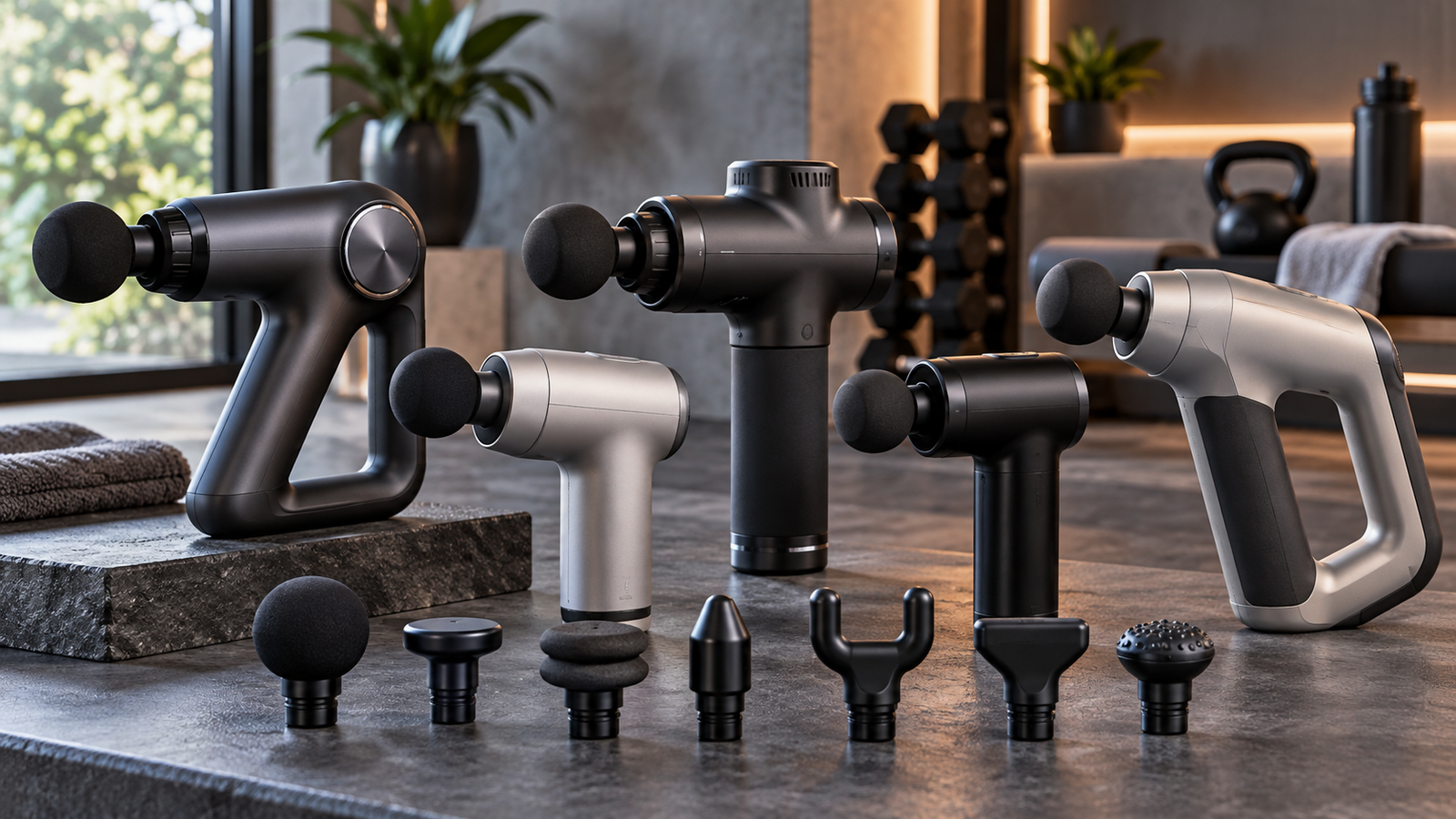
9. Which Massage Gun Attachments Are Safer?
Different attachments create different pressure sensations.
Round ball attachment
Often a practical starting option for large muscle groups because it distributes pressure over a broader surface.
Flat attachment
Provides a relatively broad contact surface and may suit certain healthy muscle areas.
Bullet attachment
Concentrates pressure and requires additional caution. Not recommended for experimenting on sensitive or painful areas.
Fork attachment
Designed for use around certain structures, but does not make direct spinal or neck percussion safe without professional guidance.
Attachment names and intended uses vary by manufacturer.
Do not assume that the most specialized attachment produces the best result.
For most beginners, a broad, comfortable attachment used at low intensity on an appropriate muscle is a reasonable starting point.
10. Massage Gun Before vs After Workouts
Massage guns are often used for two different purposes.
Before Exercise
Before a workout, light percussion may temporarily improve movement comfort and perceived flexibility.
For example, someone preparing for leg training may use gentle percussion on the quadriceps before beginning dynamic warm-up movements.
However, a massage gun does not replace:
- Gradual cardiovascular preparation.
- Dynamic mobility.
- Exercise-specific warm-up sets.
- Appropriate movement practice.
After Exercise
After training, gentle percussion may help reduce the sensation of tightness or discomfort.
However, it is not a proven substitute for recovery fundamentals such as sleep, adequate nutrition and appropriate training load.
Do not use percussion immediately over a newly injured or swollen area.
On Rest Days
A massage gun is optional.
There is no need to use one every day simply because you own it.
Walking, gentle movement or resting may be more appropriate depending on how your body feels.
11. Can a Massage Gun Treat Muscle Knots?
The term muscle knot is commonly used to describe a tender or tight-feeling location in a muscle.
However, it is not a precise diagnosis.
Localized tenderness may result from muscle fatigue, altered loading, referred pain or other conditions.
A massage gun may temporarily change the sensation of tightness, but this does not prove that it has broken apart a physical knot.
Why Repeatedly Targeting a Painful Spot Can Be a Mistake
A particularly painful area may be:
- An irritated muscle.
- A tendon problem.
- A nerve-related symptom.
- A bruise or minor injury.
- Referred pain from another region.
Aggressive percussion is not an appropriate way to distinguish these possibilities.
If pain is persistent, worsening or accompanied by weakness or altered sensation, seek appropriate assessment rather than increasing the massage intensity.
12. Is It Safe to Use a Massage Gun on the Calves?
The calves are a common target because they can feel tight after running, walking, cycling or leg training.
Gentle use on healthy calf muscles may be appropriate for some people.
However, this region deserves special attention because unexplained calf pain or swelling can occasionally signal a medical problem.
Situations Where You Should Avoid Calf Percussion
Do not use a massage gun on a calf that has:
- Unexplained swelling.
- New localized warmth or redness.
- Sudden unusual pain.
- Significant bruising.
- A suspected muscle tear.
- Symptoms that raise concern for a blood clot.
Do not attempt to identify or rule out a blood clot through self-massage.
If one calf is unusually swollen or painful, seek appropriate medical evaluation.
13. Is It Safe to Use a Massage Gun on the Shoulders?
The shoulder region contains several different anatomical structures.
The broad upper trapezius and surrounding shoulder muscles may be appropriate for gentle application in some healthy users.
However, this does not make the entire shoulder and neck region safe.
Avoid:
- The front and sides of the neck.
- Direct pressure over the collarbone.
- Direct pressure over prominent shoulder bones.
- The armpit.
- Locations producing radiating arm pain or tingling.
A common mistake is moving a massage gun from the upper shoulder directly toward the side of the neck.
The anatomy changes substantially in that area.
If you experience shoulder discomfort that extends into the arm, hand or fingers, avoid using percussion as a substitute for medical assessment.
14. Can You Use a Massage Gun on Lower-Back Pain?
Lower-back pain is common, but it can arise from many structures and conditions.
These include muscles, joints, intervertebral discs and nerves.
The lower back also contains the lumbar spine and underlying structures that should not be subjected to uncontrolled percussion.
For general home use, avoid direct massage-gun percussion over the lumbar spine or areas close to internal organs.
Some clinicians may use appropriate soft-tissue techniques around the back under specific circumstances, but this should not be generalized into permission for unsupervised high-force application.
Seek medical assessment if back pain is severe, follows an injury or is associated with leg weakness, numbness, fever or bladder or bowel changes.
15. What If Your Muscles Are Already Sore?
Delayed-onset muscle soreness, or DOMS, can develop after unfamiliar or demanding exercise.
It commonly becomes noticeable later the same day or over the following one to three days.
Mild soreness may make movement uncomfortable without indicating a serious injury.
Gentle percussion on appropriate, healthy muscle areas may feel pleasant for some people.
However, it is not necessary for recovery.
When to Skip Percussion
Avoid using a massage gun if the area has:
- Severe pain.
- Significant swelling.
- Extensive bruising.
- Marked weakness.
- Suspected strain or tear.
- Pain that is worsening rather than gradually improving.
Do not confuse ordinary exercise soreness with a diagnosed injury.
When symptoms are unusual, medical assessment is more appropriate than aggressive self-treatment.
16. Common Massage Gun Mistakes
1. Using the Highest Speed Immediately
High speed is not necessary for every muscle or every user.
Begin with the lowest comfortable setting.
2. Pressing Harder to Reach Deep Tissue
More pressure does not guarantee better recovery.
It may increase bruising or discomfort.
3. Using Pointed Attachments on Painful Spots
Narrow attachments concentrate force.
They should not be used to probe unexplained pain.
4. Massaging Directly Over Bones
Massage guns are generally intended for suitable muscle tissue.
Avoid joints, vertebrae and other bony prominences.
5. Treating an Acute Injury
Percussion should not be used directly on a newly injured, swollen or bruised area.
6. Ignoring Numbness or Tingling
Pins and needles, weakness or electric-shock sensations can indicate nerve irritation.
Stop immediately.
7. Continuing Despite Bruising
Bruising is not evidence that a treatment was effective.
It may indicate excessive force or increased tissue vulnerability.
8. Using the Device for Too Long
Longer treatment does not automatically produce better results.
Keep sessions brief and follow the manufacturer’s directions.
9. Sharing Attachments Without Cleaning Them
Attachments can contact sweat, skin oils and other residues.
Clean them according to the manufacturer’s instructions, especially when a device is shared.
10. Using Massage Guns Instead of Medical Care
Persistent or unexplained pain may require diagnosis.
Temporary symptom relief does not identify the underlying problem.
17. A Safer Beginner Massage Gun Routine
For generally healthy adults without contraindications, the following is a conservative approach.
Example: Three-minute lower-body comfort routine
- Check the device and your symptomsEnsure the attachment is securely installed. Do not proceed if you have concerning pain, swelling or an injury.
- Quadriceps — approximately 45 seconds per sideUse a soft, broad attachment and gentle pressure over the muscle belly. Avoid the kneecap.
- Gluteal muscles — approximately 30 seconds per sideMaintain comfortable pressure. Avoid direct pressure over prominent bones and any location producing radiating symptoms.
- Assess how you feelStop if discomfort increases. Do not extend the session automatically.
This is an illustrative routine for healthy muscle tissue. It is not appropriate for people with contraindications or unexplained symptoms without professional clearance.
You do not need to use the device on every muscle group in one session.
A short, controlled application is preferable to an aggressive full-body routine.
18. How to Choose a Massage Gun With Safety in Mind
Marketing frequently emphasizes maximum speed, motor power and the number of attachments.
But for ordinary home use, safety-related features can be more important.
| Buying factor | Why it matters |
|---|---|
| Adjustable speed | Allows a gentle starting intensity |
| Comfortable minimum setting | Makes it easier to avoid excessive stimulation |
| Broad, soft attachment | Can distribute pressure more comfortably |
| Ergonomic grip | Helps prevent awkward handling |
| Secure attachment mechanism | Reduces the risk of attachments becoming loose |
| Clear user instructions | Identifies intended use and restrictions |
| Suitable weight | Makes the device easier to control |
| Reliable warranty and support | Useful if the device develops faults |
Compact vs Full-Size Massage Guns
Compact devices may be easier to hold and transport.
Larger models may offer greater power or longer battery life.
However, neither category is automatically safer.
A powerful device used gently may be appropriate for a suitable user, while even a compact device can cause problems when used over vulnerable structures.
Choose equipment based on your actual needs, ease of control and the manufacturer’s safety instructions.
For comparisons of available options, refer to Physical Glow’s Top 5 Massage Guns in India buying guide.
19. When Should You Choose Something Other Than a Massage Gun?
Massage guns are not the only tools available for muscle comfort and mobility.
Depending on the circumstances, simpler alternatives may be more appropriate.
Gentle Walking or Movement
Light activity may be useful when muscles feel stiff after prolonged sitting or routine exercise.
It also avoids direct mechanical percussion.
Foam Rolling
Foam rolling distributes pressure differently and can provide temporary movement comfort.
However, it has its own precautions and should not be used aggressively over injuries or vulnerable structures.
Stretching and Mobility Exercises
Appropriate mobility exercises may help improve range of motion.
They also allow you to develop active control rather than relying entirely on an external device.
Heat or Cold Therapy
These may be useful in selected circumstances, but their suitability depends on the underlying condition and individual risks.
They should not be applied indiscriminately to injuries.
Physiotherapy
For persistent pain, recurrent tightness, rehabilitation or movement limitations, a qualified physiotherapist can assess the problem and recommend an appropriate plan.
A massage gun cannot determine whether a symptom originates from muscle, tendon, joint or nerve tissue.
20. A Practical Safety Checklist
Before using a massage gun, check the following:
Safety review
0 of 6 checkedI am not using the device on an injured, bruised or swollen area.I have no new unexplained symptoms suggesting a blood clot or other urgent condition.I am avoiding the neck, spine, joints, groin and other vulnerable areas.I have checked relevant medical conditions and medications with a clinician if needed.The attachment is secure and I can control the device comfortably.I will use light pressure and stop if I experience pain, tingling or numbness.
Review every applicable precaution before considering use. If uncertain about your medical suitability, seek professional advice.
Frequently Asked Questions
Can I use a massage gun on my neck?
Avoid direct percussion on the front and sides of the neck and over the cervical spine. These regions contain vulnerable blood vessels, nerves and bones. Do not use a massage gun to self-treat unexplained neck symptoms.
Can a massage gun cause nerve damage?
Improper use can irritate or injure sensitive tissues, including nerves. Stop immediately if you experience numbness, tingling, weakness or electric-shock sensations.
Is it safe to use a massage gun every day?
Some healthy people may tolerate brief, gentle use, but daily application is not necessary. Frequency should follow device instructions and individual comfort, and contraindications still apply.
Can a massage gun cause bruising?
Yes. Excessive pressure or certain underlying medical conditions and medications can increase bruising risk. Bruising should not be considered a normal target or sign of effectiveness.
Should I use a massage gun on a pulled muscle?
Avoid direct percussion on a newly strained muscle or suspected tear. Appropriate management depends on the severity and stage of the injury.
Can I use a massage gun if I take blood thinners?
Seek medical advice before use. Anticoagulant medication can increase bleeding and bruising risk.
Is a massage gun safe for people with diabetes?
It depends on individual circumstances, particularly whether neuropathy, vascular disease or impaired sensation is present. Consult a healthcare professional before use when these complications apply.
Can I use a massage gun on my lower back?
Direct percussion over the lumbar spine and vulnerable surrounding structures is best avoided in unsupervised home use. Persistent back pain warrants appropriate assessment.
Can massage guns improve circulation?
Percussion may influence local blood-flow measurements or the sensation of warmth in some circumstances. However, massage guns are not established treatments for vascular diseases or blood clots.
Is a massage gun better than a physiotherapist?
No. A physiotherapist can assess movement, symptoms and potential injuries and provide a rehabilitation plan. A massage gun is only a self-care tool and cannot diagnose or treat the full range of musculoskeletal conditions.
When should I stop using a massage gun?
Stop immediately if you experience sharp pain, new numbness, tingling, weakness, swelling, marked redness or other unusual symptoms. Seek medical advice when symptoms are significant or persistent.
Final Verdict: Safety Matters More Than Massage Gun Power
Massage guns can be useful for temporary muscle comfort, but their benefits depend on appropriate use.
Healthy large muscle groups may tolerate gentle percussion, while sensitive anatomical regions such as the neck, spine, groin, joints and areas of injury should be avoided.
Medical conditions involving blood clotting, bone fragility, impaired sensation or recent surgery require particular caution.
The most important principles are straightforward:
- Use the device only on appropriate, healthy muscle tissue.
- Begin with light pressure and a comfortable speed.
- Keep application brief and controlled.
- Never treat sharp pain, numbness or bruising as desirable results.
- Seek medical evaluation for unexplained, persistent or concerning symptoms.
The best massage gun routine is not the deepest or most intense one. It is the one that provides comfort without creating unnecessary risk.
Editorial references
This article’s safety recommendations are informed by guidance from the Hospital for Special Surgery, University of Utah Health, Mayo Clinic and Therabody’s device safety guidance.
Physical Glow Editorial Note: This article is intended for general fitness and wellness education. It does not replace medical diagnosis, physiotherapy or individualized clinical advice. People with underlying health conditions, injuries or unexplained symptoms should obtain appropriate professional guidance before using a percussion massage device.