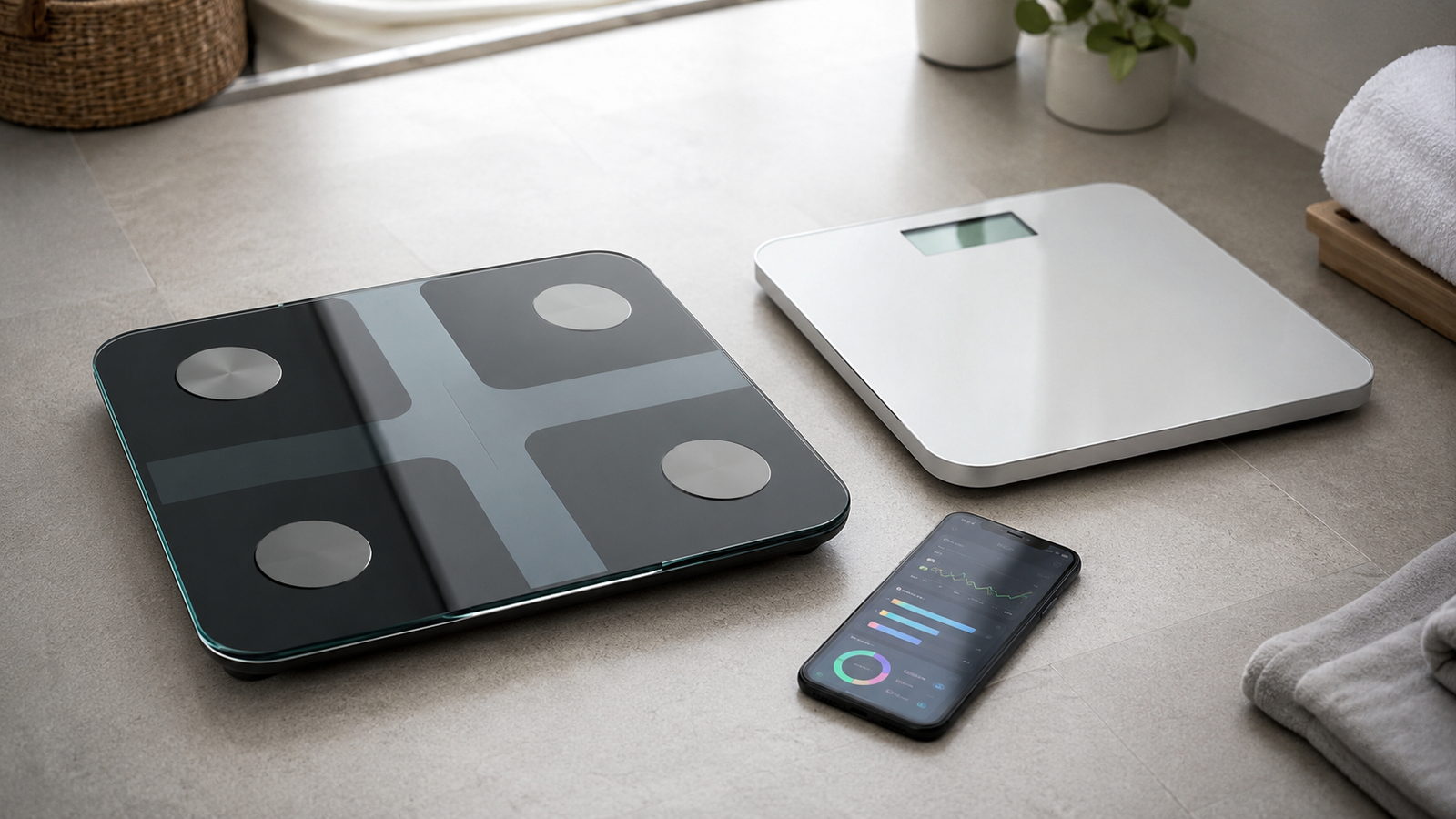
Smart Scale vs Regular Scale: Is Body Composition Tracking Worth It?
A regular digital scale answers one question: what is your current body weight? A smart scale tries to add context by syncing readings to an app and, on many models, estimating additional metrics such as body-fat percentage, muscle-related values or other body-composition figures.
The extra data can be useful for tracking trends, but it can also create false precision. A smart scale is worth paying for when its app, automatic history and multi-user features improve your routine—not simply because it displays more numbers.
Smart Scale vs Regular Scale at a Glance
| Factor | Regular Digital Scale | Smart Scale |
|---|---|---|
| Body weight | Yes | Yes |
| Automatic history | Usually no | Usually via app |
| Body-composition estimates | No | Often yes |
| App syncing | No | Usually Bluetooth/Wi-Fi |
| Multi-user tracking | Manual | Often supported |
| Complexity | Low | Higher |
Choose a Regular Scale If You Only Need Weight
A simple digital scale can be the better product when your only goal is monitoring body weight. There is less setup, no account to manage and no additional metrics to interpret.
If you already log weight elsewhere or only check occasionally, paying for app connectivity may add little value.
Choose a Smart Scale If Automatic Trend Tracking Helps You
The strongest advantage of a smart scale is not necessarily body-composition estimation. It is automatic data logging. Instead of remembering or writing down every reading, the app can build a history over time.
That can make trends easier to see and reduce the temptation to overreact to one isolated measurement.
How Body-Composition Estimates Work
Many consumer smart scales use bioelectrical impedance analysis. A very small electrical current passes through the body and the device uses the measured resistance, along with personal data and algorithms, to estimate body-composition metrics.
These are estimates, not direct laboratory measurements. Hydration, recent exercise, meals, time of day and other factors can influence readings.
Trend Data Is More Useful Than One Reading
If you use body-composition estimates, focus on consistency and longer-term patterns. A single body-fat or muscle estimate should not be treated as exact.
Measure under similar conditions when possible. For example, use the same scale, on the same hard floor, at a similar time of day and with similar hydration conditions.
App Quality Can Matter More Than Extra Metrics
A scale may advertise many tracked parameters, but a cluttered or unreliable app can make the experience frustrating. Check whether the app supports multiple profiles, historical graphs and the integrations you genuinely use.
Also consider whether the app remains useful without a subscription and whether the manufacturer provides clear information about account and data handling.
Privacy and Account Setup
Smart scales may store personal health-related data in an app or cloud service. Before buying, review the manufacturer’s privacy controls and decide whether you are comfortable creating an account and syncing this information.
If you prefer not to share or store body data electronically, a regular scale is the simpler choice.
Multi-User Households
Smart scales can be convenient when several people want separate histories. Automatic user recognition can reduce manual entry, although it is not always perfect when users have similar body weights.
Check how many profiles the system supports and whether each person needs a separate phone or account.
Accuracy: What Should You Expect?
For body weight, use the scale on a hard, level surface and follow calibration instructions. For body-composition metrics, expect more variation because the numbers are algorithmic estimates.
A consumer smart scale should not be used to diagnose a medical condition or make treatment decisions. If body composition is clinically important, use appropriate professional assessment.
When a Smart Scale Is Worth Paying More For
A smart scale can be worth the extra cost when automatic logging, multiple profiles and long-term graphs will change how consistently you track progress.
If you will open the app once and then ignore it, a simple high-quality digital scale may be better value.
Common Buying Mistakes
- Assuming every body-composition number is precise.
- Comparing readings taken under very different conditions.
- Choosing the scale with the most metrics instead of the best app fit.
- Ignoring privacy and account requirements.
- Using a scale on carpet or uneven flooring.
- Letting daily fluctuations drive unnecessary decisions.
Final Verdict
Choose a regular digital scale if you want simple, low-maintenance body-weight tracking. Choose a smart scale if automatic history, household profiles and trend tracking genuinely help you stay consistent.
The extra body-composition numbers can provide context, but they should be treated as estimates. The most valuable smart feature is often not another metric—it is a clearer record of change over time.