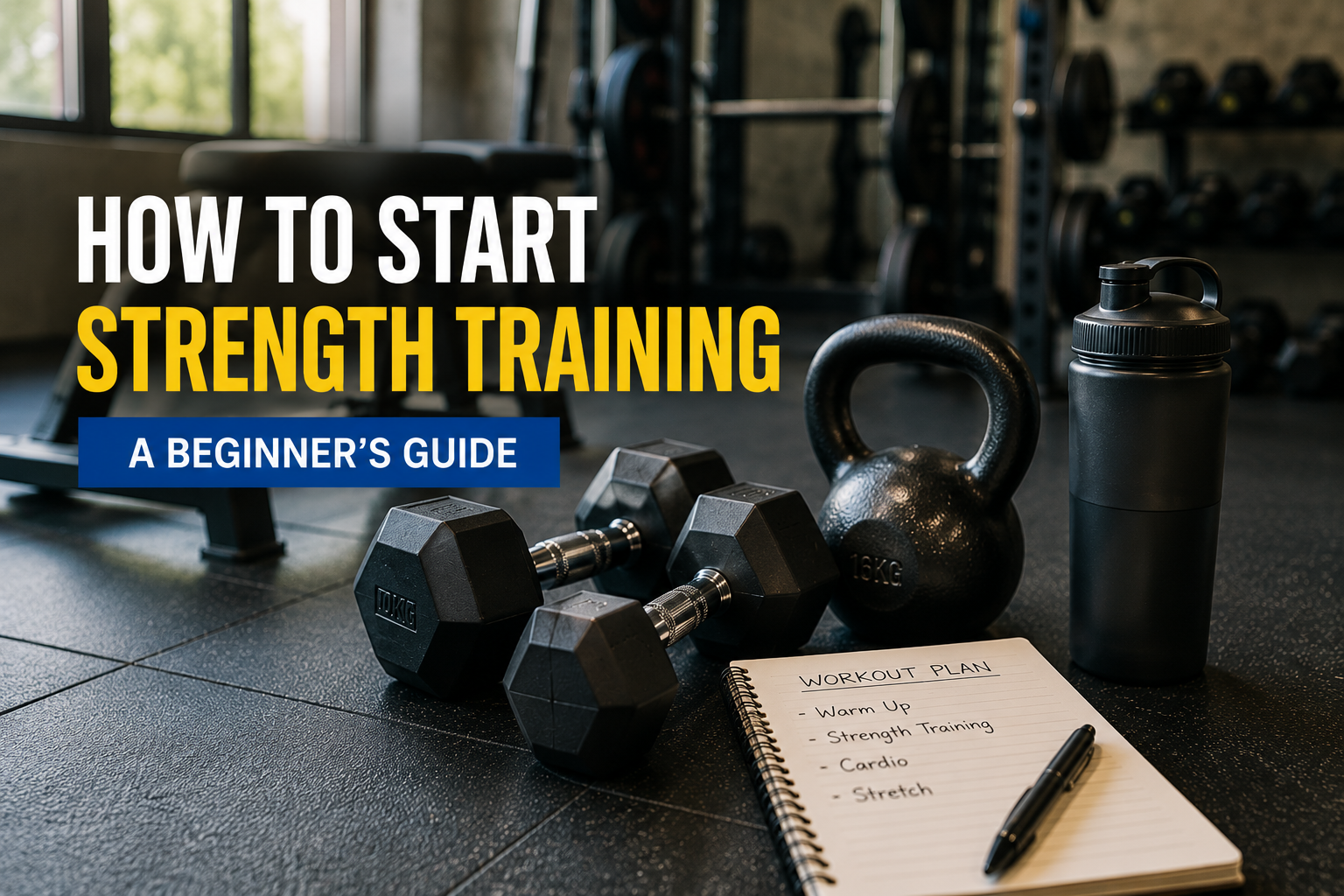
How to Start Strength Training: A Beginner’s Guide
Strength training can help build muscle, improve strength, support bone health, and make everyday movements easier. You don’t need an advanced workout plan or a room full of equipment to get started.
For beginners, the priority should be learning basic movements, using manageable resistance, and progressing gradually.
What Is Strength Training?
Strength training involves performing movements against resistance. That resistance can come from your body weight, resistance bands, dumbbells, machines, or other equipment.
The goal is to challenge your muscles enough that they gradually adapt and become stronger.
Benefits of Strength Training
A consistent strength-training routine can help:
- Increase muscular strength
- Build and maintain muscle
- Support bone health
- Improve your ability to perform everyday activities
- Improve balance and physical function
- Support overall fitness
Results depend on factors such as training consistency, nutrition, recovery, age, and individual circumstances.
How Often Should Beginners Strength Train?
For many beginners, training the major muscle groups at least twice per week is a practical starting point.
You don’t necessarily need to train every day. Recovery between sessions is an important part of adapting to exercise.
A simple schedule might be:
- Monday — Full body
- Wednesday — Full body
- Friday — Full body
Alternatively, two full-body sessions per week can be enough when you’re just getting started.
Start With Basic Movement Patterns
A beginner program can focus on a few fundamental movement patterns.
Squat
Squatting movements primarily train the legs and hips.
Beginners can start with bodyweight squats before progressing to additional resistance.
Push
Examples include wall push-ups, incline push-ups, regular push-ups, and chest presses.
Choose a variation you can perform with controlled technique.
Pull
Rows and similar pulling movements train muscles of the upper back and arms.
Resistance bands, dumbbells, cables, or machines can provide resistance.
Hip Hinge
Hip-hinge movements train the hips and posterior chain.
Learning the movement pattern correctly is more important than immediately adding heavy resistance.
Core
Simple exercises such as planks can help train the muscles responsible for stabilizing your trunk.
How Many Sets and Repetitions?
Beginners don’t need complicated programming.
A straightforward starting point is approximately:
- 1–3 sets per exercise
- A resistance that allows controlled repetitions with good technique
- Adequate rest between sets
The exact number of repetitions can vary depending on the exercise, resistance, goals, and experience level.
Avoid sacrificing technique simply to complete more repetitions.
Don’t Start Too Heavy
One of the easiest beginner mistakes is trying to lift too much weight too soon.
Start with resistance that allows you to learn the movement comfortably.
As your technique and strength improve, resistance or training volume can gradually increase.
What Is Progressive Overload?
Your body adapts to training over time.
Progressive overload means gradually increasing the challenge placed on your muscles.
Progression might involve:
- Adding a small amount of resistance
- Performing additional repetitions
- Adding a set
- Improving movement control
- Progressing to a more challenging exercise variation
Progress doesn’t require increasing weight during every workout.
Recovery Matters
Muscles need time to recover from training.
Support recovery with:
- Adequate sleep
- Appropriate nutrition
- Sufficient protein as part of a balanced diet
- Rest between demanding workouts
- Gradual increases in training difficulty
Persistent exhaustion or declining performance can be signs that your training or recovery needs adjustment.
What About Muscle Soreness?
Some muscle soreness can occur when starting a new exercise program.
However, severe pain should not be considered a requirement for an effective workout.
Sharp pain, significant swelling, or pain associated with an injury should not simply be trained through.
A Simple Beginner Strength Workout
A basic full-body session could include:
- Bodyweight squat
- Incline push-up
- Resistance-band or dumbbell row
- Glute bridge
- Plank
Focus on controlled movement and technique rather than speed.
The exercises can later be modified as your fitness and experience improve.
Common Beginner Mistakes
Avoid these common problems:
- Starting with excessive resistance
- Copying advanced training programs
- Ignoring exercise technique
- Increasing training volume too quickly
- Training hard every day without adequate recovery
- Frequently changing routines before allowing time for progress
- Comparing your progress with experienced lifters
Consistency usually matters more than complexity.
When Should You Get Professional Guidance?
Consider working with a qualified fitness professional if you’re unsure how to perform exercises correctly or need help designing an appropriate program.
If you have an injury, medical condition, significant pain, or other health concerns that could affect exercise, seek appropriate professional guidance before beginning or substantially changing your exercise routine.
Final Verdict
Strength training does not need to be complicated.
Start with basic movement patterns, manageable resistance, and a schedule you can maintain. Learn good technique first and increase the challenge gradually as your strength and confidence improve.
A simple program performed consistently is generally more useful than an advanced program you cannot sustain.
Editorial note: This article provides general fitness information and is not individualized medical or exercise advice. Individual exercise needs and limitations vary.