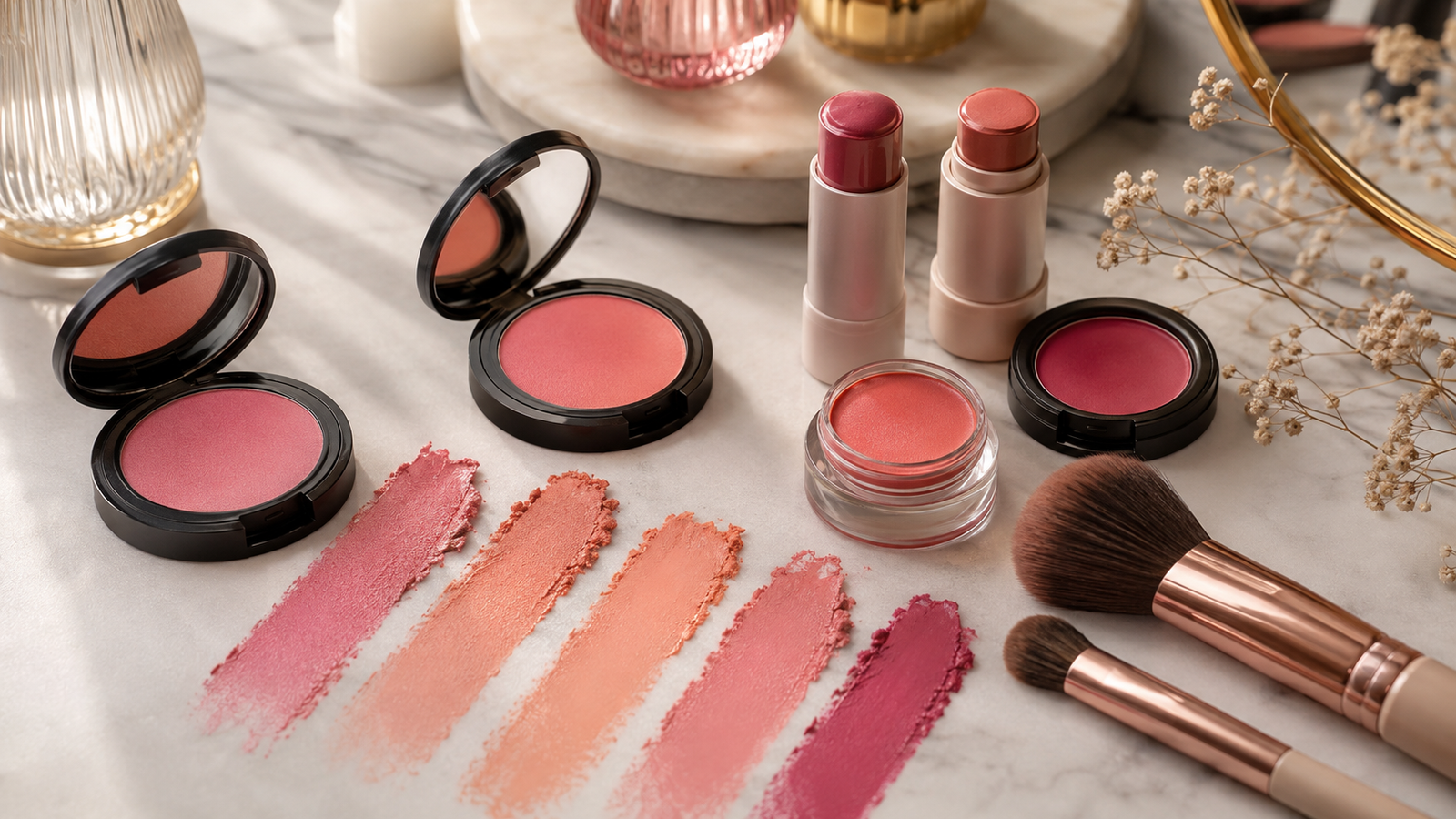
How to Choose the Right Blush for Your Skin Tone and Finish
Blush can completely change the balance of a makeup look.
A small amount can make the complexion appear:
- fresher;
- warmer;
- more dimensional;
- more polished;
- naturally flushed.
But choosing blush is not simply a matter of finding a shade labelled:
- pink;
- peach;
- coral;
- berry;
- mauve.
The final result depends on several factors working together:
skin depth → undertone → blush depth → colour intensity → formula → finish → placement
The goal is not to find one universally flattering blush.
It is to find a blush that gives you the colour, finish and intensity you want while blending naturally with your complexion and the rest of your makeup.
What Does Blush Actually Do?
Foundation and concealer can make skin tone appear more even.
But that can also reduce some of the natural colour variation in the face.
Blush adds controlled colour back to areas such as the:
- cheeks;
- cheekbones;
- upper cheek area.
Depending on placement, blush can create different effects.
It can make the face look:
- softly flushed;
- lifted;
- sculpted;
- youthful;
- warm;
- dramatic.
Blush is therefore both a colour product and a shaping product.
Do You Need Blush?
No makeup product is mandatory.
You may prefer:
- foundation without blush;
- bronzer only;
- bare skin;
- minimal complexion makeup.
But blush is particularly useful if your base makeup leaves your face looking:
- flat;
- overly uniform;
- washed out.
Even a very sheer blush can restore dimension without making the makeup look obviously colourful.
Start With Skin Depth
Before undertone, think about the overall depth of your complexion.
Broadly, skin may be described as:
- fair;
- light;
- medium;
- tan;
- deep;
- very deep.
These categories overlap, but they help determine how much depth a blush shade needs.
A blush that looks vivid on fair skin may barely appear on deeper skin.
Similarly, an extremely deep or saturated blush may require a very light hand on fair skin.
The important principle is:
the blush needs enough contrast to be visible without becoming harder to control than necessary.
Blush for Fair Skin
Fair complexions often work easily with softer shades such as:
- pale pink;
- soft peach;
- light rose;
- muted coral.
Highly pigmented formulas can still work.
But apply them with:
- a small brush;
- minimal product;
- gradual layering.
You do not need to restrict yourself to pale colours.
A deeper berry shade can look beautiful when used sheerly.
The application matters as much as the shade.
Blush for Light Skin
Light complexions generally have more flexibility.
Useful colour families include:
- pink;
- peach;
- rose;
- soft coral;
- light mauve.
Look at:
- undertone;
- desired makeup style.
For a subtle everyday look, choose a shade relatively close to your natural flush.
For stronger contrast, choose something:
- deeper;
- warmer;
- cooler.
Blush for Medium Skin
Medium complexions can usually support more colour saturation.
Consider:
- rose;
- coral;
- apricot;
- warm pink;
- mauve;
- terracotta.
Very pale blushes may sometimes appear:
- chalky;
- ashy;
- almost invisible.
Look for enough pigment depth to remain visible.
Blush for Tan Skin
Tan skin often pairs well with:
- warm coral;
- terracotta;
- deeper peach;
- warm rose;
- reddish pink;
- bronze-rose shades.
But cool-toned berry and mauve shades can also create beautiful contrast.
Do not feel restricted to warm blush simply because your skin is tan.
Blush for Deep Skin
Deeper complexions generally benefit from blushes with:
- stronger saturation;
- richer pigment;
- deeper base colours.
Useful families include:
- berry;
- plum;
- deep rose;
- brick;
- burnt coral;
- red;
- wine.
Very pale pastel blushes can sometimes appear ashy unless specifically formulated for deeper complexions.
Blush for Very Deep Skin
Rich pigments often create the clearest result.
Consider:
- deep berry;
- burgundy;
- vivid red;
- raisin;
- plum;
- deep terracotta;
- saturated coral.
A strong blush shade can look surprisingly natural once blended into deeper skin.
Do not judge the colour only by how dramatic it appears in the pan.
What Is Skin Undertone?
Undertone is the subtle underlying colour of the complexion.
It is often described as:
- warm;
- cool;
- neutral;
- olive.
Your undertone is not the same as your skin depth.
Someone can have:
- fair warm skin;
- fair cool skin;
- deep warm skin;
- deep cool skin.
Warm Undertones
Warm undertones may lean toward:
- golden;
- yellow;
- peach.
Blush colours that often harmonize well include:
- peach;
- coral;
- apricot;
- warm rose;
- terracotta.
But this is not a rule.
Cool pink can look striking on warm skin when you want contrast.
Cool Undertones
Cool undertones may lean toward:
- pink;
- rosy;
- bluish.
Commonly harmonious blush families include:
- cool pink;
- rose;
- mauve;
- berry;
- plum.
Warm peach can still work.
It simply creates a different effect.
Neutral Undertones
Neutral undertones contain a relatively balanced mixture of warm and cool characteristics.
They often have considerable flexibility.
You may find that both:
- peach;
- pink;
look natural.
Your decision can therefore focus more heavily on:
- makeup look;
- clothing;
- lip colour;
- personal preference.
Olive Undertones
Olive skin can have a subtle:
- green;
- golden-green;
- muted quality.
Some blush shades may unexpectedly turn:
- very orange;
- very pink;
- greyish.
Good possibilities often include:
- muted rose;
- peach;
- terracotta;
- warm berry;
- mauve.
But olive undertones vary significantly.
Testing the product on your actual skin is particularly useful.
How Do You Identify Your Undertone?
There is no single perfect home test.
You may see methods involving:
- wrist veins;
- jewellery;
- white clothing;
- sunlight.
These can provide clues but are not always reliable.
A better approach is to look at products you already know suit you.
Ask:
- Does yellow-toned foundation usually look natural?
- Does pink-toned foundation look too rosy?
- Do both warm and cool colours work?
- Does foundation frequently look too orange despite being the correct depth?
If matching foundation has been difficult, you may have:
- neutral;
- olive;
- less easily categorized undertones.
Do You Have to Match Blush to Undertone?
No.
This is one of the most important points.
Matching undertone creates harmony.
Contrasting undertone creates visual interest.
For example:
Warm Skin + Peach Blush
Creates a cohesive warm appearance.
Warm Skin + Cool Pink Blush
Creates stronger contrast and can make the cheeks look noticeably fresh.
Both can work.
Undertone guidance should help you predict the result—not restrict your choices.
Natural Flush vs Makeup Effect
Think about the result you want.
Natural-Looking Blush
Choose something relatively close to:
- your natural flush;
- your undertone;
- your skin’s colour depth.
Fresh, Bright Look
Choose a slightly clearer:
- pink;
- coral.
Warm Sun-Kissed Look
Consider:
- peach;
- terracotta;
- warm rose.
Dramatic Look
Choose:
- berry;
- red;
- wine;
- deeper plum.
The same person can wear several blush families successfully.
Pink Blush
Pink is one of the broadest blush categories.
It ranges from:
- baby pink;
- rose pink;
- hot pink;
- dusty pink.
Soft Pink
Can create a delicate flush on lighter skin.
Medium Rose Pink
Versatile across many complexions.
Bright Pink
Can look surprisingly natural when applied sheerly, particularly on medium-to-deep skin.
Do not assume bright colour in the pan means an equally bright result on the face.
Peach Blush
Peach combines elements of:
- pink;
- orange.
It often creates a warm, fresh complexion.
Particularly useful for:
- warm;
- neutral undertones.
But it can also brighten cooler complexions.
Coral Blush
Coral is usually more saturated than peach.
It combines:
- pink;
- orange;
- sometimes red.
Coral can work particularly well for:
- summer makeup;
- warm complexions;
- medium and tan skin.
Deeper coral shades can also look excellent on deep skin.
Rose Blush
Rose sits somewhere between:
- pink;
- red.
It is one of the most versatile blush families.
Muted rose can create a realistic flush across many skin tones.
For someone buying a first blush, a medium rose shade is often an easy place to start.
Mauve Blush
Mauve usually contains:
- pink;
- purple;
- grey.
It creates a cooler, more muted appearance.
It can work particularly well for:
- cool;
- neutral;
- olive undertones.
On some warm complexions, mauve creates sophisticated contrast.
Berry Blush
Berry shades contain deeper:
- red;
- pink;
- purple.
They work particularly well on:
- medium;
- tan;
- deep skin.
But fair skin can also wear berry blush very lightly.
Because berry shades are often strongly pigmented, gradual application matters.
Plum Blush
Plum is generally:
- deeper;
- cooler;
- more purple.
It can be especially flattering on deeper skin tones.
On lighter complexions, use it sparingly for a dramatic cool flush.
Red Blush
Red blush may appear intimidating in the pan.
But remember:
natural flushing is often red.
When sheerly applied, red blush can look extremely natural.
It is particularly effective across:
- medium;
- tan;
- deep complexions.
Choose pigmentation carefully if you prefer subtle makeup.
Terracotta Blush
Terracotta combines:
- warm brown;
- orange;
- red.
It can create:
- warmth;
- definition;
- sun-kissed colour.
Particularly attractive on:
- medium;
- tan;
- deep skin.
Fair skin can wear softer terracotta shades with a light hand.
Brown-Toned Blush
Muted brown-pink or brown-peach blushes are useful for understated makeup.
They can create:
- subtle dimension;
- sophisticated neutral colour.
But if the shade is too close to your skin tone, it may disappear.
Should Blush Match Your Lipstick?
It does not need to match exactly.
But keeping both within related colour families can create harmony.
For example:
Warm Makeup
Peach blush + warm nude lip.
Cool Makeup
Mauve blush + rosy lip.
Neutral Makeup
Rose blush + balanced nude.
You can also deliberately contrast them.
The goal is overall balance, not perfect colour matching.
Powder Blush
Powder is the traditional blush format.
Advantages include:
- easy control;
- buildable application;
- broad shade selection;
- good wear over foundation and powder.
It can work for almost every skin type.
Who Should Choose Powder Blush?
Particularly useful if you:
- are new to blush;
- have oily skin;
- prefer matte or satin finishes;
- like applying makeup with brushes.
Powder gives you excellent control over intensity.
Powder Blush for Dry Skin
Dry skin can still use powder blush.
The key is preparation.
Use:
- moisturizer;
- appropriate base makeup.
Choose finely milled powders rather than very dry-looking formulas.
Apply lightly.
Avoid repeatedly layering powder over already textured dry areas.
Cream Blush
Cream blush has become extremely popular.
It generally creates a more:
- skin-like;
- soft;
- emollient finish.
Cream formats include:
- pots;
- sticks;
- compacts.
They often blend well with:
- fingers;
- sponge;
- brush.
Who Should Choose Cream Blush?
Cream blush is particularly useful if you prefer:
- natural makeup;
- dewy skin;
- easy finger application.
It often works well for:
- normal;
- dry;
- combination skin.
Oily skin can also wear it.
Setting may simply be useful.
Cream Blush for Mature Skin
Cream formulas may work beautifully on mature skin because they can avoid adding too much powder texture.
Look for:
- smooth blendability;
- moderate sheen;
- comfortable texture.
Extremely glossy blush may emphasize texture if that bothers you.
A satin cream can provide a balanced result.
Liquid Blush
Liquid blush is often highly pigmented.
A very small amount may cover both cheeks.
Advantages include:
- high spreadability;
- strong colour;
- lightweight feel.
The main challenge is controlling the amount.
How to Apply Liquid Blush
Do not automatically place a large applicator swipe on each cheek.
Instead:
- Place a tiny amount on the back of your hand.
- Pick it up with a brush or sponge.
- Tap onto the cheek.
- Build gradually.
This gives much more control.
Blush Sticks
Blush sticks are cream products in a convenient solid format.
They are useful for:
- travel;
- quick application;
- cream makeup routines.
You can apply:
- directly;
- with a brush;
- with fingers.
For strong formulas, picking product from the stick with a brush gives better control.
Balm Blush
Balm formulas are usually:
- sheer;
- emollient;
- dewy.
They work well for minimal makeup.
But very glossy balms may have shorter wear time.
They can also remain slightly tacky.
Blush Tint
Tints are designed to stain the skin lightly.
They may provide:
- long wear;
- natural transparency.
But they can set quickly.
You need to blend faster than with many creams.
Matte Blush
Matte blush has no visible shimmer.
Advantages:
- versatile;
- photographs predictably;
- works with other luminous complexion products.
It can be particularly useful for:
- textured skin;
- oily complexions;
- people who prefer controlled shine.
Matte does not need to mean flat or dry.
Modern formulas can still look soft.
Satin Blush
Satin blush contains subtle luminosity.
It falls between:
matte ↔ shimmer
This is one of the easiest finishes to wear.
It can add enough light reflection to make the cheeks look dimensional without obvious sparkle.
Luminous Blush
Luminous formulas reflect more light.
They can create:
- glow;
- freshness.
They may reduce the need for separate highlighter.
However, reflective particles can emphasize texture depending on:
- particle size;
- skin texture;
- placement.
If you want glow without obvious shimmer, look for finely luminous formulas.
Shimmer Blush
Shimmer blush contains visible reflective particles.
This can create a more dramatic effect.
It works well for:
- evening makeup;
- festive looks;
- smooth cheek areas.
But it can emphasize:
- enlarged pores;
- texture;
- acne marks.
That does not mean textured skin must avoid shimmer.
It simply means you should know what visual effect it creates.
Dewy Blush
Dewy blushes typically come in:
- cream;
- balm;
- liquid forms.
They create visible sheen.
Excellent for:
- minimal makeup;
- dry skin;
- fresh editorial looks.
But they may have:
- shorter longevity;
- more transfer.
People with very oily skin may prefer a satin finish.
Which Finish Is Best for Oily Skin?
A practical starting point is:
- powder;
- matte;
- satin.
These tend to remain more stable.
You can still use cream blush.
Try:
cream blush → light setting powder or matching powder blush
for better longevity.
Which Finish Is Best for Dry Skin?
Cream and satin formulas often feel comfortable.
Look for:
- cream;
- balm;
- finely milled satin powder.
Avoid applying excessive face powder before blush.
The smoother the base, the smoother blush tends to appear.
Which Finish Is Best for Combination Skin?
Almost any format can work.
Choose based on:
- preferred finish;
- longevity.
You may use:
- cream on cheeks;
- light powder through oilier areas.
Which Blush Works for Acne-Prone Skin?
Acne-prone skin can use:
- powder;
- cream;
- liquid.
There is no universally acne-safe blush format.
Look for products your skin tolerates.
Remove makeup thoroughly.
Avoid aggressively rubbing inflamed acne with:
- stiff brushes;
- repeated layering.
If active acne is painful, keep application gentle.
Blush and Sensitive Skin
If your skin reacts easily, consider:
- fragrance-free formulas;
- simpler ingredient lists;
- products you already tolerate.
Stop using any product that causes:
- burning;
- persistent redness;
- itching;
- swelling.
Makeup should not hurt.
Pigmentation Matters
Two blushes that look identical in the pan may behave very differently.
One may be:
- sheer;
- buildable.
The other may deliver strong colour immediately.
Neither is better.
Sheer Blush
Advantages:
- easy to control;
- beginner-friendly;
- natural effect.
Highly Pigmented Blush
Advantages:
- less product required;
- works particularly well on deeper skin.
But beginners may find it more difficult to control.
Is Highly Pigmented Blush Better?
No.
Pigmentation is a characteristic, not a quality score.
For everyday makeup, a sheer blush can actually be easier.
The best pigmentation level depends on:
- skin depth;
- desired intensity;
- application skill.
How to Swatch Blush Properly
Finger swatches can show:
- colour;
- pigmentation;
- finish.
But they do not perfectly show how blush will appear on the face.
Why?
Because blush is normally applied:
- much more thinly;
- with a brush or sponge;
- over foundation or skin.
Whenever possible, test it on the cheek or use a sheer swatch.
Blush Oxidation
Some cream and liquid formulas may appear slightly different after setting.
Your:
- foundation;
- skin oils;
- undertone;
may also influence the final appearance.
When testing in-store, wait a few minutes before deciding.
Blush Over Bare Skin
Blush can be applied directly to:
- moisturized;
- sunscreen-covered skin.
Cream and liquid formulas often work particularly well this way.
Allow sunscreen to set before blending aggressively over it.
You do not want to disturb your sun-protection layer unnecessarily.
Blush Over Foundation
Most blushes work over foundation.
But texture compatibility matters.
Powder Blush Over Foundation
If foundation remains tacky, powder blush may grab unevenly.
You can:
- lightly set first;
- use a very soft brush.
Cream Blush Over Foundation
Tap rather than rub.
Rubbing may lift the foundation underneath.
Powder Over Cream Blush
Layering powder blush over cream is a classic technique for:
- stronger colour;
- longer wear.
For example:
cream blush → matching powder blush
This can be useful for:
- weddings;
- events;
- humid weather;
- long days.
For everyday makeup, one blush is usually enough.
Can You Put Cream Blush Over Powder?
You can, but it is more difficult.
Cream applied over a heavily powdered surface may:
- grab;
- become patchy;
- lift product.
A better order is generally:
liquid/cream products → powder products
But modern formulas sometimes break this rule successfully.
Blush Brush Types
Brush design affects application.
Fluffy Blush Brush
Provides:
- diffused;
- soft application.
Best for:
- powder blush;
- highly pigmented shades.
Angled Blush Brush
Can follow the cheekbone.
Useful for:
- lifted placement;
- controlled application.
Dense Brush
Useful for:
- cream;
- liquid blush.
It deposits more colour.
Be careful with strongly pigmented formulas.
Duo-Fibre Brush
Can provide a very sheer application.
Useful for:
- liquid blush;
- highly pigmented cream.
Makeup Sponge
A damp sponge works particularly well with:
- cream;
- liquid blush.
It can produce a seamless finish.
Use tapping motions.
Avoid rubbing.
Fingers
Fingers work very well for many cream and balm formulas.
Body warmth helps spread the product.
Use clean hands.
Tap rather than drag.
Where Should You Apply Blush?
There is no universal correct placement.
Placement changes the visual structure of the face.
Common approaches include:
- apples of cheeks;
- upper cheekbones;
- across cheeks and nose;
- temple-focused placement.
Choose according to the effect you want.
Blush on the Apples of the Cheeks
Smile gently and apply around the fuller cheek area.
This creates:
- rounded;
- youthful;
- traditional flush.
Avoid placing all the colour too close to the nose.
Blend outward.
Lifted Blush Placement
Apply slightly higher on the cheekbones and blend toward:
- temples.
This creates a more:
- elongated;
- lifted effect.
It is particularly popular with modern makeup styles.
Blush Across the Nose
Applying a small amount across the:
- cheeks;
- bridge of nose;
can imitate a sun-flushed appearance.
Keep it subtle for a natural look.
Remember that blush does not replace sunscreen.
Draped Blush
Blush draping uses colour more extensively around:
- cheekbones;
- temples.
It can create a more editorial or dramatic look.
This technique often works well with:
- stronger colours;
- monochromatic makeup.
Under-Eye Blush
Some trends place blush relatively high near the under-eye area.
This can create:
- youthful;
- animated complexion.
But if you have:
- redness;
- dark circles;
- textured under-eyes;
you may prefer keeping the strongest colour slightly lower.
Blush for Round Faces
If you want a visually more elongated effect:
apply blush slightly higher and blend outward.
Avoid concentrating all colour directly in the centre of the cheeks.
But there is no rule saying round faces cannot wear apple-of-cheek blush.
The final effect is a preference.
Blush for Long Faces
More horizontal placement across the cheek can visually add width.
Consider keeping the colour:
- slightly lower;
- more central.
Again, face-shape guidance is optional rather than mandatory.
Blush for Square Faces
Soft, diffused blush around the cheek area can create balance.
You can blend:
- outward;
- slightly upward.
Do not feel obligated to “correct” a square face.
Makeup should enhance according to your preference, not force every face toward the same shape.
Blush for Heart-Shaped Faces
You can place blush:
- slightly below the cheekbone;
- blend outward.
But face shape should remain secondary to:
- personal style;
- your natural cheek structure.
Should Blush Go Above or Below Bronzer?
Usually:
Bronzer
Adds warmth around areas such as:
- forehead;
- cheek perimeter.
Blush
Adds colour to the cheeks.
They may overlap slightly.
A typical order is:
bronzer → blush → highlighter
But there is no strict requirement.
Blush vs Bronzer
These products perform different jobs.
Blush
Adds:
- pink;
- peach;
- red;
- berry tones.
Creates a flushed appearance.
Bronzer
Adds:
- golden;
- brown;
- warm tones.
Creates sun-kissed warmth.
You can use:
- blush alone;
- bronzer alone;
- both.
Blush vs Contour
Contour uses cooler shadow-like shades to create visual depth.
It is typically placed:
- beneath cheekbone;
- jaw;
- sides of nose.
Blush adds colour.
Do not use a very warm orange bronzer as contour if your goal is to imitate natural shadow.
Blush vs Highlighter
Highlighter reflects light.
Blush adds colour.
Luminous blush can sometimes perform both jobs.
If your blush already has strong sheen, separate highlighter may be unnecessary.
How Much Blush Should You Use?
Start with less.
Blush is much easier to build than remove.
For powder:
- Tap brush into product.
- Tap off obvious excess if necessary.
- Apply lightly.
- Build gradually.
For liquid:
use the smallest possible amount first.
How to Fix Too Much Powder Blush
If you apply too much:
Option 1
Blend with a clean fluffy brush.
Option 2
Use the brush that still has a little foundation powder on it.
Option 3
Lightly press a sponge over the area.
Avoid immediately adding more powder everywhere.
How to Fix Too Much Cream Blush
Use:
- clean sponge;
- foundation brush with leftover base product.
Tap gently over the edges.
Do not rub aggressively because you may remove the foundation underneath.
Why Does Blush Look Patchy?
Possible reasons include:
- dry skin;
- uneven foundation;
- applying powder onto a sticky base;
- too much pigmentation at once;
- poor blending;
- incompatible layers.
Preventing Patchy Powder Blush
Try:
- Prepare skin properly.
- Apply foundation.
- Lightly set sticky areas.
- Use a soft brush.
- Build colour gradually.
Preventing Patchy Cream Blush
Try:
- Use thin foundation layers.
- Apply small amounts.
- Tap rather than drag.
- Blend quickly if the formula sets fast.
Why Does Blush Disappear During the Day?
Blush can fade because of:
- skin oil;
- touching the face;
- humidity;
- low-pigment formula;
- insufficient setting.
For longer wear:
cream blush → powder blush
can work extremely well.
You can also use:
- setting spray;
- long-wear formula.
Blush for Humid Weather
In hot or humid conditions, consider:
- powder blush;
- long-wear liquid tint;
- cream set with powder.
Keep complexion layers thin.
Heavy layering can become uncomfortable in heat.
Blush for Dry Weather
Cream or balm formulas may feel comfortable.
But good skin preparation matters more than changing blush alone.
Use:
- moisturizer;
- appropriate base.
Blush for Everyday Makeup
For a simple routine, choose:
- one easy-to-blend shade;
- medium pigmentation;
- natural or satin finish.
Apply lightly.
You do not need a large blush collection.
One versatile colour can work across many looks.
Blush for No-Makeup Makeup
Choose:
- cream;
- sheer liquid;
- balm.
Use a colour close to your natural flush.
Apply:
- lightly;
- diffusely.
Keep the edges invisible.
Blush for Full Glam Makeup
You may want:
- stronger pigmentation;
- powder layering;
- more structured placement.
Use blush after:
- contour;
- bronzer.
Then add highlight if needed.
Blush for Bridal Makeup
Longevity matters.
A common technique:
- Cream or liquid blush.
- Set complexion lightly.
- Add matching powder blush.
This provides:
- depth;
- durability.
Choose colour based on:
- skin tone;
- photography;
- overall makeup palette.
Blush for Photography
Flash and strong lighting can reduce visible colour.
Professional makeup may therefore use slightly more blush than everyday makeup.
But reflective shimmer can behave differently under flash.
For photography, satin or matte formulas can be predictable.
Blush and Mature Skin
There is no age at which you should stop using blush.
Blush can bring freshness to the complexion.
Useful approaches include:
- cream textures;
- finely milled powders;
- satin finishes;
- careful placement.
Avoid excessive powder if it emphasizes dryness.
But mature skin can absolutely wear powder blush if the formula works.
Blush for Textured Skin
If you want to minimize the appearance of texture, consider:
- matte;
- satin;
- finely luminous finishes.
Large shimmer particles reflect light from texture.
That may make it more noticeable.
But texture is normal.
If you enjoy shimmer, wear it.
Blush Over Acne
Apply gently.
Avoid repeatedly buffing inflamed lesions.
A soft brush or sponge can reduce friction.
If the blush is sheer, you can leave some natural redness visible rather than trying to create a completely uniform base underneath.
Can Blush Cause Breakouts?
Any leave-on cosmetic can potentially contribute to irritation or breakouts for a particular person.
Possible contributors include:
- heavy emollients;
- fragrance;
- individual ingredient sensitivity;
- contaminated brushes.
There is no universal list of blush ingredients that causes acne for everyone.
Clean your tools regularly.
How Often Should You Wash Blush Brushes?
For personal-use makeup brushes, regular washing is sensible.
Especially if you use them with:
- cream;
- liquid products.
Wash with an appropriate cleanser and allow them to dry completely.
Do not share unclean brushes.
Cream Blush Hygiene
Avoid repeatedly dipping dirty fingers into pot products.
Use:
- clean fingers;
- brush;
- spatula where practical.
Keep the product closed when not in use.
Blush Expiry
Makeup does not last indefinitely.
Check the product’s:
- period-after-opening symbol;
- manufacturer guidance.
Replace if you notice major changes in:
- smell;
- texture;
- colour.
Liquid and cream products generally require more attention to hygiene than dry powders.
Should You Buy a Blush Palette?
A palette can be useful if you:
- enjoy changing makeup;
- work professionally;
- want several finishes.
But for everyday use, you may end up using only one or two shades.
A single well-chosen blush can provide better value.
Blush Duos
Duos may combine:
- matte + shimmer;
- light + deep shade.
They can be useful because you can mix the colours.
But make sure both sides work for your complexion.
Multi-Use Lip and Cheek Products
These can be convenient.
But the formula needs to work on both areas.
A product comfortable on lips may feel:
- sticky;
- too glossy;
on cheeks.
A blush formula may feel too dry for lips.
Multi-use does not automatically mean equally good everywhere.
Can You Use Lipstick as Blush?
Many people do.
Cream lipstick can work as a cheek colour.
But check whether the product is suitable for use on the face.
Apply:
- small amount;
- blend quickly.
Long-wear matte lipstick can be harder to blend.
Can You Use Eyeshadow as Blush?
Technically, some powder eyeshadows can create cheek colour.
But pigments approved for eye use are not necessarily intended for large cheek application in every market.
For routine use, a dedicated blush is easier and more predictable.
Does Expensive Blush Work Better?
Not necessarily.
Premium pricing may reflect:
- packaging;
- branding;
- formula texture;
- pigment quality;
- luxury positioning.
An affordable blush can be excellent if it:
- blends evenly;
- lasts well;
- provides the desired colour.
What Makes a Good Blush?
Look for:
Blendability
Colour should diffuse without obvious patches.
Appropriate Pigmentation
Strong enough for your skin tone but controllable.
Suitable Finish
Matte, satin or luminous according to preference.
Wear Time
Should last long enough for your routine.
Texture
Should not become excessively:
- dry;
- sticky;
- greasy.
Shade Depth
Should remain visible on your complexion.
These factors matter more than luxury packaging.
How Many Blush Shades Do You Need?
For a functional makeup collection, even two or three can cover most needs.
For example:
Everyday Neutral
Rose or muted peach.
Warm Option
Coral or terracotta.
Cool/Evening Option
Mauve or berry.
You do not need dozens unless blush is something you particularly enjoy collecting.
Choosing Your First Blush
For your first blush, prioritize:
- medium pigmentation;
- easy blendability;
- satin or soft matte finish;
- versatile shade.
A natural rose or peach-rose often works well.
Avoid starting with:
- extremely pigmented liquid;
- highly glittery finish;
unless that is specifically what you want.
Blush and Seasonal Makeup
You can change colour with the season if you enjoy it.
Spring
- soft pink;
- peach.
Summer
- coral;
- bright pink.
Autumn
- terracotta;
- warm rose.
Winter
- berry;
- mauve;
- plum.
This is stylistic—not a rule.
Common Blush Mistakes
Choosing Only by the Pan Colour
Blush behaves differently when blended.
Assuming Undertone Rules Are Mandatory
Contrast can look excellent.
Using Too Much Highly Pigmented Liquid Blush
Start extremely small.
Applying Powder Over a Very Sticky Base
Can create patchiness.
Rubbing Cream Blush Over Foundation
This may lift the base.
Using the Wrong Brush for the Formula
Dense brushes deposit more pigment.
Applying Shimmer Everywhere When Texture Bothers You
Choose placement carefully.
Buying Shades Too Pale for Your Skin Depth
They may appear ashy or disappear.
Applying All Blush Too Close to the Nose
This can visually concentrate redness in the centre of the face.
Following Face-Shape Rules Too Strictly
Placement should support the look you actually like.
A Simple Blush Routine for Fair Skin
- Complete your complexion base.
- Choose soft pink, peach or rose.
- Use a fluffy brush.
- Pick up very little product.
- Apply to cheeks.
- Build gradually.
If using a deeper berry shade, use an especially light hand.
A Simple Blush Routine for Medium Skin
- Choose rose, coral, peach or mauve.
- Apply with medium-sized blush brush.
- Start on the cheek.
- Blend outward.
- Add another layer if needed.
A Simple Blush Routine for Deep Skin
- Choose saturated berry, plum, red, coral or terracotta.
- Avoid overly pale chalky shades.
- Use enough pigment to remain visible.
- Blend edges carefully.
- Add highlighter separately only if needed.
A Simple Cream Blush Routine
- Apply complexion products.
- Place a small amount of cream blush on hand.
- Pick it up with sponge or brush.
- Tap onto cheeks.
- Blend outward.
- Set lightly if needed.
A Simple Long-Wear Blush Routine
- Apply thin foundation.
- Add cream/liquid blush.
- Lightly set complexion.
- Apply matching powder blush.
- Finish with setting spray if desired.
This can improve longevity without applying one extremely thick layer.
Blush Buying Checklist
Before choosing, ask:
1. What is my skin depth?
The shade needs enough saturation to show.
2. What is my undertone?
Use this to predict harmony or contrast.
3. What colour effect do I want?
Pink, peach, coral, rose, berry or terracotta?
4. Do I want matte, satin or glow?
Choose the finish intentionally.
5. What is my skin type?
This can influence formula preference.
6. How pigmented do I want the product?
Beginners may prefer buildable formulas.
7. Do I prefer brush, sponge or fingers?
Choose a compatible texture.
8. Will I use it over foundation or bare skin?
Consider layering.
9. Do I need long wear?
Cream + powder layering may help.
10. Does the shade actually show naturally on my complexion?
This matters more than the colour name.
When Should You Stop Using a Blush?
Stop using the product if you develop:
- persistent itching;
- burning;
- swelling;
- rash;
- irritation.
If your skin repeatedly reacts to makeup, consider discussing the issue with a dermatologist.
Do not continue using a product simply because it was expensive.
The Physical Glow Takeaway
Choosing blush becomes much easier when you separate the decision into three questions:
What colour? → What formula? → What finish?
Start with skin depth so the blush has enough pigment to show.
Then consider undertone:
- warm undertones → peach, coral and warm rose often create harmony;
- cool undertones → pink, mauve and berry often create harmony;
- neutral undertones → both warm and cool families can work;
- olive undertones → muted rose, peach, terracotta and berry can be particularly useful.
But these are guidelines—not restrictions.
A contrasting blush can look just as beautiful.
Then choose the formula:
- powder → easy control and reliable wear;
- cream → soft, skin-like finish;
- liquid → lightweight and often highly pigmented;
- balm → sheer and dewy.
Finally, choose your finish:
- matte → controlled and versatile;
- satin → subtle dimension;
- luminous → visible glow.
The most important technique is simple:
start with less and build gradually.
A good blush should look like colour belongs on the complexion rather than sitting separately on top of it.
You do not need the shade that someone says is universally flattering.
You need the colour, depth and finish that create the version of your complexion you want to see.