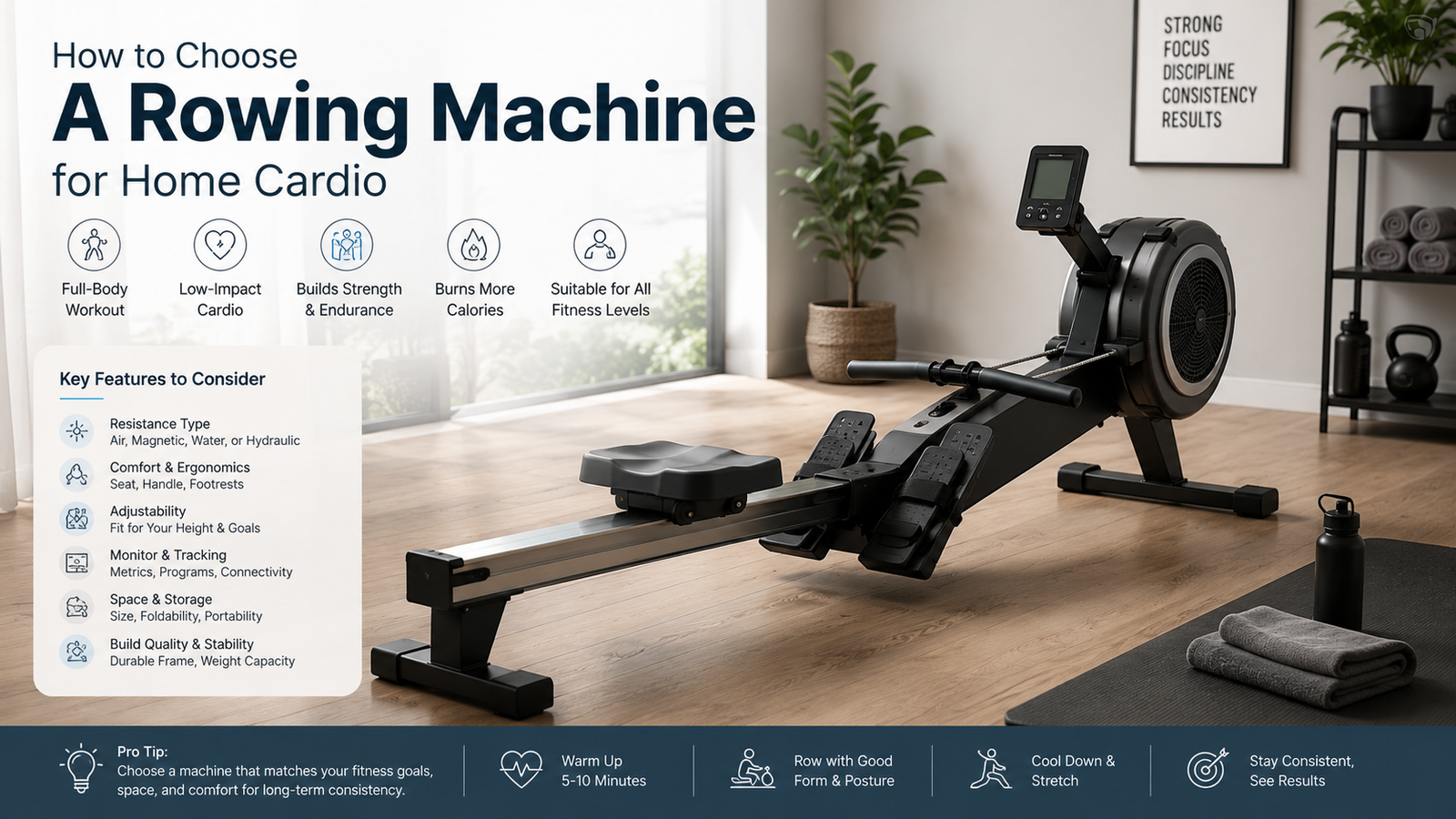
How to Choose a Rowing Machine for Home Cardio
A rowing machine can be one of the most effective pieces of cardio equipment for home workouts because it combines:
- cardiovascular exercise;
- lower-body effort;
- upper-body involvement;
- trunk stabilization;
- adjustable training intensity.
Unlike a treadmill or exercise bike, rowing uses a coordinated movement involving:
legs → hips → trunk → arms
That can make it feel like a more complete whole-body exercise.
But rowing machines vary significantly in:
- resistance system;
- rail length;
- seat height;
- noise;
- size;
- storage;
- monitor quality;
- build stability;
- maintenance;
- price.
The right machine depends on:
your fitness goals → body size → available space → noise tolerance → preferred resistance feel → training intensity → budget
The best rowing machine is not automatically the one with:
- the heaviest resistance;
- the largest water tank;
- the most resistance levels;
- the biggest screen.
A good rower should provide a smooth stroke, fit your body properly and allow you to train consistently with good technique.
What Is a Rowing Machine?
A rowing machine, sometimes called an indoor rower or rowing ergometer, is designed to reproduce elements of the movement used in rowing.
The user typically:
- Sits on a sliding seat.
- Places the feet on footplates.
- Holds a handle.
- Pushes with the legs.
- Opens the hips.
- Pulls the handle toward the body.
- Reverses the sequence to return.
The machine creates resistance using one of several systems such as:
- air;
- magnetic;
- water;
- hydraulic resistance.
What Does Rowing Train?
Rowing involves many major muscle groups.
The movement commonly uses:
- quadriceps;
- glutes;
- hamstrings;
- calves;
- back;
- shoulders;
- arms;
- trunk muscles.
However, the contribution is not equal throughout the stroke.
The legs should generate a large portion of the initial drive.
A common beginner mistake is treating rowing like a seated arm exercise.
Is Rowing Really a Full-Body Workout?
It involves much of the body, so it is reasonable to describe rowing as a full-body cardio movement.
But it should not be considered a complete replacement for strength training.
Rowing mainly develops:
- cardiovascular fitness;
- muscular endurance;
- work capacity.
It does not provide the same progressive strength stimulus as exercises such as:
- squats;
- presses;
- rows;
- deadlifts.
A balanced fitness program can include both:
rowing + strength training
What Are the Benefits of a Rowing Machine?
Depending on how you train, rowing can help improve:
- aerobic capacity;
- cardiovascular endurance;
- muscular endurance;
- conditioning;
- work capacity.
It can also contribute to:
- energy expenditure;
- general physical activity;
- weight-management efforts.
One major advantage is that the exercise can become very hard without requiring:
- high running speed;
- repeated jumping.
Is Rowing Low Impact?
Rowing is generally considered low impact because the feet remain connected to the footplates and there is no repeated landing as in:
- running;
- jumping rope.
However, low impact does not mean low physical demand.
Rowing still places substantial movement demands on:
- knees;
- hips;
- lower back;
- shoulders.
Poor technique or excessive training volume can still create discomfort.
Is Rowing Good for Beginners?
Yes, but beginners need to learn the movement.
The basic cardio demand is easy to adjust.
You can row:
- slowly;
- at low resistance;
- for short periods.
The challenge is technique.
Someone can begin cycling relatively intuitively.
Rowing requires more coordination.
Spend your first few workouts learning the stroke rather than trying to achieve:
- maximum speed;
- maximum calories;
- maximum distance.
Start With Your Main Goal
Before choosing a rowing machine, decide how you plan to use it.
General Fitness
Most good rowers can work.
Prioritize:
- smooth movement;
- comfort;
- durability.
Moderate Home Cardio
Magnetic or water rowers may be particularly comfortable.
High-Intensity Conditioning
Air rowers are popular because resistance responds strongly to effort.
Quiet Apartment Training
Magnetic rowers can be attractive.
Realistic Rowing Feel
Water and air systems are often preferred.
Compact Storage
Some magnetic or hydraulic rowers may work better.
Performance Tracking
Choose a machine with a high-quality monitor and consistent resistance measurement.
The Four Main Resistance Systems
Most rowing machines use one of four systems:
- Air resistance
- Magnetic resistance
- Water resistance
- Hydraulic resistance
Each creates a different:
- feel;
- sound;
- maintenance profile.
Air Resistance Rowing Machines
Air rowers use a flywheel with fan blades.
When you pull the handle:
- the flywheel spins;
- air resistance increases.
The harder and faster you row, the more resistance you feel.
What Does an Air Rower Feel Like?
Air resistance feels dynamic.
If you row gently:
- resistance feels easier.
If you row explosively:
- resistance increases automatically.
This makes air rowers popular for:
- interval training;
- sports conditioning;
- performance-oriented rowing.
Advantages of Air Rowers
Common advantages include:
- responsive resistance;
- smooth acceleration;
- suitable for easy and hard workouts;
- widely used for performance training.
They are particularly useful when multiple users have different fitness levels because resistance automatically responds to:
- effort.
Disadvantages of Air Rowers
The main drawback is:
noise
The fan can become loud during intense rowing.
This may be perfectly acceptable in:
- garage gym;
- dedicated workout room.
It may be less suitable in:
- small apartment;
- shared bedroom.
Damper Settings on Air Rowers
Some air rowers include a damper that changes airflow into the flywheel.
A higher damper does not simply mean:
better or harder workout
It changes the feel of the stroke.
Very high damper settings can create a heavier pull.
Beginners often do better with a moderate setting while learning technique.
Magnetic Rowing Machines
Magnetic rowers use magnets to create resistance around a flywheel.
Because there is little or no physical contact in the resistance system, they are often:
- quiet;
- smooth.
Advantages of Magnetic Rowers
Common advantages:
- low noise;
- smooth operation;
- selectable resistance levels;
- good for home environments.
They are particularly attractive if you want to row:
- early morning;
- late evening.
Disadvantages of Magnetic Rowers
Some magnetic systems feel less naturally responsive than:
- air;
- water.
Resistance may remain more constant regardless of how aggressively you pull.
Higher-quality systems can feel excellent, but budget magnetic rowers may feel somewhat artificial.
Manual vs Electronic Magnetic Resistance
Some machines use a simple:
- resistance dial.
Others use:
- electronic controls;
- motorized resistance.
Electronic resistance may integrate with:
- programmed workouts;
- apps.
But it introduces more:
- electronics;
- potential repair points.
A simple manual system can be extremely reliable.
Water Rowing Machines
Water rowers use paddles rotating inside a water tank.
The water creates resistance.
The harder you pull:
- the faster the paddles move;
- the more resistance you encounter.
What Does a Water Rower Feel Like?
Water rowers often provide a:
- smooth;
- fluid;
- natural-feeling stroke.
They also produce a characteristic:
- rushing water sound.
Many people find this sound more pleasant than the fan noise of an air rower.
Advantages of Water Rowers
Potential advantages:
- responsive resistance;
- smooth stroke;
- visually attractive designs;
- immersive sound.
They can work very well for:
- steady cardio;
- intervals.
Disadvantages of Water Rowers
Potential drawbacks include:
- heavier machine;
- water-tank maintenance;
- larger footprint;
- more difficult moving.
You may also need to periodically manage:
- water clarity;
- treatment tablets;
according to manufacturer instructions.
Does More Water Mean More Resistance?
Usually adding water changes the baseline feel of the rowing stroke.
But harder rowing itself also increases water resistance.
Do not fill the tank beyond the manufacturer’s limit in an attempt to create extreme resistance.
Follow the marked fill level.
Hydraulic Rowing Machines
Hydraulic rowers use pistons or cylinders to provide resistance.
They are often:
- smaller;
- less expensive.
Some use:
- independent arms;
- fixed handles.
Advantages of Hydraulic Rowers
Possible advantages:
- compact;
- affordable;
- easy to store.
They may suit users who have very limited:
- floor space;
- budget.
Limitations of Hydraulic Rowers
Potential issues include:
- shorter movement path;
- different stroke feel;
- resistance changing as hydraulic cylinders heat;
- less natural rowing motion.
They may work for casual fitness, but serious rowing enthusiasts often prefer:
- air;
- water;
- magnetic systems.
Which Resistance Type Is Best?
There is no universal winner.
Choose Air If You Want:
- performance training;
- dynamic resistance;
- hard intervals.
Choose Magnetic If You Want:
- quiet home cardio;
- smooth controlled resistance.
Choose Water If You Want:
- natural-feeling stroke;
- pleasant resistance sound.
Choose Hydraulic If You Want:
- maximum compactness;
- lower cost.
The right choice depends on your environment.
Rowing Machine Size Matters
Rowers are usually:
- long;
- relatively narrow.
The rail needs enough length for your legs to extend.
A machine that looks compact in a product photo may still require:
- substantial floor length.
Measure before buying.
Rail Length
Rail length determines how far the seat can travel.
This is especially important for:
- taller users.
If the rail is too short, you may not be able to achieve the correct:
- catch;
- leg extension.
Check the manufacturer’s recommended:
- user-height range.
Rowing Machine for Tall Users
Tall users should prioritize:
- long rail;
- adequate handle clearance;
- suitable footplate positioning.
Test the machine where possible.
A rower can technically support your height but still feel cramped.
Rowing Machine for Shorter Users
Very short users should check whether:
- footplates adjust sufficiently;
- straps sit in the correct position;
- handle can be reached comfortably.
Most good rowers accommodate a broad range, but very compact or unusual designs may not.
User Weight Capacity
Check the manufacturer’s maximum user-weight rating.
Choose a rower with:
- adequate capacity;
- reasonable margin.
A stronger frame may provide better:
- stability;
- durability.
This matters especially during hard rowing because each stroke generates substantial force.
Frame Stability
A rower should remain secure during the drive.
Watch for:
- rocking;
- frame flex;
- side-to-side movement.
A lightweight compact rower may be easier to move but less stable during:
- intense intervals.
Seat Height
Traditional rowing machines may have relatively low seats.
Some models use elevated rails.
Higher seats can make:
- sitting down;
- standing up;
easier for some users.
This can be particularly useful for:
- older adults;
- people with mobility limitations.
But suitability still depends on the individual.
Seat Comfort
Rowing seats are usually:
- firm;
- relatively small.
A heavily padded seat is not necessary for good rowing.
But the shape should feel supportive.
If the seat creates discomfort during longer sessions, options may include:
- thin seat pad;
- different seat design.
Avoid very thick cushions that alter your rowing position excessively.
Seat Rollers
The seat moves along the rail using wheels or rollers.
The motion should feel:
- smooth;
- quiet;
- free of sticking.
Poor rollers can make rowing feel:
- jerky;
- uneven.
Check the rail periodically for:
- dust;
- debris.
Footplates
Footplates secure the feet during the stroke.
They should provide:
- stable support;
- adjustable positioning.
Good footplates help you push effectively during the drive.
Foot Strap Position
The strap usually sits across the:
- widest part of the foot;
- around the ball of the foot depending on design.
Adjust so the foot remains secure but comfortable.
If the strap is too high or low, it may affect:
- ankle movement;
- catch position.
Adjustable Footrests
The ability to adjust footplate length is especially important in multi-user households.
Different shoe sizes require:
- different positioning.
Check that adjustments are:
- simple;
- secure.
Rowing Handle
The handle should feel comfortable and allow:
- relaxed grip;
- natural wrist position.
Avoid gripping extremely tightly.
The hands primarily connect you to the machine.
They should not be doing all the work.
Handle Width
A comfortable handle allows the arms to track naturally.
An excessively:
- narrow;
- awkwardly shaped handle;
can increase wrist or shoulder discomfort.
Handle Grip
Textured grips improve security.
But aggressive rubber texture may create:
- blisters;
- hand irritation.
Beginners often grip too hard, which makes hand discomfort worse.
Chain vs Strap Drive
The handle may connect to the resistance system using:
- chain;
- strap;
- belt.
Chain Drive
Common on some performance air rowers.
Advantages:
- strong;
- durable;
- direct feel.
Potential maintenance:
- periodic lubrication depending on manufacturer.
Strap/Belt Drive
Can feel:
- quieter;
- smoother.
Often requires relatively little maintenance.
Both can work well.
Recovery Mechanism
After pulling, the handle should return smoothly.
The return should not:
- jerk;
- snap aggressively.
A well-designed machine provides consistent tension throughout the recovery.
Monitor Quality Matters
The monitor can range from a simple display showing:
- time;
- stroke count;
to advanced systems tracking:
- pace;
- watts;
- distance;
- stroke rate;
- heart rate;
- workout intervals.
For general fitness, you do not need every metric.
For performance rowing, monitor quality becomes much more important.
Useful Rowing Metrics
Common metrics include:
- time;
- distance;
- strokes per minute;
- split pace;
- watts;
- estimated calories.
Strokes Per Minute
Stroke rate is usually displayed as:
SPM
This represents the number of strokes performed per minute.
A higher stroke rate does not automatically mean a better workout.
Efficiency matters.
Beginner Stroke Rate
A comfortable beginner range may often fall roughly around:
- low-to-mid 20s strokes per minute;
depending on workout and technique.
The goal is not to row as quickly as possible.
You should have enough time during the recovery phase to maintain control.
What Is Split Time?
Split time usually represents how long it would take you to row:
500 metres
at your current pace.
For example:
2:30/500 m
means the current pace would theoretically cover 500 metres in two minutes and thirty seconds.
This is one of the most useful performance metrics on rowing machines.
Why Split Pace Matters
It allows you to compare effort across:
- workouts;
- intervals.
You can use split pace to structure sessions.
For example:
- easy rowing at one pace;
- intervals at a faster pace.
Watts
Watts represent power output.
Higher wattage means you are producing more mechanical power.
This can be a useful training metric.
But do not chase watts before learning technique.
A technically efficient stroke is more important than forcefully pulling with poor form.
Distance
Rowing machines may measure distance differently depending on:
- resistance system;
- manufacturer.
A 2,000-metre effort on one machine may not be directly comparable with another brand.
Use your machine consistently for personal tracking.
Calories
Calorie displays are estimates.
They may use:
- power output;
- body weight;
- generic equations.
Actual energy expenditure varies.
Do not treat the number as exact.
Heart-Rate Monitoring
Some rowers support:
- chest straps;
- wireless heart-rate monitors;
- smartwatches.
This can help structure:
- endurance;
- interval training.
Grip-based heart-rate sensors are uncommon because both hands are moving.
Bluetooth and App Connectivity
Some machines can connect to:
- fitness apps;
- heart-rate monitors;
- training platforms.
This can provide:
- workout history;
- guided sessions;
- virtual challenges.
Useful if you value data.
Unnecessary if you simply want reliable cardio.
Bluetooth FTMS
Some modern fitness machines support Bluetooth FTMS, which can allow standardized communication with compatible apps.
Check the exact product.
A generic Bluetooth label does not automatically mean full compatibility with your preferred app.
Built-In Workouts
Some monitors offer programs such as:
- intervals;
- target distance;
- target time;
- calories;
- heart-rate zones.
These can be useful.
But a simple timer can create an excellent rowing workout.
Do not buy primarily based on:
- number of programs.
Touchscreens
Premium rowers may include:
- large touchscreen displays;
- instructor-led classes;
- scenic rows;
- entertainment.
These can increase motivation.
But they also add:
- cost;
- software dependence;
- repair complexity.
Prioritize the rowing machine itself first.
Subscription-Based Rowers
Before buying, check:
- monthly membership cost;
- which workouts require subscription;
- what the machine can do without membership.
A subscription that seems inexpensive monthly can become substantial over several years.
Tablet Holder
A tablet holder may be enough if you want:
- classes;
- entertainment;
- workout apps.
This can provide more flexibility than a proprietary display.
Phone Holder
Useful for:
- timers;
- music;
- workout tracking.
It should remain secure while the machine moves.
Storage
Rowing machines can be long.
Many models solve this through:
- folding;
- vertical storage;
- separation into two pieces.
Folding Rowers
Some rowers fold the rail upward.
This can substantially reduce:
- floor footprint.
Check:
- folded dimensions;
- locking mechanism.
A folded machine may still be tall.
Vertical Storage
Some rowers are designed to stand upright when not in use.
This can work extremely well in:
- small home gyms.
But not every rower can safely be stored vertically.
Follow manufacturer instructions.
Water Rower Vertical Storage
Some water rowers are specifically designed for upright storage even with water in the tank.
Others may not be.
Never assume.
Check the manual.
Transport Wheels
Most rowers include wheels.
Because the machine is:
- long;
- sometimes heavy;
good wheels make repositioning much easier.
Machine Weight
Water and premium air rowers can be relatively heavy.
A heavier machine may feel more stable.
But moving it can be difficult.
If you plan to store it after every session, check whether you can realistically:
- tilt;
- wheel;
- lift it.
Floor Protection
Use an equipment mat if needed.
Benefits include:
- floor protection;
- sweat collection;
- improved stability;
- some vibration reduction.
Choose a mat long enough for the full rower.
Noise
Noise differs significantly by resistance system.
Magnetic
Usually quiet.
Water
Moderate, with water-sloshing sound.
Air
Can be loud at high intensity.
Hydraulic
Usually relatively quiet, though cylinder noise may occur.
Best Rower for Apartments
A magnetic rower is often the most practical choice when noise is a major concern.
Also consider:
- frame vibration;
- seat-roller noise.
A quiet resistance system does not help if the frame:
- rattles;
- vibrates.
Rowing Technique Is More Important Than Resistance Level
One of the biggest rowing mistakes is selecting high resistance and then pulling primarily with the arms.
Good rowing is a coordinated sequence.
The basic stroke consists of:
- Catch
- Drive
- Finish
- Recovery
The Catch Position
The catch is the starting position.
You generally have:
- knees bent;
- shins near vertical;
- torso slightly forward from hips;
- arms straight;
- handle held lightly.
The shoulders should remain:
- relaxed.
Avoid rounding excessively through the lower back.
How Far Forward Should You Slide?
You do not need to compress yourself as far forward as possible.
At the catch:
- shins are roughly near vertical.
If knees travel excessively beyond this position, you may:
- overcompress;
- lose efficient leg drive.
Range varies with body proportions.
The Drive
The drive is the power phase.
A useful sequence is:
legs → hips/body → arms
Start by pushing strongly through the feet.
The arms should remain relatively straight during the initial leg drive.
Why Legs Come First
Your legs contain much larger muscles than your arms.
Starting with the legs allows you to generate force more efficiently.
If you bend the elbows immediately, you reduce:
- stroke efficiency;
- leg contribution.
Think:
push the machine away with your legs
before pulling strongly with the arms.
Hip Opening
As the legs approach extension:
- begin opening the torso from the hips.
This transfers force from the legs into the handle.
Avoid dramatically leaning backward.
A controlled slight backward lean is enough.
The Finish
At the finish:
- legs are extended;
- torso is slightly leaned back;
- handle moves toward the lower ribs/upper abdomen.
Elbows travel:
- backward.
Avoid pulling the handle toward:
- neck;
- chin.
Wrist Position
Keep wrists relatively:
- neutral;
- flat.
Avoid dramatically bending them upward.
This reduces unnecessary:
- forearm tension.
The Recovery
Recovery reverses the sequence.
A useful order:
arms → body → legs
- Extend arms forward.
- Hinge torso slightly forward.
- Bend knees.
- Slide toward the catch.
This sequence prevents the handle from colliding with the knees.
Recovery Should Be Slower Than Drive
The drive is the powerful phase.
The recovery is controlled.
A common rhythm might feel roughly like:
one count drive → two counts recovery
You do not need exact timing, but avoid racing the seat forward immediately.
Common Beginner Mistake: Pulling With the Arms
If your arms become exhausted much earlier than your legs, you may be:
- pulling too early;
- using too much upper body.
Practice rowing with:
- legs-only drills;
- partial strokes.
Common Beginner Mistake: Opening the Back Too Early
If you lean backward while the knees are still deeply bent, you may lose efficient:
- leg drive.
Begin with the legs.
Then open the hips.
Common Beginner Mistake: Bending the Knees Too Early on Recovery
If the knees rise before the handle passes them, the handle may need to travel around:
- knees.
Sequence:
arms away → body forward → knees bend
Common Beginner Mistake: Overreaching at the Catch
Reaching too far forward can cause:
- rounded back;
- shoulders pulled excessively forward.
You do not gain useful stroke length by collapsing posture.
Common Beginner Mistake: Leaning Too Far Back
A dramatic backward lean wastes energy and can stress the:
- lower back.
The finish does not need to resemble lying down.
Common Beginner Mistake: Death-Gripping the Handle
Hold the handle firmly enough to control it, but avoid squeezing excessively.
A tight grip can create:
- forearm fatigue;
- hand blisters.
Common Beginner Mistake: High Stroke Rate, Low Power
Some people row at:
- 35–40 strokes per minute;
with little force in each stroke.
Slowing down can improve:
- technique;
- power;
- efficiency.
Do not confuse faster stroke rate with better training.
Resistance and Technique
Very high resistance may encourage:
- excessive pulling;
- poor movement.
Start moderate.
Learn to generate power through:
- leg drive;
- coordinated movement.
Should You Set Resistance to Maximum?
Usually not.
Maximum resistance does not automatically produce:
- maximum cardiovascular benefit;
- better rowing.
It can increase muscular demand and fatigue.
Moderate resistance often allows better:
- rhythm;
- technique.
Rowing Damper vs Resistance
On air rowers, the damper affects how much air reaches the flywheel.
It changes the feel.
A high damper can feel heavier.
But experienced rowers do not necessarily train at the highest setting.
Use a setting that supports:
- smooth;
- powerful strokes.
Drag Factor
Some performance rowers display a value called:
- drag factor.
This provides a more consistent measure of flywheel resistance than damper number alone.
Performance-oriented users may use it to standardize workouts.
Beginners do not need to obsess over it.
Stroke Rate for Steady Cardio
A moderate stroke rate may work well for endurance.
For example, many users train around:
- low-to-mid 20s SPM.
But exact numbers vary.
The goal is controlled, repeatable technique.
Stroke Rate for Intervals
Higher-intensity efforts may increase stroke rate.
But power should still come from:
- stronger drive;
- not simply faster sliding.
If technique deteriorates badly, slow down.
Beginner Rowing Workout
A simple first workout:
Warm-Up
5 minutes easy rowing.
Main Session
10 minutes at a comfortable steady effort.
Focus on:
- sequence;
- relaxed recovery.
Cool-Down
5 minutes easy.
Your first goal is not distance.
It is learning efficient movement.
Beginner Interval Workout
Once technique is reasonably comfortable:
Warm-Up
5 minutes.
Main Set
8 rounds:
- 1 minute moderate;
- 1 minute easy.
Cool-Down
5 minutes.
Keep the moderate interval controlled.
Steady-State Rowing Workout
Warm-Up
5–10 minutes.
Main Session
20–40 minutes at moderate effort.
Maintain:
- consistent stroke rate;
- smooth breathing.
Cool-Down
5 minutes.
This is useful for building:
- aerobic endurance.
500-Metre Intervals
A more performance-oriented session might use repeated:
- 500 m efforts.
For example:
4 × 500 m
with:
- easy recovery between intervals.
Do this only after learning technique and building basic fitness.
2,000-Metre Row
The 2,000 m row is a widely used rowing benchmark.
It can be very demanding when performed for maximum speed.
Beginners should not feel pressure to test it immediately.
First develop:
- technique;
- pacing;
- aerobic capacity.
Pacing a 2K
Starting too fast is a common mistake.
A better approach is often:
- controlled opening;
- sustainable middle pace;
- stronger finish if possible.
A maximal 2K is a hard test.
Do not treat every workout like one.
Rowing for Weight Management
Rowing can contribute to:
- energy expenditure;
- cardiovascular fitness;
- overall activity.
But no rowing machine independently causes fat loss.
Weight change depends on:
- overall energy balance;
- nutrition;
- activity;
- sleep;
- consistency.
Use rowing because it is an effective exercise—not because a console promises a specific number of calories.
Does Rowing Burn More Calories Than Cycling?
It depends on:
- body size;
- intensity;
- duration;
- skill.
Hard rowing may use substantial energy.
But an hour of enjoyable cycling may produce more total work than 15 minutes on a rower you dislike.
Consistency matters more than theoretical rankings.
Rowing vs Treadmill
Rowing Machine
Advantages:
- low impact;
- upper- and lower-body involvement;
- excellent intervals.
Treadmill
Advantages:
- simpler movement;
- walking/running specificity;
- weight-bearing exercise.
Choose according to:
- preference;
- goals;
- joint tolerance.
Rowing vs Exercise Bike
Rower
- more technically complex;
- involves more upper-body musculature.
Bike
- simpler;
- seated throughout;
- easier to learn.
For beginners who want the easiest cardio setup, a bike may be simpler.
For people who enjoy coordinated full-body movement, a rower may be more engaging.
Rowing vs Elliptical
Both provide low-impact cardio.
The elliptical involves:
- standing;
- repetitive gliding.
Rowing involves:
- seated movement;
- deep knee and hip flexion.
Choose based on which movement feels better.
Rowing for Runners
Rowing can be useful cross-training because it provides hard cardiovascular work without repeated running impact.
But it does not replace running-specific:
- foot;
- ankle;
- tendon;
- running-economy adaptations.
Use it to supplement running rather than fully replace it when running performance is the goal.
Rowing for Cyclists
Rowing provides a different movement pattern involving more:
- upper body;
- trunk.
It can add variety.
But it is not specific enough to replace cycling-specific training for performance cyclists.
Rowing for Strength Athletes
Rowing can provide conditioning without requiring:
- running.
It may fit well around strength training.
However, hard rowing can fatigue:
- posterior chain;
- legs;
- back.
Schedule demanding rowing carefully around:
- heavy deadlifts;
- squats;
- pulling sessions.
Rowing Before Strength Training
A short easy rowing warm-up can work well.
For example:
5–10 minutes.
But avoid a hard rowing interval workout before strength training if you want maximum lifting performance.
Rowing After Strength Training
Moderate rowing can be done afterward.
But intense intervals following:
- heavy leg;
- back training;
may increase fatigue significantly.
Adjust based on:
- recovery;
- goals.
Rowing on Recovery Days
Easy rowing can be used as light activity.
But rowing still uses many muscle groups.
If your:
- legs;
- back;
are significantly fatigued, walking may be a gentler recovery option.
How Often Should You Row?
For general fitness, several sessions per week can work well.
For example:
- 2–4 sessions.
Mix:
- easy;
- moderate;
- harder sessions.
You do not need high-intensity rowing every day.
How Long Should a Rowing Workout Be?
Useful sessions may range from:
- 10 minutes;
- 20 minutes;
- 30 minutes;
- 60 minutes or more.
Duration should match:
- fitness;
- intensity;
- technique quality.
A short technically good session is better than a long session with poor posture.
Is 10 Minutes of Rowing Useful?
Yes.
Ten minutes can provide meaningful cardiovascular work, especially for:
- beginners;
- interval sessions.
You can gradually extend the workout.
Rowing and General Activity Guidelines
Public-health recommendations often encourage adults to accumulate approximately:
- 150 minutes of moderate aerobic activity per week;
or an equivalent amount of vigorous activity, alongside strength training.
Rowing can contribute to that total.
Rowing Intensity and the Talk Test
Easy
Conversation is comfortable.
Moderate
Breathing is elevated but controlled.
Hard
Speaking becomes difficult.
This is a simple way to estimate intensity without relying on exact:
- heart-rate numbers.
Heart-Rate Training
If you use heart-rate monitoring, rowing can be structured into different intensity zones.
But formula-based heart-rate zones are estimates.
Individual responses vary.
You do not need precise laboratory zones for general fitness.
Zone 2 Rowing
Zone 2 generally refers to moderate aerobic training.
A practical approximation is rowing at an intensity where:
- breathing is elevated;
- you can still talk in short sentences.
Keep technique smooth.
HIIT Rowing
Rowing machines are excellent for intervals because resistance responds immediately to effort.
Example:
30 Seconds Hard
followed by:
90 Seconds Easy
Repeat several times.
Hard intervals are demanding.
Beginners should not immediately perform:
- maximal sprints.
Does Rowing Build Back Strength?
Rowing trains the back muscles through repeated pulling.
It can improve:
- muscular endurance;
- conditioning.
But it is not equivalent to progressively loaded exercises such as:
- barbell rows;
- pull-ups;
- cable rows.
If back strength is a major goal, include proper resistance training.
Does Rowing Build Legs?
The legs generate substantial force.
Rowing can improve:
- leg endurance;
- conditioning.
But muscle and strength development will generally be more limited than with:
- squats;
- lunges;
- leg presses.
Does Rowing Train the Core?
The trunk stabilizes and transfers force during the stroke.
This creates useful core involvement.
But rowing should not be considered a complete core-training program.
Rowing and Lower-Back Stress
Rowing can be comfortable when performed correctly.
But poor technique can increase stress on the lower back.
Common problems include:
- rounded lumbar spine;
- excessive backward lean;
- high resistance;
- fatigue-related technique breakdown.
Is Rowing Bad for the Back?
Not automatically.
Many people row without problems.
But someone with an existing back condition may not tolerate repeated:
- hip flexion;
- trunk movement.
If rowing produces persistent back pain, stop and assess:
- technique;
- resistance;
- medical considerations.
Rowing With Disc Problems
Do not assume rowing is appropriate simply because it is low impact.
Certain spinal conditions may be aggravated by repeated flexion.
Seek individualized advice from an appropriate healthcare professional.
Rowing and Knee Stress
The catch position involves substantial knee flexion.
Many people tolerate this well.
But someone with:
- knee pain;
- limited knee range;
may find the movement uncomfortable.
Do not force maximum compression.
Knee Position at the Catch
Allow the knees to track naturally.
Avoid forcing them:
- dramatically inward;
- outward.
Footplate position should allow comfortable alignment.
Rowing After Knee Surgery
Rowing is sometimes introduced during rehabilitation, but timing depends on:
- surgery type;
- healing;
- range of motion.
Follow the rehabilitation plan provided by your medical team.
Rowing and Hip Problems
Rowing requires repeated hip:
- flexion;
- extension.
If you have hip impingement or other hip conditions, the catch position may feel uncomfortable.
Shorten the stroke and seek professional guidance if needed.
Rowing and Shoulder Problems
The arms participate mainly in the later phase of the drive.
Poor technique can increase shoulder stress if you:
- pull too early;
- shrug;
- yank the handle.
Keep shoulders relaxed.
Persistent shoulder pain deserves evaluation.
Rowing and Wrist Pain
Maintain a neutral wrist.
Avoid:
- curling the handle upward;
- squeezing excessively.
Grip should remain relatively relaxed.
Rowing and Hand Blisters
Blisters often result from:
- excessive grip;
- friction.
Try:
- lighter grip;
- keeping hands dry.
Gloves are optional.
Many rowers prefer bare hands because gloves can reduce handle feel.
Rowing Gloves
They may help if:
- your hands blister easily;
- you prefer extra grip.
But they are not necessary.
Correct grip technique usually matters more.
Rowing Shoes
Most machines use foot straps, so ordinary athletic shoes are generally enough.
Choose:
- secure;
- relatively firm footwear.
Very thick highly cushioned shoes may slightly alter foot feel but are usually still usable.
Barefoot Rowing
Some users row barefoot, but machine design varies.
Straps and footplates may create:
- friction;
- discomfort.
Use appropriate footwear unless the manufacturer specifically supports barefoot use.
Rowing and Breathing
Avoid holding your breath.
A common rhythm is:
- exhale during the drive;
- inhale during recovery.
But exact breathing pattern can vary.
The main goal is:
- continuous;
- controlled breathing.
Warm-Up Before Rowing
A good warm-up can include:
5–10 Minutes Easy Rowing
Gradually increase:
- stroke length;
- power.
You can also perform technique drills.
Rowing Technique Drills
Useful drills include:
Arms Only
Focus on handle path.
Arms + Body
Add hip hinge.
Half Slide
Add partial leg movement.
Full Stroke
Combine everything.
This can help beginners learn the correct sequence.
Cool-Down
After a hard session:
- row gently for 5 minutes.
Allow:
- breathing;
- heart rate;
to decline gradually.
Rowing and Dizziness
If you become dizzy:
- stop rowing safely;
- remain seated or lie down if needed.
Possible causes include:
- overheating;
- dehydration;
- sudden stopping.
Persistent exercise-related dizziness should be evaluated medically.
When to Stop Exercising
Stop and seek appropriate medical attention if exercise causes concerning symptoms such as:
- chest pain;
- fainting;
- severe unusual breathlessness;
- significant dizziness;
- new neurological symptoms.
Do not assume every symptom is normal exertion.
Rowing During Pregnancy
Exercise during pregnancy can be beneficial for many people, but rowing suitability depends on:
- pregnancy stage;
- comfort;
- prior exercise history;
- medical guidance.
The increasing abdomen may make the catch position difficult later in pregnancy.
Discuss ongoing exercise with an appropriate healthcare professional.
Rowing for Older Adults
Rowing may be suitable for some older adults, especially those comfortable with:
- getting onto a low seat;
- repeated knee flexion.
A higher-seat rower may be easier.
For people with:
- mobility;
- balance;
- joint limitations;
a recumbent bike may sometimes be more accessible.
Rowing for People With Obesity
Rowing can provide low-impact cardiovascular exercise.
But machine fit is critical.
Check:
- user-weight capacity;
- rail strength;
- seat width;
- footplate comfort;
- range at the catch.
A machine with additional weight-capacity margin is preferable.
Rowing for Small Apartments
Important factors:
- length;
- vertical storage;
- noise.
A magnetic rower that stores upright may be particularly practical.
Measure both:
- operating dimensions;
- stored dimensions.
Rowing for Large Home Gyms
If space is not a constraint, prioritize:
- stroke quality;
- durability;
- monitor performance.
Full-size air and water rowers can provide excellent long-term use.
Multi-User Households
Look for:
- large weight capacity;
- adjustable footplates;
- long rail;
- easy resistance adjustment.
A responsive air or water system can work particularly well because resistance naturally adapts to effort.
Rowing Machine Maintenance
Maintenance varies by resistance type.
Air Rower Maintenance
Potential tasks include:
- cleaning rail;
- inspecting chain;
- removing dust from fan area;
- chain lubrication where specified.
Follow manufacturer instructions.
Magnetic Rower Maintenance
Usually relatively low maintenance.
Check:
- rail cleanliness;
- seat rollers;
- electronic resistance system;
- fasteners.
Water Rower Maintenance
May require:
- water-treatment tablets;
- water changes depending on manufacturer;
- tank inspection.
Never add random household chemicals.
Use the recommended treatment.
Hydraulic Rower Maintenance
Hydraulic cylinders may:
- heat;
- wear;
- lose resistance over time.
Inspect for:
- leaks;
- inconsistent motion.
Cleaning the Rail
Dust and sweat can make seat movement rough.
Wipe the rail regularly with an appropriate cloth.
Do not apply random:
- oils;
- grease;
unless the manufacturer instructs it.
Lubricating the wrong area can attract more dust.
Seat Rollers
Check rollers for:
- dirt;
- wear.
A clicking or uneven seat may indicate:
- debris;
- damaged roller.
Chain Maintenance
If the rower uses a chain, follow the recommended lubrication schedule.
Do not use inappropriate heavy grease.
Handle and Strap Inspection
Check for:
- fraying;
- cracks;
- looseness.
Replace worn parts before they fail during a hard stroke.
Foot Strap Inspection
Foot straps experience repeated tension.
Replace them if they become:
- torn;
- weak.
Fastener Checks
Hard rowing generates repeated force.
Periodically inspect:
- bolts;
- frame connections.
If the machine develops unexpected:
- movement;
- noise;
stop and investigate.
Water-Tank Care
Follow the manufacturer’s instructions regarding:
- water type;
- treatment;
- cleaning.
If algae or cloudiness develops, use the approved maintenance method.
Do not assume chlorine bleach is appropriate unless specifically instructed.
Electronics
Keep sweat away from:
- monitor;
- charging ports;
- sensors.
Wipe after workouts.
Avoid spraying cleaner directly onto electronics.
Rowing Machine Warranty
Check separate coverage for:
- frame;
- resistance system;
- parts;
- electronics;
- labour.
Long-term service matters because a rowing machine can be expensive and difficult to transport.
Local Service Availability
Before buying, check:
- whether technicians are available;
- whether replacement parts can be ordered;
- whether the brand supports your region.
This becomes more important with:
- electronic magnetic systems;
- touchscreen machines.
Buying a Rowing Machine in India
For Indian buyers, also consider:
- authorized service network;
- spare-part availability;
- warranty coverage in your city;
- installation support;
- app availability;
- subscription availability.
For water rowers, also consider whether the manufacturer provides:
- water-treatment supplies.
Assembly
Rowers may require assembly of:
- rail;
- seat;
- footplates;
- front frame;
- console.
Large models can be:
- awkward;
- heavy.
Follow instructions carefully.
Buying Online
Compare specifications such as:
- resistance type;
- rail length;
- user-height range;
- user-weight capacity;
- dimensions;
- stored dimensions;
- monitor metrics;
- warranty;
- service.
Do not shop primarily by:
- number of resistance levels;
- display size.
Online Reviews
Look for recurring feedback on:
- smoothness;
- seat-roller noise;
- resistance consistency;
- frame stability;
- monitor accuracy;
- service quality.
Reviews written after months of use are particularly valuable.
Return Policy
Large rowers can be difficult to return.
Check:
- return window;
- assembled-product restrictions;
- shipping costs;
- damaged-delivery procedure.
Budget Rowing Machines
Affordable rowers can work well for:
- beginners;
- moderate cardio.
Prioritize:
- full stroke;
- stable frame;
- smooth seat movement;
- adequate user capacity.
Avoid choosing a cheap rower with severely restricted range just because it has:
- many display modes.
Mid-Range Rowers
Often a strong value category.
You may get:
- better rail;
- smoother resistance;
- more stable frame;
- improved monitor;
- better warranty.
For regular weekly use, these upgrades can be worthwhile.
Premium Rowing Machines
Premium rowers may offer:
- commercial-grade frame;
- highly consistent resistance;
- advanced performance monitor;
- touchscreen classes;
- premium materials.
These can be worthwhile for:
- serious users;
- high-frequency training;
- households with several users.
But they are unnecessary for basic cardio.
Commercial Rowers
Commercial machines are designed for:
- heavy repeated use;
- gyms;
- training facilities.
They are often:
- durable;
- expensive.
A quality home rower is enough for most individual users.
Used Rowing Machines
Used rowers can offer excellent value because many have relatively simple mechanical systems.
Inspect:
- rail;
- seat rollers;
- handle;
- chain/strap;
- flywheel;
- monitor;
- foot straps.
Test the machine under real effort.
Used Water Rowers
Check:
- tank condition;
- leakage;
- seals;
- frame condition.
A small water leak can become a serious problem.
Used Air Rowers
Check:
- chain;
- monitor;
- fan;
- damper;
- seat movement.
Performance-oriented air rowers may have accumulated enormous training volume even if they still look reasonable.
Machine Usage History
Some advanced monitors store:
- workout history;
- total distance.
This can provide a rough indication of prior use.
But it should not replace physical inspection.
Smart Rower Software Support
For used smart rowers, verify:
- platform still supported;
- account activation;
- subscription availability;
- software compatibility.
A large touchscreen has little value if the service has been discontinued.
Rowing Machine Safety Around Children
Rowers contain moving components including:
- sliding seat;
- chain/strap;
- flywheel;
- rail.
Keep children away while the machine is being used.
The moving seat can pinch:
- fingers;
- hands.
Safety Around Pets
Pets can move beneath:
- rail;
- seat;
- handle path.
Keep them away during workouts.
Vertical Storage Safety
If storing the machine upright:
- make sure it is stable;
- follow manufacturer instructions.
Do not leave a tall unstable rower where:
- children;
- pets;
could knock it over.
Common Rowing-Machine Buying Mistakes
Choosing by Maximum Resistance
Technique matters more.
Buying a Short Rail Without Checking Height
Tall users may feel cramped.
Ignoring Operating Length
Rowers need substantial floor space.
Assuming More Resistance Levels Means Better Training
Not necessarily.
Buying an Air Rower Without Considering Noise
Fan sound can be significant.
Buying a Water Rower Without Considering Maintenance
The tank requires care.
Paying for a Large Screen Before Mechanical Quality
Stroke quality comes first.
Ignoring User-Weight Capacity
Safety and stability matter.
Buying Without Checking Storage Method
A long rower can dominate a small room.
Ignoring Local Service
Especially for smart systems.
Common Rowing Technique Mistakes
Pulling With Arms First
Use the legs first.
Rounding the Lower Back
Hinge through the hips while maintaining controlled posture.
Leaning Too Far Back
Keep the finish compact.
Bending Knees Too Early
Arms and torso move before knees during recovery.
Overcompressing at the Catch
You do not need to slide as far forward as possible.
Rowing at Extremely High Stroke Rate
Slow down and develop power.
Setting Resistance Too High
Moderate resistance is often better for learning.
Gripping Too Hard
Relax the hands.
Pulling Handle Toward the Neck
Aim closer to the lower ribs/upper abdomen.
Ignoring Technique When Tired
Stop or reduce intensity when form deteriorates badly.
How to Test a Rowing Machine Before Buying
If possible, row for:
- 5–10 minutes.
Do not judge only by sitting on it.
Try:
- easy strokes;
- moderate pace;
- a few harder strokes.
Evaluate:
- seat smoothness;
- resistance response;
- rail length;
- footplate comfort;
- handle feel;
- frame stability;
- noise.
Questions to Ask During a Test
Can I reach a comfortable catch position?
Can I fully extend my legs?
Does the seat roll smoothly?
Does resistance feel natural?
Does the machine wobble during harder strokes?
Is the monitor easy to read?
Is the noise acceptable?
Can I get on and off comfortably?
A Simple Choice by Resistance Type
Performance/Intervals
Choose:
air rower
Quiet Home Training
Choose:
magnetic rower
Natural Feel and Sound
Choose:
water rower
Budget/Compact Use
Choose:
hydraulic rower
A Simple Choice by Space
Very Limited Space
Consider:
- foldable magnetic;
- hydraulic rower.
Medium Room
Consider:
- full-size magnetic rower;
- foldable air rower.
Dedicated Home Gym
Consider:
- full air;
- water;
- premium magnetic rower.
Always measure the full operating length.
A Simple Choice by Noise
Quietest
Usually:
magnetic
Moderate/Pleasant Mechanical Sound
water
Louder
air
Actual construction still matters.
A Simple Choice by Training Style
Easy Long Cardio
- magnetic;
- water;
- air.
High-Intensity Intervals
- air;
- quality magnetic;
- water.
Technique-Focused Indoor Rowing
- air or water machines with full-length stroke.
Casual Exercise
- magnetic or hydraulic depending on budget.
A Simple Choice for Beginners
A beginner should prioritize:
- smooth stroke;
- comfortable rail length;
- moderate resistance;
- clear display;
- stable frame.
You do not need:
- extreme resistance;
- competition metrics;
- touchscreen classes.
Rowing-Machine Buying Checklist
Before purchasing, ask:
1. What type of resistance do I prefer?
Air, magnetic, water or hydraulic?
2. Does the rail fit my height?
Especially important for tall users.
3. Is the user-weight capacity adequate?
Leave a reasonable margin.
4. Does the stroke feel smooth?
No jerking or sticking.
5. Is the frame stable?
Test under harder strokes if possible.
6. Is the seat comfortable enough?
Particularly for longer sessions.
7. Are the footplates adjustable?
Important for proper setup.
8. Is the noise suitable for my home?
Especially in apartments.
9. Does it fit the room when fully extended?
Measure first.
10. Can it be stored conveniently?
Folded or vertical?
11. What metrics does the monitor provide?
Time, distance, SPM and pace may be enough.
12. Is heart-rate or app connectivity important to me?
Do not pay for it if you will not use it.
13. Does it require a subscription?
Include ongoing costs.
14. Is maintenance practical?
Especially for water or chain-drive machines.
15. Is local service available?
Important for long-term ownership.
16. Will I realistically use it regularly?
The most important question.
Example Beginner Home Rowing Routine
Warm-Up
5 minutes easy.
Focus on:
- legs first;
- arms last.
Main Session
15 minutes steady.
Keep the stroke rate controlled.
Cool-Down
5 minutes easy.
This is enough for a first training phase.
Example Moderate Cardio Routine
Warm-Up
5 minutes.
Main Session
30 minutes at a sustainable effort.
Every 5 minutes:
- increase pace slightly for 1 minute.
Cool-Down
5 minutes.
Example Interval Routine
Warm-Up
10 minutes.
Main Set
8 rounds:
- 1 minute hard;
- 2 minutes easy.
Cool-Down
5–10 minutes.
Keep technique intact throughout.
Example Short Conditioning Workout
Warm-Up
5 minutes.
Main Set
10 rounds:
- 30 seconds strong;
- 60 seconds easy.
Cool-Down
5 minutes.
This can be very demanding despite the short duration.
When Should You Seek Professional Guidance?
Individualized medical or exercise guidance may be appropriate if you have:
- significant back problems;
- major knee or hip conditions;
- recent surgery;
- known cardiovascular disease;
- significant mobility limitations;
- unexplained exercise-related symptoms.
A rowing coach or qualified trainer can also be useful if you regularly experience:
- lower-back discomfort;
- shoulder discomfort;
- inefficient technique.
The Physical Glow Takeaway
Choosing a rowing machine becomes much easier when you first decide how and where you plan to row.
A simple guide:
- performance training and hard intervals → air rower;
- quiet home workouts → magnetic rower;
- smooth, natural-feeling resistance → water rower;
- low-cost compact exercise → hydraulic rower.
Then evaluate the features that actually affect training:
- rail length → enough room for your legs and height;
- stroke quality → smooth from catch through recovery;
- frame stability → no excessive rocking during hard strokes;
- footplates → adjustable and secure;
- seat → smooth movement and acceptable comfort;
- noise → appropriate for your living environment;
- storage → realistic for the room you have;
- monitor → provides the metrics you will actually use;
- weight capacity → sufficient margin for safe use;
- service and warranty → important for long-term ownership.
Most importantly, remember that rowing-machine quality cannot compensate for poor technique.
Effective rowing should follow a controlled sequence:
legs → hips → arms
followed by:
arms → hips → legs
during the recovery.
Do not chase:
- maximum resistance;
- maximum stroke rate;
- maximum calories;
before learning that rhythm.
The best rowing machine is the one that allows you to:
sit comfortably → move through a full controlled stroke → train at different intensities → track your progress → repeat the workout consistently.
Choose the machine that fits your body and your home first.
Then let good technique and gradual progression make the workout effective.