Progressive Overload With Dumbbells: When to Add Reps or Weight
Building strength with dumbbells does not require lifting heavier weights every workout. In fact, increasing the weight too quickly is one of the most common mistakes beginners make when starting resistance training.
A pair of dumbbells can remain useful for months—or even longer—when you understand how to adjust repetitions, sets, exercise difficulty and training intensity.
The principle behind these adjustments is called progressive overload.
Progressive overload means gradually increasing the demands placed on your muscles as they adapt to training. Without sufficient challenge, progress may eventually slow. However, increasing difficulty too aggressively can compromise technique, recovery and consistency.
This creates an important question: When should you perform more repetitions with your current dumbbells, and when should you move to a heavier pair?
The answer depends on your training goal, exercise technique, current strength, recovery and how challenging your existing weights feel.
This guide explains how to apply progressive overload with dumbbells, how to choose between increasing repetitions and increasing weight, and how to progress safely during home workouts.
1. What Is Progressive Overload?
Progressive overload is a fundamental principle of resistance training.
When you repeatedly expose your muscles to an appropriate training stimulus, they can adapt over time by becoming stronger and, under suitable conditions, increasing in size.
However, as your body adapts, the same workout may become easier.
For example, suppose you begin performing dumbbell chest presses using 5 kg dumbbells.
During your first week, completing 10 controlled repetitions might feel challenging.
After several weeks of consistent training, you may be able to perform 15 repetitions with the same weight.
Your muscles have become better able to handle that exercise.
To continue progressing, you may eventually need to increase the training challenge.
Progressive overload can be achieved through several methods:
- Increasing the weight lifted.
- Performing more repetitions.
- Adding sets.
- Improving exercise range of motion.
- Increasing movement control.
- Choosing a more challenging exercise variation.
- Increasing training volume when appropriate.
The objective is not simply to make every workout harder.
It is to create a manageable increase in training demand while maintaining good technique and sufficient recovery.
2. Repetitions vs Weight: Understanding the Difference
Two of the most practical ways to progress with dumbbells are increasing repetitions and increasing resistance.
Increasing Repetitions
Increasing repetitions means performing more complete movements with the same dumbbell weight.
For example:
Example: Dumbbell shoulder press with 5 kg dumbbells
Week 1
8
Reps per set
Week 3
10
Reps per set
Week 5
12
Reps per set
Illustrative progression, not a guaranteed rate of improvement. Each repetition should remain controlled and technically sound.
By gradually performing more repetitions, you increase the amount of work completed using the same resistance.
This can be particularly useful when you have only a limited selection of dumbbells at home.
Increasing Weight
Increasing weight means moving to heavier dumbbells while potentially performing fewer repetitions.
For example, after comfortably performing 12 repetitions with 5 kg dumbbells, you might progress to 6 kg dumbbells and initially complete fewer repetitions.
The heavier weight increases the resistance your muscles must overcome.
However, increasing weight is only productive if you can maintain an appropriate range of motion and exercise technique.
Comparing the Two Approaches
| Factor | Increasing repetitions | Increasing weight |
|---|---|---|
| Main change | More repetitions per set | Greater resistance |
| Equipment required | No new dumbbells | Heavier or adjustable dumbbells |
| Useful for | Extending progression at a given weight | Continuing progression when current weight becomes easy |
| Main limitation | Very high repetitions can become inefficient | Large weight jumps may be too difficult |
| Technique priority | Maintain control as fatigue increases | Maintain control with heavier loading |
| Suitable for beginners | Yes | Yes, when appropriate |
Both methods can contribute to strength and muscle development.
They are not competing strategies. They often work best together.
3. What Is Double Progression?
One of the simplest ways to combine repetitions and weight increases is a method commonly called double progression.
With double progression, you select a repetition range and increase repetitions within that range before increasing the weight.
For example, you might use a target of 8–12 repetitions per set.
Initially, your goal is to perform at least eight controlled repetitions.
As your strength improves, you gradually increase repetitions.
Once you can perform all planned sets at the top of the range with suitable technique and effort, you consider increasing the dumbbell weight.
After moving to the heavier dumbbells, repetitions may temporarily decrease toward the bottom of the range.
You then repeat the process.
Example: Dumbbell Chest Press
| Training stage | Dumbbell weight | Sets × reps |
|---|---|---|
| Starting point | 6 kg each | 3 × 8 |
| Progression | 6 kg each | 3 × 10 |
| Upper target reached | 6 kg each | 3 × 12 |
| Increase resistance | 7 kg each | 3 × 8 |
| Progress again | 7 kg each | 3 × 10 |
This is a hypothetical progression, not a fixed weekly schedule.
Some exercises may progress faster than others, and actual improvements are rarely perfectly linear.
Double progression is especially practical for home workouts because it provides a clear decision rule without requiring constant equipment changes.
4. When Should You Increase Repetitions?
Increasing repetitions is often appropriate when your current dumbbell weight remains challenging but you can perform slightly more work without losing technique.
Signs You Can Add Repetitions
Consider increasing repetitions when:
- You complete your current target with good form.
- The final repetitions are challenging but controlled.
- You are recovering adequately between workouts.
- Your range of motion remains consistent.
- You can perform an additional repetition without excessive swinging or compensation.
For example, if you comfortably perform three sets of eight dumbbell rows, your next goal might be three sets of nine.
There is no need to jump immediately from eight repetitions to fifteen.
Small, manageable improvements can accumulate over time.
When Not to Add Repetitions
Avoid increasing repetitions simply to achieve a bigger number when:
- Technique becomes unstable.
- You shorten the movement excessively.
- You experience pain.
- You begin using momentum to complete every repetition.
- Fatigue prevents you from maintaining appropriate control.
A controlled set of ten repetitions is often more useful than a poorly executed set of fifteen.
5. When Should You Increase Dumbbell Weight?
Increasing weight becomes useful when your current resistance no longer provides sufficient challenge within your planned repetition range.
Suppose your program calls for three sets of 8–12 repetitions.
If you can perform all three sets of twelve with consistent technique and still have considerable capacity remaining, it may be time to consider heavier dumbbells.
However, the change should be manageable.
Practical Signs That You Are Ready
- You consistently reach the upper end of your repetition range.
- You maintain appropriate technique throughout every set.
- The final repetitions are not excessively difficult.
- You can control the weight during both lifting and lowering.
- The next available dumbbell weight is not an unreasonable jump.
Why Weight Jumps Matter
Moving from 5 kg to 6 kg represents a 20% increase in the weight of each dumbbell.
Moving from 10 kg to 11 kg represents a 10% increase.
The same absolute increase can therefore be proportionally more demanding at lighter weights.
This is particularly important for smaller muscle groups.
For exercises such as lateral raises, a 1–2 kg increase may feel substantial.
Smaller weight increments or adjustable dumbbells can make progression easier to manage.
6. How Many Repetitions Should You Perform for Strength or Muscle Growth?
Different repetition ranges can be useful for resistance training.
Your best choice depends on the exercise, goal, training experience and effort level.
| Training goal | Common practical repetition range | Main consideration |
|---|---|---|
| Strength emphasis | 3–6 reps | Heavier loading, greater technique and recovery demands |
| General strength and muscle growth | 6–12 reps | Practical balance of resistance and volume |
| Muscle growth with lighter weights | 12–20 reps | Sets generally need sufficient effort |
| Local muscular endurance | 15–25+ reps | Greater emphasis on repeated contractions |
These are broad programming ranges, not strict physiological boundaries.
Muscle growth can occur across a relatively wide range of repetitions when sets provide sufficient training stimulus.
Heavier resistance is generally more specific to improving maximal strength.
For beginners, moderate repetition ranges are often practical because they allow time to learn technique without immediately handling very heavy loads.
You do not need to train every exercise in the same range.
For example, dumbbell squats might use 8–12 repetitions while lateral raises use 12–20.
7. Understanding Reps in Reserve
One useful way to judge exercise difficulty is repetitions in reserve, often abbreviated as RIR.
RIR estimates how many additional technically sound repetitions you could complete before reaching muscular failure.
Consider a set of dumbbell curls.
If you complete ten repetitions and believe you could perform two more with good technique, the set has approximately two repetitions in reserve.
| RIR | What it means |
|---|---|
| 4 RIR | Approximately four good repetitions remain |
| 3 RIR | Challenging, with several repetitions remaining |
| 2 RIR | Hard set, with limited capacity remaining |
| 1 RIR | Very hard set, with one repetition remaining |
| 0 RIR | No further complete, technically sound repetition appears possible |
RIR is an estimate, not an exact measurement.
Beginners may initially find it difficult to judge accurately.
Do You Need to Train to Failure?
No.
Training to failure is not necessary for every set, particularly for beginners.
Many useful training sessions can be performed while stopping a few repetitions before failure.
This may help manage fatigue while still providing a productive challenge.
Exercises involving balance, complex movement or greater injury consequences deserve particular caution.
8. How to Progress When You Only Own One Pair of Dumbbells
A common home-training limitation is having only one fixed-weight pair.
Suppose you own 5 kg dumbbells and cannot immediately purchase heavier weights.
You can still make training more challenging.
Increase Repetitions
If an exercise originally feels difficult at eight repetitions, gradually progress toward twelve or fifteen.
For suitable exercises, higher repetitions may also be useful.
Add a Set
Moving from two sets to three increases total training volume.
However, additional sets should be introduced gradually because they also increase fatigue and recovery requirements.
Improve Range of Motion
Using a controlled, appropriate range of motion can make an exercise more effective than performing shortened repetitions.
Do not force a range beyond your current mobility or control.
Improve Technique
Reducing momentum and maintaining controlled movement may increase the actual demand on the target muscles.
For example, swinging a dumbbell during curls can make a heavy weight appear manageable without delivering the intended movement quality.
Try a More Challenging Variation
Some exercises can be made harder by changing body position or using one limb at a time.
Examples include:
- Regular squats progressing to split squats.
- Bilateral Romanian deadlifts progressing toward supported single-leg variations.
- Standard rows progressing to carefully controlled unilateral rows.
Choose variations that you can perform safely.
Adjust Tempo Carefully
A controlled lowering phase can improve movement awareness and reduce reliance on momentum.
However, deliberately making every repetition extremely slow is not automatically superior for muscle growth or strength.
Tempo is a tool, not a substitute for adequate resistance.
9. How to Progress Dumbbell Exercises Without Increasing Weight
Five practical progression methods
More repetitions
Progress from 8 to 10 to 12 controlled reps.
Additional sets
Move from 2 sets to 3 when recovery allows.
Better range of motion
Perform a suitable full movement without compensating.
Improved control
Reduce swinging and use deliberate movement.
Exercise variations
Choose a safe variation that increases challenge.
These methods do not need to be used simultaneously.
Changing several variables at once makes it harder to understand what is actually improving.
For most beginners, increasing repetitions within a planned range is the simplest starting strategy.
10. Different Exercises Progress at Different Speeds
A common mistake is expecting every exercise to progress at the same rate.
Large compound movements often allow heavier loads than smaller isolation exercises.
For example, a person may use substantially more resistance for a dumbbell Romanian deadlift than for a lateral raise.
Dumbbell Squats
Squats involve several large muscle groups.
Progress may involve adding repetitions, increasing resistance or moving to a more challenging squat variation.
However, grip strength and the ability to hold the dumbbells can become limiting factors.
Dumbbell Chest Press
A chest press requires coordinated effort from the chest, shoulders and triceps.
Increasing weight should not cause excessive shoulder discomfort or uncontrolled movement.
Dumbbell Rows
Rows can often progress steadily when technique and trunk stability are maintained.
Avoid turning every repetition into a twisting motion.
Dumbbell Shoulder Press
Overhead pressing may require smaller weight increments.
Maintain comfortable shoulder movement and avoid compensating with excessive lower-back arching.
Dumbbell Lateral Raises
Lateral raises use relatively small muscle groups and long lever arms.
A small increase in dumbbell weight can create a substantial jump in difficulty.
Increasing repetitions before weight is often particularly useful for this exercise.
Dumbbell Biceps Curls
Curls can progress through additional repetitions and carefully selected weight increases.
Avoid excessive torso swinging to lift loads that are beyond your present capacity.
11. How Fast Should You Increase Weight?
There is no fixed rule that everyone should increase dumbbell weight every week.
Progress depends on factors such as:
- Training experience.
- Exercise selection.
- Sleep.
- Nutrition.
- Recovery.
- Training frequency.
- Available weight increments.
- Individual adaptation.
Beginners sometimes improve rapidly during early training because of neural and coordination adaptations.
Later progress may become slower.
This is normal.
A workout without a weight increase is not a failed workout.
Maintaining performance during a stressful or poorly recovered week can still be productive.
Conversely, increasing weight before you can control it may create unnecessary risk.
12. A Practical Eight-Week Example
The following example demonstrates how double progression might work for someone performing dumbbell goblet squats.
Assume a starting weight of 8 kg, three sets per session and a target range of 8–12 repetitions.
| Week | Weight | Reps per set | Decision |
|---|---|---|---|
| 1 | 8 kg | 8, 8, 8 | Establish technique |
| 2 | 8 kg | 9, 9, 8 | Continue |
| 3 | 8 kg | 10, 9, 9 | Continue |
| 4 | 8 kg | 11, 10, 10 | Continue |
| 5 | 8 kg | 12, 12, 12 | Assess readiness |
| 6 | 10 kg | 8, 8, 8 | Heavier weight introduced |
| 7 | 10 kg | 9, 8, 8 | Continue |
| 8 | 10 kg | 10, 9, 9 | Continue |
This is illustrative. Real progress is not usually this orderly.
Importantly, moving from 8 kg to 10 kg is a 25% increase.
That may be too large for some people or exercises. A smaller increment may be preferable when available.
The weight should increase only when the heavier option can be handled safely with suitable technique.
13. How to Know Whether You Are Actually Getting Stronger
Progress is not limited to the number printed on a dumbbell.
You may be improving when you can:
- Perform more repetitions with the same weight.
- Lift the same weight with better control.
- Complete the same workout with lower perceived difficulty.
- Perform a more demanding variation.
- Maintain technique across additional sets.
- Use a heavier dumbbell for a similar number of repetitions.
However, not every improvement reflects a large increase in muscle strength.
Better coordination, learning the exercise and increased familiarity can also improve performance.
These adaptations are still valuable, especially for beginners.
Why a Training Log Helps
Recording your workouts reduces guesswork.
Without a log, it is easy to forget whether you performed eight, ten or twelve repetitions during the previous session.
A simple record may include:
- Exercise name.
- Dumbbell weight.
- Number of sets.
- Repetitions per set.
- Estimated repetitions in reserve.
- Notes about technique or discomfort.
14. Interactive Dumbbell Progression Planner
Use this example tool to understand the double-progression decision process.
Choose your current training performanceDumbbell weight (kg)
6
Reps completed per set
10
Target repetition range6–10 reps8–12 reps12–15 repsWas your technique controlled throughout?YesNoHow difficult were the final repetitions?Relatively easy; several good reps leftChallenging; approximately 1–3 reps left
Suggested next step
Continue with 6 kg and gradually build toward 12 technically sound repetitions per set.Illustrative training guidance, not an individualized exercise prescription. Readiness to increase weight depends on completing all planned sets and managing fatigue and recovery.
15. What If You Cannot Increase Repetitions or Weight?
Progress is not always continuous.
Sometimes you may perform the same weight and repetitions for several workouts.
This is often called a training plateau, although a short period without improvement is not necessarily a true plateau.
Before changing your entire program, consider a few questions.
Are You Training Consistently?
Occasional workouts may not provide the repeated stimulus needed for steady improvement.
Consistency matters more than constantly changing exercises.
Are You Recovering Properly?
Insufficient sleep, inadequate nutrition and excessive training fatigue can affect performance.
Muscles need time to recover and adapt.
Is the Weight Too Heavy?
If every set ends with significant technique breakdown, the chosen load may be inappropriate.
Reducing weight can sometimes help you build a stronger foundation.
Are You Doing Too Much?
Adding sets and exercises without accounting for recovery may reduce performance.
More training is not automatically better.
Have You Been Progressing Too Quickly?
Increasing weight every workout may work briefly for some beginners, but it is not sustainable for everyone.
Allow progress to occur at a manageable pace.
16. How Often Should Beginners Train With Dumbbells?
Many beginners can benefit from resistance training on two or more days per week.
A simple full-body program performed two or three times weekly can be practical.
The exact schedule depends on exercise intensity, experience and recovery.
For example:
| Day | Example focus |
|---|---|
| Monday | Full-body dumbbell workout |
| Tuesday | Recovery or light activity |
| Wednesday | Full-body dumbbell workout |
| Thursday | Recovery or light activity |
| Friday | Optional full-body workout |
| Saturday | Recovery or recreational activity |
| Sunday | Rest or light movement |
You do not need to train the same muscles intensely every day.
A suitable program should allow enough recovery to maintain movement quality.
Beginners should also learn appropriate technique before attempting demanding lifts or maximal efforts.
17. Common Progressive Overload Mistakes
Increasing Weight Every Workout
Strength does not improve at a fixed rate.
Forcing heavier loads can lead to compromised technique and unnecessary fatigue.
Counting Poor-Quality Repetitions
Swinging, shortening the range of motion or using excessive body movement can make the recorded number misleading.
Count repetitions that meet your intended technique standard.
Changing Exercises Too Frequently
If you replace every exercise each week, tracking progress becomes more difficult.
Keep core movements consistent long enough to evaluate improvement.
Adding Reps, Weight and Sets Simultaneously
Changing several variables at once may increase workload too aggressively.
Progress gradually and deliberately.
Training to Failure on Every Set
Repeated maximal efforts can create substantial fatigue and are not necessary for all resistance training.
Leave some repetitions in reserve when appropriate.
Ignoring Recovery
Training creates a stimulus. Recovery allows the body to adapt.
Adequate sleep, nutrition and sensible scheduling support progress.
Comparing Your Weights With Other People
Different people have different training histories, body sizes, movement mechanics and goals.
Progress should be evaluated relative to your own starting point.
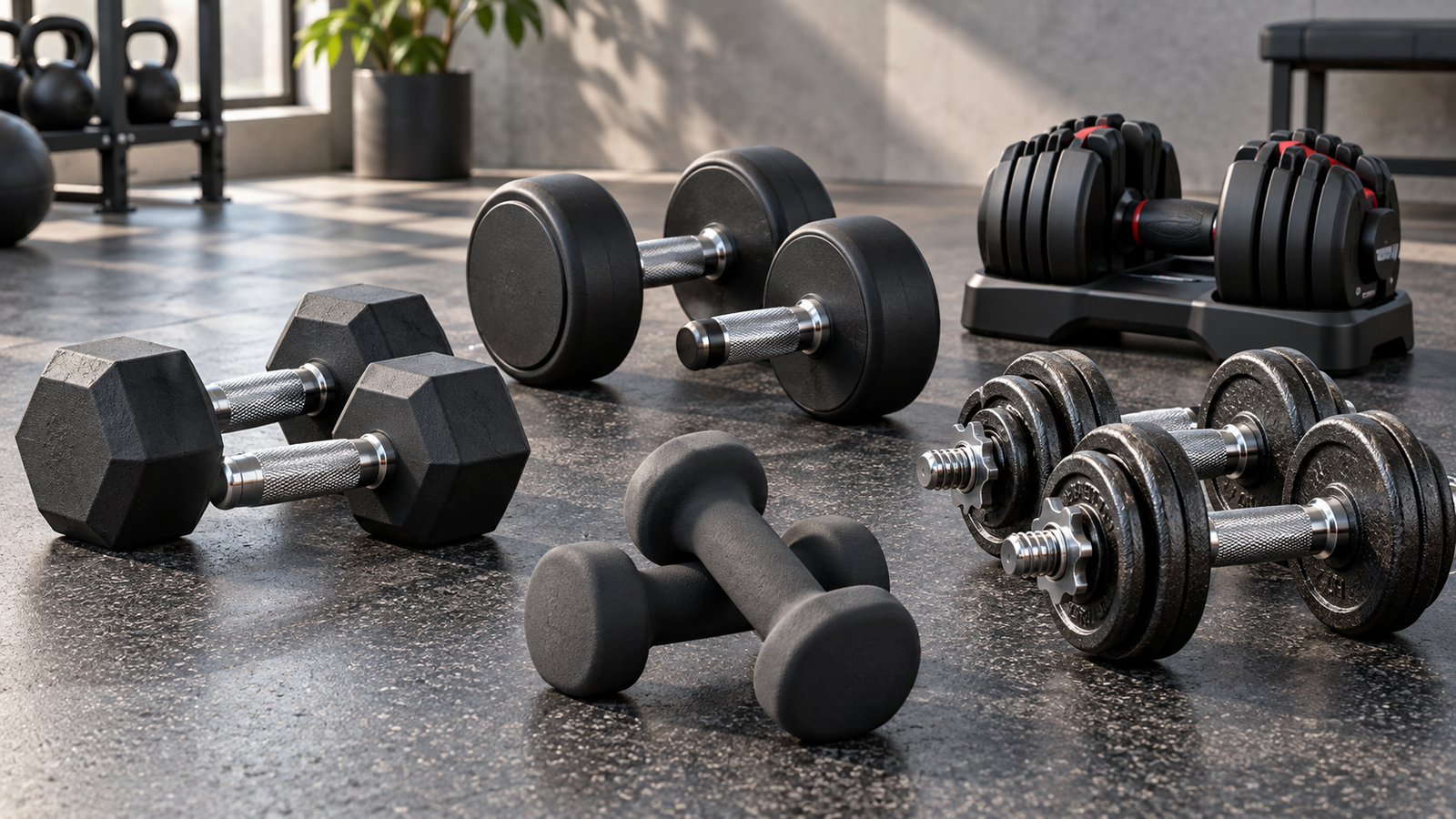
18. Fixed vs Adjustable Dumbbells for Progressive Overload
Your equipment can influence how easily you increase resistance.
Fixed Dumbbells
Fixed dumbbells have a set weight.
Their advantages include simple handling and convenience.
However, progressing may require purchasing additional pairs.
If you own only 5 kg and 10 kg dumbbells, the gap may be too large for certain exercises.
Adjustable Dumbbells
Adjustable dumbbells allow you to change resistance using plates or an integrated adjustment mechanism.
They can be particularly useful for home training because different exercises require different weights.
For example, the resistance suitable for a shoulder press may differ substantially from the resistance suitable for a squat.
Which Is Better?
| Factor | Fixed dumbbells | Adjustable dumbbells |
|---|---|---|
| Weight changes | Switch to another pair | Adjust the mechanism or plates |
| Storage | Multiple pairs need more space | Often more compact |
| Increment options | Depends on pairs owned | Depends on available settings |
| Convenience | Quick when multiple pairs are available | Adjustment may take time |
| Initial cost | Can be low for one pair | Often higher for a suitable set |
| Long-term progression | May require more purchases | More resistance options in one system |
For someone planning long-term home strength training, adjustable dumbbells may offer practical value if they provide appropriate increments, reliable locking mechanisms and sufficient maximum resistance.
For product comparisons, read Physical Glow’s Top 5 Dumbbells for Home Workouts in India, which covers different dumbbell options for home training.
19. Building a Simple Dumbbell Progression Plan
A beginner does not need a complicated spreadsheet or advanced strength-training formula.
Start with a small number of exercises covering major movement patterns.
Example Beginner Full-Body Workout
| Exercise | Sets | Repetition target |
|---|---|---|
| Goblet squat | 2–3 | 8–12 |
| Dumbbell Romanian deadlift | 2–3 | 8–12 |
| Dumbbell floor press | 2–3 | 8–12 |
| One-arm dumbbell row | 2–3 | 8–12 per side |
| Dumbbell shoulder press | 2 | 8–12 |
| Dumbbell curl | 2 | 10–15 |
This is an illustrative program for generally healthy adults, not a personalized prescription.
Adjust exercises to your ability, mobility and available equipment.
How to Progress
- Choose a weight you can control for the lower end of the repetition range.
- Keep technique consistent.
- Record your repetitions after each workout.
- Add repetitions gradually when appropriate.
- Once all sets reach the upper target comfortably, consider a small weight increase.
- Return toward the lower end of the range with the heavier weight.
- Repeat the process as your strength improves.
Remember that not every exercise will progress at the same speed.
20. Safety Considerations Before Increasing Dumbbell Weight
Progressive overload should improve your training—not turn every session into a test of maximum strength.
Before increasing resistance:
- Make sure your exercise technique is stable.
- Choose a manageable increase.
- Maintain control throughout the movement.
- Avoid lifting through sharp or unusual pain.
- Use a stable training surface.
- Check that adjustable dumbbell plates or locking mechanisms are secure.
- Allow appropriate recovery between demanding sessions.
If you have a recent injury, significant joint problems, cardiovascular limitations or another condition affecting exercise safety, seek individualized guidance from a qualified professional.
Muscle fatigue during resistance training can be normal, but sharp pain, dizziness, chest discomfort or other concerning symptoms should not be ignored.
Frequently Asked Questions
Should I increase repetitions or weight first?
For many beginners, increasing repetitions within a planned range before increasing weight is a practical approach. This is commonly called double progression.
Is lifting heavier always better for muscle growth?
No. Muscle growth can occur across a range of resistance levels when training provides sufficient stimulus. Heavier weights are particularly relevant to maximal strength, but technique and recovery remain important.
Can I build muscle with 5 kg dumbbells?
Potentially, especially for beginners and certain exercises. Whether 5 kg remains sufficient depends on the muscle group, exercise, training experience and how challenging the repetitions become.
How many repetitions should I complete before increasing weight?
A common approach is to use a target range such as 8–12 repetitions. Consider increasing weight once you can perform all planned sets at the upper end with good technique and suitable effort.
Should I increase dumbbell weight every week?
No. Progression rates vary. Some people can increase frequently during early training, while others may need several weeks or longer.
Can I progress without buying heavier dumbbells?
Yes. You can increase repetitions, add appropriate sets, improve movement quality or use more challenging exercise variations. Eventually, heavier resistance may become useful for some goals.
Is it okay to perform 20 repetitions with dumbbells?
Yes. Higher repetition sets can be useful, especially with lighter loads, provided the exercise remains controlled and appropriate for your goal.
Do I need to reach muscular failure to grow?
No. Training close enough to failure to provide a meaningful stimulus can support progress without necessarily reaching failure on every set.
What if I can lift heavier but my form gets worse?
Keep the lighter weight and improve technique. A heavier load is not a useful progression if you cannot control it safely.
How do I know when my dumbbells are too light?
If you can consistently exceed your planned repetition range with good technique and relatively little effort, the dumbbells may be too light for that exercise and goal.
Final Verdict: Build Repetitions First, Then Increase Weight When Ready
Progressive overload with dumbbells does not require constant increases in weight.
For many home workouts, the most practical approach is to choose a suitable repetition range, gradually increase repetitions and move to heavier dumbbells when the current resistance becomes manageable.
This method provides a measurable path forward without encouraging unnecessary jumps in resistance.
However, progression is not only about repetitions and kilograms.
Better technique, improved movement control, appropriate exercise variations and consistent training also matter.
The best progression is one that increases the challenge gradually while preserving technique, recovery and long-term consistency.
Whether you train with one fixed pair or a complete adjustable dumbbell set, understanding when to increase repetitions and when to increase weight will help you make more purposeful decisions during every workout.
Physical Glow Editorial Note: This article provides general fitness education and is not a substitute for individualized exercise coaching or medical advice. Exercise selection, loading and progression should reflect personal ability, training experience and health considerations.