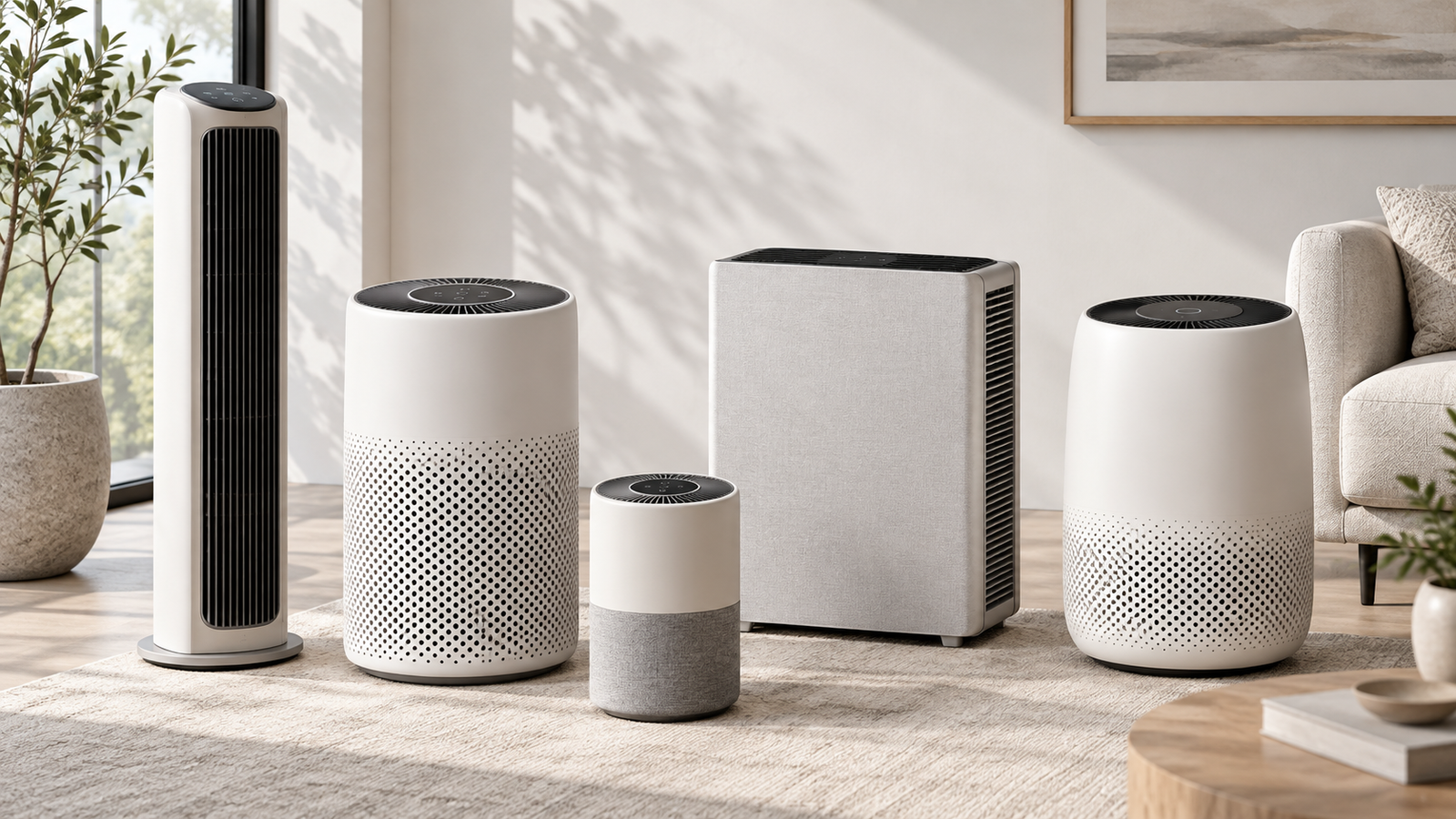
Where to Place an Air Purifier: Clearance, Doors and Airflow
Buying an air purifier is only the first step toward improving indoor air quality. Where you place the machine can significantly influence how effectively it circulates and filters the air inside your home.
A high-quality air purifier with a suitable HEPA filter may perform poorly if its air intake is blocked by furniture, its outlet faces a wall or it is placed in a corner with insufficient airflow.
On the other hand, a properly positioned purifier can help reduce airborne particles more efficiently in the room where you spend the most time.
This is particularly relevant in Indian homes, where outdoor pollution, cooking emissions, dust and seasonal changes can affect indoor air quality.
But several practical questions arise:
- Should an air purifier be placed near a window or in the middle of the room?
- How much space should you leave around it?
- Should bedroom doors remain open or closed?
- Can one purifier clean the air in an entire apartment?
- Is it better to place a purifier near the pollution source or near where you sit?
The most important principle is to place the purifier where it can draw in polluted room air and distribute filtered air without obstruction.
This guide explains the relationship between purifier placement, clearance, doors and airflow, with practical recommendations for bedrooms, living rooms, home offices and apartments.
1. Why Air Purifier Placement Matters
An air purifier works by moving air through a filtration system.
Most portable particle-filtering purifiers use a fan to draw surrounding air into the machine, pass it through filters and return filtered air to the room.
Depending on the model, its filters may include:
- A pre-filter for larger particles.
- A HEPA or other high-efficiency particle filter.
- Activated carbon or another sorbent intended for certain gases and odours.
The effectiveness of the system depends on several factors, including the purifier’s clean air delivery rate, the room’s size, the air exchange with outdoors and the way air mixes within the space.
Placement influences the last factor.
The Importance of Air Circulation
Imagine placing an air purifier behind a large sofa.
The purifier may still operate, but the sofa could obstruct its intake or discharge airflow.
This can reduce effective circulation and make it more difficult for the machine to distribute filtered air throughout the occupied space.
A purifier placed in a more open location can often move room air more freely.
However, this does not mean every purifier must be positioned in the exact centre of a room.
Some models are designed to work near walls, while others require more space around multiple intake surfaces.
Manufacturer instructions and unobstructed airflow are more important than following a universal placement rule.
2. Understand Your Purifier’s Air Intake and Outlet
Before deciding where to place your purifier, identify how its airflow system works.
Not all purifiers draw and release air in the same direction.
Front-Intake Purifiers
Some models draw air through a front panel and release filtered air through the top or rear.
These units require sufficient clearance at the intake panel.
Side-Intake Purifiers
Other models draw air through vents on one or both sides.
Placing such a purifier tightly between furniture can obstruct airflow.
Rear-Intake Purifiers
Certain purifiers draw air from behind the machine.
For these models, pushing the unit directly against a wall may substantially restrict the intake.
360-Degree Intake Purifiers
Some cylindrical purifiers draw air through openings around their circumference.
These models generally benefit from open space around the unit.
Positioning them tightly in a corner can obstruct part of their intake area.
Top-Discharge Purifiers
Many portable purifiers release filtered air upward.
These should not be placed directly beneath low shelves or other objects that obstruct the outgoing airflow.
Why Design Matters
Basic air purifier airflowSimplified illustration of a side-intake, top-discharge purifier. Actual airflow direction varies by model.
Before setting up the machine, examine its vents and check the manufacturer’s installation diagram.
A visually attractive location is not necessarily a functional one.
3. How Much Clearance Does an Air Purifier Need?
Clearance refers to the open space maintained around a purifier’s intake and outlet vents.
Adequate clearance helps prevent furniture, walls or other objects from restricting airflow.
Is 30 cm Enough?
You may encounter general advice recommending approximately 15–30 cm or more of clearance around portable air purifiers.
Such distances can be useful as preliminary planning guidelines, but they are not universal requirements.
A particular model may specify different distances depending on its intake and outlet design.
For example:
- A rear-intake model may require substantial space behind it.
- A cylindrical unit may need clearance around its sides.
- A top-discharge model needs unobstructed vertical airflow.
- A wall-oriented purifier may be specifically designed for installation closer to a wall.
Always follow the clearance instructions supplied with your device.
What Happens When Clearance Is Insufficient?
Obstructions can potentially:
- Restrict intake airflow.
- Alter the outlet airflow pattern.
- Reduce effective air circulation.
- Affect noise characteristics.
- Cause the purifier to recirculate air inefficiently.
- Interfere with operation or maintenance access.
The consequences depend on the model.
For best performance, keep the intake and outlet vents clear rather than surrounding the machine with decorative objects.
4. Should You Put an Air Purifier in the Middle of the Room?
A central location is sometimes recommended because it can provide unobstructed airflow in multiple directions.
However, this is not always practical or necessary.
Placing a purifier in the middle of a living room may create problems such as:
- Blocking walking paths.
- Exposing the machine to accidental knocks.
- Creating a cable-trip hazard.
- Interfering with furniture arrangements.
- Making the purifier inconvenient to use.
In many rooms, an open area closer to a wall can work well if the required clearance is maintained.
The Better Placement Principle
Rather than asking whether the purifier must be in the centre, ask:
Can air enter and leave this purifier freely, and will filtered air circulate through the area where people spend time?
If the answer is yes, a location away from the exact centre may be perfectly reasonable.
For many homes, a stable floor position with adequate clearance is a practical starting point.
5. Should an Air Purifier Be Placed Near a Window?
Windows influence indoor air quality because they can allow outdoor air to enter the home.
However, the correct placement strategy depends on whether the window is open or closed and what pollution sources are present.
When the Window Is Closed
If outdoor pollution is high, closing windows can reduce uncontrolled entry of outdoor particles, although leakage and ventilation-system pathways may still allow infiltration.
In this situation, a purifier can help remove airborne particles already present inside the room.
It does not need to be directly beside the window.
When the Window Is Open
An open window introduces outdoor air continuously.
The purifier may remove some incoming particles, but the ongoing air exchange can make it harder to maintain low indoor particle concentrations.
During severe outdoor particulate pollution, opening windows widely may undermine the benefit of portable particle filtration.
Should the Purifier Face the Window?
Not necessarily.
There is no universal benefit to pointing a purifier toward a window.
A portable purifier is designed to circulate and filter indoor air, not operate as a mechanical barrier across the entire window opening.
What About Fresh Air?
Air purification and ventilation serve different purposes.
A HEPA purifier can reduce many airborne particles but generally does not remove carbon dioxide or supply outdoor air.
Therefore, using an air purifier is not a substitute for adequate ventilation.
When outdoor air quality is suitable, ventilation may be beneficial. When pollution is elevated, ventilation strategies should account for the incoming pollutants.
6. Should Bedroom Doors Stay Open or Closed?
This is one of the most important questions when positioning an air purifier.
A portable purifier is generally rated for a particular room size or operating condition.
When a bedroom door remains open, air may exchange more freely with adjoining spaces.
This effectively changes the area and air volume the purifier is attempting to influence.
Closed-Door Operation
Keeping the bedroom door closed can make the treated space more predictable.
For a purifier sized appropriately for that room, this may help it reduce particle concentrations more effectively within the bedroom.
However, door closure must not compromise required ventilation, cooling, heating or other safety considerations.
Open-Door Operation
An open door allows greater air exchange with neighbouring rooms.
This may be desirable for comfort or household use, but it means the purifier’s effective cleaning task can extend beyond the bedroom.
A small purifier may struggle to maintain similar particle reductions across the larger connected space.
Which Is Better?
| Situation | Practical approach |
|---|---|
| Bedroom purifier sized only for bedroom | Closed door may improve particle control in that room |
| Large open-plan room | Choose adequate total clean-air capacity |
| Bedroom door must remain open | Expect additional air exchange; size accordingly |
| Mechanical ventilation required | Follow building and ventilation requirements |
| High outdoor pollution | Manage infiltration as well as purification |
A closed door can help create a more defined purification zone, but it does not replace proper ventilation.
Never seal a room in a way that creates unsafe ventilation conditions, particularly where fuel-burning appliances are present.
7. Where Should You Place an Air Purifier in a Bedroom?

Bedrooms are a common location for portable air purifiers because people spend several hours there while sleeping.
A practical bedroom placement should balance cleaning performance, noise and safety.
Recommended Starting Position
Consider placing the purifier:
- On a stable surface approved by the manufacturer.
- In an open area with unobstructed vents.
- Away from curtains and bedding.
- Away from direct splashes or moisture.
- Where the power cable does not create a trip hazard.
- Close enough to the occupied room area for useful circulation without blowing uncomfortably toward the sleeper.
Should It Be Next to the Bed?
It can be placed near the bed if the manufacturer permits the position and it does not obstruct movement or airflow.
However, placing the purifier directly beside your pillow does not guarantee better filtration.
Avoid directing a strong air outlet straight toward your face if this causes discomfort.
Should It Be Under the Bed?
Usually not.
Under-bed placement may block intake or discharge openings and create maintenance difficulties.
Only use such a location if the purifier is explicitly designed for it and the clearance requirements are satisfied.
What About Curtains?
Curtains can move toward suction vents or block outgoing airflow.
Keep fabric away from the machine.
This includes bedsheets, blankets, clothing and other soft materials.
8. Where Should You Place an Air Purifier in a Living Room?

Living rooms often have larger floor areas and more complex furniture arrangements than bedrooms.
They may also connect to kitchens, hallways and balconies.
Key Placement Factors
Furniture clearance
Avoid placing the machine tightly behind a sofa, cabinet or television unit.
Open circulation
Select an area where outgoing filtered air can circulate through the room.
Room connectivity
A living room that opens directly into a dining area or kitchen may require more clean-air capacity than a similarly sized enclosed room.
Electrical safety
Avoid stretching the cable across walking paths.
Maintenance access
Leave enough space to replace filters and clean the purifier.
One Large Purifier or Two Smaller Ones?
For a large or irregularly shaped living space, two appropriately positioned purifiers may provide more useful distribution than one machine placed in a remote corner.
However, the result depends on their combined clean-air delivery and the room layout.
Do not assume that two small purifiers always outperform one larger model.
Compare the total clean-air capacity and practical placement options.
9. Where Should You Place an Air Purifier in a Home Office?
A home office may contain several particle sources, including dust, outdoor pollution entering through openings and particles generated by nearby activities.
The purifier should provide useful circulation without interfering with work.
Practical Placement Tips
- Avoid blocking the air intake with desk panels.
- Keep the machine away from loose papers that could move toward vents.
- Do not place it where cables create a hazard.
- Keep it away from moisture-sensitive electrical equipment if spills are possible.
- Maintain the manufacturer-required clearances.
- Choose an operating speed that balances noise and cleaning performance.
Should It Be Under Your Desk?
Only if the device design and available clearance make this appropriate.
Many under-desk spaces are too enclosed for ideal airflow.
A purifier placed beside the desk with open vents may be more practical.
10. Air Purifier Placement Near the Kitchen
Cooking can generate substantial indoor particle pollution.
Frying, grilling and other cooking methods can produce fine particles, and certain appliances can also produce combustion-related pollutants.
However, a portable air purifier should not be treated as a replacement for effective kitchen ventilation.
Use Source Control First
Where available, use an appropriately installed and maintained kitchen exhaust system that vents outdoors.
Controlling pollution at the source is often more effective than relying entirely on filtration after pollutants spread.
Should the Purifier Sit Beside the Stove?
Generally, avoid placing an ordinary portable purifier immediately next to a hot stove or cooking surface.
Potential problems include:
- Heat exposure.
- Grease accumulation.
- Moisture.
- Splashes.
- Fire or electrical hazards.
- Rapid filter contamination.
Instead, position the purifier according to the manufacturer’s instructions in a suitable adjacent area if additional particle filtration is needed.
Can HEPA Filters Remove Cooking Smells?
HEPA filters are designed to capture particles.
Many odour-causing substances are gases or vapours.
Activated carbon and other gas-phase filtration media may help with selected odours, but effectiveness varies substantially with the amount and design of the sorbent.
A thin carbon sheet should not automatically be expected to remove large amounts of cooking fumes.
For persistent cooking pollution, improve source control and appropriate ventilation first.
11. Can One Air Purifier Clean an Entire Apartment?
It depends on the apartment’s layout, air exchange and the purifier’s capacity.
In a small studio with one largely open space, a properly sized purifier may provide meaningful particle reduction across much of the occupied area.
In a multi-room apartment with separate bedrooms, hallways and closed doors, one purifier may not effectively clean every room.
Why Closed Rooms Matter
Filtered air does not automatically distribute evenly through closed doors.
If a purifier operates in the living room, a closed bedroom may receive much less of the cleaned air.
Practical Options
For a multi-room apartment, consider:
- Placing the purifier in the room you use most.
- Moving a suitable purifier between rooms when needed.
- Using separate purifiers for frequently occupied enclosed rooms.
- Evaluating the clean-air capacity required for open-plan areas.
Moving a purifier can be convenient, but remember that air quality can worsen again when filtration stops and pollution sources remain.
12. Understanding CADR Before Choosing a Location
Clean Air Delivery Rate, or CADR, describes the volume of particle-cleaned air a purifier can deliver under defined test conditions.
CADR is commonly expressed in cubic metres per hour (m³/h) or cubic feet per minute (cfm).
A higher CADR generally indicates greater particle-cleaning capacity.
However, CADR alone does not describe:
- The room’s airflow pattern.
- Outdoor pollution infiltration.
- Noise at the selected fan speed.
- Performance for all gases.
- Maintenance condition.
- Actual particle concentration throughout the room.
Placement and room size still matter.
CADR and Room Size
One useful planning relationship is:
\[ \text{Equivalent clean-air changes per hour} = \frac{\text{CADR (m³/h)}}{\text{Room volume (m³)}} \]
For example, imagine a room measuring:
- Length: 4 metres.
- Width: 3 metres.
- Height: 2.7 metres.
The room volume is:
\[ 4 \times 3 \times 2.7 = 32.4\text{ m³} \]
If the purifier has a particle CADR of 250 m³/h, the theoretical equivalent clean-air changes are approximately:
\[ 250 \div 32.4 \approx 7.7 \text{ per hour} \]
This is a simplified capacity calculation. It assumes the stated CADR applies at the chosen fan speed and does not establish the actual indoor air-change rate or pollutant removal performance in every part of the room.
Interactive Air Purifier Capacity Estimator
Estimate equivalent clean-air changesRoom length (m)
4.0Room width (m)
3.0Ceiling height
2.7 mPurifier particle CADR
250 m³/h
Room volume
32.4 m³
Equivalent clean-air changes
7.7/hour
Illustrative clean-air capacity estimate, not a measurement of actual ventilation or indoor air quality. Check whether the stated CADR applies at a noise level you can tolerate.
A purifier’s clean-air capacity is an important buying consideration, but it should be evaluated alongside practical placement and airflow.
13. Should You Place a Purifier on the Floor or a Table?
The correct height depends on the purifier’s design.
Floor Placement
Many larger air purifiers are designed specifically for floor use.
They have intake locations, feet and stability features suited to this position.
Follow the manufacturer’s directions.
Table Placement
Compact models may be designed for desks, shelves or other stable surfaces.
If the manufacturer allows elevated placement, ensure that:
- The surface can support the machine.
- Vibration will not cause movement.
- The purifier cannot easily be knocked over.
- The intake and outlet remain unobstructed.
- Cables are safely routed.
Is Higher Always Better?
No.
Placing a purifier higher does not automatically improve overall particle removal.
Different particle sizes, room air currents and purifier designs influence how pollution is distributed.
A stable, manufacturer-approved location with good circulation is generally a better choice than choosing height alone.
14. Should Air Purifiers Be Placed Near an AC?
Air conditioners influence indoor airflow, which can affect how particles circulate through a room.
However, placement near an AC vent requires careful consideration.
Potential Problems
Strong supply airflow may change how filtered air disperses.
It may also affect local airflow around the purifier’s sensors.
Placing a purifier directly beneath a cooling unit can create additional concerns if condensation or water leakage is possible.
Practical Recommendation
Do not block either the AC or purifier airflow.
Avoid locations where condensate could drip onto electrical equipment.
Follow the purifier manufacturer’s distance and placement guidance.
Remember that a standard split AC generally recirculates indoor air and does not necessarily supply outdoor ventilation.
Air conditioning and particle filtration are different functions.
15. Can Ceiling Fans Improve Air Purifier Performance?
Ceiling fans can increase air movement and mixing within a room.
This may help distribute airborne particles toward a purifier in some circumstances.
However, increased airflow does not automatically produce better results in every layout.
Strong air currents may change the direction of outlet air or affect where pollutants travel.
What Should You Do?
Use the ceiling fan at a comfortable speed if needed.
Keep the purifier intake and outlet clear.
Avoid trying to direct all fan airflow into the purifier unless the manufacturer specifically recommends such a setup.
A portable purifier does not need to be positioned directly beneath a ceiling fan to work.
16. Should You Keep Your Air Purifier Running All Day?
For persistent indoor particle sources or elevated outdoor pollution, continuous operation may provide more stable particle reduction than short periods of occasional use.
However, the practical decision depends on:
- Outdoor air quality.
- Indoor pollution sources.
- Purifier capacity.
- Fan speed.
- Electricity use.
- Noise.
- Filter maintenance.
- Manufacturer instructions.
Why Short Bursts May Be Less Effective
A purifier can reduce particles while it operates.
But indoor pollution does not necessarily stop when the machine is switched off.
New particles may enter from outdoors or be generated by indoor activities.
As a result, air quality can deteriorate again.
Auto Mode vs Manual Speed
Auto mode can be convenient when the purifier has appropriate sensors.
However, onboard particle sensors vary in quality and may not detect every pollutant or respond well to all room conditions.
For situations requiring sustained filtration, a suitable continuous fan setting may be more predictable than relying entirely on automatic adjustments.
What About Nighttime Operation?
A quiet setting is important for bedrooms.
But reducing fan speed typically reduces CADR as well.
A purifier advertised with a high maximum CADR may deliver much less clean air on its quietest setting.
Compare cleaning performance at the speed you actually intend to use.
17. Air Purifier Placement During High-Pollution Days
During periods of elevated outdoor particulate pollution, controlling the entry of polluted air becomes especially important.
Practical steps may include:
- Keeping windows closed when outdoor pollution is high, where appropriate.
- Operating an adequately sized particle-filtering purifier.
- Using suitable filtration in mechanical ventilation systems if available.
- Reducing indoor particle-producing activities.
- Avoiding unnecessary smoke sources.
- Maintaining filters according to the manufacturer’s recommendations.
For example, candles, incense and indoor smoking can generate particles.
Using an air purifier does not make indoor smoke exposure harmless.
What About Outdoor Air Quality Apps?
AQI information can help you understand broader outdoor pollution conditions.
However, outdoor AQI does not directly measure particle concentrations inside your bedroom.
Indoor levels depend on building leakage, ventilation, filtration and indoor sources.
For a more direct assessment, a suitable indoor particulate monitor can provide additional information, although sensor accuracy and placement also matter.
18. Common Air Purifier Placement Mistakes
1. Pushing the Purifier Directly Against a Wall
This can restrict airflow on models with rear or side intakes.
Follow model-specific clearance instructions.
2. Hiding It Behind Furniture
A purifier placed behind a large cabinet or sofa may not circulate air efficiently.
Choose a more open location.
3. Blocking the Top Outlet
Avoid placing the machine beneath low shelving or covering the outlet with objects.
4. Placing It Too Close to Curtains
Loose fabric can obstruct vents or be drawn toward intake openings.
Maintain appropriate clearance.
5. Expecting One Small Unit to Clean Several Closed Rooms
Walls and closed doors limit air mixing.
Match filtration capacity to the occupied spaces.
6. Using It Beside a Hot Stove
Heat, grease and moisture can create operating and maintenance problems.
Use appropriate cooking ventilation and follow the purifier’s placement restrictions.
7. Forgetting Filter Replacement
A purifier with clogged or incorrectly installed filters may not perform as intended.
Check the filter replacement schedule and maintenance instructions.
8. Leaving Plastic Packaging on a New Filter
Some replacement filters arrive sealed in protective plastic.
Remove all packaging according to the manufacturer’s setup instructions before operating the device.
9. Using the Quietest Mode Without Checking Capacity
Low fan speed can substantially reduce clean-air delivery.
Choose a setting that balances noise and effective filtration.
10. Assuming the Purifier Replaces Ventilation
Particle filtration does not provide fresh air or solve every indoor air quality problem.
Address ventilation and pollutant sources separately.
19. Best Placement by Room Type
| Room | Practical starting location | Avoid |
|---|---|---|
| Bedroom | Open floor area with manufacturer-required clearance | Under beds, behind curtains, blocked corners |
| Living room | Unobstructed area serving the occupied room | Behind large furniture |
| Home office | Beside desk with open vents | Enclosed under-desk spaces |
| Children’s room | Stable, secure position inaccessible to unsafe interference | Loose cables, unstable elevated surfaces |
| Dining area | Open space away from direct heat and spills | Immediately beside cooking surfaces |
| Studio apartment | Central or otherwise open location with good circulation | Narrow enclosed spaces |
| Large open-plan room | Location supporting circulation, possibly multiple purifiers | Assuming a small unit can cover the entire connected area |
These are general starting points.
Actual installation should follow the device’s airflow design, required clearance and safety instructions.
20. How to Check Whether Your Purifier Is Well Positioned
You do not need to rearrange the entire room immediately.
Start with a basic evaluation.
Air purifier placement checklist
0/8The purifier is sized appropriately for the room.All air intake vents have the manufacturer’s required clearance.The filtered-air outlet is unobstructed.The unit stands securely on an approved surface.Curtains, bedding and furniture do not obstruct airflow.The power cable is safe and does not cross a walking path.Doors, windows and ventilation are managed appropriately.The filter is correctly installed and maintained.
Review the remaining items before finalizing the location.
Can an Indoor Air Quality Monitor Help?
A suitable PM2.5 monitor may help evaluate changes in indoor particle concentrations.
For example, you can compare readings over time with the purifier operating in different positions under reasonably similar conditions.
However, this is not a controlled laboratory test.
Cooking, outdoor air infiltration, room occupancy and sensor measurement errors can change the results.
Do not draw strong conclusions from one short measurement.
21. How to Choose an Air Purifier That Fits Your Room
Before purchasing a purifier, evaluate whether the machine can operate effectively in the space available.
Check Particle CADR
Compare the purifier’s rated CADR with the room volume.
Do not rely solely on broad marketing claims such as suitable for up to 1,000 sq ft without examining the assumptions behind the coverage rating.
Check Intake and Outlet Design
A machine with several intake surfaces may require more open space than one designed for a particular wall-facing arrangement.
Check Noise at Useful Fan Speeds
Maximum CADR is less useful if the corresponding noise level is too loud for your bedroom.
Check Filter Availability
Replacement filters should be available at a reasonable cost.
An inexpensive purifier with expensive proprietary filters may have a higher long-term operating cost than expected.
Check Electricity Consumption
For continuous use, power consumption affects operating cost.
Compare the wattage at the fan speeds you expect to use.
Check Maintenance Requirements
Consider how easily you can access the filter and clean the intake surfaces.
The placement should leave enough room for routine maintenance.
For product comparisons, see Physical Glow’s Top 5 Air Purifiers in India buying guide, which covers different home air purification options.
Frequently Asked Questions
What is the best place to put an air purifier in a bedroom?
Choose an open, stable location with adequate intake and outlet clearance, away from curtains, bedding and obstructions. Follow the manufacturer’s directions.
Should an air purifier be placed near a window?
Not necessarily. The best position depends on room airflow and the purifier design. During high outdoor pollution, managing window opening and air infiltration is often more important than placing the machine directly beside the window.
Should I close the bedroom door when using an air purifier?
Closing the door can help define the space being filtered, provided ventilation and safety requirements remain satisfied. An open door increases air exchange with adjoining areas.
Can I put an air purifier in a corner?
Only if the model’s intake, outlet and clearance requirements allow it. Many purifiers perform better in less obstructed locations.
Should an air purifier be on the floor or a table?
Follow the manufacturer’s intended placement. Many larger purifiers are floor-standing, while some compact models can be safely placed on suitable elevated surfaces.
Is it safe to place an air purifier next to the bed?
It may be appropriate if the unit is stable, its vents remain clear and the airflow is comfortable. Keep cables and equipment positioned safely.
Can one air purifier clean a three-bedroom apartment?
One portable purifier generally cannot be assumed to clean several separate closed rooms effectively. Multiple appropriately sized units or a suitable whole-home filtration strategy may be needed.
Can I use an air purifier with an AC?
Yes, provided the devices are installed safely and neither blocks the other’s airflow. Remember that ordinary air conditioning does not necessarily provide outdoor ventilation.
Should I run my purifier continuously?
Continuous operation can provide more consistent particle reduction when pollution sources persist. Balance filtration performance, noise, operating costs and manufacturer instructions.
Does an air purifier remove carbon dioxide?
Standard particle-filtering purifiers do not meaningfully remove carbon dioxide or replace ventilation.
How much clearance should I leave around an air purifier?
Use the distance specified by the manufacturer. Generic recommendations such as 15–30 cm are only planning examples and may be insufficient for some designs.
Does moving an air purifier improve its performance?
It can, particularly when the original position restricts airflow. However, moving the machine is not a substitute for sufficient CADR, clean filters and controlling pollution sources.
Final Verdict: Give Your Air Purifier Space to Work
Air purifier performance depends on more than filter quality and advertised room coverage.
Placement can influence how effectively a machine draws in polluted air and distributes filtered air through the occupied space.
For most homes, the strongest starting strategy is simple:
Place the purifier on a stable, manufacturer-approved surface with unobstructed intake and outlet airflow, adequate clearance and a position that supports circulation through the room.
Avoid hiding the purifier behind furniture, pushing it against blocked vents or expecting one small device to clean multiple enclosed rooms.
Manage windows and doors according to outdoor pollution, room connectivity and ventilation requirements.
Finally, choose a purifier with sufficient clean-air delivery for the actual room volume and operating speed.
A well-positioned purifier can make better use of the filtration capacity you have already purchased—without requiring unnecessary upgrades or additional equipment.
Physical Glow Editorial Note: This article provides general home-wellness and indoor-air-quality education. Air purifier performance varies with device design, filter condition, room volume, ventilation and pollution sources. Portable air cleaners supplement but do not replace appropriate ventilation, source control or professional assessment of serious indoor air-quality concerns.