How to Track Resistance Band Progress Without Reliable Kilogram Labels
Resistance bands are among the most versatile tools for home strength training. They are affordable, portable, easy to store and useful for exercises ranging from biceps curls and rows to squats, shoulder movements and rehabilitation exercises.
However, resistance band training introduces a problem that is less common with traditional weights: How do you measure progress when you do not know exactly how much resistance you are lifting?
A dumbbell labeled 10 kg has a reasonably consistent mass. A resistance band labeled 10 kg does not necessarily produce 10 kg of force throughout an exercise.
The resistance changes as the band stretches.
Different manufacturers also use different measurement methods, making direct comparisons between brands difficult.
This creates uncertainty for people trying to follow progressive overload, record workouts or determine when to use a stronger band.
The good news is that you do not need perfectly accurate kilogram labels to make measurable progress.
By standardizing your exercise setup, tracking repetitions, recording band length and monitoring how challenging each set feels, you can build a reliable resistance band progression system.
This guide explains how band resistance actually works and how to measure strength improvements without relying entirely on the numbers printed on the packaging.
1. Why Resistance Band Kilogram Ratings Can Be Misleading
Many resistance bands are sold with labels such as:
- 5–10 kg resistance.
- 10–20 kg resistance.
- 15–35 kg resistance.
- 25–45 kg resistance.
These numbers may appear straightforward, but they require careful interpretation.
Unlike a dumbbell, a resistance band does not provide one constant resistance throughout the movement.
The force produced depends on how far the band is stretched and how the material behaves.
Resistance Changes With Stretch
When you pull an elastic resistance band, the material resists deformation.
As the band becomes longer, the force required to stretch it generally increases within its usable range.
Consider a standing biceps curl.
At the beginning of the movement, the band may be only slightly stretched.
As you bend your elbows, the band length increases.
Near the top of the movement, the band may produce substantially more resistance than at the beginning.
Illustrative band force across a movementConceptual illustration only—not measured data from any band. Real force–extension curves depend on the material, construction and stretch range and are not necessarily linear.
This is sometimes described as variable resistance.
The exercise becomes more demanding in different ways as band tension and joint positions change.
However, the total challenge also depends on biomechanics. Greater band force does not automatically mean that a movement is hardest at its endpoint.
Different Bands Have Different Force–Stretch Characteristics
Two bands marketed as providing the same resistance may feel different because of:
- Material composition.
- Band thickness.
- Width.
- Length.
- Construction.
- Manufacturing tolerances.
- Previous use and material fatigue.
Therefore, printed kilogram ratings should be treated as approximate product-specific references unless the manufacturer provides a clear testing method.
2. Resistance Band Weight vs Dumbbell Weight: What Is Different?
A dumbbell has a fixed mass.
The force due to gravity is approximately constant, although the torque experienced at a joint changes throughout the exercise.
A resistance band behaves differently.
Its pulling force varies with stretch, and the direction of that force depends on how the band is anchored and positioned.
| Feature | Dumbbell | Resistance band |
|---|---|---|
| External resistance | Fixed mass | Changes with stretch |
| Main force source | Gravity | Elastic tension |
| Printed weight | Relatively straightforward | Depends on testing conditions |
| Exercise setup | Usually simpler to reproduce | Anchor and starting length matter |
| Progress tracking | Weight, sets and reps | Band, setup, reps, effort and range |
| Resistance direction | Downward gravitational force | Along the stretched band |
| Common limitation | Requires multiple weights | Harder to quantify exact force |
Neither tool is automatically superior for every purpose.
Dumbbells provide straightforward loading measurements.
Resistance bands offer portability, directional flexibility and variable resistance.
For home training, both can be effective when used appropriately.
3. The Biggest Mistake: Comparing Band Colours
Many resistance bands are colour-coded.
For example, a manufacturer might use yellow for light resistance, red for medium resistance and black for heavy resistance.
However, there is no universal colour standard across all manufacturers.
A red band from one brand may provide substantially different resistance from a red band made by another.
Even within one manufacturer’s range, colour alone may not tell you the exact force generated during your exercise.
A Better Approach
Record the manufacturer, band model and resistance level rather than simply writing red band in your training log.
For example:
Brand A — 208 cm loop band — medium resistance — blue
This provides a more meaningful reference than colour alone.
If you eventually replace the band, the new band’s resistance may differ even if the colour is identical.
4. Why Starting Band Length Matters
Starting length is one of the most important variables in resistance band training.
Suppose two people perform standing biceps curls using identical bands.
Person A holds the band with significant slack at the beginning.
Person B stands farther from the anchor point or shortens the band by gripping it closer to the attachment.
Person B begins the movement with greater initial stretch.
The same band can therefore produce different resistance during otherwise similar exercises.
Understanding Pre-Stretch
Pre-stretch refers to how much the band has already been stretched before the exercise movement begins.
More pre-stretch often means greater initial resistance.
For consistent progress tracking, try to reproduce the same starting stretch from workout to workout.
Useful methods include:
- Standing on the same marked spot.
- Using the same anchor height.
- Keeping your grip position consistent.
- Using the same band length.
- Maintaining a similar starting body position.
This is more reliable than remembering only the band’s printed resistance rating.
5. How Band Resistance Changes With Distance
Consider a resistance band with an unstretched length of 100 cm.
If it stretches to 150 cm, its extension is 50 cm, or 50% of the original length.
If it stretches to 200 cm, its extension is 100 cm, or 100%.
Understanding percentage extensionOriginal band length
100 cmStretched length
150 cm
Extension
50 cm
Percentage extension
50%
\[ \text{Extension \%}=\frac{\text{Stretched length}-\text{Original length}}{\text{Original length}}\times100 \]
This measures extension only, not resistance force. Do not use it to determine a safe maximum stretch. Always follow the band’s manufacturer limits.
Percentage extension helps describe the band setup, but it cannot independently tell you how many newtons or kilograms-force the band produces.
That relationship requires reliable force measurements for the specific band.
6. Five Ways to Track Progress Without Exact Kilogram Numbers
You can measure resistance band training progress through several repeatable indicators.
Method 1: Track Repetitions
The simplest approach is to record how many controlled repetitions you complete with the same band and setup.
For example:
| Workout | Band | Sets | Repetitions |
|---|---|---|---|
| Session 1 | Medium | 3 | 8, 8, 8 |
| Session 2 | Medium | 3 | 10, 9, 9 |
| Session 3 | Medium | 3 | 11, 10, 10 |
| Session 4 | Medium | 3 | 12, 12, 12 |
If exercise technique, range of motion and starting stretch remain consistent, performing more repetitions is a meaningful sign of improving exercise performance.
However, if you shorten the band or change your stance, the recorded repetitions may no longer represent the same resistance.
Consistency is essential.
Method 2: Track Sets
Increasing the number of sets can increase training volume.
For example:
- Week 1: Two sets of band rows.
- Week 3: Three sets of band rows.
- Week 5: Three sets with more repetitions.
Adding sets is not always necessary.
Training volume should increase only when appropriate for your goals and recovery.
Method 3: Track Repetitions in Reserve
Repetitions in reserve, or RIR, estimates how many additional technically sound repetitions you could perform before reaching failure.
For example:
- Twelve repetitions with five RIR: relatively easy.
- Twelve repetitions with three RIR: moderately challenging.
- Twelve repetitions with one RIR: very challenging.
If you complete the same repetitions with the same band setup and the exercise feels substantially easier over time, that may indicate improved capacity.
However, perceived effort is subjective and can vary with sleep, fatigue and familiarity.
Method 4: Track Range of Motion
Movement quality matters.
For example, performing a complete controlled band row with an appropriate range of motion may be more meaningful than performing additional shortened repetitions.
Record whether you maintain:
- A consistent starting position.
- An appropriate finishing position.
- Stable body alignment.
- Controlled movement.
- Minimal unwanted momentum.
Better movement quality can be a legitimate form of progress.
Method 5: Track Band Setup
Record how the band is anchored and stretched.
Useful notes include:
- Anchor height.
- Distance from the anchor.
- Grip position.
- Whether the band is folded.
- Starting stretch.
- Foot position.
These details help make workouts reproducible.
Without them, comparing one training session with another becomes much less reliable.
7. Use Double Progression With Resistance Bands
Double progression is a simple method for gradually increasing training difficulty.
Instead of immediately switching to a stronger band, you first increase repetitions within a planned range.
Once you consistently reach the upper end of that range with good technique, you increase resistance.
Example: Resistance Band Rows
Assume your goal is three sets of 8–12 repetitions.
| Stage | Resistance | Reps per set | Next step |
|---|---|---|---|
| 1 | Medium band | 8 | Continue |
| 2 | Medium band | 10 | Continue |
| 3 | Medium band | 12 | Evaluate progression |
| 4 | Stronger band | 8 | Build repetitions again |
| 5 | Stronger band | 10 | Continue |
The band increase should be manageable.
Some band sets have substantial jumps between resistance levels.
If the next band is too difficult, you may be better off maintaining the existing band and progressing through suitable repetitions or exercise variations.
There is no need to force a stronger band simply because you reach twelve repetitions once.
Make sure all planned sets are completed with consistent technique and adequate control.
8. How to Know When a Band Is Too Easy
A band may be becoming too easy for a particular exercise when:
- You consistently exceed your target repetition range.
- Your technique remains controlled.
- You experience relatively little effort during the final repetitions.
- The same setup feels easier over several sessions.
- You recover comfortably and can repeat the performance.
However, a band that is too easy for one exercise may remain challenging for another.
A medium band might be suitable for rows but too difficult for lateral raises.
Resistance bands should be selected by exercise, not simply by the user’s overall strength level.
9. When Should You Switch to a Stronger Band?
Consider moving to a stronger band when you can repeatedly complete all planned sets at the upper end of your repetition range without excessive difficulty.
Before changing bands, verify that:
- Your starting position is consistent.
- The movement range is appropriate.
- You are not using momentum.
- You can control the return phase.
- You are recovering adequately.
- The stronger band allows safe, controlled movement.
If you cannot complete the lower end of your target range with a stronger band, the increase may be too large.
You could return to the previous band or choose an intermediate resistance if available.
10. Why Shortening a Band Is Not the Same as Increasing Dumbbell Weight
Shortening the working length of a resistance band generally changes how much it is stretched during the exercise.
For example, gripping a long band closer to its center may increase resistance for a given movement.
But the resulting increase cannot be translated reliably into a specific number of kilograms without measurement.
Shortening a band can also change the exercise’s resistance profile.
It may increase tension at the beginning and end of the movement in different proportions.
Therefore, shortening the band should be treated as a change in training setup.
Record it accordingly.
Do not describe the change as automatically equivalent to adding 2 kg or 5 kg to a dumbbell.
11. Should You Combine Two Resistance Bands?
Combining bands can provide additional resistance in some exercise setups.
However, doing so requires caution.
Two bands do not automatically produce a predictable combined resistance across the entire movement.
Their interaction depends on their lengths, stretch characteristics and arrangement.
For example, two bands of different lengths attached in parallel may begin contributing resistance at different points if one initially has more slack.
Combining bands may also create attachment and handling complications.
If you use multiple bands:
- Make sure each band is in good condition.
- Use compatible anchors and handles.
- Avoid exceeding manufacturer limits.
- Maintain secure attachments.
- Check that the combined resistance is manageable.
- Keep bands away from the face and eyes if a sudden release is possible.
For beginners, one suitable band is often easier to control and track.
12. Resistance Band Progress for Different Exercises
The best progression method depends on the movement.
Resistance Band Squats
Band squats can become more challenging as the band stretches.
You can track repetitions and technique while keeping foot and grip positions consistent.
However, high band tension near the top of the movement does not always correspond to equally high muscular demand at every joint position.
Do not sacrifice squat depth or control simply to use a thicker band.
Resistance Band Rows
For rows, anchor height and starting distance strongly influence resistance.
Mark your starting position if possible.
Maintain stable trunk posture and avoid turning the exercise into a whole-body pulling motion.
Resistance Band Chest Press
Anchor position and the distance from the anchor affect the tension profile.
Record your stance and band position.
Keep the anchor secure and avoid setups in which a released band could strike you.
Resistance Band Biceps Curls
If you stand on the band, your stance width and hand position can substantially change resistance.
Using a consistent setup is important.
Resistance Band Lateral Raises
These involve smaller muscle groups and may require very light resistance.
Switching to a substantially thicker band can make the exercise difficult to control.
Increasing repetitions may be preferable before attempting a band change.
Resistance Band Glute Bridges
For loop bands placed above the knees, track band position, movement range and technique.
A stronger loop may increase the demand of maintaining outward knee tension, but it does not necessarily indicate greater overall loading of the hip-extension movement.
13. Build a Resistance Band Training Log
A training log is one of the simplest ways to measure progress.
It does not need to be complicated.
Here is a useful format:
| Field | Example |
|---|---|
| Exercise | Standing resistance band row |
| Band | Brand A, medium loop |
| Anchor height | Chest height |
| Starting position | Feet approximately 1.5 m from anchor |
| Sets | 3 |
| Repetitions | 12, 11, 10 |
| Effort | Approximately 2–3 RIR |
| Technique | Full controlled range |
| Notes | Same setup as previous session |
The starting distance is only meaningful when the same band, anchor geometry and grip configuration are used.
The purpose of recording the distance is consistency rather than producing an exact kilogram estimate.
For exercises without anchors, note the standing position and how the band is held instead.
14. Simple Resistance Band Workout Tracker
Use this example tracker to decide whether you should build repetitions, maintain your current band or consider more resistance.
Your current band-training performanceBand resistance levelLightMediumHeavyRepetitions completed per set
10
Upper repetition target10 reps12 reps15 repsHow difficult were the final repetitions?Challenging, with limited good reps remainingRelatively easy, with several good reps remainingWas your setup consistent with previous workouts?YesNo
Suggested next step
Keep the medium band and gradually build toward 12 controlled repetitions across all planned sets.This is a simple progression illustration. Actual resistance depends on band stretch, geometry and material, not just light, medium or heavy labels.
15. Can You Measure Actual Band Resistance at Home?
It is possible to estimate force with suitable measuring equipment, but there are limitations.
Some people use luggage scales or force gauges to measure how much pulling force a band produces at a specific extension.
This can give a rough point measurement.
However, a luggage scale is not necessarily designed or calibrated for elastic exercise testing.
Improvised testing can also create snap-back hazards.
More Reliable Measurement Requires
- A suitably rated force-measuring device.
- A secure and controlled test setup.
- A known extension length.
- Repeatable testing conditions.
- Correct interpretation of measurement units.
Force is properly measured in newtons (N).
Some consumer devices display kilograms-force (kgf), which is not the same physical quantity as mass in kilograms (kg).
One kilogram-force corresponds to approximately 9.81 newtons under standard gravity.
Even with accurate point measurements, the full resistance profile of an exercise may remain unknown.
For most home exercisers, detailed force testing is unnecessary.
Consistent training performance offers a more practical progress indicator.
16. Can Resistance Bands Build Muscle Without Exact Weights?
Yes.
Resistance bands can provide enough mechanical tension to support strength and muscle development when exercises are appropriately selected and performed with sufficient challenge.
Muscles respond to the forces and demands placed on them, not to whether a product displays an exact kilogram number.
However, the training stimulus needs to be suitable.
If a band produces very little challenge throughout an exercise, it may not provide adequate loading for your goal.
Likewise, an excessively strong band that prevents a useful range of motion may be difficult to train with effectively.
What Matters Most?
- Exercise selection.
- Appropriate resistance.
- Sufficient effort.
- Consistent technique.
- Gradual progression.
- Adequate recovery.
- Long-term adherence.
A precise load measurement is useful but not essential for every type of resistance training.
17. Are Resistance Bands as Effective as Dumbbells?
Resistance bands and dumbbells can both support muscular training adaptations.
However, they are not perfectly interchangeable.
Dumbbells are particularly convenient when you want straightforward loading measurements and consistent gravitational resistance.
Bands are valuable for portability, variable resistance and movements in different directions.
The effectiveness of either tool depends on exercise selection, loading, effort and consistency.
For maximal strength development in specific free-weight lifts, training with those movements and appropriate external loads is important.
For general strength and muscle-conditioning goals, resistance bands can be a practical option.
Some home exercisers benefit from combining both tools.
For example, dumbbells can provide measurable loading for squats and presses, while resistance bands offer additional exercise variations or portable training options.
18. How Often Should You Increase Resistance Band Difficulty?
There is no fixed schedule that works for everyone.
Some beginners may improve their repetitions quickly.
Others may require several weeks before they are ready for a stronger band.
Progress depends on:
- Current training experience.
- Exercise complexity.
- Training frequency.
- Sleep and recovery.
- Available resistance increments.
- Individual adaptation.
An important principle is to increase resistance when performance supports it—not simply because a new week has started.
You may also have periods in which maintaining previous performance is appropriate.
Fatigue, illness, poor sleep and changes in daily activity can influence individual sessions.
Avoid judging progress solely from one unusually good or bad workout.
19. Common Resistance Band Progression Mistakes
Trusting the Kilogram Label as an Exact Load
A band’s stated resistance may apply only under particular testing conditions.
It does not necessarily represent the force throughout your exercise.
Changing Foot Position Every Workout
Standing farther apart or gripping the band differently can change its starting stretch.
This makes comparison harder.
Increasing Resistance While Reducing Range of Motion
A stronger band is not necessarily an improvement if it prevents you from performing the intended movement properly.
Using Momentum
Jerking the band can make a difficult movement appear achievable without maintaining control.
Use deliberate repetitions.
Progressing Too Many Variables at Once
Increasing sets, repetitions and band resistance together can create unnecessary fatigue.
Change training demands gradually.
Training With Worn Bands
Resistance bands can deteriorate over time.
Cracks, tears, severe discoloration, damaged seams and worn attachment points may indicate that a band should be replaced.
Ignoring Anchor Safety
An insecure anchor can release suddenly.
Use appropriate attachment equipment and follow the manufacturer’s directions.
Avoid placing your face or eyes in the potential path of a released band.
20. Choosing Resistance Bands That Are Easier to Progress With
If you are purchasing bands specifically for strength training, consider progression options as well as price.
Multiple Resistance Levels
A set offering several gradual resistance increments may be more useful than one extremely strong band.
Consistent Product Dimensions
Bands of different lengths and construction can be difficult to compare.
A coordinated set from one manufacturer may make transitions easier to track, although this does not guarantee exact force consistency.
Durable Construction
Inspect the material, seams, handles and attachment mechanisms.
Resistance bands experience repeated stretching, so condition and maintenance matter.
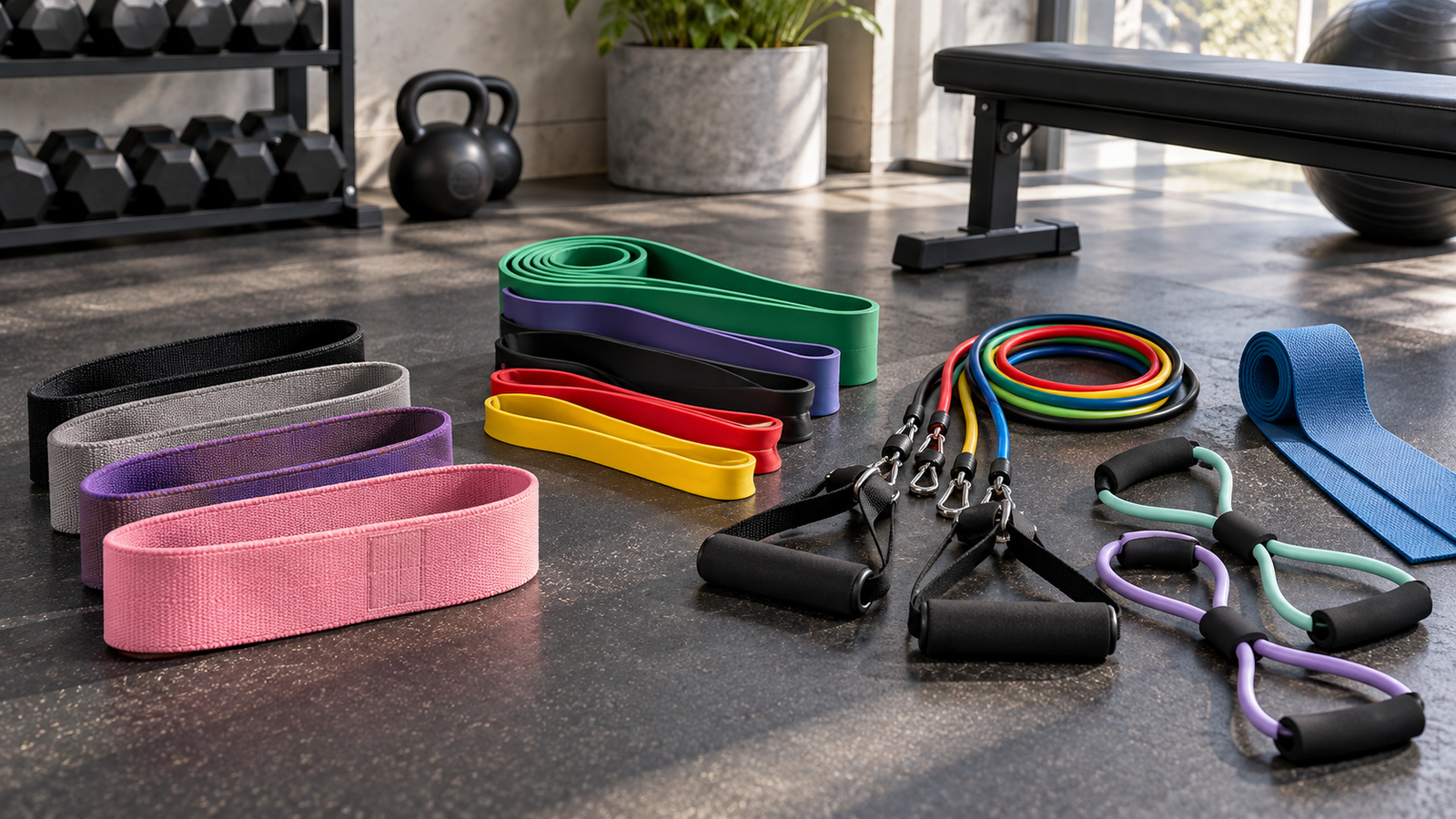
Suitable Band Format
Different band types suit different exercises.
| Band type | Common uses | Progress-tracking consideration |
|---|---|---|
| Mini loop bands | Hip and lower-body exercises | Loop position and limb spacing |
| Long loop bands | Rows, presses and assisted exercises | Anchor, grip and stretch length |
| Tube bands with handles | General resistance exercises | Handle position and tubing length |
| Flat therapy bands | Light resistance and rehabilitation-style movements | Folded length and grip position |
No single type is ideal for every exercise.
For product comparisons, see Physical Glow’s Top 5 Resistance Bands in India, which covers different band formats and intended training uses.
21. A Simple Four-Week Progression Example
Consider someone performing resistance band rows twice weekly.
Their target is three sets of 8–12 repetitions.
| Week | Band | Repetitions | Objective |
|---|---|---|---|
| 1 | Medium | 8, 8, 8 | Establish setup and technique |
| 2 | Medium | 10, 9, 9 | Build repetitions |
| 3 | Medium | 12, 11, 10 | Continue progression |
| 4 | Medium | 12, 12, 12 | Assess readiness for a stronger band |
If all repetitions remain controlled and the final sets no longer feel particularly difficult, the person may consider a stronger band.
If the heavier band creates an excessive jump, continuing with the medium band or adjusting another variable may be more appropriate.
This schedule is illustrative, not a prediction.
Real progression rates differ substantially.
22. Safety Considerations When Tracking Band Progress
Resistance bands can be convenient, but elastic tension creates specific hazards.
Before each session:
- Inspect the band for damage.
- Check anchors and handles.
- Avoid overstretching beyond the manufacturer’s limits.
- Use a secure stance.
- Keep the band away from sharp edges.
- Maintain controlled movements.
- Avoid positioning your face near a band that could recoil.
- Replace damaged bands rather than attempting unsafe repairs.
If an exercise produces sharp pain, unusual joint discomfort or other concerning symptoms, stop and reassess.
People using resistance bands for injury rehabilitation should follow the progression plan provided by their qualified healthcare professional rather than applying general strength-training advice indiscriminately.
Frequently Asked Questions
Are resistance band kilogram ratings accurate?
They may be useful approximate references under the manufacturer’s stated testing conditions, but they do not necessarily describe the resistance throughout an exercise.
How do I measure resistance band strength progression?
Track repetitions, sets, perceived effort, range of motion and consistent setup details. These can provide meaningful progress measurements without exact kilogram values.
Should I increase repetitions or use a stronger band?
For many people, increasing repetitions within a target range before moving to a stronger band is a practical approach.
Does standing farther from the anchor increase resistance?
Often, yes, because it increases the band’s initial stretch. However, the resulting force depends on the band’s characteristics and the exercise geometry.
Can I compare resistance bands by colour?
Not reliably across brands. Colour coding is manufacturer-specific and should not be treated as a universal resistance standard.
Can I build muscle with light resistance bands?
Potentially, if the band and exercise provide sufficient challenge. As strength increases, more resistance or more demanding variations may become necessary.
Are two medium resistance bands equivalent to one heavy band?
Not necessarily. Their combined resistance depends on their construction, starting length and stretch characteristics.
What happens if I use the same resistance band for months?
You may continue progressing through repetitions, sets and movement quality. However, if the band no longer provides enough challenge, stronger resistance may eventually be useful.
Do resistance bands lose resistance over time?
Elastic materials can change with age, exposure and repeated use. Inspect bands regularly and replace those showing damage or deterioration.
Should beginners train to failure with resistance bands?
Not necessarily. Beginners can make progress without taking every set to failure. Controlled movement and gradual progression are more important than maximal effort on every set.
Final Verdict: Track Performance, Not Just the Printed Kilograms
Resistance bands offer a flexible way to build strength, but their resistance is more complex than the number printed on the packaging.
A band rated at 20 kg does not necessarily produce that resistance throughout every exercise.
Force changes with stretch, anchor position, grip and band construction.
For practical home training, the most effective approach is to standardize your setup, record repetitions and sets, monitor effort and increase difficulty gradually.
A simple training log can reveal meaningful improvement even when you cannot measure the exact force being produced.
Rather than worrying about whether your band truly provides 10 kg or 20 kg of resistance, focus on whether you are performing more controlled work under comparable conditions.
Consistent, measurable progression is more valuable than an unreliable kilogram label.
Physical Glow Editorial Note: This article provides general fitness education and is not a substitute for individualized exercise coaching, rehabilitation guidance or medical advice. Resistance band condition, secure anchoring, safe stretching limits and appropriate exercise technique should always be prioritized.