Blow Brush vs Hot Air Styler: Which Tool Fits Your Hair Routine?
Blow brushes and hot air stylers both combine airflow with styling, but they are not always the same type of tool. A blow brush is usually built around one main brush head, while a hot air styler may use several interchangeable attachments for smoothing, volume, curling or shaping.
The better choice depends less on which tool looks more advanced and more on how you actually style your hair. If your goal is a quick blowout-style finish with minimal setup, a simple blow brush may be enough. If you want one handle that can perform several styling tasks, a multi-attachment hot air styler may make more sense.
This guide compares blow brushes and hot air stylers by drying role, styling flexibility, learning curve, storage, handling and routine fit.
Blow Brush vs Hot Air Styler at a Glance
| Feature | Blow Brush | Hot Air Styler |
|---|---|---|
| Main design | Usually one integrated brush head | Often one handle with multiple attachments |
| Best for | Simple drying, smoothing and volume | Multiple styling looks from one system |
| Setup | Minimal | Requires choosing and changing attachments |
| Storage | One main tool | More accessories to store |
| Learning curve | Usually simpler | Can take longer to learn |
| Styling flexibility | Moderate | Higher with multiple attachments |
What Is a Blow Brush?
A blow brush, sometimes called a hot-air brush or dryer brush, combines a brush head with heated airflow.
The most common design uses a large oval or round brush barrel with bristles around the surface. Air flows through vents in the brush while you move it through sections of hair.
The tool is generally intended to simplify the process of using a separate hair dryer and round brush at the same time.
What Can a Blow Brush Do?
Depending on its shape and design, a blow brush may help with:
- Drying damp hair
- Smoothing the lengths
- Creating root lift
- Adding volume
- Turning the ends inward or outward
- Reducing the number of tools needed for a basic blowout-style finish
It is usually strongest at one specific type of styling rather than trying to perform several unrelated tasks.
What Is a Hot Air Styler?
A hot air styler is a broader category of heated-air styling tool.
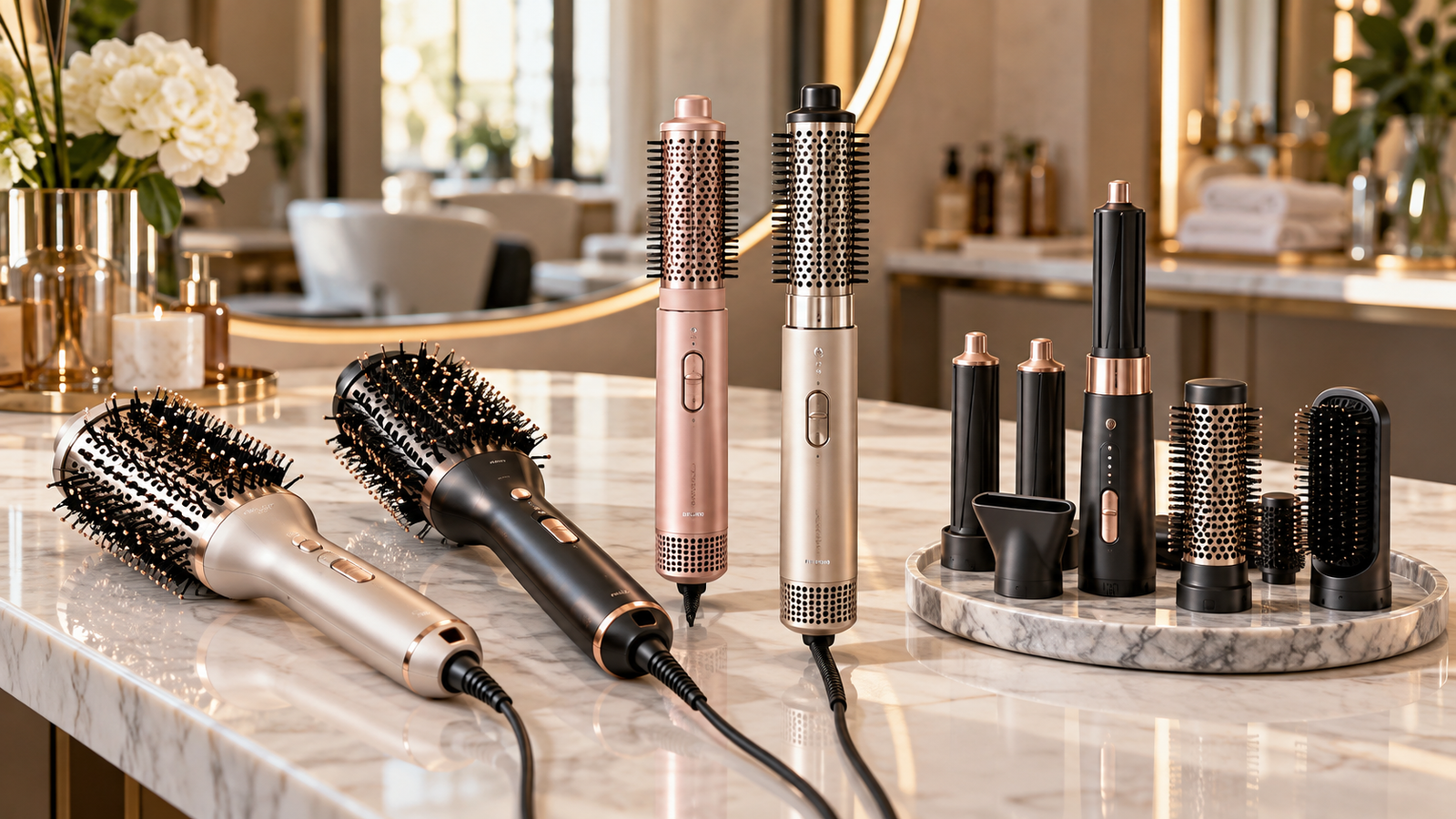
Some hot air stylers look almost identical to blow brushes. Others use a central handle that accepts multiple attachments.
A multi-attachment system might include:
- Oval brush
- Round brush
- Smoothing brush
- Drying nozzle
- Curling barrel
- Concentrator attachment
The exact combination varies by product.
Why the Terminology Can Be Confusing
Brands do not always use the same product names consistently.
A tool described as an “air styler,” “blow brush,” “hot air brush” or “multi-styler” may overlap with another category.
For that reason, it is more useful to look at the physical design and included attachments than to rely only on the product name.
Single-Brush Tool vs Multi-Attachment System
This is usually the biggest difference between the two buying approaches.
Single blow brush
A single brush tool is straightforward.
You plug it in, select the heat or speed setting and style without changing components.
This simplicity can be useful if you mostly want one result, such as smoothing and adding volume after washing.
Multi-attachment hot air styler
A multi-styler offers more variety.
You may be able to rough-dry with one attachment, smooth with another and create waves or curls with a third.
The trade-off is additional setup, storage and a potentially steeper learning curve.
Which Is Better for Fast Styling?
If speed means minimal setup, a blow brush usually has an advantage.
There are no attachments to choose and fewer parts to organise before styling.
A multi-styler can still be efficient once you know which attachments work for you, but the flexibility is useful only if you actually use it.
Which Is Better for Different Hairstyles?
A multi-attachment hot air styler is generally more versatile.
It may support several looks without requiring separate styling tools.
For example, one system might let you:
- Dry the roots
- Smooth the lengths
- Add volume with a round brush
- Create loose waves with a curling attachment
A simple blow brush usually focuses more strongly on one main blowout-style result.
Can a Blow Brush Dry Wet Hair?
Many blow brushes are designed for damp hair, but that does not mean they are always the fastest tool for soaking-wet hair.
Very wet hair may require a long styling session because the brush has to both evaporate water and shape the hair.
A common approach is to remove excess water first and allow the hair to partially air-dry before using the tool.
Follow the exact manufacturer’s instructions because some devices are designed for different starting moisture levels.
Can a Hot Air Styler Replace a Hair Dryer?
Sometimes.
A hot air styler with a dedicated drying or pre-drying attachment may handle much of the job of a separate dryer.
A brush-only styler may be slower when the hair is very wet or dense.
If you have thick hair, you may still prefer a conventional dryer for the initial drying stage and then use the styler for shaping.
Blow Brush vs Hair Dryer and Round Brush
A traditional salon-style blowout uses a separate hair dryer and round brush.
This setup offers a high level of control, but coordinating both tools takes practice.
A blow brush combines those two functions into one device.
That usually makes it easier for home use, although a professional dryer and separate brush may provide more precise control over airflow, tension and section size.
What Does Brush Shape Change?
The shape of the brush head affects the final style.
Oval brush
Oval brushes are common in volumising tools.
The flatter sides can help smooth longer sections, while the curved edges help create lift and shape.
Round brush
A round brush can create more curvature through the hair and may be useful for shaping ends or adding bounce.
Paddle-style brush
A flatter brush attachment generally prioritises smoothing and straightening over creating dramatic volume.
Do Barrel Size and Brush Size Matter?
Yes.
A larger brush head usually works efficiently on longer hair and creates broader, softer bends.
A smaller brush gives more control on shorter sections, fringes and tighter shaping.
A very large oval brush can be awkward on short hair because there may not be enough length to wrap around or move through the bristles effectively.
Blow Brush for Fine Hair
Fine hair often benefits from tools that can create lift without requiring excessive heat or tension.
A blow brush can be useful because the brush head can lift roots while drying.
However, fine hair may also be more vulnerable to excessive heat.
Use lower heat where possible and avoid repeatedly passing over already-dry sections.
Blow Brush for Thick Hair
Thick hair can take longer to dry with a brush-based tool.
Useful strategies include:
- Remove as much excess water as possible first.
- Work in smaller sections.
- Pre-dry if the tool instructions allow it.
- Use enough airflow rather than relying only on maximum heat.
A multi-styler with a separate drying attachment can be especially useful for dense hair.
Hot Air Styler for Curly or Wavy Hair
Whether a hot air styler suits curly or wavy hair depends heavily on the attachment.
A smoothing brush may stretch the curl pattern, while a round brush may create a blowout finish.
Some multi-stylers include curling attachments that create a different result from the natural pattern.
If preserving natural curls is the goal, a diffuser-equipped hair dryer may be more appropriate than a brush styler.
What About Frizz?
A blow brush can make hair look smoother because the combination of airflow, heat, brushing and tension helps align the strands.
However, the tool does not permanently change the hair’s tendency to frizz.
Humidity, hair condition, styling products and technique continue to matter after styling.
Which Tool Creates More Volume?
Both can create volume when they include the right brush attachment.
A large oval blow brush is particularly popular for root lift and a rounded blowout effect.
A hot air styler with several brush sizes may provide more control over where the volume appears.
Technique matters as much as the device.
Lifting each section away from the scalp while drying usually creates more root volume than pulling the brush straight downward.
Which Tool Is Better for Straightening?
Neither is identical to a flat iron.
A brush-based hot-air tool can make hair smoother and straighter-looking while maintaining more volume than a flat iron.
If you want a very sleek, flat finish, a straightener may still create a stronger result.
The advantage of a hot-air brush is that drying and smoothing can often happen in one stage.
Which Tool Is Better for Curling?
A basic oval blow brush is not primarily a curling iron.
It can curve the ends and create soft bends, but it usually will not create defined curls across the full length.
A multi-attachment hot air styler may offer dedicated curling barrels, making it significantly more flexible for curl or wave styling.
Do Hot Air Stylers Use Less Heat Than Straighteners?
They often style using heated airflow rather than clamping the hair directly between very hot plates.
That does not mean they are damage-free.
Temperature, exposure time and repeated brushing still matter.
Even with an air-based tool, use sensible heat settings and appropriate heat protection.
Should You Use Heat Protectant With a Blow Brush?
Yes, a heat protectant can be a useful part of the routine when using heated airflow.
Choose a product that is intended for the type of styling and starting hair condition you are using.
For more detail, see our guide to How Heat Protectants Work.
Does a Higher Wattage Mean a Better Styler?
No.
Wattage can influence power and drying performance, but it is only one specification.
Also consider:
- Airflow design
- Heat settings
- Brush size
- Attachment design
- Tool weight
- Cord length
- Grip comfort
A more powerful tool that feels awkward or overheats the hair is not automatically the better choice.
Heat Settings vs Speed Settings
Some tools allow heat and airflow to be controlled separately, while others combine them into preset levels.
Separate controls provide more flexibility.
For example, you may want:
- Higher airflow with moderate heat during initial drying
- Lower airflow while shaping the ends
- A cool setting to finish the style
What Is a Cool-Shot Setting For?
Cool air reduces heat exposure at the end of styling and can help the hair cool in the shape you have created.
It does not permanently lock a hairstyle in place, but it can be a useful finishing step.
How Heavy Is the Tool?
Weight is easy to overlook when shopping online.
A hot air styler can be held for a significant amount of time during a full styling session.
A heavier motor or large brush head may become tiring, particularly for long or dense hair.
Multi-stylers can also become bulky when the complete attachment set is considered.
Storage: One Tool vs Multiple Attachments
A simple blow brush has an obvious storage advantage.
There is one tool and usually no separate attachment case.
A multi-styler requires space for:
- Main motor handle
- Brush attachments
- Drying nozzle
- Curling barrels
- Storage case or stand if included
If your bathroom or dressing area has limited storage, this can matter more than expected.
Travel Convenience
Neither category is particularly compact compared with a small travel hair dryer.
A single blow brush is simpler to pack because there are fewer parts.
A multi-styler offers more functions from one motor base but can require several attachments if you want full styling flexibility.
Also check electrical voltage compatibility before international travel.
Learning Curve
Blow brush
The learning curve is generally straightforward:
- Section the hair.
- Place the brush under or over the section.
- Maintain gentle tension.
- Move slowly from roots toward ends.
Multi-styler
Each attachment may require a different technique.
A smoothing brush, round brush and curling barrel do not behave the same way, so getting the full value from the system may require practice.
How to Use a Blow Brush More Safely
- Remove excess water from freshly washed hair.
- Apply an appropriate heat protectant.
- Detangle before switching on the tool.
- Divide the hair into manageable sections.
- Start with a moderate heat setting.
- Keep the brush moving rather than holding it against one section.
- Avoid repeatedly styling areas that are already dry.
- Use the cool setting at the end if available.
Common Blow Brush Mistakes
Starting with soaking-wet hair
This can make the styling session unnecessarily long.
Taking sections that are too large
Oversized sections make it harder for air to reach the entire section evenly.
Pulling too hard
More tension is not automatically better. Excessive pulling can add mechanical stress to wet or damp hair.
Using maximum heat throughout
Use only as much heat as needed for the result.
Wrapping hair tightly around the brush
Hair can become tangled around some brush designs if too much is wrapped at once.
Common Multi-Styler Mistakes
Trying every attachment in one session
More attachments do not mean they all need to be used together.
Choose the few that serve your styling goal.
Ignoring attachment purpose
A smoothing brush and a volumising brush are designed to create different effects.
Changing attachments while they are very hot
Follow the manufacturer’s safety instructions and allow components to cool where required.
Buying for the number of attachments alone
Five useful attachments can be better than ten pieces you never use.
Which Tool Is Easier for Beginners?
A simple blow brush is generally easier for someone who wants a basic blowout-style result without learning multiple techniques.
A hot air multi-styler is better suited to someone willing to spend time learning different attachments in exchange for greater styling flexibility.
Which Tool Offers Better Value?
Value depends on what you would otherwise buy separately.
A multi-styler may represent good value if it replaces several tools that you genuinely use.
If you only want to dry and smooth your hair, paying for numerous curling and shaping attachments may offer little practical benefit.
A simpler blow brush can therefore be the better value even if the feature list is shorter.
Blow Brush vs Hot Air Styler: Which Should You Choose?
Choose a blow brush if you:
- Mainly want a smooth, voluminous blowout
- Prefer a simple one-piece tool
- Do not want to manage multiple attachments
- Want a relatively short learning curve
- Have limited storage space
Choose a multi-attachment hot air styler if you:
- Regularly switch between different hairstyles
- Want several brush or curling attachments
- Prefer one motor base instead of several separate tools
- Are willing to learn different attachment techniques
- Have enough space to store the full system
For specific models and formats, see our Top 5 Hot Air Stylers in India.
Frequently Asked Questions
Is a blow brush the same as a hot air styler?
A blow brush is one type of hot-air styling tool, but a hot air styler may include several interchangeable attachments rather than one fixed brush.
Can a blow brush replace a straightener?
It can create a smoother and straighter-looking finish, but it generally does not produce the same very flat result as a flat iron.
Can you use a blow brush on dry hair?
Some tools can be used for touch-ups on dry hair, but many are primarily designed for damp-to-dry styling. Follow the instructions for the exact model.
Can a hot air styler curl hair?
A multi-styler can if it includes dedicated curling attachments. A basic blow brush usually creates soft bends rather than defined curls.
Do you need a heat protectant with a hot air brush?
Using an appropriate heat protectant is a sensible step because the hair is still exposed to heat and mechanical styling.
Which is better for beginners?
A single blow brush is usually simpler because there are fewer components and techniques to learn.
Final Takeaway
A blow brush and a hot air styler can both simplify at-home hair styling, but they suit different routines.
A blow brush is the more straightforward option when your main goal is drying, smoothing and volume with minimal setup.
A multi-attachment hot air styler offers greater versatility and can make sense when you regularly create several different hairstyles.
Do not choose based only on wattage or the number of attachments. Consider brush size, controls, tool weight, storage, heat settings and whether you will genuinely use the styling options provided.
The best tool is the one that makes your normal routine easier without encouraging unnecessary heat exposure or buying features that remain in the box.
Physical Glow publishes educational beauty, fitness and wellness content. This article is for general informational purposes and is not a substitute for professional hair, dermatological or medical advice.