How Heat Protectants Work: Application, Film Formers and Styling Temperature
Heat protectants are designed to reduce some of the stress that hot styling tools place on the hair surface. They are commonly used before blow-drying, straightening, curling or other heat-based styling, but they do not make high temperatures completely harmless.
The most useful way to think about a heat protectant is as part of a broader heat-management routine. The product can help create a more protective film over the hair, improve slip and reduce friction, but tool temperature, number of passes, hair condition and application technique still matter.
This guide explains how heat protectants work, why even coverage is important, when to apply them and how to use hot tools more carefully.
What Is a Heat Protectant?
A heat protectant is a leave-on hair product formulated for use before thermal styling.
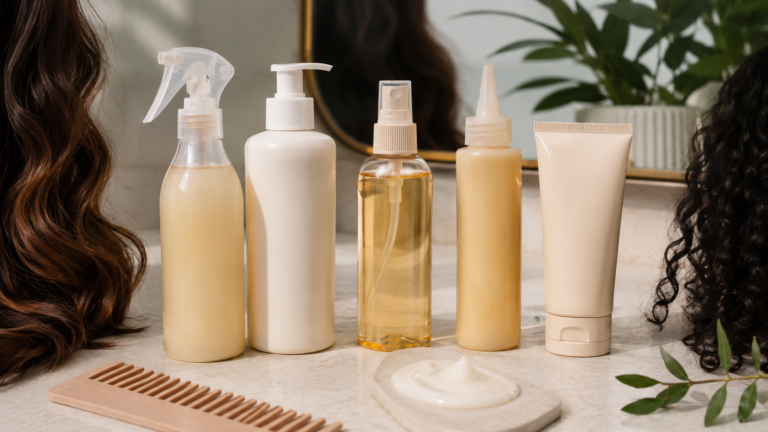
Depending on the product, it may be sold as:
- Spray
- Mist
- Serum
- Cream
- Leave-in treatment
Many formulas combine conditioning agents, film-forming ingredients and styling components so the product can help the hair feel smoother while it is being exposed to heat.
What Happens to Hair During Heat Styling?
Hair is made largely of keratin and contains internal moisture as well as surface lipids.
When a hair dryer, straightener or curling tool applies heat, several things can happen:
- Water evaporates from the hair.
- The cuticle can become rougher with repeated high-temperature exposure.
- Mechanical friction from brushes or plates can add stress.
- Repeated styling can contribute to dryness, breakage and split ends.
The level of stress depends on temperature, exposure time, tool design, hair condition and how often the process is repeated.
How Do Heat Protectants Work?
Heat protectants do not create an impenetrable shield around the hair.
Instead, the formula may help in several practical ways.
They can form a thin film
Film-forming ingredients can coat the hair surface and create a more even layer between the strand and the styling environment.
This can help distribute heat more evenly and reduce direct friction from styling tools.
They can improve slip
Conditioning ingredients can make the hair easier to comb, brush and move through hot plates.
Less drag means less mechanical stress during styling.
They can reduce moisture loss
Some formulas are designed to help slow excessive moisture loss during heating, although the degree of protection varies by formula and application.
They can smooth the cuticle surface
Smoothing agents can reduce roughness and help the hair appear shinier after styling.
What Are Film Formers?
Film formers are ingredients that leave a thin coating on the hair surface after application.
They are commonly used in hair styling and conditioning products.
The exact ingredients vary widely between formulas, but common categories can include certain polymers, silicones and conditioning compounds.
The important point is not whether one specific ingredient appears on the label, but whether the full formula spreads evenly and works with the styling routine.
Do Silicones Help With Heat Protection?
Silicones are frequently used in heat-protection and smoothing products because they can improve slip, reduce friction and create a smoother surface feel.
They are not inherently bad for the hair.
Some users prefer silicone-free formulas for personal or styling reasons, but removing silicones does not automatically make a heat protectant better or worse.
The complete formulation is more important than one ingredient category.
Does Heat Protectant Completely Prevent Damage?
No.
A heat protectant can reduce some styling stress, but it cannot make unlimited heat exposure safe.
Damage risk still increases when you:
- Use very high temperatures
- Make repeated passes over the same section
- Style already fragile or chemically treated hair aggressively
- Use hot tools every day
- Apply a straightener to wet hair unless the device is specifically designed for it
The best protection strategy combines product use with sensible temperature and technique.
When Should You Apply Heat Protectant?
The correct timing depends on the formula and styling tool.
Before blow-drying
Many sprays, creams and leave-ins are designed for damp hair before blow-drying.
Apply the product after gently towel-drying the hair, then distribute it evenly before starting with the dryer.
Before straightening or curling
Some heat protectants can be used on dry hair before flat irons or curling tools.
Others are intended only for damp hair and should not be reapplied immediately before a hot plate.
Always check the product directions.
Should Heat Protectant Be Applied to Wet or Dry Hair?
There is no universal answer.
The label should tell you whether the product is intended for:
- Damp hair
- Dry hair
- Both damp and dry hair
Using a damp-hair-only formula immediately before straightening may leave extra moisture on the hair, which is not ideal unless the product and tool are specifically designed for that use.
How Much Heat Protectant Should You Use?
Enough product should be applied to create reasonably even coverage without saturating the hair.
Using too little can leave sections untreated.
Using far too much can make the hair feel heavy, greasy or coated.
The amount needed depends on:
- Hair length
- Hair density
- Product concentration
- Spray pattern
- Whether the product is a mist, cream or serum
Follow the brand’s directions first, then adjust within reason for your hair density and length.
Why Even Coverage Matters
One of the most common application mistakes is spraying only the outer surface of the hair.
If the underneath sections are also going to be blow-dried or straightened, they need coverage too.
A more reliable method is to divide the hair into sections and distribute the product through each area.
This is especially useful for thick or dense hair.
How to Apply Heat Protectant Spray Correctly
- Follow the product directions for damp or dry application.
- Divide the hair into manageable sections.
- Spray from the recommended distance.
- Focus on the mid-lengths and ends while also covering the sections that will receive direct heat.
- Distribute with fingers or a wide-tooth comb if appropriate.
- Allow excess moisture from the spray to settle or dry before using a hot iron.
- Style at the lowest effective temperature.
Should Heat Protectant Go on the Roots?
It depends on the styling method and formula.
If you are blow-drying the roots, some lightweight protection there may be useful.
However, heavy creams and oily serums near the scalp can make roots look greasy or flat.
For many users, lighter sprays work better around the root area while richer products are concentrated through the mid-lengths and ends.
What Styling Temperature Should You Use?
There is no perfect temperature that suits every hair type and every tool.
The safest principle is to use the lowest temperature that achieves the desired result without requiring many repeated passes.
Higher temperature does not automatically mean better styling.
Lower temperatures may be more appropriate for:
- Fine hair
- Bleached hair
- Colour-treated hair
- Already dry or damaged hair
Coarser or very resistant hair
Coarser hair may require more heat to achieve the same styling result, but excessive temperature can still cause damage.
Increase temperature only as much as necessary.
Is 230°C Too Hot for Hair?
For many people, very high tool temperatures are unnecessary and can increase damage risk.
Just because a straightener can reach a particular maximum temperature does not mean that setting should be used routinely.
Start lower and increase only if the hairstyle cannot be achieved effectively.
Heat Protectant for Blow-Drying
Blow-drying generally exposes hair to lower direct temperatures than clamping it between hot flat-iron plates, but heat and mechanical brushing still create stress.
Useful practices include:
- Remove excess water gently before drying
- Use medium heat where possible
- Keep the dryer moving
- Avoid holding the nozzle extremely close to one spot
- Use a concentrator nozzle when you need directional airflow
- Finish with cooler air if that works for your style
Heat Protectant for Straightening
Flat irons create concentrated direct contact with the hair.
To reduce unnecessary stress:
- Make sure the hair is fully dry unless the tool is specifically designed otherwise.
- Work in small, organised sections.
- Avoid repeated passes over the same strand.
- Use the lowest effective temperature.
- Keep the plates clean.
A heat protectant is an additional protective step, not permission to repeatedly straighten the same section at maximum heat.
Heat Protectant for Curling Irons
Curling tools also create direct heat contact.
Avoid holding each section on the barrel longer than necessary.
If the curl does not form properly, adjusting section size or styling technique may be better than simply increasing heat.
Do You Need to Reapply Heat Protectant?
If you applied the product before blow-drying and then plan to straighten the hair later, whether you need another application depends on the formula.
Some products are designed to cover multiple styling stages, while others may be suitable for reapplication on dry hair.
Check the manufacturer’s directions rather than automatically layering more product.
Over-application can leave residue and make styling more difficult.
Heat Protectant Spray vs Serum
| Feature | Spray or Mist | Serum or Cream |
|---|---|---|
| Application | Fast and broad | Applied by hand |
| Best for | Lightweight coverage | More conditioning and smoothing |
| Fine hair | Often easier to keep lightweight | Can be heavy if overused |
| Thick or dry hair | Useful for coverage | Can provide additional slip |
| Distribution | Needs even spraying | Needs careful hand distribution |
Neither format is automatically more protective. Application quality and formula design matter more.
Heat Protectant for Fine Hair
Fine hair can become weighed down easily.
Look for lightweight sprays or mists that distribute evenly without leaving a heavy residue.
Avoid concentrating too much product on the roots.
Heat Protectant for Thick or Coarse Hair
Thicker hair may benefit from products that combine heat protection with additional conditioning and smoothing.
Sectioning becomes particularly important because spraying only the outer layer will not cover the hair underneath.
Heat Protectant for Curly and Wavy Hair
For curly and wavy hair, consider how heat protection interacts with the rest of your styling products.
A leave-in or cream-based protectant may fit well before diffusing, while a lighter spray may be useful before occasional straightening.
Avoid layering so many products that the hair becomes sticky or difficult to distribute evenly.
Heat Protectant for Colour-Treated or Bleached Hair
Chemically treated hair may already be more fragile.
Heat protection is useful, but reducing styling temperature and frequency becomes especially important.
Do not rely on a protectant alone to compensate for aggressive heat use.
Can You Use Hair Oil as Heat Protectant?
Not every hair oil is formulated for thermal protection.
An oil may make the hair feel smoother or shinier but should not automatically be treated as a substitute for a product specifically designed for heat styling.
Some styling oils are explicitly labelled for heat protection. If so, follow the manufacturer’s stated use.
Can Leave-In Conditioner Replace Heat Protectant?
Only if the leave-in conditioner specifically states that it provides heat protection.
A regular leave-in may improve conditioning and slip but may not be designed or tested for thermal styling.
Heat Protectant vs Hairspray
These products serve different purposes.
A heat protectant is applied to help manage thermal styling stress.
Hairspray is primarily a finishing product used for hold.
Some styling sprays combine both functions, but a standard hairspray should not automatically be used as a heat protectant.
For a broader explanation of styling-product roles, see our guide to Heat Protectant, Hair Wax and Hairspray: What Does Each One Do?.
Common Heat Protectant Mistakes
Applying only to the top layer
This leaves underneath sections with little or no coverage.
Using a hot iron while the hair is still damp
Unless the tool is specifically designed for wet-to-dry styling, this can expose the hair to unnecessary stress.
Using maximum temperature automatically
Higher heat is not a measure of better styling.
Making too many passes
Repeated contact can increase damage even when a heat protectant is present.
Applying too much product
More product does not necessarily create more protection and may leave buildup.
Ignoring the ends
The ends are often among the oldest and most fragile parts of the hair and should not be forgotten during application.
How Often Can You Heat Style Hair?
There is no single schedule that is safe for everyone.
Hair condition, tool temperature, chemical processing and styling technique all matter.
In general, reducing unnecessary heat exposure gives the hair more opportunity to retain its condition over time.
If you notice increasing dryness, breakage, roughness or split ends, consider reducing temperature and frequency.
How to Reduce Heat Damage Beyond Using a Protectant
- Use the lowest effective temperature.
- Limit repeated passes.
- Allow hair to partially air-dry before blow-drying when practical.
- Keep hot tools clean.
- Use appropriate conditioning products.
- Avoid excessive tension while brushing.
- Trim severely split ends when necessary.
- Reduce heat frequency if the hair becomes increasingly fragile.
How to Choose a Heat Protectant
Consider:
- Whether you primarily blow-dry, straighten or curl
- Whether the product is for damp hair, dry hair or both
- How much conditioning your hair needs
- Whether a light spray or richer cream suits your hair density
- How large a bottle you need
- Whether you want additional smoothing or styling benefits
For specific options, see our Top 5 Heat Protectant Sprays in India.
Frequently Asked Questions
Does heat protectant really work?
A well-formulated heat protectant can help reduce some thermal and mechanical stress, but it cannot eliminate the risk of damage from excessive temperature or repeated styling.
Should I let heat protectant dry before straightening?
If a spray leaves the hair damp, allow that moisture to dry before using a conventional flat iron unless the product and tool specifically state otherwise.
Do I need heat protectant every time I use a hair dryer?
If you regularly use heated airflow, a suitable protectant can be a useful part of the routine, especially when using higher heat or brush tension.
Can heat protectant be used every day?
The product itself may be suitable for regular use depending on the formula, but daily high-temperature styling can still create cumulative stress.
Can I use two heat protectants together?
Usually there is no need. Layering multiple products can create unnecessary buildup. Choose one formula that suits your styling method unless the products are specifically designed to be combined.
Does more heat protectant mean more protection?
No. Even coverage is more important than saturating the hair. Excess product can make the hair heavy or coated.
Final Takeaway
Heat protectants are useful styling products, but they work best as one part of a sensible heat routine.
The formula can improve slip, create a protective film and help manage some of the stress associated with blow-drying, straightening and curling.
However, temperature and technique still matter.
Apply the product evenly, follow its damp-or-dry hair instructions, use the lowest effective styling temperature and avoid unnecessary repeated passes.
The goal is not to make high heat completely safe. It is to reduce avoidable stress while still achieving the style you want.
Physical Glow publishes educational beauty, fitness and wellness content. This article is for general informational purposes and is not a substitute for professional hair, dermatological or medical advice.