Cool-Mist Humidifier vs Aroma Diffuser: Tank Size, Cleaning and Bedroom Use
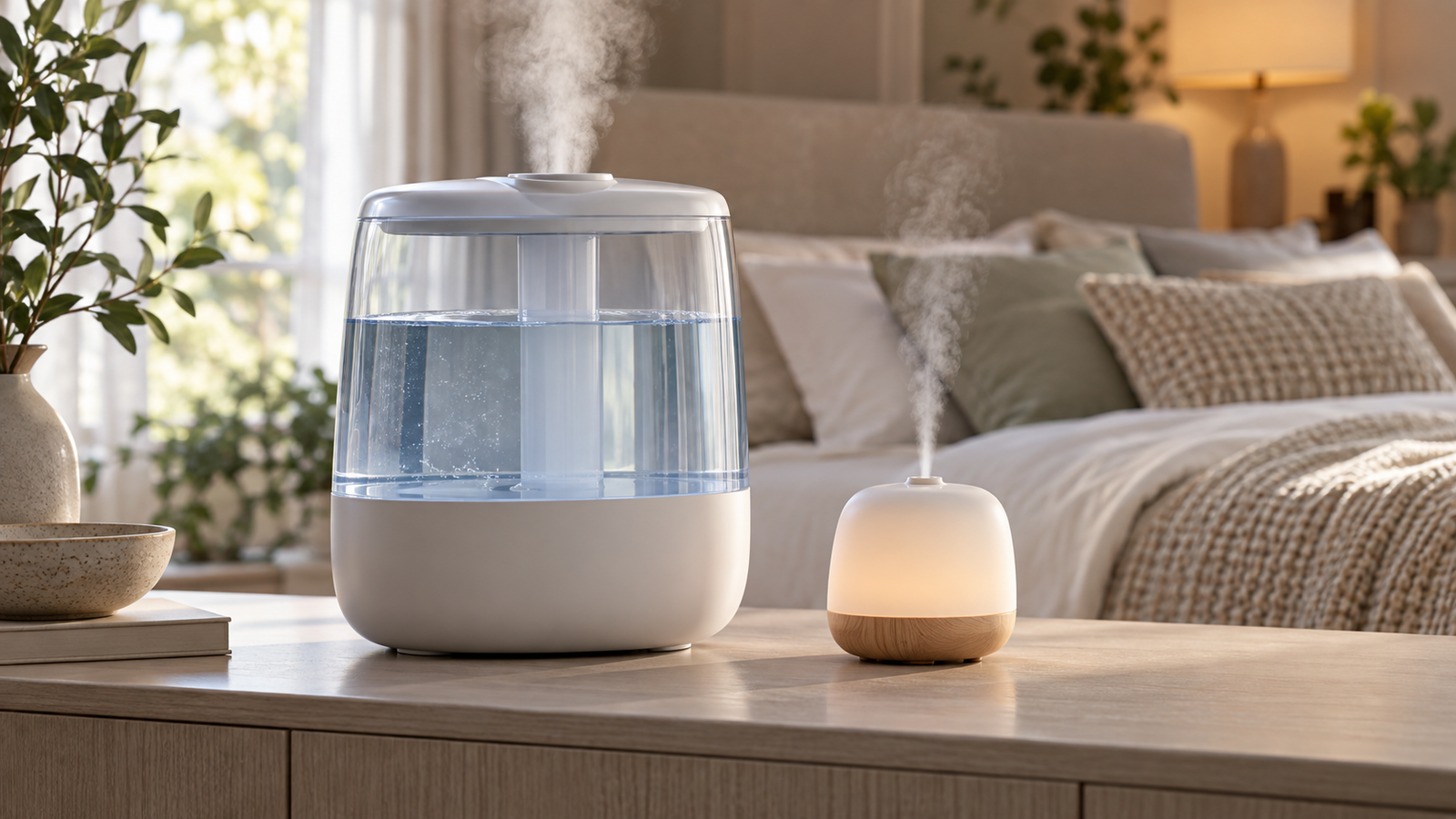
Cool-mist humidifiers and aroma diffusers can look surprisingly similar, especially when both use small tabletop housings and release visible mist.
But they are designed for different purposes.
A cool-mist humidifier is primarily intended to add moisture to indoor air. An aroma diffuser is mainly designed to disperse fragrance, usually from essential oils, into a room.
A humidifier generally has a much larger water tank and is designed to run for longer periods. A diffuser usually uses a smaller reservoir and produces far less overall moisture.
The right choice depends on whether your goal is changing room humidity or simply adding fragrance to the room.
What is a cool-mist humidifier?
A cool-mist humidifier is a device that adds water vapour or tiny water droplets to the surrounding air without heating the water to create steam.
Common household models use:
- Ultrasonic technology.
- Evaporative technology.
Ultrasonic humidifiers are especially common in bedrooms because they can operate quietly and produce a visible mist.
The main purpose is to increase moisture in dry indoor air.
What is an aroma diffuser?
An aroma diffuser is primarily used to disperse fragrance.
Many modern diffusers use ultrasonic vibration to break a mixture of water and essential oil into a fine mist.
Because the technology can resemble that of a humidifier, the two devices can look almost identical.
The difference is mainly in:
- Tank size.
- Mist output.
- Intended runtime.
- Intended use.
An aroma diffuser is not usually designed to meaningfully humidify an entire bedroom.
Cool-mist humidifier vs aroma diffuser at a glance
| Factor | Cool-mist humidifier | Aroma diffuser |
|---|---|---|
| Main purpose | Increase indoor humidity | Disperse fragrance |
| Water-tank size | Usually much larger | Usually small |
| Mist output | Higher | Lower |
| Typical runtime | Long | Short to moderate |
| Essential oils | Usually not unless specifically approved | Often designed for them |
| Room-humidity effect | Meaningful | Usually limited |
| Maintenance | Frequent cleaning required | Frequent cleaning required |
| Best for | Dry indoor air | Scented ambience |
Why they can look so similar
Both devices may use ultrasonic technology.
An ultrasonic transducer vibrates rapidly and breaks liquid into tiny droplets.
These droplets leave the device as a visible mist.
This visual similarity causes a lot of confusion.
A small diffuser may create an impressive plume of mist, but the total amount of water released can still be much lower than that of a full-size humidifier.
Mist appearance alone does not tell you how much humidity a device can add to the room.
Tank size is one of the biggest differences
A humidifier may hold several litres of water.
A compact diffuser may hold only a few hundred millilitres.
The larger tank allows a humidifier to operate for many hours without constant refilling.
This becomes especially important if you plan to run the device overnight.
Why humidifiers need larger tanks
Raising room humidity requires releasing a meaningful amount of water into the air.
A larger room usually requires greater output.
A tiny tank cannot sustain that level of output for very long.
This is why humidifiers marketed for bedrooms often use much larger reservoirs than aroma diffusers.
Top-fill vs bottom-fill humidifiers
Humidifiers commonly use one of two filling designs.
Top-fill
You remove a lid and pour water directly into the tank from above.
Advantages include:
- Easier refilling.
- Less lifting.
- Easier access for cleaning.
Bottom-fill
You remove the water tank, turn it over and fill it through an opening underneath.
These models can work perfectly well but may be less convenient with large tanks.
For regular bedroom use, ease of refilling matters because the device may need water frequently.
What is an ultrasonic humidifier?
An ultrasonic humidifier uses a rapidly vibrating component to create a fine mist.
Advantages often include:
- Quiet operation.
- Low power consumption.
- Compact design.
- Visible mist.
Potential drawbacks include:
- Mineral residue if hard water is used.
- Need for regular cleaning.
The quality of the water you use can affect both maintenance and visible residue.
What is an evaporative humidifier?
An evaporative humidifier typically uses:
- A water reservoir.
- A wick or filter.
- A fan.
Water moves through the wick and evaporates into the air.
These devices may produce less visible mist.
They can also create more fan noise than ultrasonic models.
Filters usually need replacement.
Which is quieter?
Ultrasonic humidifiers and aroma diffusers are usually among the quieter options.
This makes them popular for bedrooms.
Evaporative humidifiers may create more audible fan noise.
However, actual noise varies by product.
If you are a light sleeper, check whether the device has:
- Sleep mode.
- Display-off function.
- Low-speed mode.
Does a humidifier actually change room humidity?
Yes, if it is appropriately sized for the room and operated correctly.
That is its primary job.
Actual performance depends on factors such as:
- Room size.
- Mist output.
- Ventilation.
- Air conditioning.
- Existing humidity.
- Door and window openings.
A very small humidifier may have little effect in a large room.
Does an aroma diffuser humidify the room?
Technically, it releases some water.
But most aroma diffusers use such small reservoirs and low output that they should not be treated as proper room humidifiers.
If your goal is to raise humidity, choose a humidifier.
If your goal is fragrance, choose a diffuser.
Why indoor humidity matters
Very dry indoor air can make some people feel uncomfortable.
Common complaints in dry conditions may include:
- Dry-feeling nose or throat.
- Dry skin.
- Static electricity.
- Dry-feeling airways.
However, excessively high humidity can also create problems.
The goal is not to make the room as humid as possible.
Can humidity become too high?
Yes.
Excessive indoor humidity can encourage:
- Condensation.
- Damp surfaces.
- Mould growth.
- Dust-mite proliferation.
- Musty odours.
If windows or walls begin collecting moisture, the humidifier may be adding too much water to the room.
A hygrometer can help you monitor conditions.
What is a hygrometer?
A hygrometer measures relative humidity.
Some humidifiers include one.
You can also buy a separate digital room hygrometer.
This is more useful than guessing humidity based on how the room feels.
It helps prevent unnecessary over-humidification.
What humidity level should you aim for?
A moderate indoor humidity range is generally preferable to very dry or very damp conditions.
Many people aim for roughly 30% to 50% relative humidity indoors.
The ideal level can vary with climate, temperature and individual comfort.
If condensation appears regularly, humidity may be too high even if the number seems acceptable.
Humidistat vs basic humidity display
Some humidifiers include a humidistat.
This allows the device to adjust or stop output when a selected humidity level is reached.
A basic display may only show humidity without controlling the machine.
If automatic regulation matters to you, check whether the product includes an actual humidistat rather than simply a sensor.
Mist output matters
Humidifier output may be listed in units such as millilitres per hour.
Higher output can humidify a room more quickly.
But higher is not always better.
For a small bedroom, excessive output may create condensation.
Adjustable mist levels are useful.
Room-size claims
Manufacturers often specify a recommended room size.
This can be useful, but actual performance still depends on room conditions.
A humidifier designed for a small bedroom may struggle in:
- Large open-plan spaces.
- Rooms with doors constantly open.
- Highly ventilated areas.
Choose a size appropriate to the room where you will actually use it.
Can one humidifier cover an entire house?
Usually not.
Small consumer humidifiers are generally designed for individual rooms.
Whole-house humidity control requires a different system.
A bedroom unit should not be expected to affect distant rooms significantly.
Where should you place a humidifier?
Placement affects performance.
A practical setup is usually on a stable, water-resistant surface with enough clearance around the mist outlet.
Avoid placing it:
- Directly against a wall.
- On delicate wood without protection.
- Immediately beside electronics.
- Where mist constantly hits bedding.
- On an unstable surface.
Follow the manufacturer’s minimum-clearance recommendations.
Should a humidifier sit on the floor?
Some larger units can.
However, elevated placement may help mist disperse before settling on nearby surfaces.
The right position depends on the model.
Protect surrounding surfaces from condensation.
Should it be placed next to the bed?
It can be used in a bedroom, but it does not need to sit directly beside your face.
A short distance away can distribute moisture more evenly and reduce the chance of mist settling onto bedding or electronics.
Is visible mist supposed to land on furniture?
No.
If nearby surfaces become wet, reduce output or reposition the device.
A humidifier should increase airborne moisture without creating puddles or damp patches.
Can you use tap water?
This depends on water quality and device type.
Hard tap water contains minerals.
In ultrasonic humidifiers, those minerals can sometimes be dispersed into the room as fine residue.
You may notice white dust on nearby surfaces.
Using distilled or demineralised water can reduce this issue.
Follow the manufacturer’s water recommendation.
What is white dust?
White dust is mineral residue that can appear when mineral-rich water is atomised by an ultrasonic humidifier.
It may settle on:
- Furniture.
- Electronics.
- Floors.
It is mainly associated with ultrasonic models using hard water.
Filtered, distilled or demineralised water may reduce the problem.
Does boiled water solve the problem?
Not necessarily.
Boiling does not remove all dissolved minerals.
It can actually concentrate some minerals as water evaporates.
Use the water type recommended for the device.
Cleaning is essential
A humidifier contains standing water.
Without regular cleaning, buildup can develop inside the tank and base.
That can include:
- Mineral scale.
- Biofilm.
- Odour.
- Microbial growth.
A dirty humidifier can release contaminated droplets or unpleasant smells into the room.
Cleaning should be considered part of ownership, not an optional extra.
How often should a humidifier be cleaned?
Follow the manufacturer’s instructions.
In practice, regular water replacement and frequent cleaning are important.
Do not leave old water sitting in the tank for long periods.
If the water develops an odour or visible film, stop using the device and clean it thoroughly.
Daily maintenance
A simple routine may include:
- Emptying leftover water.
- Rinsing the tank.
- Refilling with fresh water.
- Wiping obvious residue.
- Allowing parts to dry when not in use.
A deeper cleaning schedule should follow the product manual.
Descaling
Mineral deposits may build up on:
- Ultrasonic plates.
- Heating elements.
- Tank surfaces.
The manufacturer may recommend a descaling method.
Do not scrape delicate ultrasonic components with hard tools.
Why removable tanks help
A wide removable tank is easier to clean than a narrow sealed reservoir.
When comparing humidifiers, check whether you can comfortably reach:
- Corners.
- Base surfaces.
- Lid channels.
A difficult-to-clean tank is more likely to be neglected.
Can essential oils be added to a humidifier?
Usually not unless the manufacturer specifically says the device is designed for them.
Essential oils can damage:
- Plastic.
- Ultrasonic membranes.
- Filters.
- Internal seals.
They may also leave oily residue inside the water system.
Do not pour essential oils directly into a standard humidifier tank unless the instructions explicitly permit it.
Humidifiers with aroma trays
Some humidifiers include a separate aroma tray or fragrance compartment.
This is different from adding oil to the water tank.
If the device provides a dedicated aroma pad, use it exactly as directed.
Why diffusers are designed for essential oils
A diffuser is built with fragrance use in mind.
Materials and internal components are generally selected to tolerate diluted essential oils better than a standard humidifier.
However, diffusers still require cleaning because oils can leave residue.
How much essential oil should you add?
Follow the diffuser manufacturer’s instructions.
More oil does not necessarily create a better experience.
Too much can make the scent overwhelming and can increase residue inside the device.
Start conservatively.
Can essential oils irritate people?
Yes.
Fragrance and essential oils can cause discomfort or irritation for some users.
Possible issues include:
- Headache.
- Eye irritation.
- Respiratory discomfort.
- Skin sensitivity.
If a scent makes you feel unwell, stop using it and ventilate the room.
Essential oils around children
Extra caution is appropriate.
Not every essential oil is suitable around infants or children.
Age, concentration and exposure matter.
If a diffuser is being used in a child’s room, verify the safety of the specific oil rather than assuming all “natural” fragrances are harmless.
Essential oils around pets
Some essential oils can be problematic for pets, particularly in concentrated or poorly ventilated environments.
Dogs, cats, birds and other animals can have different sensitivities.
Before diffusing oils around pets, check species-specific veterinary guidance.
Diffuser use in poorly ventilated rooms
Strong fragrance can become overwhelming in a closed bedroom.
Use a lower oil concentration or shorter runtime.
Ventilation matters.
You do not need continuous fragrance throughout the night.
Intermittent mist modes
Diffusers commonly include intermittent settings.
For example, the device may alternate between misting and pausing.
This can extend runtime and reduce fragrance intensity.
For aroma use, intermittent output is often sufficient.
Continuous mist
Continuous mode produces fragrance more quickly.
It may suit:
- Larger rooms.
- Shorter sessions.
However, it also empties the reservoir faster.
Diffuser tank size
A small diffuser may hold around a few hundred millilitres.
Larger diffusers can run longer.
But unlike humidifiers, tank size is mainly about fragrance runtime rather than increasing room humidity.
Diffuser lighting
Many aroma diffusers include coloured LEDs.
These are decorative features.
Some models allow:
- Fixed colour.
- Colour cycling.
- Light off.
For bedroom use, the ability to disable the light can be useful.
Humidifier display lights
Bright displays can be annoying at night.
Useful bedroom features include:
- Display-off mode.
- Dim night mode.
- No continuously flashing indicators.
A quiet device is not very sleep-friendly if the screen is bright enough to illuminate the room.
Automatic shut-off
Both humidifiers and diffusers should ideally include automatic shut-off when the water runs low.
This reduces the chance of the device operating dry.
Check the exact product specification.
Runtime
Humidifier runtime depends on:
- Tank size.
- Mist level.
- Room humidity.
- Automatic regulation.
Diffuser runtime depends mainly on:
- Reservoir size.
- Continuous vs intermittent mode.
Do not compare their runtime numbers directly because the output levels serve different purposes.
Which uses more electricity?
Both are usually relatively low-power devices.
Larger humidifiers can use more energy than compact diffusers because they move more water.
Evaporative humidifiers also use fans.
Energy consumption is rarely the main deciding factor for a single bedroom unit.
Which is easier to maintain?
A diffuser is generally smaller and quicker to rinse.
However, essential oils can leave stubborn residue.
Humidifiers have larger surfaces and may require more frequent mineral-scale management.
Neither should be considered maintenance-free.
Can a humidifier help with dry skin?
Increasing room humidity may make very dry indoor air feel more comfortable.
However, it is not a substitute for moisturiser or treatment of a skin condition.
If dryness is persistent or severe, skincare and medical factors may also need attention.
Can a humidifier help with a dry nose or throat?
Some people find moderately humidified air more comfortable in dry environments.
But a humidifier is not a treatment for infection, allergy or another medical condition.
Persistent respiratory symptoms require appropriate assessment.
Can a humidifier cure a cold?
No.
A humidifier may improve comfort in dry air, but it does not cure viral infections.
Be cautious with products making disease-treatment claims.
Can a diffuser help you sleep?
Some users find certain scents relaxing.
But an aroma diffuser should not be treated as a sleep treatment.
Sleep quality depends on many factors, including:
- Schedule.
- Light.
- Noise.
- Stress.
- Caffeine.
- Sleep environment.
Fragrance is mainly an ambience preference.
Can lavender or other oils guarantee better sleep?
No.
Some people enjoy particular scents before bed, but response is individual.
A pleasant fragrance does not guarantee deeper or longer sleep.
Humidifier and allergies
A humidifier may feel comfortable when air is excessively dry.
However, excessive humidity can worsen environments where:
- Mould.
- Dust mites.
are concerns.
That is another reason to monitor humidity rather than continuously running the device at maximum output.
Humidifier and asthma
Some people with asthma may find dry air uncomfortable, while others may react poorly to excessive humidity, mould or fragrance.
If asthma symptoms are affected by indoor air conditions, use medical guidance rather than experimenting aggressively with humidity or essential oils.
Diffusers and asthma
Strong fragrances and essential oils can trigger symptoms in some people with asthma or fragrance sensitivity.
If breathing becomes uncomfortable, stop the diffuser and ventilate the room.
Can humidifiers cause mould?
They can contribute if they raise humidity excessively or repeatedly wet nearby surfaces.
Signs of too much moisture include:
- Condensation.
- Damp walls.
- Musty smell.
Reduce use if these appear.
Does bigger tank always mean better?
No.
A larger tank means fewer refills.
But it also means:
- Larger footprint.
- More water to carry.
- More surfaces to clean.
Choose based on room size and runtime needs.
Is higher mist output always better?
No.
Output should match the room.
Too little output will not meaningfully affect humidity.
Too much can create damp conditions.
Adjustability is more important than simply choosing the highest specification.
Humidifier filters
Some models use replaceable filters or cartridges.
Check:
- Replacement interval.
- Cost.
- Availability.
A low-priced humidifier can become expensive if replacement filters are difficult to source.
Filterless humidifiers
Filterless designs reduce replacement costs.
However, they may require more frequent descaling, especially with hard water.
There is a trade-off between consumables and cleaning.
Diffuser maintenance
Essential oil residue can accumulate on the ultrasonic plate and inside the tank.
A simple cleaning routine should follow the manual.
Avoid mixing new oil into old residue indefinitely.
If scent changes unexpectedly, clean the device before adding more oil.
Mixing essential oils
Many users blend oils.
If you do, keep concentrations moderate and make sure each oil is appropriate for the household members and pets exposed to it.
More ingredients make it harder to identify which scent is causing irritation if a problem develops.
Can perfume be used in a diffuser?
Usually not.
A diffuser is generally designed for essential oils or fragrance products specifically approved by the manufacturer.
Perfume can contain:
- Alcohol.
- Solvents.
- Other ingredients.
that may damage the device or produce an inappropriate mist.
Can diffuser oil be added to humidifier water?
Do not assume so.
Even if both devices use ultrasonic mist, their materials and internal systems may differ.
Only use oils in a humidifier if the manufacturer explicitly approves them.
Bedroom humidifier safety
Keep electrical components away from spilled water.
Use the device on a stable surface.
Do not:
- Overfill the tank.
- Block vents.
- Operate a damaged power cable.
- Place it where children can easily overturn it.
Diffuser safety
The same basic electrical precautions apply.
Also keep concentrated essential-oil bottles away from:
- Children.
- Pets.
- Eyes.
Do not ingest essential oils simply because they are plant-derived.
Which is better for a baby’s room?
A cool-mist humidifier may sometimes be used to increase humidity in a dry room.
However, cleanliness and placement are especially important.
Keep cords and the device out of reach.
Do not add essential oils to a baby’s room humidifier unless specifically advised by an appropriate healthcare professional.
Why cool mist is usually preferred over hot steam around children
Cool mist does not involve a tank of very hot water or steam near the user.
This removes the burn risk associated with hot-water vapour devices.
Even so, a cool-mist unit should still be placed where it cannot be pulled over.
Common humidifier mistakes
The most common problems are running the device at maximum output regardless of room conditions, leaving old water in the tank, failing to clean mineral buildup, placing the unit too close to furniture or walls, using inappropriate water and adding essential oils to a tank not designed for them.
A humidifier only works well when it is kept clean and used at an appropriate output level.
Common diffuser mistakes
Typical problems include adding too much oil, running strong fragrance continuously in a closed room, neglecting oil residue, using liquids not approved by the manufacturer and assuming the diffuser is significantly humidifying the bedroom.
Its main job is aroma, not humidity control.
How to compare cool-mist humidifiers
| Factor | What to check |
|---|---|
| Tank capacity | Appropriate for desired runtime |
| Room coverage | Suitable for bedroom size |
| Mist output | Adjustable levels |
| Fill design | Top-fill or removable tank |
| Humidistat | Useful for automatic control |
| Noise | Important for sleep |
| Display | Can lights be turned off? |
| Cleaning | Wide tank access |
| Water requirement | Tap, filtered or distilled |
| Filters | Replacement cost and availability |
| Aroma use | Only if specifically supported |
How to compare aroma diffusers
| Factor | What to check |
|---|---|
| Tank size | Determines fragrance runtime |
| Mist modes | Continuous or intermittent |
| Timer | Useful for short sessions |
| Light | Optional colour and off mode |
| Noise | Bedroom suitability |
| Auto shut-off | Low-water protection |
| Cleaning | Easy access to tank and plate |
| Oil compatibility | Manufacturer-approved oils |
| Footprint | Bedside or console placement |
Which should you choose for dry bedroom air?
Choose a humidifier.
A diffuser is unlikely to release enough water to meaningfully control room humidity.
Use a hygrometer so you can determine whether the room is genuinely dry.
Which should you choose for fragrance?
Choose an aroma diffuser.
It is designed to work with fragrance oils and generally provides better control over scent intensity.
Do not buy a large humidifier simply because you want aroma.
Which should you choose if you want both?
Some humidifiers include a dedicated aroma tray.
This can provide both room humidification and light fragrance.
However, check how the aroma system works.
A separate fragrance tray is preferable to adding oil directly into the water tank unless the device explicitly permits that.
Frequently asked questions
Is an aroma diffuser the same as a humidifier?
No.
A humidifier is designed to raise room humidity.
A diffuser is primarily designed to disperse fragrance.
Can a diffuser humidify a bedroom?
It releases some moisture, but usually not enough to function as a proper room humidifier.
Can I put essential oils in a humidifier?
Only if the manufacturer specifically says the device supports them.
Is a cool-mist humidifier good for sleeping?
It can be appropriate if the room air is dry, the device is kept clean and humidity is not allowed to become excessive.
Should I run a humidifier all night?
It can be run for extended periods if the product is designed for it, but room humidity should be monitored and the device kept clean.
Is more humidity better?
No.
Excessive humidity can contribute to condensation, mould and dust-mite growth.
Can I use tap water in an ultrasonic humidifier?
Possibly, but hard water may create mineral residue. Follow the manufacturer’s recommendation.
Why is there white dust around my humidifier?
It may be mineral residue from hard water dispersed by an ultrasonic unit.
Can I use perfume in an aroma diffuser?
Usually not unless specifically approved by the manufacturer.
Is it safe to diffuse essential oils around pets?
Not every oil is safe for every species. Check appropriate veterinary guidance before use.
Choosing between a humidifier and a diffuser
Start with the outcome you want.
Choose a cool-mist humidifier if your main goal is to increase moisture in genuinely dry indoor air.
Choose an aroma diffuser if your main goal is fragrance and atmosphere.
Do not use a small diffuser as a substitute for proper humidity control, and do not pour essential oils into a humidifier that was not designed for them.
For bedroom use, practical factors matter just as much as appearance: tank size, cleaning access, noise, automatic shut-off, display brightness and output control can determine whether you continue using the device after the first few weeks.
Physical Glow’s Top 5 Bedroom Cool-Mist Humidifiers and Aroma Options in India comparison looks at several humidifier and diffuser formats for bedroom use. Use that comparison alongside this guide, then verify the current tank capacity, mist output, room-size guidance, cleaning requirements, noise level and aroma compatibility for the exact device you are considering.