How to Choose Hair Gel: Hold, Finish, Hair Type and Washout
Hair gel looks like a simple styling product, but two gels can behave very differently.
One may give a glossy, firm hold that keeps hair in place for hours. Another may feel lighter, dry faster and leave less stiffness. Some gels rinse out easily, while others leave more residue and need a stronger wash.
The best choice depends on the hairstyle you want, your hair type, how much hold you actually need and how comfortable the product is to use repeatedly.
What does hair gel actually do?
Hair gel helps control the position and shape of the hair.
Depending on the formula, it can be used to:
- Keep short hairstyles in place.
- Define curls or waves.
- Control flyaways.
- Slick hair back.
- Create a wet-look finish.
- Add structure to textured styles.
- Keep hair neat around the hairline.
Most gels contain film-forming ingredients that dry around the hair fibres and help them stay in position.
The stronger the film, the firmer the hair may feel.
What does “hold” mean?
Hold describes how strongly the product keeps the hair in the shape you create.
Hair gels are commonly marketed as:
- Light hold.
- Medium hold.
- Strong hold.
- Extra strong hold.
- Ultra hold.
These terms are not standardised across every brand.
One company’s “strong hold” may feel similar to another company’s “medium hold.”
For that reason, the hold rating is useful as a starting point rather than an exact performance measurement.
Light-hold gel
Light-hold gel provides some control without making the hair feel very rigid.
It may suit:
- Loose curls.
- Soft waves.
- Natural-looking styles.
- Fine hair.
- People who dislike stiffness.
The downside is that it may not hold demanding hairstyles for very long.
If you need a highly structured or slicked-back style, light hold may not be enough.
Medium-hold gel
Medium hold provides more structure while usually keeping some flexibility.
It can work well for:
- Everyday styling.
- Short to medium hair.
- Defined curls.
- Controlled side-part styles.
- Light flyaway control.
This is often a practical middle ground if you want control without a very hard finish.
Strong-hold gel
Strong-hold gel is designed for hairstyles that need more structure.
It may be useful for:
- Slicked-back styles.
- Spikes.
- Sculpted short hair.
- Hairstyles exposed to humidity or movement.
- Styles that need to remain fixed for several hours.
A stronger gel may leave the hair noticeably firmer and can create a cast as it dries.
Extra-strong and ultra-hold gels
These formulas are aimed at maximum control.
They may be useful for:
- Very structured hairstyles.
- Thick or difficult-to-control hair.
- Short styles that need strong definition.
- Long wear.
However, the strongest hold is not automatically the best choice.
If you only need light control, an ultra-hold formula may feel unnecessarily stiff and can be harder to restyle.
What does hair-gel finish mean?
Finish describes how the hair looks after the gel dries.
Common finishes include:
- Matte.
- Natural.
- Low shine.
- Glossy.
- Wet look.
Finish does not necessarily tell you how strong the hold will be.
A shiny gel may have medium or strong hold, while a matte formula can also be very firm.
Matte-finish gel
A matte gel is designed to minimise visible shine.
It can be useful if you want:
- A more natural-looking hairstyle.
- Texture without a glossy appearance.
- A modern, dry-looking finish.
Matte products are often popular for short hairstyles and textured looks.
However, some matte formulas can make dry or coarse hair look dull if too much is applied.
Glossy hair gel
Glossy gel leaves visible shine.
It may suit:
- Slicked-back styles.
- Polished formal looks.
- Wet-look hairstyles.
- Defined curls.
Shine can make hair look smoother, but a very glossy finish may not suit someone who wants an understated everyday style.
Wet-look gel
Wet-look gel is designed to keep the hair looking glossy even after the product has dried.
It is often used for:
- Slick-back hairstyles.
- Defined curls.
- Fashion-oriented styling.
- Polished evening looks.
This finish is mainly a visual preference.
It does not mean the hair is actually wet.
Gel vs wax vs hairspray
These products are often grouped together, but they serve different purposes.
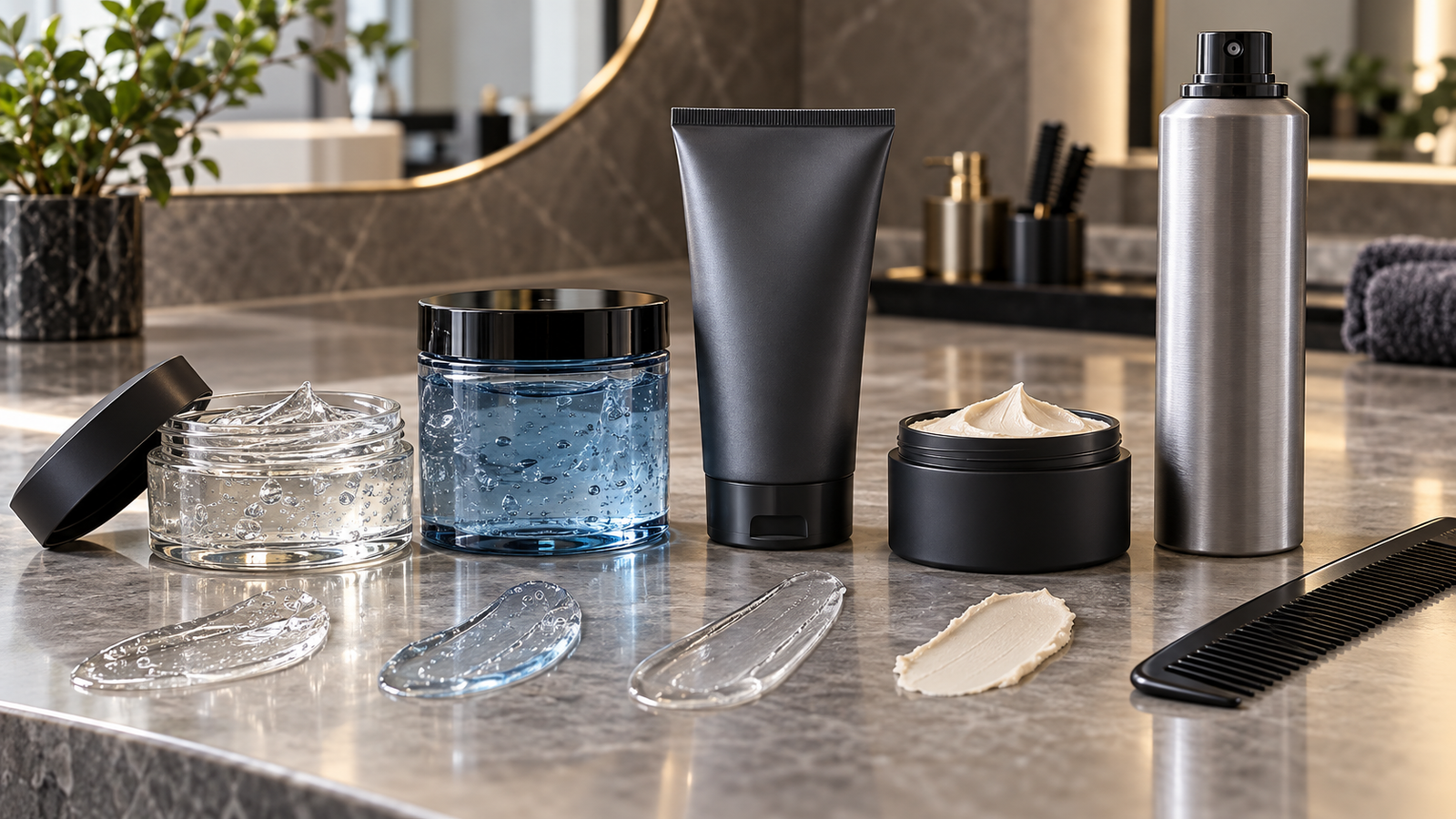
| Styling product | Main role | Typical finish | Restyling ability |
|---|---|---|---|
| Hair gel | Shapes and holds hair as it dries | Matte to glossy | Usually limited after drying |
| Hair wax | Adds texture and separation | Matte to low shine | Often easier to restyle |
| Hairspray | Fixes a finished hairstyle | Usually natural to glossy | Depends on formula |
A gel is useful when you want to shape the hair first and let the product dry into position.
Wax is often better for flexible texture.
Hairspray is usually applied after styling to help keep the finished shape in place.
Hair gel vs pomade
Pomades are commonly used for smooth, controlled hairstyles and may provide more flexibility than gel.
A traditional pomade can create:
- Shine.
- Slickness.
- Separation.
- Restylable hold.
Gel usually dries more firmly.
If you want a hairstyle that stays fixed, gel may be more suitable.
If you want to reshape the hair throughout the day, a wax or pomade may be easier to work with.
Why hair type matters
The amount and type of hold you need depends partly on your hair.
Fine hair
Fine hair can be weighed down easily.
A heavy layer of strong gel may make it look flat or separated into stiff sections.
A lightweight or medium-hold formula may be more practical.
Use small amounts and build gradually.
Thick hair
Thick hair may need stronger hold to maintain a structured style.
A stronger gel can help with:
- Controlling volume.
- Holding the sides in place.
- Maintaining shape.
However, very thick hair may also require more product, which makes washout and residue more important.
Curly hair
Gel is commonly used in curly-hair routines because it can help preserve curl shape while the hair dries.
A gel may create a temporary hard “cast.”
Once the hair is fully dry, some users gently scrunch the curls to soften that cast while keeping the curl definition.
Choose according to:
- Curl pattern.
- Desired definition.
- Humidity.
- How much stiffness you tolerate.
Wavy hair
Wavy hair may need less product than tightly curled hair.
A lighter gel can help define waves without making them heavy.
Apply gradually and assess the result after the hair dries.
Coarse hair
Coarse hair may benefit from stronger hold and formulas that do not make the hair excessively dry.
If your hair already feels rough, look at the overall formula rather than choosing purely by hold level.
Short hair vs long hair
Short hair
Short hairstyles can often tolerate stronger gels because less hair needs to be coated.
Gel can help with:
- Spikes.
- Structured texture.
- Side-part styles.
- Slicked-back looks.
Medium-length hair
Medium hair may benefit from a balance between hold and flexibility.
Too much strong gel can make the style appear overly stiff.
Long hair
Gel is usually used more selectively on long hair.
Common uses include:
- Flyaway control.
- Slick ponytails.
- Curl definition.
- Hairline control.
Coating all long hair heavily in strong gel can make washing and detangling more difficult.
Should gel be applied to wet or dry hair?
Both can work, but the result is different.
Damp hair
Applying gel to damp hair usually produces:
- More even distribution.
- Softer definition.
- Less concentrated stiffness.
- Better curl clumping.
This is common for curly or wavy styling.
Dry hair
Applying gel to dry hair usually gives:
- Stronger localised control.
- More definition.
- Greater ability to shape short hair.
- More noticeable product texture.
For strong, sculpted styles, dry or nearly dry hair may be more suitable.
Follow the directions for the specific gel.
How much hair gel should you use?
Start with less than you think you need.
Too much gel can cause:
- Heavy buildup.
- Visible flakes.
- Excessive stiffness.
- Hair clumping.
- Difficult washout.
- An overly wet appearance.
For short hair, begin with a small amount and spread it evenly between your palms before applying.
For longer or curly hair, distribute product section by section if needed.
Add more only if necessary.
Why rubbing gel between your hands helps
Spreading gel between the palms before applying can help distribute it more evenly.
This reduces the chance of one section receiving a large blob of product.
For curls, however, some users prefer techniques such as:
- Praying hands.
- Scrunching.
- Raking.
- Glazing over the surface.
The best technique depends on the hairstyle.
What does washout mean?
Washout refers to how easily the styling product comes out of the hair during cleansing.
Some gels rinse out easily with water and a mild shampoo.
Others may leave more residue because of:
- Strong film-forming polymers.
- Heavy waxes.
- Silicones.
- Oils.
- Repeated application.
If you style your hair daily, washout becomes an important buying factor.
Water-soluble gel
Some gels are designed to dissolve relatively easily with water.
These can be convenient for frequent styling.
A water-soluble formula may reduce the need for aggressive shampooing.
However, “water-based” does not automatically mean zero residue.
Always judge the actual product.
Why some gels flake
Flaking can happen when dried product breaks into visible particles.
Possible causes include:
- Applying too much.
- Reworking the hair after the gel has dried.
- Layering incompatible products.
- Product buildup.
- Certain gel formulations.
- Friction from touching the hair.
White flakes are not necessarily dandruff.
If flaking happens only after styling, product residue may be the cause.
Product layering and gel
Hair gel is sometimes layered over:
- Leave-in conditioner.
- Curl cream.
- Heat protectant.
- Styling mousse.
Layering can work well, but some combinations can create:
- Pilling.
- Flaking.
- Stickiness.
- Reduced hold.
If you are trying a new gel, test it with a simple routine first.
That makes it easier to understand how the gel behaves by itself.
Can hair gel dry out the hair?
Some gels may leave hair feeling dry, especially if:
- The formula contains ingredients your hair does not tolerate well.
- You use a large amount.
- You wash aggressively every day.
- Your hair is already dry or damaged.
However, not every gel is drying.
Many modern formulas also contain conditioning or humectant ingredients.
Judge the complete product rather than assuming that all gels are harsh.
Alcohol in hair gel
The word “alcohol” can cause confusion.
Different alcohols serve different purposes.
Some volatile alcohols can help a product dry quickly.
Fatty alcohols such as cetyl alcohol and stearyl alcohol are generally used for texture and conditioning.
Do not assume every ingredient containing “alcohol” will dry the hair.
Look at the complete formulation.
Fragrance in styling products
Hair gels often contain fragrance.
If you like scented styling products, this may not be a problem.
However, fragrance can be an issue for some people with:
- Sensitive scalps.
- Fragrance sensitivity.
- Certain scalp conditions.
If your scalp becomes itchy or irritated after using a gel, stop using it and assess whether the product may be contributing.
Hair gel and scalp contact
Gel is mainly intended for the hair.
You do not usually need to coat the scalp heavily.
Repeated buildup on the scalp can make the hair feel greasy or uncomfortable.
When possible, focus application on the hair itself unless the product is specifically designed for scalp styling.
Can gel cause hair loss?
Hair gel itself should not automatically be blamed for hair loss.
However, styling habits can contribute to problems.
For example:
- Pulling the hair into very tight styles.
- Repeatedly brushing through hardened gel.
- Aggressive washing.
- Breaking hair while restyling.
These can increase breakage or stress on the hair.
Hair shedding from the root has many possible causes and should not be assumed to come from a styling product without evidence.
Hair gel for slick-back hairstyles
For a slick-back look, consider:
- Strong or medium-strong hold.
- Smooth application.
- Shine level.
- Resistance to humidity.
- Whether the gel dries too hard.
Apply to slightly damp or dry hair, depending on the product.
Use a comb to distribute the hair evenly.
Avoid pulling the hairstyle excessively tight.
Hair gel for curls
For curls, look at:
- Hold strength.
- Cast formation.
- Humidity resistance.
- Flaking.
- Compatibility with leave-in products.
A stronger cast can sometimes help curls maintain definition longer.
After the hair is completely dry, gently softening the cast can create a less rigid feel while preserving the shape.
Hair gel for flyaways
You usually need very little gel for flyaways.
Apply a small amount with:
- Fingertips.
- A clean brush.
- A fine comb.
Using too much around the hairline can make the hair appear greasy or overly stiff.
Hair gel for humid weather
Humidity can cause some hairstyles to lose definition.
A gel with stronger film-forming performance may help.
However, humidity resistance varies between formulations.
Marketing terms such as “humidity proof” or “24-hour hold” should be treated as product-specific claims rather than guaranteed outcomes for every hair type and climate.
What does “24-hour hold” mean?
Long-wear claims usually come from manufacturer testing.
The claim does not mean the hairstyle will look identical for every person for exactly 24 hours.
Real-world performance depends on:
- Hair type.
- Amount used.
- Humidity.
- Sweat.
- Physical activity.
- Headwear.
- Touching or brushing the hair.
Use these claims as comparative information, not a guarantee.
How often should you wash out hair gel?
There is no single schedule.
Wash when:
- Product buildup becomes noticeable.
- The scalp feels uncomfortable.
- Hair becomes stiff or dull.
- You need a clean base for restyling.
If you apply significant amounts of gel every day, regular cleansing is useful to prevent excessive buildup.
You do not necessarily need a very harsh shampoo.
Choose a cleansing routine appropriate for your hair and scalp.
Clarifying shampoo and styling-product buildup
A clarifying shampoo can help remove heavier styling residue periodically.
It may be useful if:
- Hair feels coated even after normal washing.
- Products stop behaving as expected.
- You use several styling products frequently.
Clarifying shampoos can be more cleansing than regular shampoos, so they may not be ideal for daily use, especially on dry hair.
Hair gel and heat styling
Hair gel should not automatically be treated as a heat protectant.
If you use:
- Hair dryers.
- Straighteners.
- Curling irons.
Use a dedicated heat-protection product if appropriate.
Check whether your gel is designed to be used before heat.
Do not assume that because a product is applied to the hair, it provides thermal protection.
Common mistakes when using hair gel
Using maximum hold for every hairstyle
Strongest is not always best.
Choose the hold required for the style.
Applying too much product
Excess gel increases stiffness, residue and flaking.
Constantly touching the hair after it dries
This can break the gel film and create flakes.
Applying new gel over several days of buildup
Repeated layers can make the hair dull and difficult to wash.
Ignoring the finish
A wet-look gel can appear very different from a matte gel, even if their hold is similar.
Treating gel as heat protectant
Use the correct product for heat styling.
Brushing through fully hardened gel aggressively
This can increase hair breakage.
How to compare hair gels before buying
Use a practical checklist.
| Factor | What to check |
|---|---|
| Hold | Light, medium, strong or ultra |
| Finish | Matte, natural, glossy or wet look |
| Hair type | Fine, thick, curly, wavy or coarse |
| Restylability | Does it dry hard or stay flexible? |
| Washout | Easy rinse or more persistent buildup? |
| Flaking | Are there reports or indications of residue? |
| Fragrance | Important if you are sensitive to scent |
| Bottle size | Useful for price comparison |
| Application | Damp hair, dry hair or both |
| Other products | Compatibility with leave-ins or creams |
How to choose by hairstyle
For a natural everyday look
Choose light to medium hold with a natural or matte finish.
For slick-back styles
Choose medium to strong hold with natural or glossy finish depending on preference.
For curls
Choose a gel that provides enough hold for definition without excessive flaking.
For spikes or structured short hair
Choose strong or extra-strong hold.
For flyaway control
A small amount of medium-hold gel is often enough.
For flexible texture
Wax or pomade may be more suitable than a hard-drying gel.
Frequently asked questions
Is strong-hold gel bad for hair?
Not automatically.
Problems are more likely to come from excessive buildup, aggressive styling or rough removal than from the hold category itself.
Can I use hair gel every day?
Yes, if the product suits your hair and scalp and you cleanse buildup appropriately.
Monitor for dryness, irritation or excessive breakage.
Is matte gel better than glossy gel?
Neither is better.
They create different visual finishes.
Choose according to the hairstyle you want.
Can I sleep with hair gel in?
Occasionally doing so is unlikely to be a major issue, but dried styling products can transfer to bedding and create friction.
If you use heavy amounts of gel, washing or refreshing the hair before sleep may be more comfortable.
Does hair gel make hair thicker?
Gel can make hair appear fuller by adding structure or separating strands, but it does not necessarily increase actual hair density.
Why does my gel turn white?
This can happen because of excess product, dried residue or incompatibility with another styling product.
Try using less product and simplifying the layers underneath.
Can I apply oil over hair gel?
Applying oil after a strong gel can disrupt the hold and create uneven texture.
If you want shine, choose a gel or styling product designed for that finish.
Is gel better than wax?
Gel is better for fixed, structured hold.
Wax is often better for flexible, restylable texture.
The best choice depends on the hairstyle.
Choosing the right gel for your routine
Start with the style you actually wear.
Then choose the minimum hold strength needed to keep that style in place.
After that, compare finish, washout and comfort.
A strong glossy gel may be ideal for a slicked-back style but excessive for a casual textured look. A light matte gel may feel comfortable for everyday use but may not hold thick hair in place.
The most practical product is one that gives you the appearance you want without forcing you to use excessive amounts or making your hair difficult to wash.
Physical Glow’s Top 5 Strong-Hold Hair Gels, Sprays and Wax Products in India comparison looks at several hold levels and styling formats. Use that comparison alongside this guide, then check the current hold claim, finish, product size and usage directions for the exact styling product you are considering.