How to Choose the Right Mascara: Length, Volume and Curl Explained
Mascara looks like a simple makeup product, but the differences between formulas and brushes can change the final result considerably.
One mascara may separate and define every lash. Another may create a thicker, fuller appearance. Some are designed to help lashes hold a curl, while others focus on dramatic length.
The challenge is that words such as lengthening, volumising, curling and defining can all appear on similar-looking tubes.
The easiest way to choose mascara is to start with the result you want.
Think about:
your natural lashes → the effect you want → the brush → the formula → how you want it to wear
Once those are clear, choosing between mascaras becomes much easier.
First Decide What You Want Mascara to Do
Before looking at formulas or wand shapes, decide what you would most like to change about the appearance of your lashes.
You may want:
- more visible length;
- fuller-looking lashes;
- better separation;
- stronger curl;
- more definition;
- a natural everyday effect;
- or a more dramatic finish.
You do not necessarily need one mascara that claims to do everything.
A formula that performs one or two jobs particularly well may suit you better than a product promising extreme length, volume, curl and definition at the same time.
Lengthening Mascara
Lengthening mascaras are designed to make lashes appear longer and more extended.
They usually focus on coating individual lashes from root to tip without adding excessive bulk.
They can work especially well if your lashes already have reasonable density but look short or difficult to see.
What to look for
Lengthening mascaras often have:
- narrower brushes;
- closely spaced bristles;
- comb-like applicators;
- lighter formulas;
- strong lash separation.
The aim is usually to define individual lashes rather than build a very thick layer around them.
Who may prefer it?
Lengthening mascara may suit you if:
- your lashes are naturally short;
- you want a cleaner, more separated look;
- heavy mascara tends to make your lashes clump together;
- you prefer definition over dramatic thickness.
Volumising Mascara
Volumising mascara is designed to make lashes appear fuller and denser.
Instead of focusing mainly on extending the lash, the formula usually deposits more product around it.
This can make the lash line look thicker and more prominent.
What to look for
Volumising mascaras often use:
- larger brushes;
- dense bristles;
- richer formulas;
- brushes designed to collect more product.
Some formulas become increasingly dramatic as additional coats are applied.
Who may prefer it?
Volumising mascara can be useful if:
- your lashes look sparse;
- you want a stronger lash line;
- you prefer more dramatic eye makeup;
- you want lashes to appear thicker rather than simply longer.
However, very rich formulas can become clumpy if too much product is applied at once.
Starting with a thin coat and building gradually usually gives you more control.
Curling Mascara
Curling mascara is designed to emphasise upward lift and help lashes appear more open and raised.
This can be particularly useful if your lashes naturally point downward or lose their curl quickly.
What to look for
Curling mascaras may use:
- curved brushes;
- lightweight formulas;
- formulas designed to set relatively quickly;
- brushes that help lift lashes from the root.
The wand alone does not create all of the curl, but its shape can make it easier to reach and lift the lashes while applying the product.
Do you still need an eyelash curler?
Not necessarily, but a lash curler can create a stronger initial lift before mascara is applied.
If you use one, curl your lashes before applying regular mascara unless the curler manufacturer specifically states otherwise.
Trying to curl lashes once mascara has dried can cause the lashes to stick to the tool or place unnecessary stress on them.
Defining Mascara
Defining mascara focuses on making individual lashes easier to see without necessarily creating extreme length or volume.
It is often a good choice for natural-looking makeup.
These mascaras generally aim to:
- separate lashes;
- reduce clumping;
- give moderate colour;
- maintain a relatively lightweight finish.
If you dislike the appearance of very thick mascara, a defining formula may be a better starting point.
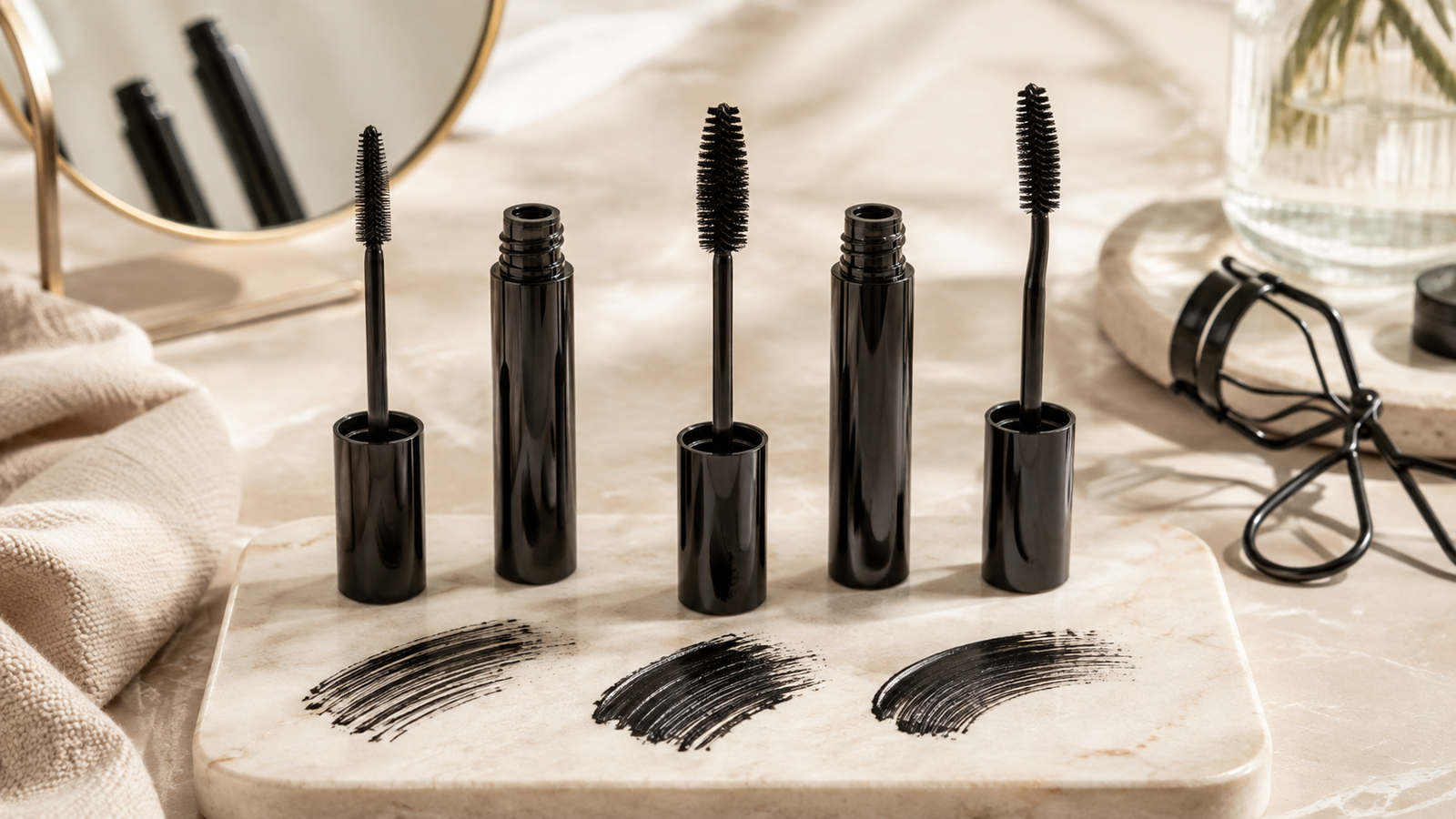
What Does the Mascara Wand Actually Do?
The brush is one of the most important parts of mascara performance.
Two formulas can behave very differently simply because their applicators distribute the product differently.
Large, Full Brushes
Large brushes usually carry more product.
They are often associated with volumising mascaras because they can coat many lashes quickly and build thickness.
They may be less convenient if:
- your eyes are small;
- your lashes are very short;
- you frequently get mascara on your eyelids.
Slim Brushes
Slim brushes provide more control and can make it easier to reach short lashes.
They may work well for:
- lengthening;
- separation;
- lower lashes;
- precise application.
They can also be useful for beginners because you can more easily see where the brush is going.
Curved Brushes
Curved brushes are designed to follow the shape of the lash line.
They can help lift lashes while coating them and may be particularly useful when curl is a priority.
Try positioning the curve so it follows the natural arc of your lashes.
Hourglass Brushes
Hourglass-shaped brushes are narrower through the centre and fuller at the ends.
They are often designed to combine volume and definition by reaching different parts of the lash line.
Whether you like this shape depends largely on your eye shape and how much product you prefer to apply.
Comb-Style Brushes
Comb-like brushes use short, defined teeth rather than fluffy bristles.
They can be useful for separating lashes and controlling clumps.
These brushes often work well when you want:
- length;
- precision;
- separation;
- a cleaner finish.
Rubber or Silicone Brushes
Some mascara wands use moulded rubber or silicone bristles.
They often provide very consistent spacing and can help comb through the lashes.
Many people find them useful for definition and separation, although performance still depends heavily on the formula.
Traditional Bristle Brushes
Traditional fibre brushes can hold a significant amount of mascara and are common in volumising formulas.
They can create a softer, fuller effect but may require more care if the brush carries too much product.
Neither type is automatically better.
The best brush is simply the one that distributes the formula in the way you prefer.
Waterproof vs Regular Mascara
One of the biggest decisions is whether you actually need a waterproof formula.
Regular mascara
Regular mascara is usually easier to remove.
It can be suitable for everyday use if you do not regularly experience:
- watery eyes;
- heavy humidity;
- rain exposure;
- situations where makeup needs exceptional resistance.
Waterproof mascara
Waterproof formulas are designed to resist moisture more effectively.
They can be useful for:
- weddings;
- humid weather;
- swimming or water exposure;
- watery eyes;
- situations where you need makeup to remain intact for a long period.
The trade-off is removal.
Waterproof mascara generally requires more thorough cleansing, often with an oil-based or dual-phase eye-makeup remover.
Avoid aggressive rubbing around the eye area.
If removal becomes difficult, give the remover time to dissolve the mascara before wiping it away gently.
What Is Tubing Mascara?
Tubing mascaras use polymers that form small flexible coatings around individual lashes.
Instead of behaving exactly like conventional mascara, they create tube-like films around the lashes.
People often like tubing mascara because it can provide:
- good definition;
- resistance to smudging;
- relatively easy removal with warm water depending on the formula.
Tubing mascaras are especially worth considering if traditional mascara tends to transfer beneath your eyes.
However, not every tubing formula gives dramatic volume.
Some focus more on length and separation.
Why Mascara Smudges Under the Eyes
Smudging can happen for several reasons.
Skin oils
Natural oils around the eyes can soften some mascara formulas.
Eye shape
If your lashes touch the skin around your eyes frequently, transfer becomes more likely.
Rich eye creams or concealers
Very emollient products around the eyes can sometimes contribute to mascara movement.
Formula choice
Some mascaras simply resist transfer better than others.
If smudging happens repeatedly, consider:
- using less eye cream immediately around the lash area;
- lightly setting nearby makeup if appropriate;
- trying a tubing or more transfer-resistant formula;
- avoiding excessive coats.
What Causes Mascara to Flake?
Flaking occurs when small dried pieces of mascara fall away from the lashes.
This can happen when:
- too much product is layered;
- the mascara becomes very dry;
- the formula does not flex well with the lashes;
- the tube is old and nearing replacement time.
If a mascara performed well when new but begins flaking significantly later, the formula may simply have dried out.
Should You Use One Coat or Several?
There is no fixed number.
For a natural look, one light coat may be enough.
For more intensity, you can build additional layers.
The key is timing.
Applying another coat while the first is still slightly workable often creates a smoother result than waiting until every layer is completely rigid.
However, repeatedly layering large amounts of mascara can create:
- clumps;
- stiffness;
- flaking;
- very heavy-looking lashes.
Build gradually rather than trying to create the final effect in one heavy application.
How to Apply Mascara More Evenly
A simple technique can improve the result regardless of which mascara you choose.
Step 1: Remove excess product if necessary
If the brush comes out heavily loaded, wipe a small amount against the inner edge of the tube.
Do not repeatedly pump the wand in and out of the tube.
That can introduce more air into the product.
Step 2: Start near the lash roots
Place the brush close to the base of the upper lashes without pressing into the eye.
Step 3: Move upward
Gently wiggle or sweep the brush upward through the lashes.
This helps distribute product from root to tip.
Step 4: Focus on the areas that need more
Instead of applying repeated heavy coats everywhere, add extra product only where you want more volume or length.
Step 5: Separate clumps before the mascara becomes completely dry
If lashes begin sticking together, use the mascara brush or a clean lash comb carefully while the product is still workable.
Should You Apply Mascara to Lower Lashes?
Only if you like the effect.
Lower-lash mascara can add definition and make the eyes appear more framed.
However, it can also increase the chance of:
- smudging;
- transfer;
- a heavier eye look.
A smaller brush or lighter application usually gives you more control.
There is no requirement to apply mascara to both upper and lower lashes.
Brown vs Black Mascara
Black is the most common mascara colour because it creates strong contrast around the eyes.
But brown mascara can create a softer effect.
Black mascara
Usually gives:
- stronger definition;
- greater contrast;
- a more dramatic appearance.
Brown mascara
Can create:
- softer definition;
- a more understated everyday look;
- less contrast on lighter colouring.
There are also coloured mascaras in shades such as navy, burgundy and green.
These are mainly aesthetic choices rather than performance differences.
What If You Wear Contact Lenses?
If you wear contact lenses or your eyes are easily irritated, comfort becomes especially important.
Consider:
- formulas labelled for eye-area use;
- avoiding products that noticeably flake into the eyes;
- replacing mascara regularly;
- keeping the wand and tube clean;
- stopping use if a product repeatedly causes discomfort.
Terms such as “ophthalmologist tested” can provide useful information about testing, but they do not guarantee that every individual will tolerate a product.
If you have persistent eye irritation, it is better to stop using the product rather than trying to make it work.
How Often Should Mascara Be Replaced?
Mascara has a shorter practical lifespan than many other makeup products because the applicator repeatedly moves between the eyelashes and the tube.
Always follow the product’s period-after-opening guidance when provided.
Replace mascara sooner if:
- the smell changes;
- the texture changes substantially;
- it becomes unusually dry;
- the formula causes new irritation;
- the brush or product becomes contaminated.
Do not add water or other liquids to an old mascara to make it usable again.
Should You Share Mascara?
It is better not to share eye makeup such as mascara.
The applicator comes into close contact with the eye area and then returns directly into the product.
Sharing therefore introduces unnecessary hygiene risk.
If mascara is being used professionally on multiple people, disposable applicators and appropriate hygiene practices are important.
How to Choose Mascara for Short Lashes
If your lashes are short, look for:
- lengthening formulas;
- slim brushes;
- comb-style or silicone applicators;
- good separation.
A very large volumising brush may deposit more product than you need and make short lashes harder to define.
How to Choose Mascara for Sparse Lashes
If your lashes appear sparse, volume may be the priority.
Look for:
- volumising formulas;
- brushes that coat the lash roots well;
- buildable texture;
- good separation so added thickness does not become clumpy.
Concentrating some product near the roots can make the lash line appear fuller.
How to Choose Mascara for Straight Lashes
If your lashes naturally point downward, consider:
- curling formulas;
- curved brushes;
- lightweight formulas;
- waterproof or long-wear options if they help your curl remain in place.
An eyelash curler before mascara may also help create more visible lift.
How to Choose Mascara for Naturally Thick Lashes
If your lashes are already thick, you may not need a strong volumising formula.
You might prefer:
- definition;
- length;
- separation;
- a lighter formula.
A comb-style wand can help keep naturally dense lashes from sticking together.
When a Mascara Is Probably Not Right for You
It clumps immediately
The brush may be carrying too much product, or the formula may be richer than you prefer.
It constantly smudges
Try a different wear technology, such as tubing or a more transfer-resistant formula.
Your lashes feel unusually heavy
Use less product or choose a lighter formula.
You cannot remove it without aggressive rubbing
A different formula may fit your routine better.
It flakes into your eyes
Stop using it if the flaking is causing discomfort.
You need several other products just to make it perform acceptably
The mascara itself may simply not suit your lashes or preferences.
A Simple Mascara Checklist
Before buying mascara, ask:
1. What result do I want most?
Length, volume, curl or definition?
2. What are my natural lashes like?
Short, sparse, straight, thick or already curled?
3. What brush shape gives me the control I need?
Large, slim, curved, comb-style or silicone?
4. How much wear resistance do I actually need?
Regular, waterproof or tubing?
5. Do I frequently experience smudging or flaking?
Choose the formula accordingly.
6. Do I want a natural or dramatic result?
This determines how much volume and buildability you need.
7. Can I remove it comfortably?
Performance matters, but so does how easily the product fits into your routine.
The Physical Glow Takeaway
Choosing mascara becomes much easier when you stop looking for one formula that promises everything.
Start with your main goal.
Choose lengthening mascara if you want lashes to look longer and more separated.
Choose volumising mascara if you want a fuller, denser lash line.
Choose a curling formula or curved brush if lift is your priority.
And consider tubing or waterproof formulas when wear resistance matters more than easy removal.
The wand shape, formula and application technique all contribute to the final result.
The best mascara is not necessarily the one that creates the most dramatic lashes. It is the one that gives you the effect you want, wears comfortably and fits naturally into your makeup routine.