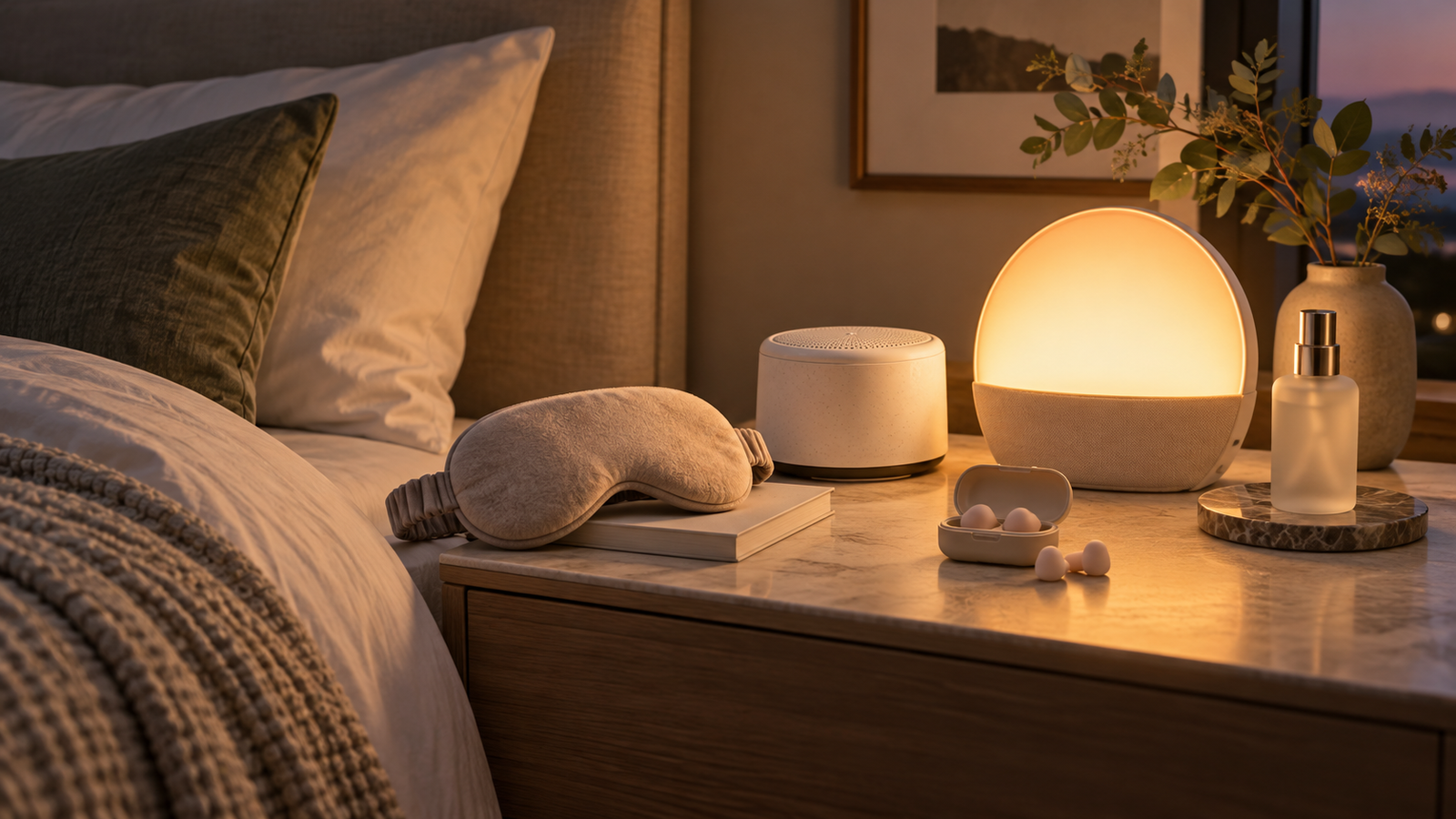
Travel Sleep Kit: Blocking Light and Noise Without Overpacking
Sleeping away from home can be difficult, even when you are physically exhausted.
Hotel corridor lights, unfamiliar pillows, aircraft cabin noise, early-morning sunlight and conversations from neighbouring rooms can all interfere with the conditions you normally associate with sleep.
For frequent travellers, the temptation is to pack an entire collection of sleep accessories: multiple masks, earplugs, a white-noise machine, travel pillow, portable fan and several other products.
However, a practical travel sleep kit does not need to be large, expensive or complicated.
The goal is to identify the specific environmental conditions that disturb your sleep and carry a small number of accessories that address those problems effectively.
For some travellers, a comfortable sleep mask and a properly fitted pair of earplugs may be sufficient. Others may benefit from a compact white-noise device or a pillow that provides better support during long journeys.
This guide explains how to build a lightweight travel sleep kit, choose between different light-blocking and noise-management options, and avoid carrying accessories that provide little practical benefit.
1. Why Sleeping While Travelling Can Be Difficult
Sleep depends on several biological and environmental factors.
Your internal circadian system helps regulate when you feel alert and when you become sleepy.
Light exposure, sleep schedules, environmental noise, temperature and comfort can all influence sleep.
Travel introduces additional complications.
Unfamiliar Lighting
A hotel room may contain:
- Bright hallway light entering beneath the door.
- Illuminated switches.
- Television standby lights.
- Streetlights outside the window.
- Curtains that do not fully block morning sunlight.
Light exposure can interfere with sleep timing and comfort, particularly when it occurs close to bedtime or during the intended sleep period.
Environmental Noise
Travellers commonly encounter:
- Road traffic.
- Aircraft engines.
- Hotel corridors.
- Neighbouring rooms.
- Air-conditioning systems.
- Railway announcements.
- Conversations and movement nearby.
Intermittent sounds may be especially distracting because they are less predictable than continuous background noise.
Uncomfortable Sleeping Positions
Aircraft, trains and buses can make it difficult to maintain a comfortable head and neck position.
Even hotel pillows may feel different from those used at home.
Schedule Disruption
Late arrivals, early departures and changing time zones can interfere with regular sleeping patterns.
A sleep mask or earplugs cannot completely prevent these disruptions.
However, they may help create a more manageable sleeping environment.
2. The Three Essentials of a Travel Sleep Kit
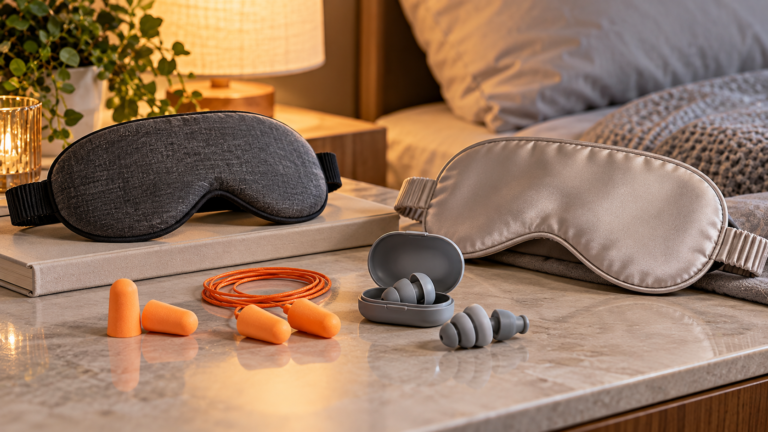
For most travellers, it makes sense to begin with three categories rather than buying every available sleep accessory.
1. A comfortable sleep mask
Helps reduce unwanted light exposure when curtains, windows or cabin lighting are difficult to control.
2. Suitable earplugs
Help reduce the intensity of environmental sounds without requiring electronic equipment or batteries.
3. Optional sound masking
A portable white-noise device or suitable phone-based sound may make intermittent disturbances less noticeable.
These accessories serve different functions.
A mask primarily addresses unwanted light.
Earplugs reduce sound entering the ears.
Sound masking introduces a relatively steady sound that can make other environmental noises less perceptually prominent.
You may not need all three.
3. How to Choose the Right Travel Sleep Mask
Sleep masks differ in shape, material, fastening systems and how effectively they block light.
A mask that appears premium may still be uncomfortable during an overnight flight or while sleeping on your side.
Flat Fabric Masks
Traditional flat masks usually consist of a fabric panel held in place by an elastic strap.
They are often:
- Lightweight.
- Easy to fold.
- Affordable.
- Convenient to wash, depending on material.
However, some flat masks rest directly against the eyelids and eyelashes.
They may also allow light to enter around the nose.
Contoured Sleep Masks
Contoured masks have shaped eye cups designed to create space between the fabric and the eyelids.
This can make them comfortable for people who dislike pressure around the eyes.
However, their shape may make them slightly bulkier.
A contoured mask is not automatically more effective at blocking light. Fit around the nose and cheeks remains important.
Silk and Satin-Style Masks
Smooth fabrics may feel comfortable against the skin.
However, material softness alone does not determine light-blocking performance.
A thin silk mask may admit more light than a well-designed opaque mask.
What Matters Most?
Prioritize:
- Effective light blocking.
- Comfortable contact around the eyes.
- An adjustable or appropriately sized strap.
- Minimal pressure on the eyeballs.
- Suitability for your usual sleeping position.
- Easy cleaning and storage.
A comfortable mask you can wear throughout the night is generally more useful than a premium mask that you repeatedly remove.
4. How to Test a Sleep Mask Before Travelling
Avoid using a new sleep mask for the first time during an important overnight journey.
Test it at home.
Step 1: Wear It in a Normally Lit Room
Put on the mask and check for light leakage.
Pay attention to gaps around the nose.
Step 2: Adjust the Strap
The mask should remain in place without excessive pressure.
A very tight strap may cause discomfort or leave noticeable marks.
Step 3: Lie in Your Usual Sleeping Position
If you sleep on your side, check whether the mask shifts when your face touches the pillow.
Step 4: Wear It for 20–30 Minutes
Notice whether the fabric becomes uncomfortable, warm or irritating.
Step 5: Check Eyelid Comfort
The mask should not press painfully against your eyes.
People with recent eye surgery, eye injuries or relevant eye conditions should seek appropriate clinical guidance before using pressure-producing eye accessories.
A short home test can prevent carrying a mask that looks good but is unsuitable for sleeping.
5. Foam vs Silicone vs Reusable Earplugs
Earplugs are one of the smallest sleep accessories you can carry.
However, their effectiveness depends heavily on fit.
Different designs have different advantages.
| Earplug type | Main advantage | Main limitation | Travel suitability |
|---|---|---|---|
| Disposable foam | Can provide substantial sound attenuation when correctly fitted | May be difficult to insert correctly | Often good |
| Reusable silicone flange | Convenient for repeated use | Fit varies by ear-canal shape | Good |
| Moldable silicone putty | Forms a seal over the ear opening | Requires correct placement and hygiene | Good for some users |
| Custom-molded earplugs | Personalized fit | Higher cost and specialist fitting | Useful for frequent users |
| Electronic sleep earbuds | Can provide audio or masking | Battery, fit and cost considerations | Depends on user |
No earplug type is universally best.
A properly fitted basic foam earplug may reduce sound more effectively than an expensive reusable model that does not seal your ear canal.
6. Understanding Noise Reduction Ratings
Some earplugs display a Noise Reduction Rating, or NRR, expressed in decibels.
Others may use a Single Number Rating, or SNR, under different testing standards.
These values describe laboratory-tested attenuation under specified conditions.
They are not simple promises about real-world noise reduction.
For example, an earplug with an NRR of 30 dB does not necessarily reduce every environmental sound by exactly 30 dB when worn by a particular person.
Actual performance depends on:
- Correct insertion.
- Ear-canal anatomy.
- Earplug size.
- Movement during sleep.
- Frequency characteristics of the sound.
- Whether the seal remains intact.
Laboratory ratings should not be directly compared across different testing systems without considering how they are determined.
Why Fit Matters More Than Marketing Numbers
A small gap between the earplug and ear canal can substantially reduce attenuation.
This is why correct insertion is essential.
For disposable foam earplugs, follow the manufacturer’s method for compressing, inserting and allowing them to expand.
Do not force an earplug deeply into the ear canal.
If insertion causes pain, stop.
7. Can Earplugs Block All Noise?
No.
Earplugs reduce sound; they do not create complete silence.
Low-frequency rumbling, vibrations and certain loud sounds may remain audible.
For example, you may still hear parts of an aircraft engine’s low-frequency sound even while wearing well-fitted earplugs.
This does not automatically mean the earplugs are defective.
A Safety Consideration
Earplugs may also reduce your ability to hear:
- Alarms.
- Emergency announcements.
- Someone calling for help.
- Important travel instructions.
When sleeping in a hotel, train or aircraft, consider whether reduced sound awareness creates a safety concern.
Never intentionally block essential safety signals.
For people with hearing impairment or other relevant conditions, suitability should be evaluated individually.
8. How to Use Earplugs Hygienically
Travel introduces dust, shared surfaces and limited washing facilities.
Earplug hygiene matters, particularly when products are reused.
Disposable Foam Earplugs
Follow the manufacturer’s single-use or replacement instructions.
Do not assume a visibly dirty or deteriorated foam earplug remains suitable for repeated use.
Reusable Earplugs
Clean and dry them as instructed.
Store them in a clean case.
Avoid placing uncovered earplugs directly inside a pocket or travel bag.
When to Avoid Earplugs
Seek medical advice before using earplugs if you have:
- Active ear infection.
- Significant ear pain.
- Ear discharge.
- Recent ear surgery.
- A known ear-canal injury.
- Recurrent problems associated with earplug use.
Do not insert earplugs into a painful or inflamed ear.
9. Earplugs vs White Noise: Which Is Better for Travel?
Earplugs and white noise work differently.
Earplugs reduce sound entering the ear.
White noise and related masking sounds introduce a steady acoustic background.
Masking may reduce the contrast between background sound and intermittent disturbances.
For example, a quiet hotel room with occasional hallway noise may feel more distracting than a room with a soft, steady fan sound.
However, masking does not remove the unwanted noise.
It simply changes the sound environment.
| Factor | Earplugs | White-noise machine |
|---|---|---|
| Main function | Reduces sound reaching the ear | Masks or reduces the prominence of some sounds |
| Requires power | Usually no | Usually yes |
| Adds sound | No | Yes |
| Storage | Very compact | Varies |
| Fit concerns | Important | Not worn in the ear |
| Possible disturbance | Ear discomfort, reduced sound awareness | Volume may bother others |
| Best use | Reducing environmental sound | Managing intermittent noise perception |
Can You Use Both?
Some people combine earplugs with low-level background sound.
However, it is not necessary for everyone.
Using multiple sound-management tools can complicate your travel routine.
Start with one method and add another only if it provides a clear benefit.
10. Do You Need a Portable White-Noise Machine?
A dedicated white-noise machine can be convenient, but it is not essential for every traveller.
Before purchasing one, consider whether you already have an appropriate option.
Dedicated White-Noise Machine
Potential advantages include:
- Physical controls.
- Consistent sound playback.
- No need to keep a phone screen active.
- Multiple sound options on some models.
Limitations may include:
- Additional luggage space.
- Battery charging.
- Power adapters.
- Another device to maintain.
Smartphone White-Noise Application
A smartphone may provide similar sound playback without requiring another physical device.
However, consider:
- Battery consumption.
- Notification interruptions.
- Speaker quality.
- Privacy and app permissions.
- Offline availability.
For travel, downloaded or offline-compatible audio is generally more dependable than streaming sounds over an unreliable connection.
Hotel Fan or Air Conditioner
Some people find steady ventilation noise comfortable.
But an air conditioner should not be operated at an uncomfortable temperature solely to generate background sound.
If a room already provides adequate, unobtrusive background sound, a separate masking device may be unnecessary.
11. How Loud Should White Noise Be?
A louder sound is not automatically a better masking sound.
The goal is to make disturbing noises less noticeable while keeping the listening environment comfortable.
A Safer Starting Approach
- Begin at a low volume.
- Place the sound source away from the pillow.
- Increase it only if necessary.
- Avoid sound levels that feel intrusive.
- Do not use maximum volume throughout the night.
Be particularly cautious when using earbuds or headphones for continuous overnight audio.
Prolonged exposure to high sound levels can affect hearing health.
For infants and children, sound-machine placement and volume require additional care. Devices should be kept well away from the sleeping child’s head, with conservative sound levels.
There is no need to create a loud sound environment to achieve a small masking benefit.
12. White Noise vs Pink Noise vs Brown Noise
Sound-masking products often advertise different noise colours.
These refer to different ways sound energy is distributed across frequencies.
White Noise
White noise has equal power per unit of frequency over its defined frequency range.
In practical playback, it often sounds like a broad hiss.
Pink Noise
Pink noise has greater relative energy at lower frequencies than white noise when compared across equal-width frequency bands, with equal energy per octave in its idealized form.
It may sound softer or deeper.
Brown Noise
Brown or Brownian noise emphasizes lower frequencies more strongly.
It is often perceived as a deeper rumbling sound.
Is One Scientifically Proven to Be Best for Sleep?
There is insufficient evidence to establish one noise colour as universally superior for sleep.
Some people prefer pink or brown noise because they find it less harsh.
Others prefer fan sounds or other steady background audio.
The most useful choice is usually a comfortable sound that does not disturb you or anyone sharing the room.
13. Should You Pack a Travel Pillow?
A travel pillow can be useful during journeys involving prolonged sitting, but it is not always necessary.
Its value depends on transport type, seat design and sleeping position.
Neck Pillows
Many travel pillows are U-shaped.
They aim to provide head and neck support when sleeping upright.
However, the shape may not fit every traveller.
Some pillows push the head forward, which can be uncomfortable.
Inflatable Travel Pillows
Inflatable models may be compact when packed.
Their firmness can often be adjusted by changing the amount of air.
However, they may be less durable or convenient for some users.
Memory-Foam Travel Pillows
These can provide a more structured feel.
However, they may be bulkier and heavier.
When to Skip the Pillow
A dedicated pillow may be unnecessary if:
- Your journey is short.
- The seat already provides suitable support.
- You rarely sleep during transport.
- Packing space is extremely limited.
- You find neck pillows uncomfortable.
Test the pillow while sitting in a position similar to your travel seat.
Do not assume that a pillow recommended online will suit your neck.
14. What Belongs in a Minimal Travel Sleep Kit?
A lightweight kit should focus on proven personal usefulness rather than collecting accessories.
Minimal kit for most adult travellers
Sleep mask
Core
A comfortable, light-blocking mask that fits your face.
Earplugs and protective case
Core
A type that fits comfortably and reduces unwanted noise.
Downloaded masking audio
Optional
Useful if you prefer a steady background sound.
Travel pillow
Optional
Consider for longer journeys involving seated sleep.
Small storage pouch
Useful
Keeps clean sleep accessories organized.
You do not need a separate pouch for every accessory.
A small, clean, easily accessible section of your carry-on may be enough.
15. Build Your Kit Based on Travel Type
Different journeys create different sleep challenges.
| Travel situation | Main challenge | Useful starting kit |
|---|---|---|
| Overnight flight | Cabin light and engine noise | Mask, suitable earplugs, optional neck pillow |
| Train journey | Announcements, light and movement | Mask, earplugs with safety awareness |
| Hotel stay | Corridor noise and light leakage | Mask, earplugs, optional sound masking |
| Road trip as passenger | Light and seated positioning | Mask, suitable support if safe |
| Business travel | Changing rooms and schedules | Compact mask and reusable earplugs |
| Backpacking | Weight and packing volume | Minimal mask and earplugs |
| Long international trip | Schedule disruption and unfamiliar environment | Core kit plus individualized sleep-planning strategies |
For people travelling with children, older adults or someone requiring overnight care, maintaining awareness of important sounds may take priority over maximum noise reduction.
16. Sleep Kit for Flights: What Actually Helps?
Aircraft introduce several sleep difficulties at once.
Cabin lighting, limited reclining space, noise and interruptions can all interfere with rest.
Before Boarding
Keep your mask and earplugs accessible rather than packed deep inside checked luggage.
Wear comfortable clothing appropriate to the cabin conditions.
During the Flight
Once it is appropriate and safe to sleep:
- Adjust your seat position.
- Use a comfortable sleep mask.
- Insert earplugs correctly if suitable.
- Use neck support if it improves comfort.
- Keep essential belongings secure.
- Remain able to follow crew instructions and safety requirements.
What About Noise-Cancelling Headphones?
Active noise cancellation can be effective for certain low-frequency, continuous sounds, including parts of aircraft cabin noise.
However, over-ear headphones are bulky and may be uncomfortable for side sleeping.
Noise cancellation is also not equally effective for all sound frequencies.
If you already own comfortable headphones, they may be useful during travel without requiring a separate purchase.
For sleeping, fit and comfort are as important as technical specifications.
17. Hotel Sleep: Start With the Room Before Using Accessories
A sleep kit can help, but changing the room environment may be even more effective.
Reduce Unwanted Light
Try:
- Closing curtains fully.
- Turning off unnecessary lights.
- Covering small indicator lights when safe and permitted.
- Moving away from bright screens before bedtime.
- Using your sleep mask when complete darkness is impractical.
Do not cover ventilation openings, safety indicators or emergency equipment.
Reduce Avoidable Noise
Where possible:
- Close windows if outdoor noise is disruptive.
- Request a quieter room away from lifts or busy corridors.
- Adjust unnecessary device notifications.
- Choose a comfortable air-conditioning setting.
Maintain Comfortable Temperature
A room that is too hot or too cold can interfere with comfort.
Use a suitable temperature and bedding combination rather than relying on noise or light accessories to solve every sleep problem.
Protect Your Sleep Schedule
A reasonably consistent bedtime and wake time can help, particularly during short trips without major time-zone changes.
For significant jet lag, sleep timing and light exposure may be more important than the accessories you pack.
18. The Overpacking Problem: Five Accessories You May Not Need
Multiple Sleep Masks
Carry one mask that fits reliably.
A backup may be worthwhile for long trips, but several different masks are usually unnecessary.
Several Types of Earplugs
Test different designs before travelling, then take the one that works best.
A small backup supply is often sufficient.
Large Sound Machines
A compact device or suitable phone application may meet your needs.
A large bedside unit may be impractical for frequent travel.
Oversized Pillows
Large neck pillows can consume valuable luggage space.
Choose one only if you know it improves your comfort.
Unfamiliar Sleep Supplements
Travel inconvenience does not automatically justify using sleep supplements or sedating medicines.
Products such as melatonin have specific considerations relating to timing, dose, interactions and individual circumstances.
Avoid self-medicating simply to compensate for light or noise.
Seek appropriate medical guidance where necessary.
19. How to Pack Sleep Accessories Hygienically
A travel sleep kit should remain clean and easy to access.
Sleep Masks
Follow fabric-care instructions.
Wash reusable masks periodically, particularly when they contact skincare products, sweat or makeup.
Allow the mask to dry fully before storage.
Earplugs
Keep them in a clean case.
Replace disposable types according to their instructions.
Avoid handling insertion surfaces with dirty hands.
White-Noise Devices
Protect charging ports from moisture and debris.
Carry appropriate charging accessories.
Travel Pillows
Use removable, washable covers when available.
Store inflatable pillows dry to reduce unwanted moisture retention.
A compact kit loses its usefulness if accessories become uncomfortable or unhygienic.
20. Choosing Between Comfort, Weight and Cost
The most expensive travel accessory is not necessarily the most useful.
Consider how frequently you travel and which conditions actually disturb your sleep.
| Buying consideration | Why it matters |
|---|---|
| Comfort | Determines whether you keep using the accessory |
| Weight | Important for carry-on and backpack travel |
| Packed size | Affects convenience |
| Durability | Matters for repeated journeys |
| Cleaning | Important for masks and earplugs |
| Replacement costs | Relevant for disposable earplugs |
| Battery dependence | Matters during long journeys |
| Sound attenuation | Important for noise-sensitive travellers |
| Light leakage | Important for masks |
| Price | Should reflect actual use and benefit |
A Sensible Buying Order
For someone building a kit from scratch:
- Start with a comfortable sleep mask.
- Test a suitable pair of earplugs.
- Travel with those accessories at least once.
- Identify any remaining sleep disturbances.
- Consider sound masking or a travel pillow only if needed.
This approach reduces unnecessary purchases.
For broader product comparisons, explore Physical Glow’s Best Sleep Accessories in India: Top 5 for Better Bedroom Comfort guide.
21. Interactive Travel Sleep Kit Planner
Choose the conditions you usually encounter to identify a compact starting kit.
Your travel conditionsMost common journeyHotel staysOvernight flightsTrain journeysMixed travelUnwanted light often disturbs meEnvironmental noise often disturbs meI frequently sleep while seatedPreferred sleep mask typeContouredFlat fabric
Your suggested minimalist kit
- Comfortable contoured sleep mask
- Well-fitted earplugs with a small storage case
Optional addition: low-volume offline sound masking if earplugs alone do not meet your needs.General packing guidance for adults. Maintain awareness of travel safety announcements and any personal care responsibilities.
22. Common Travel Sleep Kit Mistakes
Choosing a Mask That Presses on Your Eyes
A mask should block light without causing painful pressure.
Assuming Expensive Earplugs Always Block More Sound
Fit and correct insertion can matter more than price.
Using Earplugs Without Considering Safety
Reduced sound awareness may be inappropriate in certain travel situations.
Playing White Noise Too Loudly
Higher volume is not automatically more effective or safer.
Buying Every Accessory Before Testing Anything
Start with the main problem and add products selectively.
Ignoring Sleep Schedule Disruption
Light blocking and noise reduction cannot fully resolve jet lag or severe schedule changes.
Using Unfamiliar Sleep Medication
Sedating medicines or supplements may cause adverse effects or interactions and can impair alertness during travel.
Sleeping in an Awkward Position With a Thick Pillow
Neck support should improve comfort, not force the head into an uncomfortable angle.
Forgetting Hygiene
Reusable masks and earplugs need appropriate cleaning.
Carrying Too Many Charging Accessories
Battery-powered sleep devices can make a simple travel kit unnecessarily complicated.
23. When Sleep Accessories Are Not Enough
If you regularly struggle to sleep despite managing light, noise, temperature and routine, the problem may involve more than the travel environment.
Potential issues include:
- Persistent insomnia.
- Significant anxiety or stress.
- Circadian rhythm disruption.
- Sleep-related breathing disorders.
- Medication effects.
- Chronic pain.
- Other medical conditions.
Loud habitual snoring, witnessed pauses in breathing, significant daytime sleepiness or persistent insomnia deserve professional assessment.
Do not rely on sleep masks, earplugs or white noise to address symptoms that may require medical evaluation.
Frequently Asked Questions
What should I include in a basic travel sleep kit?
For many adults, a comfortable sleep mask and well-fitting earplugs are sufficient starting points. A travel pillow or sound-masking option can be added when needed.
Are contoured sleep masks better than flat masks?
Not universally. Contoured masks may reduce eyelid contact, but fit and light leakage determine practical performance.
Do earplugs completely block noise?
No. They reduce sound rather than creating silence. Effectiveness depends on the earplug and correct fit.
Are silicone earplugs better than foam earplugs?
Both can be useful. Foam earplugs may provide substantial attenuation when correctly fitted, while reusable silicone designs may offer convenience.
Is white noise better than earplugs?
They serve different functions. Earplugs reduce incoming sound, while white noise helps mask some environmental disturbances.
Can I use earplugs and white noise together?
Yes, if the combination remains comfortable and does not prevent you from hearing important safety signals.
Is a white-noise machine necessary for travel?
No. A suitable phone application or an existing steady background sound may be sufficient.
Should I sleep with noise-cancelling headphones?
Some people find them useful, but comfort, battery life, fit and awareness of important sounds matter. Bulky headphones may be uncomfortable for side sleeping.
What is the lightest travel sleep kit?
A lightweight fabric mask, suitable earplugs and a small storage case can form a very compact kit.
Can a sleep mask help with jet lag?
A mask can help reduce unwanted light during intended sleep periods, but jet lag also involves circadian timing. Appropriately timed light exposure and sleep scheduling remain important.
Are travel pillows necessary for long flights?
Not for everyone. They may help some travellers sleep more comfortably while seated, but an unsuitable pillow can create neck discomfort.
Is sleeping with earplugs every night safe?
Many people use suitable earplugs regularly without problems, but hygiene, fit, ear health and sound-awareness needs matter. Stop using them if they cause pain or irritation.
Final Verdict: Pack for Your Sleep Problems, Not Every Possible Problem
An effective travel sleep kit should be compact, comfortable and tailored to the conditions that actually disturb your sleep.
A well-fitting sleep mask can reduce unwanted light. Suitable earplugs can make a noisy environment more manageable. Low-volume sound masking may help when intermittent noise remains distracting.
A travel pillow can be useful during seated journeys, but it is not essential for everyone.
The best strategy is to begin with a sleep mask and earplugs, test them under realistic conditions and add other accessories only when they solve a specific problem.
Comfort, hygiene, safety and ease of packing matter more than the number of products in your travel bag.
With a small, carefully chosen kit, you can make unfamiliar sleeping environments more manageable without carrying unnecessary equipment.
Physical Glow Editorial Note: This article provides general sleep and travel-wellness information. Sleep accessories do not replace medical evaluation or treatment of persistent sleep disorders. Earplugs and sound-masking devices should be used with appropriate attention to hearing safety, hygiene and essential travel announcements.