Latex vs Memory Foam Mattress Toppers: Which Material Suits You?
A mattress topper can change the feel of a bed without replacing the mattress itself, but latex and memory foam create very different sleeping experiences.
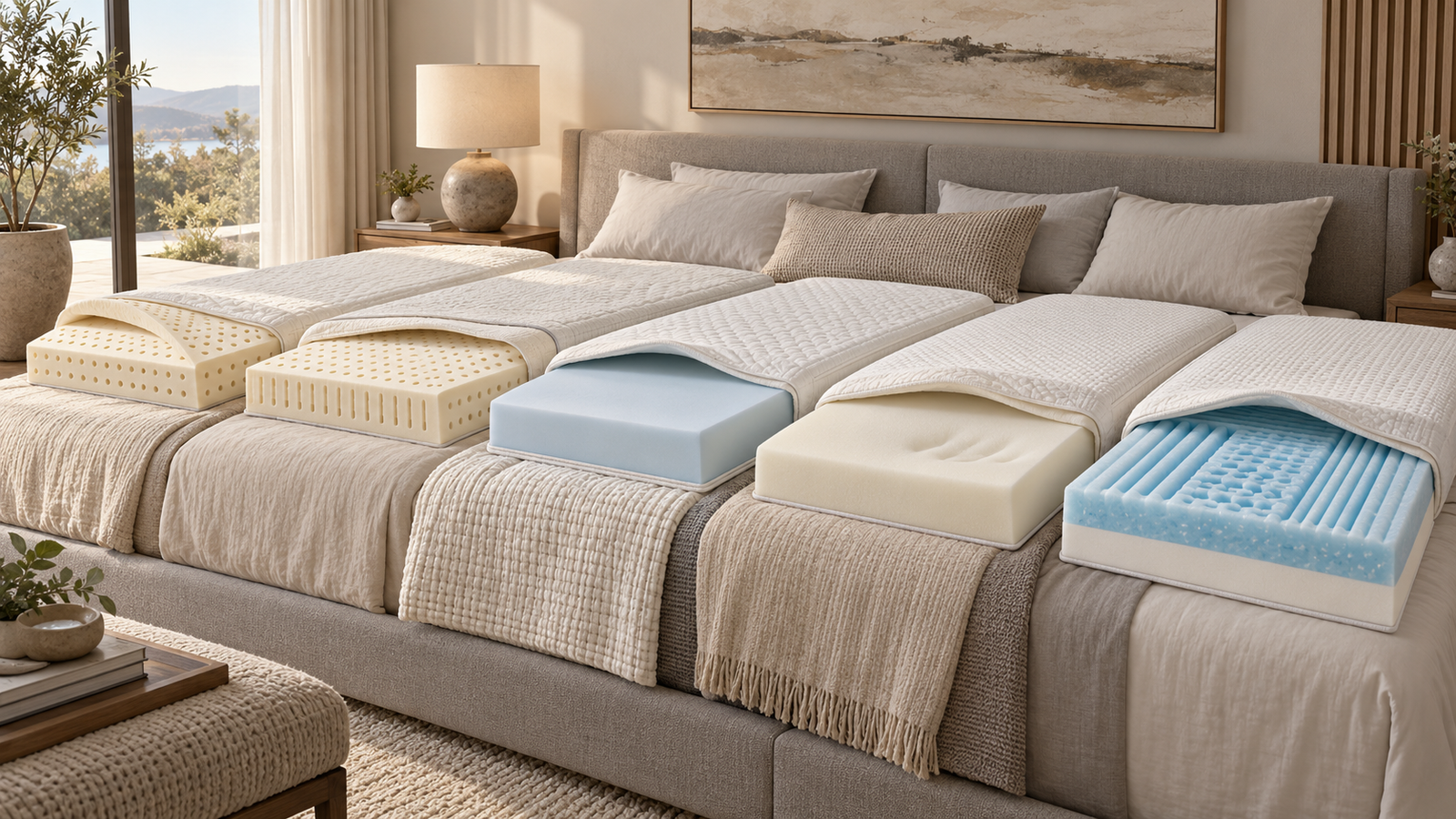
Memory foam is known for deeper contouring and pressure relief, while latex generally feels more responsive, springy and easier to move on. Neither material is automatically better. The right choice depends on whether you prefer a slow, cushioning feel or a more buoyant surface with less sink.
This guide compares latex and memory foam mattress toppers by comfort, support, heat retention, movement, durability and sleeping position so you can choose the material that better matches your bed and sleep preferences.
Latex vs Memory Foam Mattress Toppers at a Glance
| Feature | Latex Topper | Memory Foam Topper |
|---|---|---|
| Feel | Responsive and buoyant | Slow, contouring and cushioning |
| Sink | Usually lower | Usually deeper |
| Ease of movement | Generally easier | Can feel more restrictive |
| Pressure relief | Good with a more lifted feel | Usually stronger contouring |
| Heat retention | Often lower | Can retain more heat |
| Durability | Often very good | Varies significantly by density and quality |
| Weight | Usually heavy | Moderate to heavy |
What Is a Mattress Topper?
A mattress topper is a removable comfort layer placed on top of an existing mattress.
It can change how the bed feels by adding:
- Softness
- Pressure relief
- Surface cushioning
- Additional responsiveness
A topper cannot repair every mattress problem.
If the mattress is deeply sagging, structurally damaged or no longer supportive, adding another layer on top may only mask the issue temporarily.
What Is a Latex Mattress Topper?
A latex topper is made from natural latex, synthetic latex or a blend.
Latex has a springy, elastic feel.
When pressure is removed, it usually returns to shape quickly.
This creates a sleeping surface that conforms somewhat to the body while still providing a noticeable sense of lift.
What Is a Memory Foam Mattress Topper?
Memory foam is a type of polyurethane foam designed to respond to pressure and temperature.
It softens under body weight and gradually contours around the sleeper.
When you move away, the foam slowly returns to its original shape.
This slow response creates the familiar “hugging” sensation associated with memory foam.
Which Feels Softer?
Memory foam usually feels softer and more enveloping at the same nominal firmness.
Latex tends to feel more supportive and springy because it pushes back against the body more quickly.
However, both materials are available in different firmness levels.
A soft latex topper can still feel plush, while a high-density firm memory foam topper can feel relatively supportive.
Which Material Has More Sink?
Memory foam generally allows more noticeable sinking.
This can be comfortable if you enjoy a deeply cushioned bed.
Latex usually lets you remain more “on top” of the surface rather than deeply inside it.
This is one of the most important differences between the materials.
Pressure Relief: Latex vs Memory Foam
Both materials can reduce pressure by spreading body weight across a larger area.
Memory foam
Memory foam usually contours more closely around prominent areas such as:
- Shoulders
- Hips
- Knees
This deep contouring is one reason it is popular with side sleepers.
Latex
Latex also compresses under pressure but provides a more immediate upward response.
You get cushioning without as much of the slow sinking sensation.
Which Is Better for Side Sleepers?
Side sleepers generally need enough surface cushioning around the shoulder and hip to prevent excessive pressure.
A memory foam topper can work well when the existing mattress feels too firm.
A softer latex topper can also provide good pressure relief while maintaining more responsiveness.
Choice depends on whether you prefer deep contouring or a more buoyant feel.
Which Is Better for Back Sleepers?
Back sleepers often prefer a balance between cushioning and support.
Either material can work.
Latex may appeal to users who want:
- Less sink
- Easier movement
- A more supportive surface feel
Memory foam may appeal to users who prefer more contouring around the lower back and hips.
Which Is Better for Stomach Sleepers?
Stomach sleepers generally need to be more careful with very soft, thick toppers.
Too much sink around the hips can make the sleeping position feel less stable.
A firmer or thinner latex topper may be easier to manage than a very plush memory foam layer.
The underlying mattress still plays a major role.
Which Is Easier to Move Around On?
Latex usually wins here.
Because it rebounds quickly, it does not hold the body’s shape for long.
This makes turning from side to side easier.
Memory foam can feel more restrictive because the body sinks into the foam and the material responds more slowly.
Why Responsiveness Matters
Responsiveness describes how quickly a material reacts when you change position.
A responsive topper can be useful if you:
- Change sleeping position frequently
- Dislike feeling stuck
- Prefer a more active surface feel
Latex generally provides greater responsiveness than memory foam.
Which Sleeps Cooler?
Latex usually has an advantage for temperature neutrality.
Its structure tends to allow more airflow and it does not conform as deeply around the body.
Memory foam can trap more heat because:
- The body sinks farther into the material
- Foam can restrict airflow around the body
- Some formulations are more heat-retentive than others
Can Memory Foam Sleep Hot?
Yes, particularly for users who already sleep warm.
Manufacturers may try to reduce this with:
- Open-cell foam
- Perforations
- Gel infusions
- Cooling covers
These features may change the feel, but they do not guarantee that every memory foam topper will sleep cool.
Does Gel Memory Foam Stay Cooler?
Gel-infused foam is often marketed as a cooling material.
It may affect how heat is initially absorbed or distributed, but the overall sleeping temperature still depends on:
- Foam density
- Topper thickness
- Cover material
- Room temperature
- Bedding
- Your own tendency to sleep hot
Do not choose a topper solely because the word “gel” appears in the product name.
Why Latex Often Feels Cooler
Latex tends to feel less enveloping.
Many latex toppers also include perforations that allow some air movement through the material.
This does not mean latex is actively cooling, but it often retains less heat than dense memory foam.
Natural Latex vs Synthetic Latex
Natural latex
Natural latex is produced from rubber-tree sap and processed into foam.
It is often chosen for its durability, elasticity and material composition.
Synthetic latex
Synthetic latex uses man-made rubber compounds designed to imitate some of the properties of natural latex.
It may cost less but can differ in feel and durability.
Blended latex
Blended latex combines natural and synthetic components.
Always check the material specification rather than assuming every product labelled “latex” is fully natural.
Dunlop vs Talalay Latex
You may encounter the terms Dunlop and Talalay when comparing latex toppers.
Dunlop latex
Dunlop processing usually creates a denser, more substantial feel.
Talalay latex
Talalay processing generally creates a more consistent and buoyant foam with a lighter feel.
Neither is universally better.
Availability and pricing may differ significantly.
Memory Foam Density Explained
Density describes how much material is contained in a given volume of foam.
It is not exactly the same as firmness.
Higher-density memory foam may:
- Feel more substantial
- Respond more slowly
- Be more durable
- Retain more heat
However, formulation quality also matters.
Thickness: 2 Inch vs 3 Inch vs 4 Inch
2-inch topper
A thinner topper changes the surface feel without dramatically altering the mattress.
It can be a good choice when the mattress is only slightly too firm.
3-inch topper
This creates a more noticeable change in cushioning and contouring.
It is a common middle ground.
4-inch topper
A thick topper significantly changes the sleeping surface.
It may create excessive sink if the material is soft or if the underlying mattress is already plush.
Does a Thicker Topper Mean More Support?
No.
Thickness mainly determines how much material there is between your body and the mattress.
A thick, soft topper can actually make the bed feel less supportive.
Firmness and material properties matter alongside thickness.
Can a Topper Make a Firm Mattress Softer?
Yes.
This is one of the best uses of a topper.
If the mattress is structurally sound but feels too firm, a softer latex or memory foam topper can add cushioning.
Can a Topper Make a Soft Mattress Firmer?
Only to a limited extent.
A firm topper may slightly change surface feel, but it cannot fully correct a mattress that sags or allows excessive sink underneath.
If the support core has deteriorated, mattress replacement may be more appropriate.
Can a Topper Fix a Sagging Mattress?
No.
A topper follows the surface beneath it.
If the mattress has deep body impressions or structural sagging, the topper can also settle into those depressions.
A topper is a comfort adjustment, not structural repair.
Motion Isolation: Which Is Better?
Memory foam generally performs very well at absorbing movement.
This can be useful for couples when one person changes position frequently.
Latex is bouncier, so slightly more motion may travel across the surface.
However, latex still tends to isolate movement better than highly springy traditional mattress surfaces.
Which Is Better for Couples?
It depends on priorities.
Choose memory foam if you prioritise:
- Motion isolation
- Deep contouring
- Pressure relief
Choose latex if you prioritise:
- Ease of movement
- Lower heat retention
- More bounce
- Responsive support
Edge Support
Neither topper creates true structural edge support by itself.
The underlying mattress determines most of the stability at the edge.
A very soft memory foam topper may compress noticeably when sitting on the side of the bed.
Latex may feel somewhat more stable because it rebounds more quickly.
Which Material Is More Durable?
High-quality latex is generally known for strong durability.
It often maintains its resilience for a long time.
Memory foam durability depends heavily on:
- Density
- Foam quality
- Body weight
- Usage
- Heat and humidity
Low-density foam may soften or develop impressions sooner.
How Long Does a Mattress Topper Last?
There is no fixed lifespan.
A topper may need replacement when it develops:
- Permanent body impressions
- Uneven softness
- Cracks
- Crumbling
- Loss of resilience
Material quality matters more than a universal number of years.
Which Topper Is Heavier?
Latex toppers are often surprisingly heavy because latex foam is dense.
A thick queen- or king-size latex topper can be difficult for one person to move.
Memory foam is also heavy, but comparable latex models are often denser.
Why Topper Weight Matters
A heavy topper can be more difficult to:
- Rotate
- Remove for cleaning
- Move between rooms
- Place correctly on the bed
This is worth considering if you move frequently or live alone.
Do Mattress Toppers Slide?
They can.
Movement is more likely when:
- The mattress surface is very smooth
- The topper has no grip layer
- The fitted sheet is loose
- The topper is smaller than the mattress
A tightly fitted sheet or appropriate non-slip layer can help.
Should the Topper Match the Mattress Size?
Yes.
Choose a topper that matches the actual mattress dimensions as closely as possible.
Do not rely only on labels such as queen or king because dimensions can vary between markets and manufacturers.
Latex Allergy Considerations
People with a known latex allergy should be cautious with natural latex products.
Even when the latex core is covered by fabric, a known allergy deserves appropriate medical advice before use.
Does Latex Smell?
Natural latex can have a noticeable rubber-like odour when new.
This often reduces with ventilation.
How strong the smell feels varies between products and individuals.
Does Memory Foam Smell?
New memory foam can release a temporary manufacturing odour when first unpacked.
This is commonly called off-gassing.
Allowing the topper to air out in a well-ventilated room before sleeping on it can make the smell less noticeable.
How Long Should a New Topper Expand?
Compressed foam toppers may need time to recover their full shape after unpacking.
Follow the manufacturer’s instructions.
Expansion time can vary with:
- Foam type
- Room temperature
- Compression duration
Can You Sleep on a Topper Immediately?
Some products allow it, while others recommend waiting for expansion and ventilation.
Follow the specific instructions rather than assuming every compressed topper behaves the same way.
Do You Put a Mattress Protector Over the Topper?
Usually, yes.
A protector can be placed over both the topper and mattress.
This helps protect the topper from:
- Sweat
- Spills
- Dust
- Body oils
Make sure the fitted protector is deep enough for the combined mattress and topper height.
Can You Wash a Latex or Memory Foam Topper?
The foam core usually should not be machine washed.
Water can be difficult to remove completely and may damage the material.
Instead:
- Use a removable washable cover if provided.
- Spot clean according to the manufacturer’s instructions.
- Allow the foam to dry completely.
Which Material Is Better in Hot Climates?
Latex generally has the advantage because it is more breathable and less enveloping.
In a warm climate, this difference may be especially noticeable if you already sleep hot.
If choosing memory foam, look at:
- Thickness
- Perforation
- Open-cell structure
- Cover material
Which Is Better for Heavier Sleepers?
Heavier sleepers usually compress foam more deeply.
A very soft memory foam topper may therefore create excessive sink.
A firmer latex topper can provide more resistance and quicker rebound.
However, body weight alone should not determine the material. Thickness and firmness remain important.
Which Is Better for Lightweight Sleepers?
Lightweight sleepers may not compress very firm latex enough to experience much cushioning.
A softer latex or memory foam topper may provide more noticeable pressure relief.
Can a Mattress Topper Help Back Pain?
A topper may improve comfort if the current sleeping surface is too firm or creates pressure points.
However, back pain has many possible causes.
A topper should not be treated as a medical treatment or assumed to solve pain caused by injury, posture, medical conditions or a structurally failed mattress.
How to Choose Firmness
Choose softer if:
- Your mattress feels too firm
- You are a side sleeper seeking more cushioning
- You are relatively lightweight
Choose medium if:
- You want some cushioning without deep sink
- You change sleeping positions
- You want a balanced feel
Choose firmer if:
- You dislike deep sink
- You sleep mainly on your stomach or back
- You want more surface resistance
Latex vs Memory Foam for Combination Sleepers
Combination sleepers change positions through the night.
Latex is often easier for this because it responds quickly when you move.
Memory foam can still work if you enjoy contouring, but very soft foam may make repositioning feel slower.
Latex vs Memory Foam for Pressure Relief
| Preference | Better Fit |
|---|---|
| Deep body contouring | Memory foam |
| Pressure relief with less sink | Latex |
| Easy repositioning | Latex |
| Strong motion isolation | Memory foam |
| Cooler, more responsive feel | Latex |
Common Mattress Topper Mistakes
Buying only by thickness
Four inches is not automatically better than two inches.
Trying to fix a sagging mattress
A topper cannot restore a damaged support core.
Ignoring heat retention
A thick memory foam topper may feel warmer than expected.
Choosing very soft foam for stomach sleeping
Too much hip sink can make the sleeping position less comfortable.
Ignoring topper dimensions
A poorly fitting topper can move or leave exposed mattress edges.
Assuming all latex is natural
Check whether the product uses natural, synthetic or blended latex.
How to Choose a Mattress Topper
Consider:
- Latex or memory foam
- Thickness
- Firmness
- Foam density where provided
- Mattress dimensions
- Sleeping position
- Body weight
- Heat sensitivity
- Removable cover
- Material certifications where relevant
For specific current options, see our Top 5 Mattress Toppers in India.
Which Material Should You Choose?
Choose a latex topper if you:
- Prefer a responsive surface
- Dislike deep sinking
- Change sleeping positions frequently
- Sleep warm
- Value long-term resilience
Choose a memory foam topper if you:
- Prefer deeper contouring
- Want stronger motion isolation
- Need more cushioning over a firm mattress
- Like a slower, hugging feel
Frequently Asked Questions
Is latex better than memory foam for a mattress topper?
Neither is universally better. Latex is more responsive and usually cooler, while memory foam provides deeper contouring and stronger motion isolation.
Which topper is better for side sleepers?
Both can work. Memory foam often provides deeper pressure relief, while soft latex provides cushioning with less sink.
Which topper is better for hot sleepers?
Latex generally sleeps cooler because it is less enveloping and often allows more airflow.
Does memory foam become softer with heat?
Yes. Memory foam is temperature sensitive and can soften as it warms from body heat.
Does latex sag?
High-quality latex is generally durable, but any foam can soften or develop wear over time. Quality, thickness and use all matter.
Is a 2-inch topper enough?
It can be if you only want a moderate change in surface comfort. A thicker topper creates a more significant change.
Can a topper fix an old mattress?
It can improve comfort temporarily, but it cannot repair deep sagging or structural support failure.
Final Takeaway
Latex and memory foam mattress toppers solve the same general problem in very different ways.
Memory foam is the better fit if you want deeper contouring, a more cushioned feel and strong motion isolation. Latex is the better fit if you prefer quicker response, easier movement, less sink and generally better temperature neutrality.
Thickness and firmness matter just as much as material. A soft four-inch topper can transform a bed far more dramatically than a firm two-inch layer.
If you are comparing specific products, see our Top 5 Mattress Toppers in India guide for the current latex and memory foam options shortlisted by Physical Glow.
The best topper should correct the comfort problem you actually have. If the mattress is too firm, add cushioning. If you dislike sinking, choose a more responsive material. If the mattress itself is structurally worn out, replacing it may make more sense than adding another layer on top.
Physical Glow publishes educational beauty, fitness and wellness content. This article is for general informational purposes and should not be treated as medical advice or as a treatment for persistent back, neck or sleep-related problems.