What Exercises Can You Do on a Power Tower?
A power tower is one of the most versatile pieces of bodyweight equipment you can add to a home gym. Depending on the design, a single station can support pull-ups, chin-ups, dips, knee raises, leg raises, push-ups and several progression exercises without requiring a barbell or cable machine.
The main advantage is that the equipment gives you fixed handles and support points for upper-body and core training. The main limitation is that a power tower is only useful when it is stable, appropriately sized and matched to your current strength level.
This guide explains the main exercises you can do on a power tower, what muscles they train, beginner-friendly progressions and the most important setup and safety points to consider.
What Is a Power Tower?
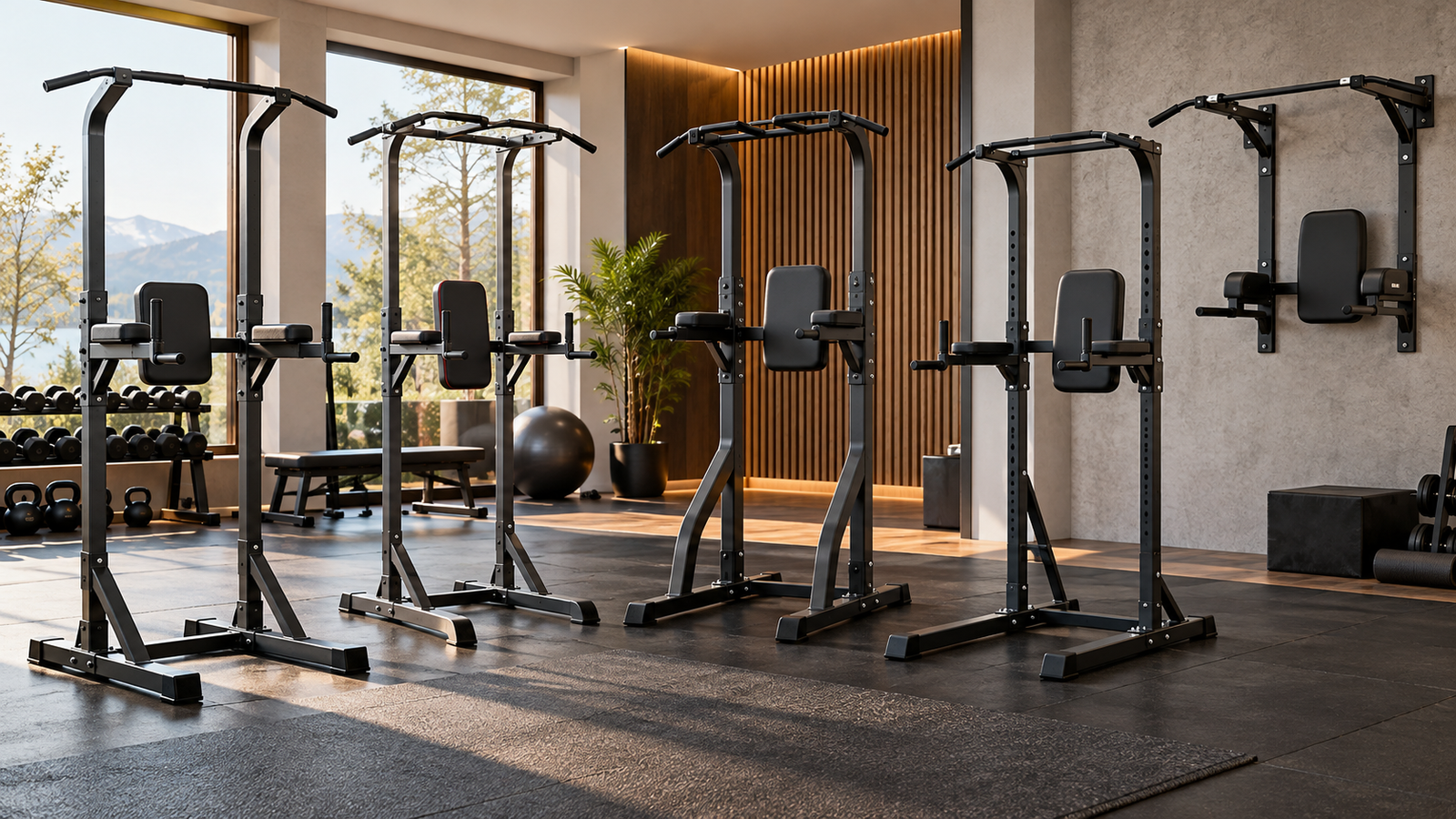
A power tower is a freestanding bodyweight training station that usually combines several exercise positions in one frame.
Common features include:
- Pull-up bar
- Dip handles
- Vertical knee-raise or captain’s-chair station
- Back pad
- Forearm pads
- Push-up handles near the base
Some models also offer adjustable height, multiple grip positions or additional resistance-band attachment points.
What Exercises Can You Do on a Power Tower?
| Exercise | Main Areas Trained | Difficulty |
|---|---|---|
| Pull-up | Back, biceps, forearms | Moderate to advanced |
| Chin-up | Back, biceps | Moderate to advanced |
| Dip | Chest, triceps, shoulders | Moderate to advanced |
| Knee raise | Core, hip flexors | Beginner to intermediate |
| Leg raise | Core, hip flexors | Intermediate |
| Push-up | Chest, shoulders, triceps | Beginner to intermediate |
| Dead hang | Grip, shoulders, forearms | Beginner |
| Scapular pull-up | Upper back, shoulder control | Beginner to intermediate |
1. Pull-Ups
Pull-ups are one of the main reasons to buy a power tower.
They primarily train the upper back, with significant involvement from the biceps, forearms and grip.
How to perform a basic pull-up
- Grip the pull-up bar with palms facing away from you.
- Start from a controlled hanging position.
- Brace the trunk.
- Pull your chest upward while driving the elbows down.
- Raise until your chin approaches or passes the bar, depending on comfortable range of motion.
- Lower slowly back to the starting position.
Form tip
Avoid swinging the legs to create momentum unless you are intentionally performing a dynamic variation.
2. Chin-Ups
Chin-ups are similar to pull-ups but usually use an underhand grip with the palms facing toward you.
This position generally places more emphasis on the biceps while still strongly training the back.
Some people find chin-ups easier than overhand pull-ups, making them a useful progression toward stronger vertical pulling.
Pull-Up vs Chin-Up
| Feature | Pull-Up | Chin-Up |
|---|---|---|
| Grip | Palms generally face away | Palms generally face toward you |
| Biceps involvement | Moderate | Usually greater |
| Back involvement | High | High |
| Beginner difficulty | Often harder | Often slightly easier |
3. Neutral-Grip Pull-Ups
If your power tower includes parallel handles, you may be able to perform neutral-grip pull-ups with the palms facing each other.
This grip can feel comfortable for some users because the wrists and shoulders remain in a relatively natural position.
It still trains the back, biceps and grip effectively.
4. Dead Hangs
A dead hang is one of the simplest power-tower exercises.
You simply hold the pull-up bar while allowing the body to hang under control.
Dead hangs can be used to train:
- Grip endurance
- Comfort in the hanging position
- Shoulder control
- Preparation for pull-ups
Do not force a passive hanging position if it creates shoulder pain.
5. Scapular Pull-Ups
Scapular pull-ups teach the first part of the pull-up movement.
- Hang from the bar.
- Keep the elbows mostly straight.
- Pull the shoulders slightly down and away from the ears.
- Raise the body a small amount.
- Return with control.
The movement is deliberately small.
It helps develop control around the shoulder blades before full pull-ups.
6. Negative Pull-Ups
Negative pull-ups focus on the lowering phase.
They are useful when you cannot yet perform a full pull-up.
- Use a safe step or platform to begin near the top position.
- Grip the bar securely.
- Lower yourself as slowly as possible.
- Step back up rather than jumping repeatedly.
Controlled negatives can build strength for future full repetitions.
7. Assisted Pull-Ups
Resistance bands can be attached safely to some power towers to reduce the effective body weight during pull-ups.
Only use bands if the frame and attachment point are appropriate.
Make sure the band is undamaged and securely positioned.
8. Dips
Dips primarily train the triceps, chest and shoulders.
Most power towers include parallel handles at chest or waist height.
How to perform a dip
- Grip the dip handles firmly.
- Support your body with straight or nearly straight arms.
- Keep the shoulders controlled.
- Lower by bending the elbows.
- Stop at a comfortable depth.
- Press back to the starting position.
You do not need to descend as deeply as possible.
Shoulder comfort and control matter more than chasing maximum range.
Chest-Focused vs Triceps-Focused Dips
Body angle can slightly change how a dip feels.
A more upright position tends to emphasise the triceps more, while a modest forward lean can increase chest involvement.
However, both variations still use several upper-body muscle groups.
9. Assisted Dips
If full bodyweight dips are too difficult, options include:
- Using a resistance band
- Performing bench-style regressions separately
- Practising negative dips
- Reducing range of motion temporarily
Do not bounce out of the bottom position just to complete more repetitions.
10. Negative Dips
Negative dips use the lowering phase to build strength.
- Begin in the supported top position.
- Lower slowly for several seconds.
- Step back into position safely.
This can be a useful bridge toward full dips.
11. Vertical Knee Raises
Most power towers include forearm pads and a backrest for knee raises.
This setup is sometimes called a captain’s chair.
How to perform a knee raise
- Place the forearms on the pads.
- Press the back lightly against the support.
- Support the body through the arms.
- Bring the knees upward under control.
- Pause briefly.
- Lower without swinging.
Avoid using momentum to throw the knees upward.
12. Straight-Leg Raises
Leg raises are a more demanding progression from knee raises.
Instead of keeping the knees bent, extend the legs more fully while lifting.
This increases the lever length and makes the exercise much harder.
Only raise the legs as high as you can while maintaining trunk control.
Do Leg Raises Train the Lower Abs?
The abdominal muscles work together rather than being completely separated into upper and lower sections.
Leg raises create significant core demand, but they also involve the hip flexors.
The exercise becomes more useful when you control pelvic position rather than simply swinging the legs.
13. Bent-Knee Oblique Raises
You can introduce a rotational component by bringing the knees slightly toward one side.
This increases the demand on the muscles responsible for trunk control.
Keep the movement small and avoid twisting aggressively.
14. Hanging Knee Raises
If you prefer to train from the pull-up bar rather than the forearm station, you can perform knee raises while hanging.
This variation adds more grip and shoulder demand.
It may be more challenging than the supported captain’s-chair version.
15. Hanging Leg Raises
Hanging straight-leg raises are an advanced core exercise.
They require:
- Grip strength
- Shoulder stability
- Core control
- Hip-flexor strength
Start with hanging knee raises if straight-leg repetitions cause excessive swinging.
16. Push-Ups Using the Base Handles
Many power towers include push-up handles near the floor.
These can raise the hands slightly off the ground and allow a neutral or semi-neutral wrist position.
Basic technique
- Grip the handles.
- Extend the body into a plank position.
- Brace the core.
- Lower the chest under control.
- Press back up.
Keep the body relatively straight rather than letting the hips sag.
17. Incline Push-Ups
If the tower design provides a stable elevated support, beginners may be able to perform incline push-ups.
The higher hand position reduces the proportion of body weight being lifted.
Only use a part of the frame that is intended to support the exercise.
18. Triceps Support Holds
The top position of a dip can itself be used as an isometric exercise.
Support your body above the dip handles and hold a stable position.
This can help beginners become comfortable supporting their full body weight before performing dips.
19. Knee-Raise Holds
Instead of performing repeated knee raises, lift the knees to a comfortable position and hold briefly.
This increases isometric core demand.
Maintain normal breathing rather than holding your breath.
20. Tuck Holds
A controlled tuck position can be performed on the dip station by supporting the body and drawing the knees upward.
This is more demanding than a simple support hold and can help build strength for advanced calisthenics.
Can You Do L-Sits on a Power Tower?
Yes, if the dip handles provide enough clearance and the tower remains stable.
An L-sit requires you to support your body while extending the legs forward.
This is an advanced exercise requiring substantial:
- Core strength
- Hip-flexor strength
- Triceps strength
- Shoulder stability
Start with bent-knee tuck holds before trying a full L-sit.
Can You Do Muscle-Ups on a Power Tower?
Usually not safely unless the tower is specifically designed and rated for dynamic muscle-up training.
Many home power towers are intended for controlled pull-ups and dips, not explosive transitions above the bar.
Dynamic swinging can destabilise a freestanding frame.
Follow the manufacturer’s intended-use guidance.
Can You Use Resistance Bands With a Power Tower?
Often yes.
Bands can be useful for:
- Assisted pull-ups
- Assisted dips
- Additional accessory exercises
Only anchor bands to a structurally suitable point.
Never loop a high-tension band around a thin decorative or unsupported part of the frame.
Can You Add a Weighted Vest?
Yes, once bodyweight repetitions become controlled and relatively easy.
A weighted vest can progress:
- Pull-ups
- Chin-ups
- Dips
- Push-ups
Start with a modest load.
For more detail, see our guide to How to Choose Weighted Vest Weight for Walking and Calisthenics.
Beginner Power Tower Workout
A simple beginner session could include:
- Dead hang
- Scapular pull-ups
- Assisted or negative pull-ups
- Support hold on dip bars
- Assisted or negative dips
- Knee raises
- Push-ups
Use low-to-moderate volume and focus on learning the movements.
Intermediate Power Tower Workout
An intermediate session could include:
- Pull-ups
- Chin-ups
- Dips
- Straight-leg raises
- Push-ups
- Tuck holds
Exercise order can be adjusted depending on whether your priority is pulling, pushing or core work.
Can a Power Tower Build Muscle?
Yes, bodyweight resistance can contribute to muscle growth when the exercises are sufficiently challenging and progressively overloaded.
Progression can come from:
- More repetitions
- More sets
- Slower tempo
- Greater range of motion
- Harder exercise variations
- Added external weight
A power tower is particularly useful for upper-body and core training.
Can a Power Tower Replace a Gym?
It can support a substantial home bodyweight routine, but it does not replace every gym function.
A typical power tower is strong for:
- Back
- Biceps
- Chest
- Triceps
- Shoulders
- Core
It offers fewer options for progressively loading the legs compared with barbells, machines or heavy dumbbells.
A complete home gym may therefore combine a power tower with equipment such as:
- Adjustable dumbbells
- Resistance bands
- Weighted vest
- Bench
How Tall Should a Power Tower Be?
The pull-up bar needs enough height for you to hang without your feet constantly hitting the floor.
At the same time, the machine must fit under your ceiling.
Before buying, measure:
- Ceiling height
- Power-tower height
- Your standing reach
- Space needed above the pull-up bar
Do not assume that a product will fit simply because the room has a standard ceiling.
How Much Floor Space Does a Power Tower Need?
Consider the full footprint, not just the vertical height.
You need room for:
- The base frame
- Your body during dips
- Leg movement during knee raises
- Safe entry and exit
Place it away from furniture and fragile objects.
Why Stability Matters
A power tower should remain stable during normal controlled exercise.
Excessive rocking can make pull-ups and dips uncomfortable and potentially unsafe.
Stability depends on:
- Base width
- Frame weight
- Floor surface
- Assembly quality
- User movement
Where Should You Place a Power Tower?
Choose a:
- Flat floor
- Dry area
- Clear training space
- Location with sufficient ceiling clearance
A hard level surface is generally more stable than a very thick carpet.
If needed, an appropriate equipment mat may help protect flooring.
Check the Weight Capacity
Every power tower has a manufacturer-stated maximum user weight.
Stay within that rating.
If you plan to use a weighted vest, remember that the equipment supports your body weight plus the added load.
Adjustable Height
Some towers allow the pull-up station to be raised or lowered.
This can be useful for:
- Different users
- Lower ceilings
- Improving hanging clearance
Make sure all adjustment pins and bolts are secured before exercise.
Power Tower for Tall Users
Taller users should pay particular attention to:
- Pull-up bar height
- Dip-handle width
- Leg clearance
- Back-pad height
A compact tower may technically support your weight while still feeling cramped.
Power Tower for Beginners
A power tower can be useful for beginners, but many of its main exercises are challenging.
You do not need to perform full pull-ups and dips immediately.
Start with:
- Dead hangs
- Scapular pulls
- Negative pull-ups
- Band-assisted pull-ups
- Support holds
- Negative dips
- Knee raises
- Push-ups
Common Power Tower Mistakes
Swinging during pull-ups
Momentum may help you reach the bar, but it reduces control and can make a freestanding tower move more.
Dropping quickly from the top
Control the lowering phase rather than suddenly releasing tension.
Going too deep on dips
Use a shoulder-friendly range instead of forcing maximum depth.
Swinging the legs during knee raises
This turns a controlled core exercise into a momentum-based movement.
Ignoring frame movement
Stop if the machine is rocking excessively and check the setup and fasteners.
Using a wall for accidental support
The tower should stand securely on its own unless the design specifically requires wall attachment.
Inspect the Power Tower Regularly
Check:
- Bolts
- Nuts
- Adjustment pins
- Welds
- Grip surfaces
- Padding
- Base feet
Fasteners can loosen over time with repeated use.
How Often Should You Train on a Power Tower?
That depends on your overall training programme.
You do not need to perform hard pull-ups and dips every day.
Allow muscles and joints enough recovery between demanding sessions.
A common approach is to include power-tower exercises several times per week while varying intensity and volume.
How to Progress on a Power Tower
Progress does not always mean adding more repetitions.
You can make exercises harder by:
- Slowing the lowering phase
- Pausing at difficult positions
- Improving range of motion
- Using harder grip variations
- Adding a weighted vest
- Progressing from knee raises to straight-leg raises
How to Choose a Power Tower
Before buying, consider:
- Maximum user weight
- Overall height
- Height adjustability
- Base dimensions
- Pull-up grip options
- Dip-handle spacing
- Back and forearm padding
- Push-up handles
- Frame construction
- Available floor and ceiling space
For specific options, see our Top 5 Power Towers in India.
Frequently Asked Questions
What exercises can beginners do on a power tower?
Beginners can start with dead hangs, scapular pull-ups, assisted pull-ups, negative dips, support holds, knee raises and push-ups.
Can a power tower build your back?
Yes. Pull-ups, chin-ups and related progressions can provide substantial resistance for the back muscles.
Can you train chest on a power tower?
Yes. Dips and push-ups can both train the chest, along with the triceps and shoulders.
Can a power tower train abs?
Yes. Knee raises, leg raises, hanging variations and tuck holds can all challenge the core.
Can you train legs on a power tower?
Leg training is limited compared with the upper body. You can add bodyweight squats or lunges separately, but most power towers do not provide heavy lower-body resistance.
Are power towers good for home gyms?
They can be very useful if you have enough ceiling and floor space and want one station for pull-ups, dips and core exercises.
Is a power tower suitable for weighted pull-ups?
Potentially, but only when the combined user and external weight remains within the equipment’s rated capacity and the frame is stable enough for controlled use.
Final Takeaway
A power tower gives you a surprisingly large exercise selection from one piece of equipment.
Pull-ups and chin-ups develop vertical pulling strength, dips and push-ups cover major pushing movements, while knee raises and leg raises add focused core training.
Beginners do not need to start with full repetitions. Dead hangs, negative pull-ups, assisted variations and support holds provide useful ways to build toward harder movements.
If you are comparing specific stations, see our Top 5 Power Towers in India guide for the models currently shortlisted by Physical Glow.
The most important buying factors are stability, user-weight capacity, pull-up height, handle position and whether the frame actually fits your available space. Once those basics are right, a power tower can become one of the most useful bodyweight-training stations in a compact home gym.
Physical Glow publishes educational beauty, fitness and wellness content. This article is for general informational purposes and is not a substitute for individual medical, physiotherapy or exercise-programming advice.